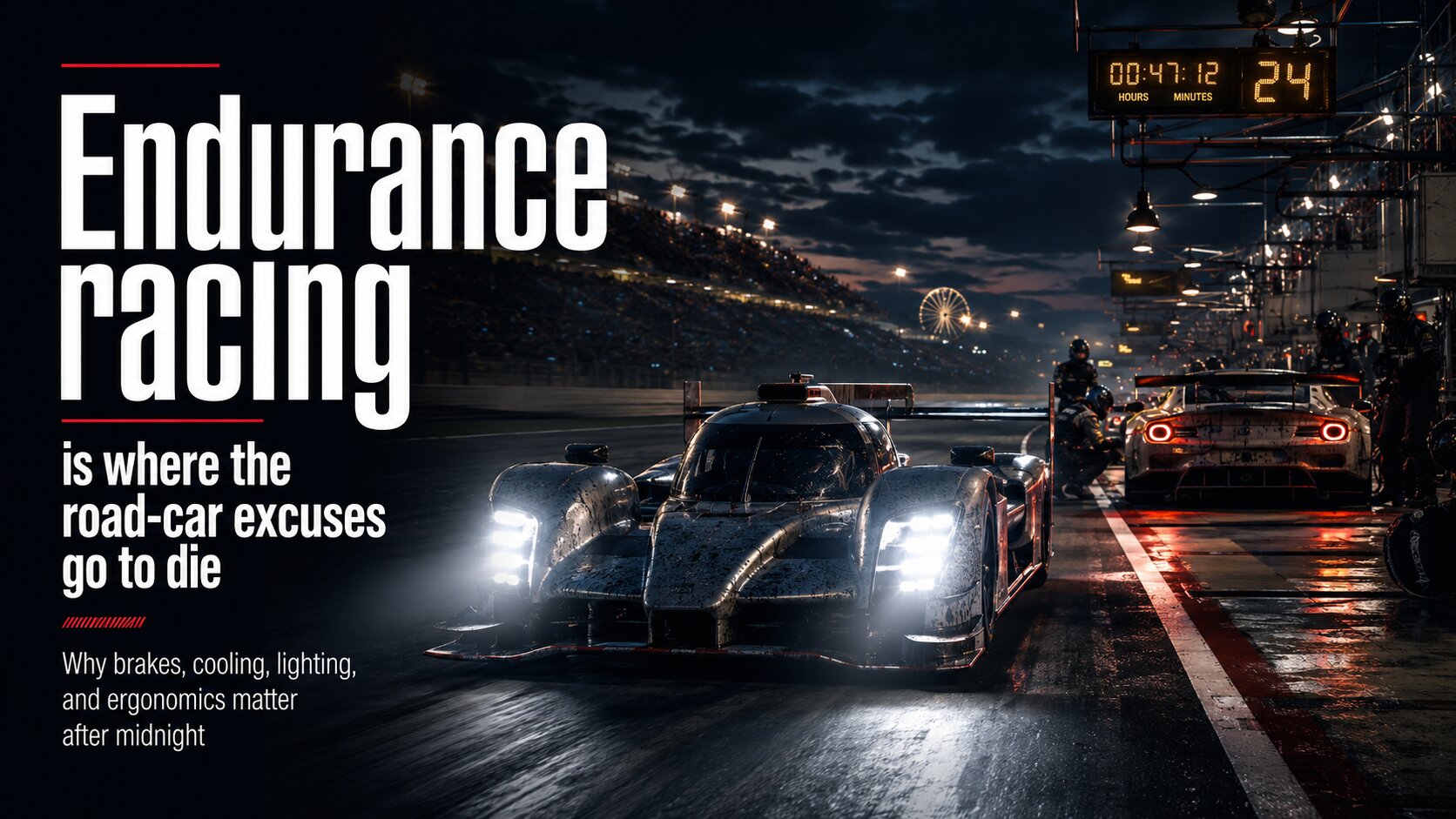
Endurance racing is where the “road car” excuses go to die
There’s a moment at any big endurance race when the grandstands stop being a collection of individuals and turn into one organism. It might be the first time a prototype slices through traffic at dusk, headlights carving bright tunnels through dust and brake smoke. Or it’s 3 a.m., cold enough that you can see breath in the pit lane, and a GT car rolls in with its brakes glowing faintly as the crew swarms it like a practiced chore. Nobody in that crowd is thinking about commute comfort or cupholders. And yet, the lessons that survive 6, 12, or 24 hours are exactly the ones that show up in the road cars we argue about on dealer lots and bring to track days.
Endurance racing is not a single sprint with a trophy at the end. It’s systems engineering under stress: brakes that have to work every lap, cooling that has to hold in traffic and heat, lighting that can’t blink out when you most need it, and human bodies that get tired long before the car “runs out.” That’s why endurance still matters. It forces honesty.
The verified backdrop: what “endurance” means in modern motorsport
Endurance racing has a few globally recognized pillars. The 24 Hours of Le Mans is the headline act, run by the Automobile Club de l’Ouest (ACO) and now part of the FIA World Endurance Championship (WEC). In North America, IMSA’s WeatherTech SportsCar Championship carries the flag with races like the Rolex 24 At Daytona and the 12 Hours of Sebring. These are not niche events either. Daytona and Sebring are cultural fixtures for American performance fans, and Le Mans remains one of those bucket list races even if you have never watched a full broadcast.
Modern top class prototypes in WEC run under “Hypercar” rules (LMH and LMDh), while IMSA’s top class is GTP (built to LMDh regulations). GT racing is also central. WEC fields LMGT3 (introduced for 2024), while IMSA runs GTD and GTD Pro based on FIA GT3 machinery. That matters because GT3 cars are closely related to production models in shape and branding, even if they are purpose-built race cars underneath.
Competitors are real household names for enthusiasts: Porsche, Ferrari, Toyota, Cadillac, BMW, Acura (Honda Performance Development), Lamborghini, Corvette (Chevrolet), Ford, Mercedes-AMG, Aston Martin, McLaren. Exactly who shows up in which class changes by series and year, so it’s smarter to talk about the structure than pretend every brand lines up everywhere at once.
Brakes: consistency beats peak numbers every time
If you want to understand why endurance racing influences road-car brakes, watch a night pit stop at Daytona or Le Mans. The car arrives hot, sometimes with rotors visibly radiating heat. The crew checks wear, swaps tires, maybe changes brake components depending on rules and strategy. Then it goes right back out into traffic where braking zones are crowded and unpredictable.
That’s not how most street cars live. In typical daily use, even an aggressive driver rarely asks for repeated near-threshold stops from triple-digit speeds lap after lap. Track days do, though. So do mountain runs when someone gets carried away chasing a friend downhill. The endurance lesson is simple: brakes must be designed as a system with heat capacity and stability in mind, not just “big calipers” for brochure appeal.
On the road-car side, you see this logic in performance packages that include larger rotors for thermal mass, better pad compounds for fade resistance, ducting to feed cooler air toward the brakes, and brake fluid specs that tolerate higher temperatures before boiling. The exact hardware varies widely by model and trim; manufacturers rarely publish detailed brake cooling flow numbers for street cars because they depend on wheel design, underbody aero, ambient temperature, and speed.
Endurance racing also reinforces something owners learn quickly: pedal feel matters as much as stopping distance. A street car might post an impressive one-stop figure in a test, but if the pedal gets long after a few hard uses or if ABS calibration feels inconsistent when tires heat up, confidence disappears fast. In endurance racing that confidence gap becomes lost time and risk. On track-day weekends it becomes an early cool-down lap or a trip to the paddock asking who brought spare pads.
There’s also an EV angle now that can’t be ignored. Many road-going EVs rely heavily on regenerative braking in normal driving. That can reduce friction brake use day-to-day but it can also leave owners surprised by how quickly friction brakes can heat up on track when regen limits kick in due to battery temperature or state-of-charge constraints. Endurance teams live in this world of energy management constantly; road-car engineers increasingly do too.
Cooling headroom: traffic is the enemy
Cooling is where endurance racing feels most relevant to real life because it punishes the same scenario that frustrates street drivers: heat soak at low speed. Think about what happens at Sebring when a fast prototype gets stuck behind slower GT traffic through bumpy sections where passing is risky. Airflow drops, throttle modulation increases heat load, brake temps stay high because you are constantly adjusting pace. The car still has to survive hours of this.
Road cars see their own version of “traffic.” Stop-and-go on a hot day with A/C blasting is not glamorous but it stacks loads on radiators, intercoolers (for turbo cars), transmission coolers (especially automatics), power steering systems (where applicable), and underhood wiring and plastics. For EVs it’s battery thermal management plus motor and inverter cooling while fast charging adds another layer of thermal stress outside driving entirely.
Endurance programs push manufacturers toward more robust thermal strategies: better airflow management through grilles and ducting, smarter control logic for fans and pumps, higher-capacity radiators when packaging allows it, and attention to how heat exits the engine bay so it does not cook nearby components over time.
It also affects performance culture decisions buyers make. A used performance car might look perfect on paper but if its cooling system was designed close to the edge or if prior owners modified it poorly (aftermarket intakes blocking ducting or cheap radiators), you feel it quickly at a track day. People love horsepower numbers; endurance racing quietly teaches that repeatable horsepower is what counts.
Lighting: night racing made LEDs feel inevitable
If you’ve stood near a braking zone at night during an endurance race, lighting becomes visceral. Headlights strobe across curbing as cars crest bumps; taillights flare under braking; marshal posts glow; reflective paint pops for an instant then disappears into darkness again.
This is one area where race-to-road influence is easy to spot without getting lost in proprietary details. Modern endurance cars rely on high-output lighting systems designed for hours of vibration and weather exposure. They also use distinctive lighting signatures so drivers can identify classes and competitors quickly at night.
On road cars, LED headlights have become common across price points because they offer efficiency and packaging advantages along with strong output when well designed. Adaptive lighting systems that shape beams around traffic exist on many modern vehicles too (availability depends heavily on market regulations and trim). Endurance racing did not invent LED tech by itself; consumer electronics pushed LEDs everywhere first. But endurance competition helped validate high-output LED durability under sustained heat and vibration while making lighting performance part of brand identity for performance models.
The practical takeaway for buyers is less romantic but real: good headlights reduce fatigue on long drives and help you spot hazards earlier on rural roads. Anyone who has driven home from a track day after sunset knows how quickly mediocre lighting turns into eye strain.
Cockpit ergonomics: fatigue is a performance limiter before anything breaks
The most underrated endurance lesson has nothing to do with horsepower or aero balance. It’s human fatigue.
Endurance drivers rotate through stints because no matter how fit you are, concentration degrades with time. Heat builds inside cockpits even with ventilation systems working hard. Dehydration sneaks up on you. Your neck gets heavy from sustained cornering loads. Your hands start to lose sensitivity through gloves as vibration adds up over hours. The car does not care; it will keep demanding precision until you make a mistake.
This filters into road-car design more than people admit. Seat support matters on long trips because micro-adjustments add up into fatigue just like they do in a stint. Pedal spacing affects consistency whether you’re heel-toeing in a manual sports car or simply trying to modulate brake pressure smoothly in stop-and-go traffic. Steering wheel reach adjustment seems boring until your shoulders ache after two hours because you could not get comfortable.
You can see endurance thinking show up in performance-oriented cabins that prioritize clear sightlines over dramatic styling tricks: straightforward gauge readability (increasingly via configurable digital clusters), steering wheels designed for secure grip over long periods, seats with bolstering that supports without pinching circulation too aggressively for many body types.
This is also where buyers sometimes get frustrated in real life: the most track-capable seat might be too tight for daily errands; the most comfortable seat might lack support during hard cornering at an HPDE event; thick A-pillars for crash structure can create blind spots that matter both on highways and when threading traffic at speed on track. Endurance racing does not solve those compromises completely but it keeps pressure on engineers to treat ergonomics as performance hardware rather than interior decoration.
Serviceability: winning often looks like not losing time in pit lane
The crowd loves big passes and late-braking moves but teams win endurance races by doing boring things flawlessly: quick tire changes, clean driver swaps, predictable refueling procedures (where allowed), efficient repairs when something goes wrong.
That obsession with serviceability has parallels in road cars even if the connection is indirect. Packaging decisions affect maintenance costs and owner satisfaction over years: how hard it is to access filters; whether cooling components can be serviced without dismantling half the front end; whether brake pads are easy to swap; whether sensor placement makes them vulnerable to road debris.
No manufacturer builds a street car purely around pit-stop logic but motorsport programs create internal pressure to think about modularity and access during development. You see echoes of this when performance models offer track-focused consumables support through factory parts catalogs: brake pad options sold over the counter; dedicated cooling upgrades; factory-approved wheel sizes that clear larger brakes without guesswork.
For American enthusiasts who actually use their cars hard once or twice a month at local tracks, serviceability becomes part of buying math right alongside MSRP or monthly payment reality. If pads take forever to change or if bleeding brakes requires special tools hidden behind dealer-only procedures, track days get expensive fast even before tires enter the chat.
Tires and balance still matter but endurance changes what “fast” means
No engineering feature about endurance racing exists in isolation from tires because tires are the interface between every system discussed here: braking heat feeds into wheel wells; cooling airflow interacts with aero drag; lighting helps drivers place the car precisely as grip changes overnight; fatigue makes smoothness harder just as tires start falling off their best window.
The enduring lesson for road-car tuning is balance over hero moments. Suspension setups that feel sharp for one lap can become nervous over an hour if they punish tires or demand constant corrections from the driver. Brake calibrations that feel aggressive can become tiring if they require too much fine control in traffic or if stability systems intervene unpredictably when components heat up.
This mindset shows up in some of today’s best dual-purpose performance cars: they are not only quick but also consistent when driven hard repeatedly within reasonable limits for street hardware. Not every model nails this balance across all trims and tire choices; manufacturers often tune around specific factory tire compounds which owners later replace with different rubber that changes everything.
The American angle: why this matters beyond Le Mans posters
In the U.S., endurance racing has always had a practical streak because our enthusiast culture includes road trips to tracks as much as trailer life (depending on budget). People drive their cars to events like Daytona weekend or Sebring week because being there matters more than watching highlights later.
That same crowd cares about whether their performance car will behave after three sessions in July heat without throwing warnings or going soft at the pedal. They care about whether headlights make rural drives home less stressful after leaving late from an event. They care about whether seats keep them comfortable enough to focus instead of fidgeting at 1 a.m., halfway through an overnight drive back north.
Endurance racing keeps those priorities visible inside automakers because it rewards durability publicly. A flashy sprint win looks great but surviving night hours with consistent pace tells customers something deeper about engineering discipline.
What we still do not get from endurance racing (and why that’s okay)
It’s tempting to claim every great road-car feature came straight from Le Mans but reality is messier. Many technologies travel both directions or develop independently due to regulations, supplier innovation, cost targets, and emissions requirements.
Carbon-ceramic brakes exist on some high-end road cars partly because they handle heat well and reduce unsprung mass but they are expensive and their cold behavior can vary depending on pad choice and calibration. Race cars use carbon systems differently again depending on class rules and budgets.
Aero tricks seen on prototypes do not translate cleanly because road cars must meet pedestrian safety rules, noise regulations, ride height constraints for driveways, winter conditions for many buyers, plus styling demands from people who never plan to see a racetrack.
The honest takeaway is not “race tech equals street tech.” It’s that endurance competition forces manufacturers to chase robustness under sustained load while keeping humans functional inside the machine.
The quiet reason endurance still matters
The best part of an endurance race is how it teaches patience even to fans who came looking for chaos. You watch teams manage brakes instead of abusing them early. You see drivers back off through traffic rather than risk contact that would ruin hours of work. You hear engines settle into rhythms built around temperature control rather than ego.
That mindset maps neatly onto road cars used hard: leave headroom in your cooling system if you plan to track it; pick pads based on repeatability not just initial bite; treat lighting as safety equipment rather than styling jewelry; set up your seating position like it matters because fatigue will show up before failure does; consider serviceability before you swipe your card for something “exotic.”
Endurance racing still matters because it measures what we actually live with as owners: consistency over time, clarity at night, comfort under stress, systems that keep working when conditions stop being ideal. The roar fades after midnight but those lessons stick around long after you pull back onto public roads.
0 comments
Join the discussion around this article.
Please login to comment.