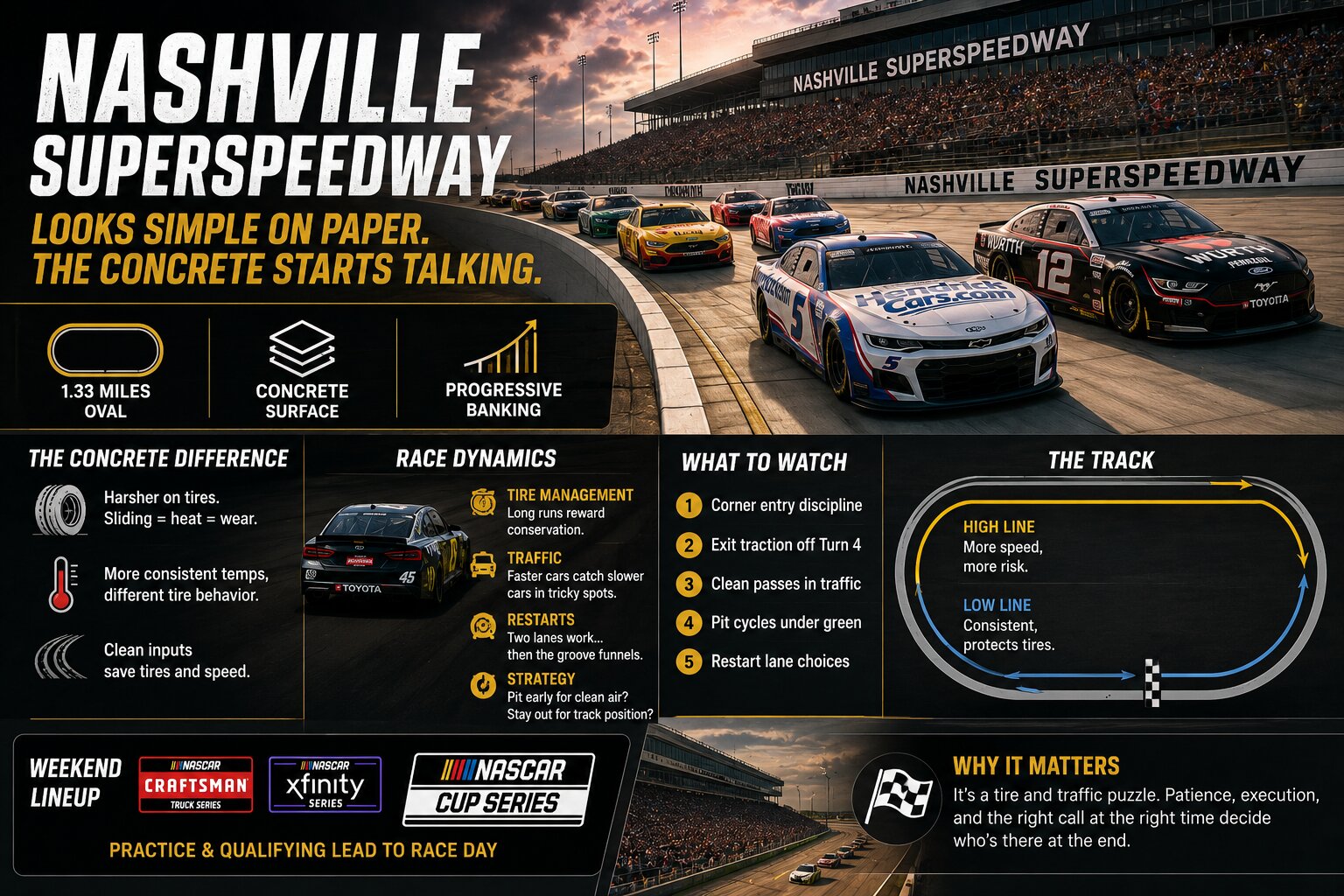
Nashville Superspeedway looks simple on paper, then the concrete starts talking
NASCAR’s Cup Series stops at Nashville Superspeedway on a 1.33 mile oval that feels straightforward until you watch a long green flag run unfold. The place is concrete, not asphalt. It has progressive banking (the corners are banked more up high than down low), and it rewards drivers who can manage tires while also surviving the kind of traffic that turns a clean lap into a compromise lap.
For casual viewers, Nashville can look like “just another intermediate,” but the rhythm is different. The surface changes the way grip comes and goes. The shape creates moments where faster cars catch slower cars in awkward parts of the corner. Restarts give you multiple lanes that work for a few laps, then funnel everyone back into the same narrow set of options. That is why it becomes a tire and traffic puzzle.
The official weekend flow: when the track actually matters
NASCAR’s Nashville weekend is built around the national series ladder. The Craftsman Truck Series and Xfinity Series run their own races, and the Cup Series headlines Sunday night. NASCAR publishes the full schedule each year through its official channels and Nashville Superspeedway mirrors that structure with practice and qualifying leading into race day. Exact session times can shift year to year and even week to week with broadcast needs, so if you are planning travel or timing your viewing party, use the official NASCAR schedule page or Nashville Superspeedway’s event schedule rather than screenshots floating around social media.
What matters from a racing standpoint is that teams get limited practice compared with older eras, so they arrive with simulation work, notebook notes from similar tracks, and a setup that has to be “good enough” quickly. On a concrete intermediate like Nashville, that first hour of meaningful running can be less about raw speed and more about how the car treats its tires over 20 to 30 laps.
Concrete 101: why it eats tires differently than asphalt
Concrete ovals have their own personality. Asphalt tends to change more dramatically with heat cycles and sunlight, while concrete often feels more consistent in temperature sensitivity but can be harsher on tires depending on texture and how rubber lays down. Nashville’s surface can build rubber in a way that changes lanes over a run, but it also punishes sliding.
That is the key word at this track: sliding. When a driver asks too much from the front tires on entry or gets back to throttle too aggressively on exit, the tire scrubs across the surface instead of rolling cleanly. Scrub creates heat, heat accelerates wear, and wear shows up later as a car that will not turn in clean air or cannot hold the bottom when it matters.
Even if you do not know what “right front” means in setup meetings, you can see it. Watch for cars that start a run strong but fade into understeer after 10 or 15 laps. They will drift up on corner exit, then they will have to lift earlier next time to keep it off the wall or keep it off someone’s door.
The tire story is not just wear, it is timing
Nashville races often become arguments about when to pit as much as how fast you are. If tire falloff is meaningful, fresh tires can be worth real lap time, which makes short pitting attractive. But Nashville’s traffic can make that gamble feel like walking into a crowded aisle at a parts store with your arms full of oil jugs. You might get through fast, or you might get stuck behind someone who has no reason to hurry.
This is where crew chiefs earn their money. Pitting early can buy you clean air if others stay out, but it can also drop you into slower cars that have not pitted yet. Staying out longer can protect track position, but it risks being a sitting duck when everyone else bolts on fresh tires.
Because I am not using race specific lap time deltas here (those vary by year, tire compound, weather, and cautions), the honest takeaway is simpler: at Nashville, tire advantage tends to be visible enough that you should pay attention whenever someone takes two tires versus four, or stays out while others pit. Those choices usually have consequences within a handful of laps.
Traffic is constant because this track compresses problems
A 1.33 mile oval sits in an interesting spot. It is longer than short tracks where lapped traffic arrives almost immediately, but it is shorter than 1.5 mile speedways where leaders can sometimes stretch things out with clean air and spacing. At Nashville, leaders still catch traffic fairly regularly during green flag runs, especially if cautions space the field back out and create mixed strategies.
Traffic here is not only about passing slower cars. It is about where you catch them. If you run down on someone mid corner while your car is already loaded up with steering input, you either pinch your line and risk losing momentum or float up into dirty air and lose front grip. Either way you pay for it.
This is why spotters matter so much at Nashville. The best ones are not just calling “inside” or “outside.” They are anticipating where two lanes will merge into one usable lane in two corners’ time and telling their driver what will be open before it becomes obvious on TV.
Restarts: two lanes look equal until they do not
Nashville’s progressive banking encourages multiple grooves, especially right after restarts when tires are fresh and everyone is willing to lean on each other for space. For casual viewers, restarts are where you should lean forward because they often define who controls the next run.
The outside lane can carry momentum if there is grip up there and if drivers commit to pushing without getting loose on exit. The inside lane can be efficient if the car rotates well and can launch off Turn 4 without spinning the rear tires. Which one wins changes with rubber buildup, temperature, and how aggressive drivers are willing to be with throttle application.
What makes Nashville tricky is that a restart groove does not always stay the best groove for 20 laps. A driver might gain three spots in two corners by ripping the high lane early, then spend the next ten laps fighting an edgy rear end because they heated up their tires too quickly or because they cannot keep clean air on the nose once things settle.
What to watch during the Cup race if you want to understand it fast
If you only have one screen and you want to feel smart by Stage 2, focus on these cues rather than staring at lap count.
1) Corner entry discipline. Watch who can enter low without washing up into traffic. A car that turns well on entry usually saves its driver from burning off the right front tire early in a run.
2) Exit traction off Turn 4. Nashville rewards drivers who can pick up throttle smoothly without lighting up the rear tires. You will see some cars step out slightly as they chase lap time; that looks exciting but often costs them later.
3) Who passes without drama. Clean passes in traffic usually mean one of two things: either the passing car has real tire advantage or their driver is managing dirty air better than others by setting up moves a corner ahead instead of dive bombing late.
4) Pit cycles under green. Even casual fans can follow this by watching timing intervals for drivers who pit early versus late in a stage run. If someone pits early and suddenly starts clicking off faster laps in clean air, that strategy might flip track position once others stop.
5) Restart lane choices from contenders. When top teams consistently choose one lane over another, they are telling you what their data says about grip at that moment.
The action beats fans remember: long runs, late cautions, and nerves
Nashville crowds tend to respond to momentum swings because they are easy to feel even if you do not know every driver’s setup philosophy. When someone charges from mid pack after a pit stop cycle works out, grandstands notice. When a leader gets trapped behind lapped traffic and loses clean air at exactly the wrong moment, you can hear it in the noise level even through TV microphones.
The emotional arc often comes from patience versus urgency. Drivers who manage tires look boring until they are suddenly faster than everyone else 25 laps into a run. Drivers who attack early look like heroes until they cannot hold their line later and start bleeding positions two at a time.
I am intentionally not calling out specific finishing results here because your prompt did not specify a particular year’s Cup race at Nashville (and NASCAR’s Nashville date has moved around on the calendar). If you want this recap tied to one exact event with winner, stages, cautions, polesitter, lead changes, and margin of victory using official box score data, tell me which season year you mean and I will write it tightly from verified NASCAR statistics only.
Why this matters beyond Sunday night: performance driving parallels
Nashville’s concrete tire story has real world parallels for anyone who does track days or autocrosses their street car. You do not need slicks to understand heat management; any performance tire gets greasy when pushed past its happy window. Concrete surfaces also tend to communicate differently through steering feel compared with typical asphalt road courses depending on texture and rubbering in.
The restart chaos has its own analogy too: mixed pace traffic is where most amateur sessions get messy. The fastest lap does not matter if you cannot place your car safely around slower drivers without overheating brakes or cooking tires while stuck behind someone through three corners.
If anything, Nashville reinforces an old truth that applies whether you drive a Cup car or a lightly modified Mustang at your local HPDE: smooth inputs make speed repeatable; repeatable speed wins long runs; long runs decide races when everyone has similar horsepower and aero rules keeping them close.
The competitor set: why teams treat Nashville like an intermediate chess match
NASCAR teams generally group tracks by length and characteristics when they prepare setups and strategy models. Nashville lives in that intermediate space where aero balance still matters quite a bit but mechanical grip and tire management can swing outcomes more than people expect if they only watch superspeedways or short tracks.
If you are thinking in terms of “competitors,” Nashville tends to get discussed alongside other intermediate style ovals on the schedule rather than being treated like an outlier novelty track. The concrete part makes it unique within that group though; teams pull notes from other concrete venues when possible because surface behavior affects how quickly grip falls away during runs.
The bottom line: expect puzzles, not pure domination
A perfect Nashville Cup race has rhythm: restarts that reshuffle lanes; long green flag runs that reward tire management; pit calls that either look genius or painful five laps later; leaders threading through traffic while trying not to burn their stuff up too soon.
If you tune in expecting constant door banging every lap, this track might feel patient at times. Stick with it anyway. The tension builds quietly here because everybody knows what concrete does when you ask for too much too early. And once track position flips through strategy or traffic at the wrong moment for someone up front, Nashville gets loud fast.
0 comments
Join the discussion around this article.
Please login to comment.