Verified facts up front (and what is not confirmed yet)
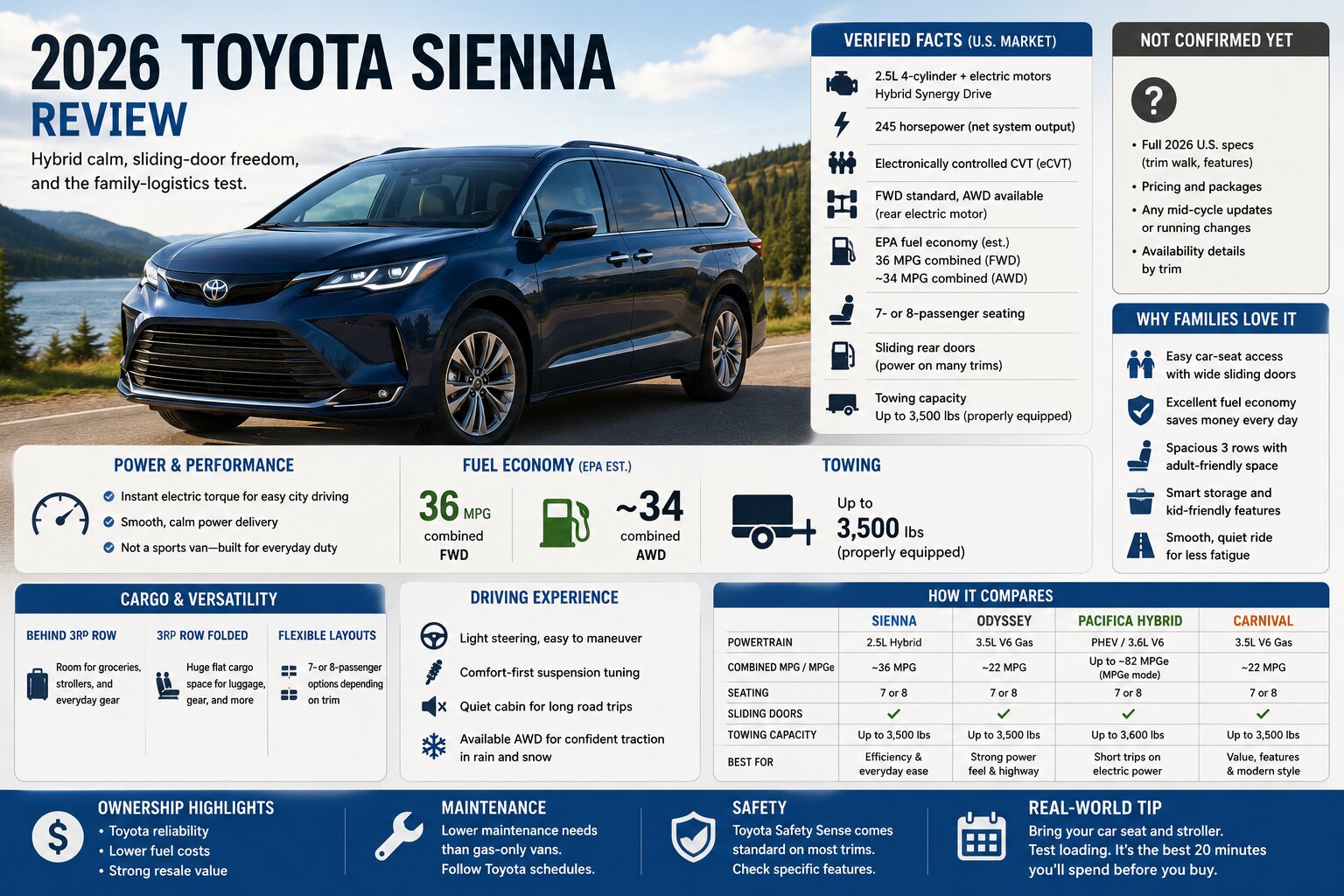
The Toyota Sienna is one of the few minivans sold in the U.S. that is hybrid-only. Since the current generation launched for the 2021 model year, every Sienna has used Toyota’s Hybrid Synergy Drive with a 2.5-liter four-cylinder engine and electric motors, a combined 245 horsepower (net system output), and an electronically controlled continuously variable transmission (eCVT). All-wheel drive is available, using an additional rear electric motor rather than a mechanical driveshaft. EPA fuel economy for the Sienna has historically landed in the mid-30 mpg range combined depending on trim and drivetrain, with front-wheel drive typically rated higher than AWD.
For seating, the Sienna is sold as a seven- or eight-passenger van depending on trim and configuration. It uses sliding rear doors (power operation is common on many trims, but exact standard content varies by trim year to year). Towing capacity is commonly listed at up to 3,500 pounds when properly equipped. These are widely published, well-established Sienna facts for the current-generation U.S.-market model.
What is not verified at the time of writing: Toyota’s full and final U.S.-spec breakdown for the 2026 Sienna, including any running changes in standard equipment, trim walk, pricing, and any possible mid-cycle update details. Automakers sometimes adjust features and packaging year to year without changing the core mechanical formula. If Toyota releases 2026-specific specs that differ from the established current-generation figures, those official numbers should take priority.
2026 Toyota Sienna Review: Hybrid Calm, Sliding-Door Freedom, and the Family-Logistics Test
A minivan review that starts with horsepower misses the point. The Sienna earns its keep in moments that do not show up on a spec sheet: a toddler arcing toward an open door in a crowded parking lot, a third-row passenger trying to climb in without stepping on someone’s backpack, a long interstate stretch where you realize nobody has asked “are we there yet” because everyone is comfortable and the cabin is quiet enough to nap.
The 2026 Toyota Sienna enters that daily reality with a familiar pitch. It is a hybrid-only minivan that prioritizes steady efficiency over drama, a calm powertrain over quick bursts, and family logistics over style points. For many American buyers, that formula is not just acceptable. It is exactly what makes the Sienna compelling.
The family-logistics scenario: car seats, curbside chaos, and door behavior
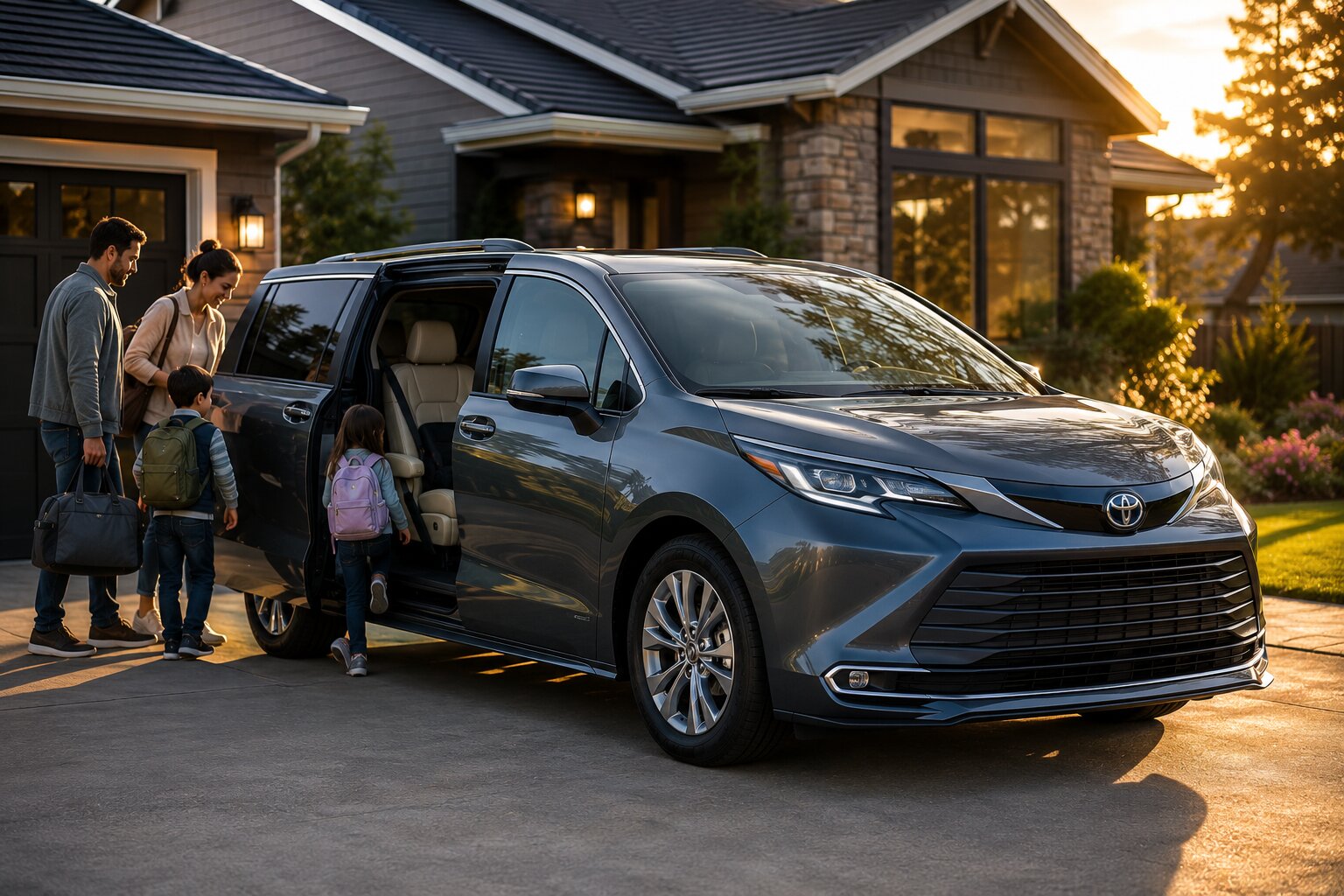
Start with the sliding doors. In typical daily use, they are the Sienna’s strongest argument against three-row SUVs. Sliding doors change how you live with a vehicle because they remove two common pain points at once: door swing clearance and awkward child loading angles. In tight school pickup lanes or narrow garage bays, you can open access to the second row without worrying about dinging adjacent cars. That matters more than it sounds until you are doing it twice a day.
Car seats amplify that advantage. A rear-facing seat eats space and demands leverage; it also turns buckling into a repetitive chore. A minivan’s door opening and step-in height usually make those motions easier than they are in many crossovers. The Sienna’s cabin packaging is built around this reality: wide openings, a low floor relative to many body-on-frame SUVs, and enough room to maneuver your shoulders while tightening straps or fishing for a dropped pacifier.
One caveat worth stating honestly: second-row design details can make or break real usability, and Toyota’s exact configuration rules vary by trim and model year. Historically on this generation of Sienna, some trims have second-row seats that do not remove easily (and in some cases are not designed to be removed), which can limit maximum cargo flexibility compared with older vans or some rivals’ seat systems. If your family alternates between “eight passengers” weekends and “Home Depot run” weekdays, you will want to confirm how your preferred trim handles second-row movement and whether removal is possible or practical.
Powertrain: hybrid calm beats V6 muscle for most families
The Sienna’s defining mechanical choice remains its hybrid-only setup: a 2.5-liter four-cylinder paired with electric motors for a combined 245 horsepower (net). There is no traditional stepped automatic transmission; instead you get an eCVT that blends engine speed with electric assist.
On paper that sounds like it might be strained in a vehicle this size. In real-world family duty, it tends to feel more composed than you might expect if you have only driven older four-cylinder minivans. The electric motors fill in low-speed torque where vans spend much of their time: rolling away from stop signs, merging into suburban traffic, crawling through school zones, inching through parking lots with one eye on pedestrians.
The tradeoff is familiar to anyone who has driven modern hybrids under heavier throttle. When you ask for brisk acceleration or climb long grades at highway speed with passengers and luggage aboard, engine sound can rise quickly as the system hunts for efficient power delivery rather than sporty response. That does not mean it cannot merge or pass; it means it does so with less mechanical drama management than a traditional V6 van might deliver.
This is where comparisons get interesting. The Honda Odyssey continues to offer V6 power in the U.S., which often translates to more confident surge at highway speeds and a more conventional transmission feel. The Chrysler Pacifica offers both gas-only V6 versions and the Pacifica Hybrid plug-in hybrid (PHEV), which can run on electricity for short trips when charged but also introduces PHEV-specific complexity and charging habits into ownership. Kia’s Carnival leans into strong V6 power and SUV-like styling cues rather than electrification.
Toyota’s bet is that most families would rather spend less time at gas stations than win stoplight sprints. Based on how minivans are actually used in America, that bet still looks smart.
Fuel economy: why the Sienna keeps showing up on shopping lists
Hybrid efficiency remains the Sienna’s headline advantage in this segment. EPA ratings vary by trim and drivetrain; front-wheel drive versions typically rate higher than AWD versions due to weight and drivetrain losses. Across recent model years of this generation, Siennas have generally posted EPA combined figures in the mid-30 mpg range, which is unusually strong for a vehicle with this much space and this much daily utility.
That efficiency shows up as something more meaningful than bragging rights: fewer fuel stops on road trips; less sting when your weekly routine includes multiple school runs plus errands; more flexibility when gas prices spike unexpectedly.
Against rivals, the contrast can be stark depending on what you cross-shop. Gas-only minivans such as Odyssey or Carnival typically return lower fuel economy than a hybrid minivan in comparable use (exact figures depend on model year and configuration). The Pacifica Hybrid can beat everyone on gasoline consumption if you plug it in regularly and your daily driving fits within its electric range window; if you cannot charge consistently or your trips are mostly longer highway runs, its advantage shrinks.
AWD without the penalty box (mostly)
Toyota’s available electronic all-wheel drive deserves special mention because it aligns with how many families actually decide on AWD: not for off-roading fantasies but for winter traction confidence when roads are messy and schedules are not optional.
The system uses an additional rear electric motor rather than sending power through a traditional mechanical setup. In practical terms that can mean smoother engagement and fewer packaging compromises than some conventional AWD systems. It also typically costs some fuel economy versus front-wheel drive due to added mass and energy use.
If you live in snow-belt suburbs where steep driveways ice over or where plows arrive late but school still opens on time, AWD can be worth it. If your winter reality is mostly cold rain with occasional flurries, good tires may deliver more real benefit per dollar than AWD alone.
Ride comfort and road manners: easygoing beats exciting
The Sienna’s driving personality suits its mission: stable, predictable, tuned for comfort rather than sharpness. Minivans carry people who may be reading, eating snacks, watching screens, or trying to sleep; abrupt body motions are not charming in that environment.
Expect steering that prioritizes light effort over feedback and suspension tuning aimed at smoothing broken pavement rather than carving corners. That does not mean it feels sloppy; it means Toyota has chosen calm over athleticism. The payoff comes on longer drives when constant small corrections feel unnecessary and when passengers do not get tossed around by expansion joints.
Cabin noise is another part of long-distance comfort that matters more after hour three than during your first test loop around the dealership area. Road noise levels vary by tire choice and trim equipment; higher trims sometimes add sound-deadening touches but details depend on Toyota’s packaging for each model year. Even without claiming specific decibel numbers (which would require instrumented testing), it is fair to say that modern minivans generally prioritize quiet cruising compared with many three-row SUVs wearing aggressive all-season tires.
The interior as a working space: storage wins days
A family vehicle’s interior should be judged like an organizer’s toolkit: where do small items live so they do not become clutter? How quickly can you hand something to row two? Can row three reach cupholders without performing yoga? Does the cabin stay orderly after two days of errands?
The Sienna’s strengths here are typical minivan strengths executed with Toyota’s pragmatic approach: numerous cupholders; bins sized for real objects; door pockets that can swallow water bottles; center-console storage designed for everyday carry items like wipes, chargers, sunglasses, hand sanitizer.
If you have ever tried to keep an SUV’s third row functional while also carrying sports gear, strollers, or groceries, you know how quickly vertical stacking becomes annoying. A minivan’s boxier cargo area behind the third row often makes packing simpler because bags sit flatter instead of tumbling into sloped hatch glass territory.
Third row access: where sliding doors change everything again
Getting into row three should not require negotiation between siblings or adults contorting around car seats. Minivans typically offer better third-row access than most three-row SUVs because their doors open wider relative to seating position and their floors sit lower.
The Sienna benefits from those fundamentals. When your second row is occupied by child seats or booster seats (a very common reality), ease of access depends heavily on how far seats slide forward and how much aisle space remains between them if configured as captain’s chairs versus bench seating (availability depends on trim).
This is another area where shoppers should slow down during a test sit rather than assuming all configurations behave identically. Bring your actual car seat if possible; try loading it; try climbing past it into row three; try buckling from both sides of the vehicle if curbside loading matters in your routine.
Cargo strategy: strollers one day, flat-pack furniture the next
Toyota publishes cargo volume figures by row position for most vehicles it sells in America; those numbers matter when comparing vehicles directly but they also need context because floor height, opening shape, seat-fold mechanism design, and tie-down points affect real usability as much as raw cubic feet do.
Rather than inventing exact cargo numbers here without confirming 2026-specific published specs, focus on what remains true about this generation of Sienna: it offers substantial cargo room behind the third row for daily family needs like groceries or compact strollers (size varies), then expands dramatically when rows fold down for bigger hauls.
The practical question many families face is whether they can keep the third row up most days while still carrying bulky items like double strollers or sports coolers without blocking rear visibility. If your life includes frequent airport runs with multiple large suitcases plus passengers in all rows, bring luggage dimensions into your shopping process rather than relying on photos alone.
Towing: enough for small trailers, not a substitute for a truck
Sienna towing capacity has commonly been listed at up to 3,500 pounds when properly equipped on this generation. That number places it in “small trailer” territory rather than “boat ramp hero.” Think lightweight campers within rating limits (and within payload limits), small utility trailers for weekend projects, or hitch-mounted accessories used responsibly.
Two reminders apply regardless of brand: towing capacity is only part of safe towing; payload limits matter too once you add passengers and gear; trailer brakes may be required depending on trailer weight laws; proper hitch hardware matters; so does cooling capacity during hot-weather climbs.
Technology and safety: Toyota’s broad approach
Toyota has made driver-assistance technology widely available across its lineup over recent years under its Toyota Safety Sense umbrella (feature sets evolve by model year). Commonly included features across modern Toyotas include automatic emergency braking with pedestrian detection capability (with limitations), lane departure alert or lane keeping assistance depending on system version, adaptive cruise control depending on trim level equipment rules.
Because 2026 trim-by-trim content may change and because feature names can be misleading across years (and across brands), treat this category as one where confirmation matters: check Toyota’s official 2026 Sienna spec sheet for standard versus optional safety features on your chosen trim before assuming availability.
If safety ratings matter strongly in your purchase decision (as they do for many parents), consult IIHS and NHTSA results specific to the model year once published or updated for 2026 vehicles sold in the U.S., since ratings can shift when tests change even if vehicles do not change much mechanically.
Design: minivan honesty with just enough polish
The current-generation Sienna wears sharper lines than older vans did and tries harder to look modern from every angle without pretending it is an SUV. That honesty works better than gimmicks because buyers who choose minivans usually do so after deciding function beats image.
The styling conversation tends to matter most at two points: first impression at purchase time; then gradually less as daily convenience takes over. A van that makes life easier earns forgiveness quickly.
Ownership implications: efficiency helps budgets but buying reality matters
A review aimed at American shoppers has to acknowledge purchase reality as well as product reality. Minivans often experience uneven availability depending on region and timing; popular trims can be hard to find at certain points in the model cycle; pricing pressure comes from demand swings as much as MSRP itself.
This review will not claim specific 2026 pricing because Toyota’s official MSRP structure may not be fully confirmed at time of writing here. What can be said responsibly is that hybrid hardware adds cost compared with older gas-only formulas but can repay some buyers through reduced fuel consumption depending on annual miles driven and local fuel prices.
Maintenance expectations also differ slightly from old-school assumptions about hybrids. Toyota hybrids have been widely sold for years across multiple models; they are not exotic technology anymore in day-to-day service terms at Toyota dealerships and independent shops familiar with them. Still, any buyer planning long-term ownership should understand warranty coverage details for hybrid components as published by Toyota for U.S.-market vehicles (terms vary by component) rather than relying on hearsay from forums or sales talk from lots.
Rivals in context: where each alternative makes sense
Honda Odyssey: The Odyssey remains the straightforward alternative for buyers who want traditional V6 performance feel and Honda’s take on interior practicality. It does not match hybrid fuel economy because it does not use a hybrid system in its current U.S.-market form. For families who routinely load up at highway speeds or who simply prefer conventional acceleration response under heavy throttle, Odyssey stays relevant.
Chrysler Pacifica: The Pacifica stands out because it offers both gas-only V6 versions and an available plug-in hybrid Pacifica Hybrid variant that can cover short trips electrically if charged regularly. For households able to plug in nightly and whose daily driving fits within PHEV patterns such as school runs plus errands close to home), Pacifica Hybrid can reduce gasoline use significantly compared with non-plug-in vans. The flip side is added complexity versus non-plug-in systems plus dependence on charging access to realize full benefits.
Kia Carnival: Carnival targets buyers who want minivan practicality wrapped in styling that leans closer to SUV vibes along with strong V6 powertrain character in most U.S.-market versions historically offered recently (confirm current-year engine offerings when shopping). It competes well on design presence and features-per-dollar depending on trim pricing dynamics but does not offer Sienna-like hybrid efficiency unless Kia changes its U.S.-market powertrain strategy for specific model years.
SUV alternatives: Three-row crossovers remain tempting because they look fashionable and often offer AWD broadly across trims. But if you regularly use row three or frequently load kids through tight parking spaces while managing strollers or sports bags, SUVs ask you to accept compromises every day: hinged doors fighting adjacent cars; tighter third rows; less efficient cargo packing behind row three due to roofline shape; higher floors making child loading harder depending on model.
Pros
Hybrid-only efficiency advantage: For many households this becomes tangible quickly through fewer fuel stops and lower fuel consumption versus non-hybrid rivals based on EPA ratings that generally land in the mid-30 mpg range combined depending on configuration.
Sliding-door usability: Easier curbside loading, fewer door dings risk in tight spaces, better access patterns around car seats compared with hinged-door SUVs.
A calm driving demeanor: Smooth low-speed response from electrification suits family duty well; ride tuning favors comfort over twitchiness.
Available AWD: A practical option for winter climates using an electric rear motor approach rather than mechanical complexity typical of some setups.
Cons
No V6 option: Buyers who value effortless high-speed passing feel may prefer Odyssey or Carnival power delivery characteristics even if they give up fuel economy.
Hybrid sound under load: Under heavy acceleration or climbs with passengers aboard, eCVT behavior can translate into higher engine sound relative to traditional automatics at similar road speeds.
Second-row flexibility depends heavily on configuration: Some trims or seat designs may limit removal or reconfiguration compared with expectations set by older vans or rival systems (confirm specifics before buying).
Pricing and availability variability: Depending on region and demand cycles, finding preferred trims at acceptable pricing can be its own logistics exercise (verify current market conditions locally).
The verdict: who should buy a 2026 Sienna?
The 2026 Toyota Sienna succeeds because it treats family transportation like operations management rather than performance theater. It keeps fuel consumption impressively low by segment standards through its hybrid-only powertrain (245 horsepower net system output), offers available AWD tailored to real winter needs, and leans hard into what makes minivans superior tools: sliding doors that work everywhere Americans park cars tightly plus cabin packaging built around car seats instead of Instagram aesthetics.
If your household lives inside logistics problems such as daycare drop-off lines followed by commuting followed by groceries followed by weekend travel) the Sienna’s calm competence will likely feel like relief more than compromise. Shoppers who crave stronger acceleration character should still consider V6-powered alternatives like Honda Odyssey or Kia Carnival. Buyers able to charge at home should evaluate Chrysler Pacifica Hybrid carefully because plug-in capability can shift fuel costs meaningfully when used correctly.
The simplest summary fits how families actually shop: if you want maximum everyday ease plus standout efficiency without changing your habits around charging cables, the Sienna remains one of the strongest arguments for choosing a minivan in America today.
0 comments
Join the discussion around this article.
Please login to comment.