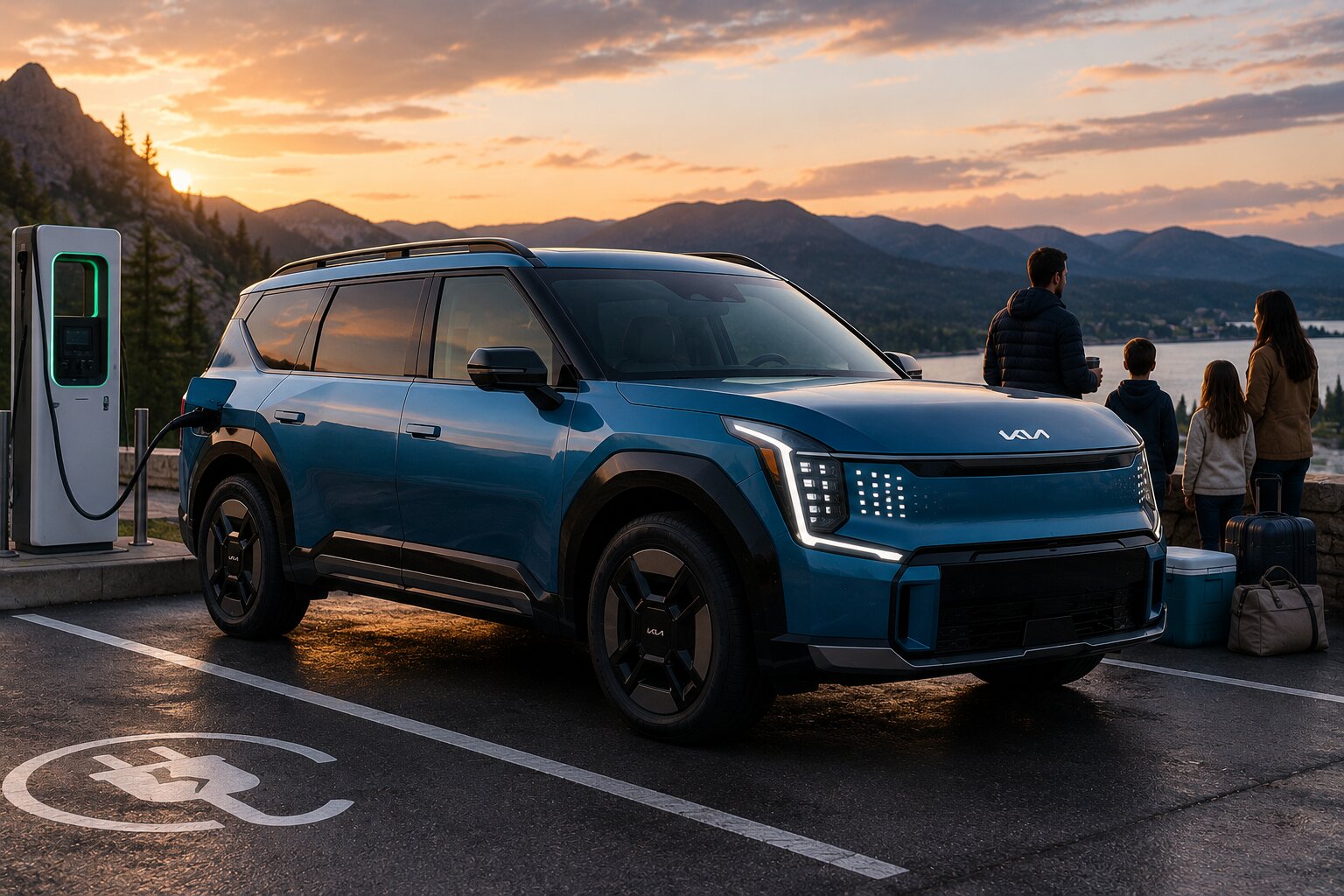
2026 Kia EV9 Review: A Big Family EV That Forces You to Build New Road-Trip Habits
The Kia EV9 is one of the first mainstream three-row electric SUVs that feels like it was designed for actual American family life, not just for a product planner’s slide deck. It is big, upright, easy to climb into, and sized like the gas-powered family haulers people already buy. The twist is that it asks you to rethink how you travel. Not in a preachy way. More like the gentle but unavoidable reality that a 5,000-plus-pound electric brick with three rows and real cargo volume will make you plan charging stops, manage kids’ patience, and learn which charging networks you trust.
This review focuses on the U.S.-market EV9 as it exists today, using widely reported and official specs from Kia and EPA where applicable. Specific 2026 model-year changes were not fully confirmed at the time of writing, so treat this as a current EV9 ownership and shopping guide for buyers considering a 2026 purchase. If Kia announces 2026 updates or reshuffles trims, the big-picture strengths and tradeoffs described here should still map closely to what you will live with.
Verified facts up front (what we know, what we do not)
What’s verified and widely reported for the U.S. EV9:
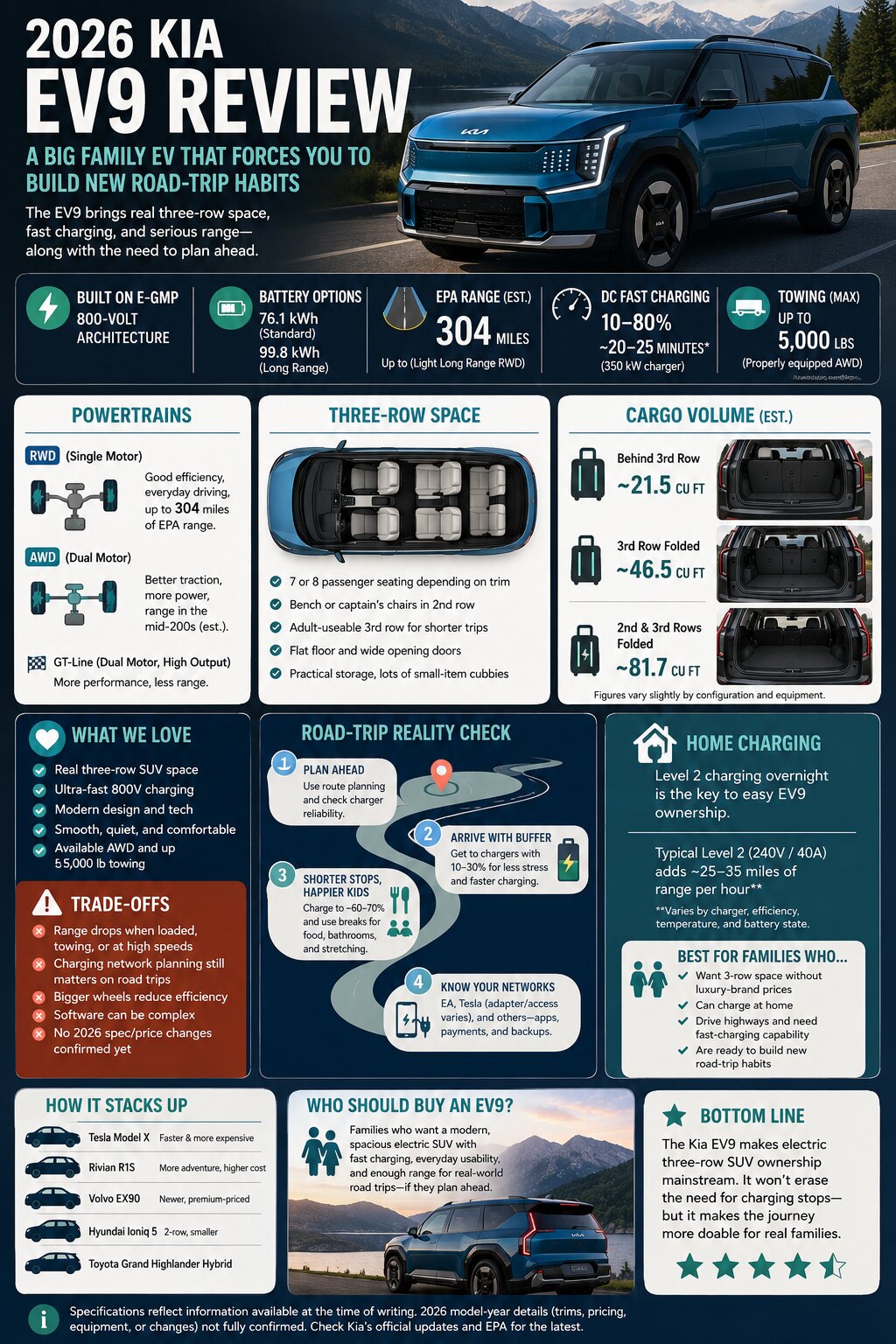
EV9 is a three-row battery-electric SUV built on Hyundai Motor Group’s E-GMP platform with an 800-volt electrical architecture (a key reason it can charge quickly on compatible DC fast chargers). U.S.-spec EV9 variants have been sold with two battery sizes: a smaller pack around 76.1 kWh (often called Standard) and a larger pack around 99.8 kWh (Long Range). Kia has offered rear-wheel drive (single motor) and all-wheel drive (dual motor) configurations depending on trim.
EPA range varies by configuration. The most efficient version has been rated up to about 304 miles (Light Long Range RWD). Other trims land lower, commonly in the mid-200s to high-200s depending on wheels, tires, powertrain, and equipment. High-output dual-motor versions trade range for acceleration.
Kia has also published DC fast-charging claims under ideal conditions for the long-range battery on a 350 kW-capable charger: roughly 10 to 80 percent in about 20 to 25 minutes. Real-world results vary heavily with charger capability, battery temperature, stall sharing, and how full you arrive.
Towing is real here too. Properly equipped EV9s have been rated up to 5,000 pounds in certain AWD configurations (lower in others). As with any EV, towing can cut range dramatically depending on speed, trailer shape, wind, elevation changes, and temperature.
What’s not verified for 2026 specifically:
Kia had not broadly published a complete set of official U.S. specs for the 2026 model year at the time of writing (final trims, pricing, standard equipment changes, or any powertrain updates). So I am not going to pretend there is some secret new range figure or new battery chemistry. If your purchase hinges on model-year changes like new software features or a revised charging port strategy, wait for Kia’s official 2026 press materials and EPA filings.
Where the EV9 sits in the market (and who it pokes at)
The EV9’s closest rivals depend on what you care about most:
If you want three rows and an EV badge, you will cross-shop the Tesla Model X (much pricier), Rivian R1S (more adventurous and also pricey), Mercedes-Benz EQS SUV (luxury money), Volvo EX90 (newer entrant), and possibly the upcoming wave of three-row electric SUVs from mainstream brands.
If your budget is closer to normal-family territory, you might compare it against near-three-row or two-row alternatives like Tesla Model Y (smaller), Hyundai Ioniq 7 (related but not yet widely available in the same way), Ford Mustang Mach-E (two-row), Hyundai Ioniq 5 and Kia EV6 (two-row), or even plug-in hybrids like the Toyota Grand Highlander Hybrid or Chrysler Pacifica PHEV if road-trip simplicity matters more than going fully electric.
The EV9’s core pitch is simple: it gives you real three-row space with modern fast-charging hardware at a price point that undercuts many premium three-row EVs. It does not magically erase charging friction. It just makes living with it more plausible.
Design and sizing: big SUV energy, with a purpose
The EV9 looks like a concept car that got approved by someone who actually has to load groceries. It is tall enough that kids can climb in without doing gymnastics, and it has that squared-off shape that tends to translate into useful interior volume.
I like that Kia did not chase coupe-SUV styling here. Aerodynamics matter for range, yes. But families buy cubic feet as much as they buy miles of EPA range. The EV9 leans into that reality with a boxier profile than many sleek crossovers.
The tradeoff is also obvious: big frontal area means you are fighting physics at highway speeds. If your life is mostly interstate driving at American traffic speeds, expect range to be more sensitive than what city commuting might suggest. That is not an EV9-specific flaw so much as a rule of three-row electric SUVs in general.
Cabin layout: built for people who carry people
This is where the EV9 earns its keep. Three-row vehicles often fail in small ways that become daily irritations: cupholders in dumb places, second-row seats that do not slide easily when someone is holding a backpack, third rows that punish adults, or cargo areas that vanish once all seats are up.
The EV9’s available second-row configurations have included bench seating or captain’s chairs depending on trim. Bench seats are usually the pragmatic choice if you need maximum passenger capacity; captain’s chairs can make third-row access easier because kids can walk between them without folding anything. Which one works depends on your family math more than your taste.
Up front and in row two, the seating position is upright and SUV-like rather than low-slung. That sounds basic until you spend time in some sleeker EVs where getting in feels like dropping into a bathtub seat while trying not to scuff plastic trim with your shoe.
Third-row comfort still comes with caveats because every third row does. Adults can fit back there for shorter stints depending on height and how far forward row two sits. For kids and teens it is typically fine. The bigger win is that the cabin feels designed around storage and usability rather than minimalism for its own sake.
Tech and software: modern features plus some real-world friction
Kia’s modern infotainment approach tends to be feature-rich: big screens, lots of menus, plenty of settings. That can be great when you want granular control over charging schedules at home or driver assistance behavior on long highway slogs. It can also be mildly annoying when you just want to do something simple quickly while your passengers are arguing about snacks.
A few realities worth calling out for U.S. ownership:
Charging planning lives inside software now. Route planning that includes charging stops can be helpful when it works well; it can also be conservative or occasionally weird about station choices depending on data quality and network availability.
Over-the-air updates matter but are not magic. Some improvements can arrive over time; other fixes still require dealer visits depending on system architecture and what Kia chooses to push remotely. If seamless software evolution is your top priority, Tesla still sets expectations for many shoppers.
Driver assistance can reduce fatigue but demands trust calibration. Most buyers will use lane centering and adaptive cruise heavily once they get comfortable with them. The best systems fade into the background; weaker tuning nags or behaves inconsistently in construction zones or faded lane markings. The EV9 generally competes well among mainstream brands here based on its feature set, but no system replaces attentive driving.
Powertrains and performance: enough muscle for a full cabin
The EV9 lineup has spanned from single-motor rear-wheel drive versions aimed at efficiency to dual-motor all-wheel drive versions aimed at traction and quicker acceleration. Kia has also offered higher-output AWD variants (often marketed as GT-Line) that prioritize punch over maximum range.
I am not going to invent stopwatch numbers from a test run I did not do. What matters more day-to-day in a family three-row is this: even the less powerful versions should feel responsive around town because electric torque arrives immediately, while AWD versions give extra confidence in rain or snow states and feel less strained when loaded up with people plus luggage.
If you regularly haul six or seven people plus gear up long grades at highway speed, AWD tends to feel like money well spent even if it costs you some efficiency. If your life is mostly school runs and suburban errands with occasional road trips where charging stops are planned anyway, the RWD long-range variant can make a strong case because every extra mile of EPA range gives you flexibility when chargers are busy or spaced far apart.
Ride comfort and noise: family-friendly tuning wins points
A big electric SUV has two competing traits: it carries mass low in the chassis thanks to the battery pack, which helps stability; but it also carries a lot of mass overall, which can challenge ride quality if suspension tuning gets too stiff chasing “sporty” vibes.
The EV9’s mission reads more comfort-first than corner-carver, which fits its role. In typical daily use, buyers should expect a planted feel on highways with less pitch than many gas SUVs because of that low battery weight distribution. At the same time, wheel size matters a lot here. Larger wheels often look great on dealer lots but can add impact harshness over broken pavement while also trimming efficiency slightly through tire choice and aero differences.
Cabin quietness is one of those things families notice immediately because kids fall asleep faster when wind noise does not build into a steady roar at 75 mph. Most modern EVs do well here because there is no engine noise masking other sounds; manufacturers have to manage wind and tire noise carefully or owners will complain loudly online. The EV9 generally plays in the expected modern-EV quiet zone for its class based on its positioning; just remember tire choice can make or break perceived refinement over time as tires wear.
Range expectations: what EPA numbers mean when your SUV is full of humans
The headline EPA number people quote most often is roughly 304 miles for the Light Long Range RWD configuration (based on published EPA ratings). Many other trims sit lower depending on drivetrain and equipment; think high-200s down into mid-200s as configurations get heavier, more powerful, or wear larger wheels.
Here is what actually matters in U.S.-style ownership:
Highway speed dominates consumption. If your road trips involve long stretches at 75 to 80 mph with HVAC running hard because it is either hot enough to melt crayons or cold enough to freeze juice boxes, expect real-world range to land below EPA estimates sometimes significantly below depending on conditions.
Weather swings are real. Cold temperatures can reduce range through battery chemistry limits and cabin heating demand; heat affects HVAC load too but often less dramatically than deep cold.
Load matters less than shape but still counts. Filling seats adds weight but aerodynamic drag remains the bigger villain at speed. Roof boxes or hitch racks can take noticeable bites out of range because they disrupt airflow.
Towing changes everything. If you plan to tow anywhere near the upper rating (up to about 5,000 pounds on certain models), plan charging stops around worst-case consumption rather than optimistic EPA thinking.
The part nobody escapes: charging habits replace gas-station habits
The EV9’s fast-charging capability is one of its biggest advantages over older-generation three-row EV attempts because E-GMP’s 800-volt system can take high power when conditions are right. Kia’s widely cited claim for long-range models is roughly a 10 to 80 percent DC fast charge in about 20 to 25 minutes using a sufficiently powerful charger with proper preconditioning and an appropriately low starting state of charge.
That sounds simple until you road trip across America with kids:
You stop earlier than you think. Most families find it less stressful to arrive at chargers with cushion rather than rolling in at single-digit percent while everyone pretends they are calm.
You charge less than you think. Charging from very low up to around 60 or 70 percent is typically faster than pushing toward 90 or 100 percent at DC fast chargers because charging power tapers as the battery fills. Real road-trip efficiency often comes from shorter stops more often instead of one long stop where everyone gets restless.
You learn your networks quickly. In many regions Electrify America remains part of the conversation for CCS fast charging availability; reliability experiences vary by location and time period. Tesla’s Supercharger network still sets expectations for uptime and ease-of-use for many drivers; access depends on vehicle compatibility and adapter support policies which have been evolving across brands. If access expands broadly for Kia vehicles through NACS adoption timelines or adapters in future model years, that could materially improve road-trip ease for many owners, but confirm current compatibility before planning purchases around it because this area changes quickly.
You build kid logistics into charging stops. Families naturally start choosing stations near bathrooms they trust, food options that do not cause meltdowns later, playgrounds if available, or simply enough space between cars so doors can open without negotiation. This becomes routine surprisingly fast if your routes have decent infrastructure; it becomes draining if they do not.
Home charging: where owning an EV actually feels effortless
If you buy an EV9 without reliable home charging access, you are signing up for more public-charging time than most busy families want. A Level 2 home charger makes this vehicle make sense because overnight charging turns daily driving into something close to “always full enough.”
The practical advice stays consistent:
If your electrical panel supports it (and your budget does too), install Level 2 charging at home so you wake up ready most days without thinking about it. If you cannot install Level 2 immediately but have access to regular household outlets only (Level 1), understand that replenishing a large battery this way can be very slow; it may work only if your daily miles are modest and predictable.
Kia supports scheduled charging features so many owners will set off-peak times if their utility offers lower overnight rates. That kind of boring adult optimization becomes part of ownership satisfaction because electricity pricing varies wildly across U.S. states and utility territories.
Road-trip practicality: how far it goes between stops matters less than where stops exist
A three-row family road trip rarely fails because one stop took too long; it fails because stops happen at bad times or bad places. The EV9 pushes you toward planning based on charger density rather than pure distance between exits like you might in a gas SUV.
If your frequent trips run along major interstate corridors with plenty of DC fast chargers spaced sensibly apart, an EV9 can be genuinely easy once everyone adapts to the rhythm: drive two-ish hours (variable), stop for food or bathrooms while charging happens automatically in the background if everything works as intended, then repeat until arrival.
If your frequent trips involve rural highways where chargers are sparse or concentrated around one unreliable site per town, then every variable matters more: arriving with buffer state-of-charge; having backup stations mapped; understanding whether stations are behind dealership gates after hours; knowing which apps require preloaded payment methods; carrying an adapter strategy if applicable; keeping passengers comfortable if you need an extra stop because one station is down.
This is where rivals diverge sharply:
Tesla still has an edge on pure road-trip ease thanks largely to its integrated Supercharger experience (availability varies by region). Rivian has strong route planning plus growing infrastructure support but sits at higher price points for many families shopping mainstream brands. Other three-row luxury EVs may offer excellent comfort yet still rely on similar public-charging realities as Kia depending on connector standard and network access at that moment in time.
Cargo space and daily hauling: minivan logic without minivan vibes
Kia built this thing like people will use it for Costco runs plus sports gear plus strollers plus random bins that never leave the trunk once school starts again. With all three rows up, cargo space exists but will still feel limited compared with two-row crossovers because physics again: seatbacks occupy volume no matter what powers them.
The bigger advantage comes when you fold rows down quickly for bulky items while keeping one row available for passengers as needed. A flat-ish load floor matters when lifting heavy boxes; tie-down points matter when groceries slide around; underfloor storage helps hide charging cables so they are not tangled with soccer cleats forever.
Towing: yes it can tow (but plan like an adult)
Certain AWD versions have been rated up to about 5,000 pounds when properly equipped (verify exact rating by trim). That rating puts it into legitimate small-trailer territory: lightweight campers, utility trailers loaded carefully within limits, small boats depending on setup.
The caution is predictable but important: towing increases energy consumption substantially at highway speed due primarily to aerodynamic drag from the trailer profile plus added rolling resistance from weight. Owners should assume more frequent charging stops while towing and should prioritize routes with reliable high-power chargers rather than scenic detours unless they know infrastructure well.
Safety and driver assistance: strong feature set matters in kid-hauler duty
Kia equips its newer vehicles with robust active safety tech suites depending on trim: automatic emergency braking features, blind-spot monitoring systems, lane keeping aids, adaptive cruise control features geared toward highway use. Exact packaging varies by trim level year-to-year so confirm what comes standard versus optional on the specific vehicle you are buying.
I am intentionally not claiming specific crash-test scores here because ratings depend on model year testing protocols from IIHS and NHTSA that may change over time; check current listings for your exact model year build before buying if top ratings are non-negotiable for your household decision-making process.
Costs and incentives: reality check before you fall in love
Kia pricing shifts with trims and model years; verify current MSRP for the exact configuration since this review targets “2026” shopping context without confirmed final pricing details published here. Historically the EV9 has spanned from comparatively attainable trims up into more expensive high-spec versions that start stepping toward premium-brand money once options stack up.
Federal tax credit eligibility: This area has been fluid due to sourcing rules tied to battery components/critical minerals plus final assembly requirements under current U.S. policy frameworks (and those policies can change). Some buyers may qualify through leasing structures where credits may be applied differently by manufacturers/captive finance arms depending on program terms at purchase time. Because eligibility depends on transaction type plus evolving guidance, treat any blanket claim about “it qualifies” as suspicious unless confirmed for your specific VIN/trim/deal structure at signing time.
Living with an EV9 day-to-day: what feels easy vs what takes patience
The easy parts:
You wake up charged if you have Level 2 at home. Cabin preconditioning becomes normal so kids climb into a cooled or warmed SUV without idling guilt or garage fumes concerns common with remote-starting gas cars indoors-adjacent spaces. One-pedal driving settings (where available) can make stop-and-go traffic less tiring once acclimated; some drivers love it instantly while others prefer lighter regen modes depending on motion sickness sensitivity among passengers.
The patience parts:
You will spend some portion of ownership thinking about apps: network apps for public charging payment initiation; navigation choices; occasional firmware updates; learning which chargers deliver advertised power versus those capped by site limitations or shared loads during peak travel weekends.
You will also develop opinions about wheel size faster than expected because bigger wheels look great but can cost money twice: once upfront at purchase time and again through slightly reduced efficiency plus potentially pricier tire replacements later depending on size availability and brand choice in your region.
Subtle rival comparisons where they matter most
p
Versus Tesla Model X: Model X brings strong performance credentials and Tesla’s integrated charging ecosystem advantages (region-dependent), but price puts it out of reach for many families who just want space without luxury-brand bills attached.
0 comments
Join the discussion around this article.
Please login to comment.