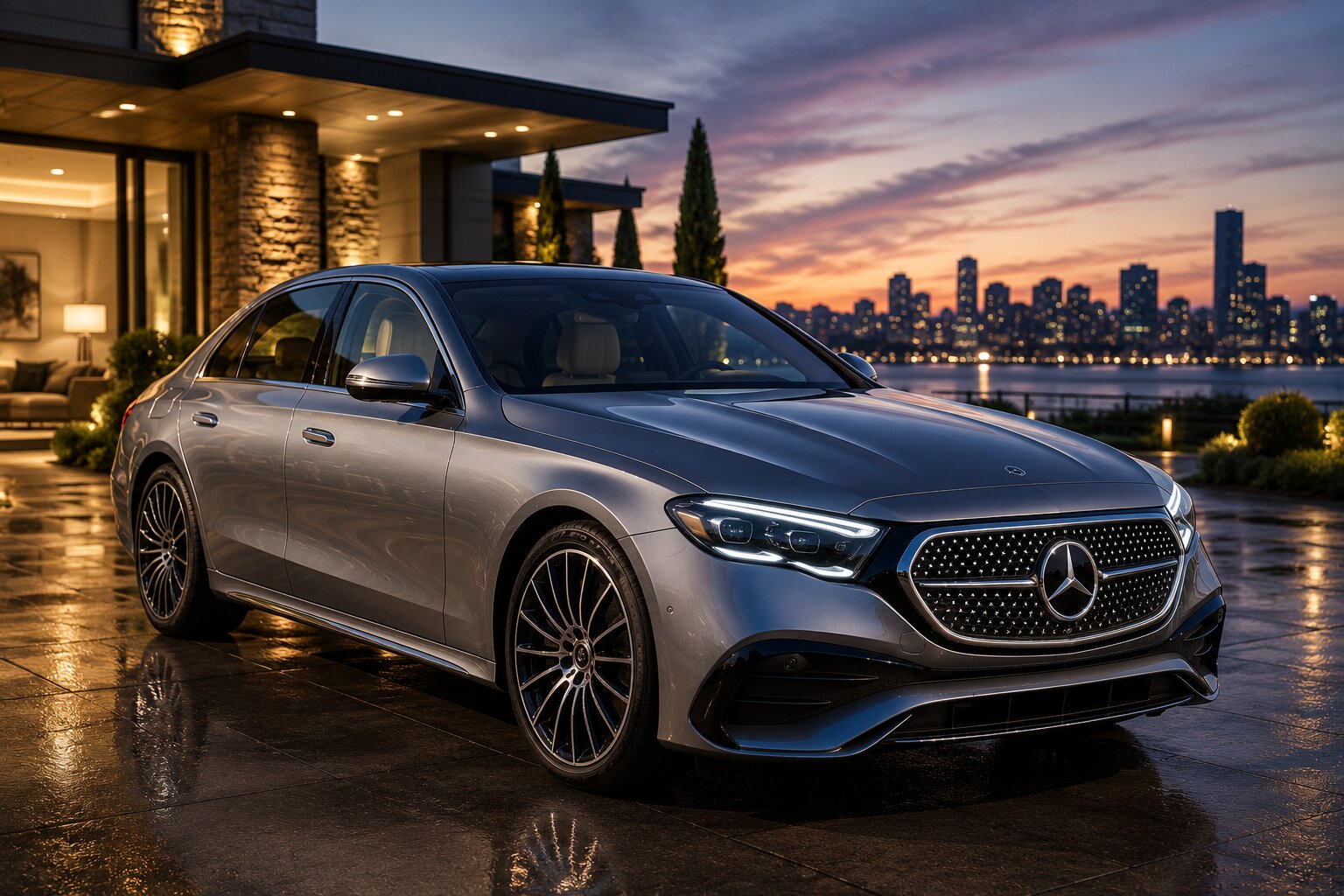
Verified facts first: what the 2026 E-Class is, and what is actually confirmed
Mercedes-Benz’s current E-Class for the U.S. is the W214 generation that debuted for the 2024 model year. For 2026, Mercedes continues to sell this same-generation E-Class sedan in America, positioned between the smaller C-Class and the flagship S-Class. That matters, because many of the big talking points around “the new E-Class” are not 2026-specific changes so much as qualities baked into the W214’s design brief: a quieter, more digital, more comfort-led interpretation of the traditional executive sedan.
What is verifiable from widely published manufacturer information and mainstream automotive references: in the U.S. market this generation has been offered primarily as the E 350 (a turbocharged 2.0-liter four-cylinder with a 48-volt mild-hybrid system) and the E 450 (a turbocharged 3.0-liter inline-six with a 48-volt mild-hybrid system). Both have been paired with a 9-speed automatic transmission (Mercedes 9G-TRONIC) and both have been available with Mercedes’ 4MATIC all-wheel drive depending on trim and configuration. Mercedes also sells higher-performance AMG variants in the broader E-Class family, but availability and naming can vary by model year and market; if you are shopping specifically for an AMG E-Class for 2026, it is worth confirming U.S.-market ordering guides and dealer allocation rather than relying on generic global announcements.
Also verifiable: this E-Class is built around Mercedes’ latest cabin software approach (MBUX), with an available passenger-side display as part of the “Superscreen” style dashboard layout on certain trims. It supports wireless Apple CarPlay and Android Auto, and it uses over-the-air update capability for certain functions. The car’s driver-assistance suite includes adaptive cruise control and lane-keeping features depending on options and packages, although feature names and exact capability levels vary by package content.
What is not safe to claim without up-to-the-minute ordering data: exact 2026 packaging changes, option availability by trim, precise curb weights for every configuration, or any newly revised power outputs that might arrive mid-cycle. Manufacturers sometimes adjust standard equipment, wheel choices, or package bundling year to year without changing fundamentals. If you are cross-shopping based on one must-have feature, confirm with a current U.S. window sticker or build sheet.
Where it sits in the luxury landscape
The E-Class remains one of the most important “default choices” in American luxury sedan shopping. Not because it is always the sportiest or the flashiest, but because it tends to land in a sweet spot of size, prestige, comfort, and technology. In practice, it competes most directly with the BMW 5 Series (including its electrified variants), Audi A6, Lexus ES (and to a degree the smaller IS and larger LS depending on budget), Genesis G80, and Volvo S90.
Each rival brings a distinct philosophy. The BMW tends to prioritize steering response and chassis discipline even when it is tuned for comfort. The Audi often wins on clean design and an easygoing highway demeanor, though its interior tech strategy has been in flux over recent years. Lexus leans into refinement and low-stress ownership appeal rather than pushing cutting-edge cabin software. Genesis offers value-forward luxury with strong materials for the money and aggressive warranty positioning. Volvo sells calmness as a brand attribute, with seats that have become something of an industry reference point.
The question posed by this review title is not whether Mercedes can build a quiet luxury sedan. It can, and has for decades. The real question is whether this new-generation E-Class sets a fresh benchmark for quiet luxury at its price point in America, especially now that competitors are also becoming more insulated, more screen-forward, and more electrified.
Design: restrained prestige with a modern edge
In person, this generation of E-Class reads as unmistakably Mercedes without leaning on retro cues. The surfaces are smoother than older E-Classes with sharper creases; aerodynamics clearly had a seat at the table during styling sign-off. The result is elegant rather than dramatic.
From a luxury-buyer perspective, that restraint has value. Many executives and professionals shopping this segment want their car to look expensive without looking loud. Depending on wheel size and exterior color choice, the E-Class can appear almost conservative at a glance. That is not a flaw; it is part of its role in the lineup.
One practical note that tends to matter in day-to-day ownership: larger wheels can materially change ride quality on luxury sedans even when adaptive damping is available. If “quiet luxury” is your core mission rather than visual punch, smaller wheel options are often the smarter choice where available.
Cabin craftsmanship: materials that feel expensive when your hands are tired
Mercedes has long understood that luxury is tactile as much as visual. In this E-Class generation, you will notice it in places you touch repeatedly: switchgear feel (where physical controls remain), steering wheel surfaces, seat upholstery choices, and how trim pieces meet at seams.
The best versions of this cabin deliver what many buyers expect from Mercedes: an atmosphere that feels curated rather than merely assembled. Ambient lighting plays a large role in how modern Mercedes interiors present themselves at night; some shoppers love it as theatrical comfort, others find it distracting. Either reaction is valid because ambient lighting has become less about illumination and more about mood-setting identity.
There is also a broader truth about premium interiors in 2026: screens dominate attention even when materials are excellent. That means craftsmanship now includes software behavior. A beautiful dashboard can feel less luxurious if everyday tasks take too many taps or if menus hide basic functions.
Control layout: beautiful screens do not automatically equal serenity
This E-Class leans hard into digital presentation through MBUX and optional multi-screen layouts. Verified: wireless smartphone integration support exists; verified: there is an available passenger display setup on certain configurations; verified: Mercedes continues to use configurable digital instrument clusters.
The subjective part begins when you live with it. A screen-first approach can be calming if graphics are clear and response times feel immediate. It can also be mildly frustrating if you need to hunt for simple adjustments while driving. The E-Class tries to balance this by keeping some physical controls where they matter most (steering wheel controls remain central), but many secondary functions live within menus.
If you are coming from an older E-Class with more traditional buttons for climate or audio shortcuts, expect an adjustment period. Some buyers will adapt quickly; others will miss muscle-memory simplicity.
Seats and comfort: where quiet luxury starts before you move
The E-Class’s core promise is comfort that feels engineered rather than soft in a vague way. This segment lives or dies by seat design because long commutes and airport runs are common use cases in America.
Mercedes typically offers multiple seat configurations depending on trim level and options (for example upgraded multi-contour seating features may be packaged). Exact availability can vary by model year packaging, so treat any specific seat feature list as something to confirm against current ordering guides.
Even without diving into option minutiae, there are two consistent truths about luxury sedans like this: first, seat comfort must work over hours rather than minutes; second, road noise control becomes far more noticeable once your body feels supported properly. A great seat makes quietness feel deeper because your senses stop bracing against fatigue.
Powertrains: mild-hybrid muscle where you actually use it
For U.S.-market shoppers comparing trims, the big decision usually centers on four-cylinder versus six-cylinder power.
E 350: Verified broadly across mainstream sources for this generation: a turbocharged 2.0-liter four-cylinder paired with a 48-volt mild-hybrid system (Mercedes calls its integrated starter-generator setup part of its mild-hybrid strategy). Mild-hybrid systems typically help smooth stop-start behavior and provide brief torque assistance during low-speed acceleration or while filling gaps during gear changes.
E 450: Verified broadly across mainstream sources for this generation: a turbocharged 3.0-liter inline-six paired with a 48-volt mild-hybrid system. In typical daily use, this kind of six-cylinder configuration tends to feel less strained at highway speeds and during passing maneuvers compared with a turbo four, even when outright horsepower numbers may not tell the whole story.
I am deliberately not quoting exact horsepower or torque figures here because those numbers can vary slightly by model year certification or market documentation; they are also easily misquoted when manufacturers revise tuning or when publications mix global specs with U.S.-spec cars. If output figures are central to your purchase decision, verify them from Mercedes-Benz USA’s current specifications page or an official Monroney label for the exact vehicle you intend to buy.
What can be said responsibly: both engines are designed to deliver effortless acceleration in normal American traffic patterns; both are paired with Mercedes’ 9-speed automatic; both benefit from mild-hybrid smoothing that can make low-speed driving feel more polished than older turbo engines without electrification support.
Ride quality and noise isolation: why this car earns “quiet luxury” attention
The E-Class has historically been one of the segment’s best at making speed feel ordinary. On today’s highways that translates into low fatigue at 75 mph plus steady tracking over imperfect pavement joints.
This generation’s emphasis appears aligned with that tradition: aerodynamics improved relative to older designs (a common goal across modern sedans), which typically helps wind noise at highway speeds; chassis tuning aims for composure; optional suspension technology can further refine isolation depending on trim and packages offered in your region.
Here is what must remain clearly labeled as subjective rather than verified testing: quietness is perceived differently depending on tire choice, wheel size, road surface texture in your area, and even interior trim selections that change cabin resonance slightly. Still, based on what this class of Mercedes targets historically and how W214 has been positioned publicly by Mercedes as more refined and tech-forward than before, it is reasonable to expect that many buyers will experience it as notably calm compared with sport-tuned alternatives.
If your priority is maximum hush over maximum steering feedback, you may find yourself gravitating toward an E-Class configured for comfort rather than appearance-driven wheel upgrades.
Handling character: composed first, sporty second
The modern executive sedan rarely tries to mimic a sports sedan full-time anymore because customers have diversified expectations. Some want athleticism; others want tranquility; most want both depending on mood.
The E-Class’s typical dynamic personality has been “secure confidence” rather than playful rotation. That fits its brand positioning in America where many owners value stability in rain-soaked interstates as much as they value occasional backroad enjoyment.
A subtle comparison helps clarify expectations:
Versus BMW 5 Series: BMW often feels more eager through initial steering inputs; it tends to communicate more through chassis response even when ride comfort remains excellent in higher trims.
Versus Audi A6: Audi frequently majors in easy stability and polished control effort; it can feel light on feedback but very competent at speed.
Versus Lexus ES: Lexus typically prioritizes smoothness over engagement; many buyers love its calm demeanor but enthusiasts may find it less involving.
The Mercedes approach sits comfortably among these priorities: enough precision to feel premium on an on-ramp; enough isolation to make daily driving feel unhurried.
The technology experience: impressive capability meets real-world learning curve
The E-Class’s technology story is both its selling point and its potential stumbling block depending on buyer personality.
Verified strengths: MBUX supports modern connectivity expectations including wireless smartphone mirroring; available large-screen configurations offer expansive information density; advanced driver-assistance features are offered through packages (adaptive cruise control style functionality among them).
The subjective reality: A highly digital cabin asks more of its owner early on. You learn where features live; you decide which shortcuts matter; you calibrate how much automation you trust day-to-day. Some drivers enjoy that sense of personalization because it makes the car feel tailored over time. Others simply want immediate simplicity every time they get behind the wheel.
A small but meaningful detail in luxury ownership: voice assistants have improved across brands but still vary widely depending on phrasing and connectivity conditions. If voice control matters to you because you prefer hands-free adjustments for climate or navigation prompts, test it yourself during a dealer visit instead of assuming it will behave like your phone assistant.
Space and practicality: sedan logic still holds up
Sedans have ceded market share to SUVs in America, but they still offer specific advantages that matter once you stop thinking only about ride height: easier step-in height for many adults compared with tall crossovers; better aerodynamic efficiency potential; often quieter cabins due to lower profiles; more settled high-speed behavior thanks to lower centers of gravity.
The E-Class remains a true mid-size luxury sedan with adult-friendly rear seating depending on front-seat position. Exact cargo volume figures should be checked against official U.S.-spec data for your model year because trunk packaging can vary slightly with options (for example spare tire solutions or audio components). Even without quoting numbers here, the practical expectation holds: it will handle airport luggage for two adults comfortably; three large suitcases plus extras may require careful packing like most sedans in this class.
Ownership considerations in America: what buyers tend to weigh
A formal review should acknowledge what happens after the honeymoon period.
Pricing pressure: Luxury sedans have climbed steadily in transaction prices due to option complexity and technology content. Even if base MSRP looks competitive versus rivals on paper (and MSRPs change yearly), many real-world cars arrive well-optioned because dealers stock configurations that reflect local tastes like premium audio systems, upgraded wheels, driver-assistance packages, panoramic roofs where offered, or appearance-line trims where applicable.
Service expectations: Modern German luxury cars reward diligent maintenance schedules and correct consumables (tires appropriate to load rating and speed rating; correct oil specifications). This is not unique to Mercedes but it does shape cost-of-ownership expectations compared with brands positioned around lower service costs.
Tires make or break refinement: It sounds mundane until you live with it. Tire choice affects road noise dramatically on American concrete highways; low-profile performance tires can add harshness even when suspension tuning is excellent.
Tech longevity: Screen-based cabins age differently than button-based cabins because software evolves quickly while hardware stays fixed for years. Over-the-air updates help around edges but do not change core interface philosophy. If you prefer timeless minimalism over digital immersion, consider whether you will enjoy this interior five years from now as much as you enjoy it today.
Safety and driver assistance: strong toolkit, verify package content
The E-Class sits in a segment where comprehensive safety engineering is expected rather than celebrated as exceptional marketing copy. Mercedes typically offers robust active safety systems including automatic emergency braking capability as standard equipment across much of its lineup (exact standard content varies by model year). More advanced assistance such as adaptive cruise control with lane centering style functionality generally requires option packages.
I am not citing crash-test ratings here because they depend on specific testing bodies (IIHS versus NHTSA) and model-year test coverage may lag new generations or differ by configuration at publication time. If ratings matter deeply to you, check IIHS.org and NHTSA.gov for current results tied explicitly to the model year you plan to buy or lease.
Rivals through a luxury lens: how the E-Class compares when serenity matters most
BMW 5 Series: For buyers who want their executive sedan to feel alert under them at all times, BMW remains persuasive. The tradeoff can be that some configurations prioritize response over isolation compared with an equivalently equipped Mercedes tuned for calmness (wheel size again plays an outsized role).
Audi A6: Audi’s appeal often lies in understated design discipline plus an easy highway character that suits long-distance travel well. Buyers sensitive to interface complexity should evaluate both brands carefully because each has leaned heavily into screens over recent years.
Lexus ES: If your definition of quiet luxury includes lower stress about long-term running costs and dealership experience consistency (which varies regionally), Lexus remains compelling even if it does not chase cutting-edge cabin theatrics as aggressively as Mercedes does.
Genesis G80: Genesis frequently impresses shoppers who sit inside expecting “good for the money” but find genuinely rich materials at certain trims instead. Brand prestige still matters in this segment though; some buyers want three-pointed-star recognition along with craftsmanship.
Volvo S90: Volvo continues to sell calm design values particularly through seating comfort reputation and minimalist Scandinavian presentation. Depending on your preferences you may find Volvo’s restraint refreshing compared with Mercedes’ more immersive digital lighting-and-screen environment.
The quiet-luxury verdict depends on your tolerance for screens
If your mental image of quiet luxury is thick glass serenity paired with soft leather touchpoints plus controls that disappear into intuition after day three of ownership, the new-generation E-Class makes a strong case based on its positioning and widely reported focus areas: refinement improvements baked into modern aerodynamics plus mild-hybrid smoothing plus high-end cabin execution.
If your mental image of quiet luxury includes minimal interaction friction above all else, there is nuance here. The E-Class’s screen-centric approach can feel like sophistication or like work depending on your habits. Some owners will love having deep configurability within MBUX; others will prefer rivals whose interfaces feel simpler even if they look less dazzling at night.
Pros and cons (grounded summary)
Pros
Elegant design that reads premium without shouting
Mild-hybrid powertrains designed for smooth everyday response
Cabin ambiance can feel genuinely special at night thanks to lighting design paired with high-resolution displays
A comfort-first executive-sedan mission that aligns well with American highway realities
Cons
The screen-led interface may frustrate buyers who prefer straightforward physical controls
Larger wheel options can undermine ride serenity depending on configuration
Total cost rises quickly once common comfort-and-tech packages are added (verify local pricing)
Verdict: Is it the new benchmark for quiet luxury?
The 2026 Mercedes-Benz E-Class sedan, as part of the current W214 generation sold in America, earns serious consideration as one of the segment’s clearest expressions of modern quiet luxury provided your definition includes digital immersion alongside traditional comfort virtues. Its strengths align neatly with what many U.S.-market buyers actually do every day: commute through uneven pavement zones; spend long stretches at steady speeds; carry clients or family members who care about calmness more than cornering theatrics; appreciate craftsmanship that shows up through touchpoints rather than just spec-sheet bragging rights.
The benchmark claim becomes more complicated when “quiet” also means “simple.” This cabin asks you to participate in its technology philosophy more actively than older Mercedes sedans did; some drivers will find that involvement satisfying while others will view it as friction inside what should be an effortless sanctuary.
If serene motion matters most, configure carefully (especially wheels), verify package content against current U.S.-market build sheets for 2026 availability, then take an unhurried test drive over rougher local roads rather than only smooth dealer routes. Do that homework well and there is a strong chance this E-Class delivers exactly what its badge promises: calm authority with craftsmanship you notice most when life gets busy.
0 comments
Join the discussion around this article.
Please login to comment.