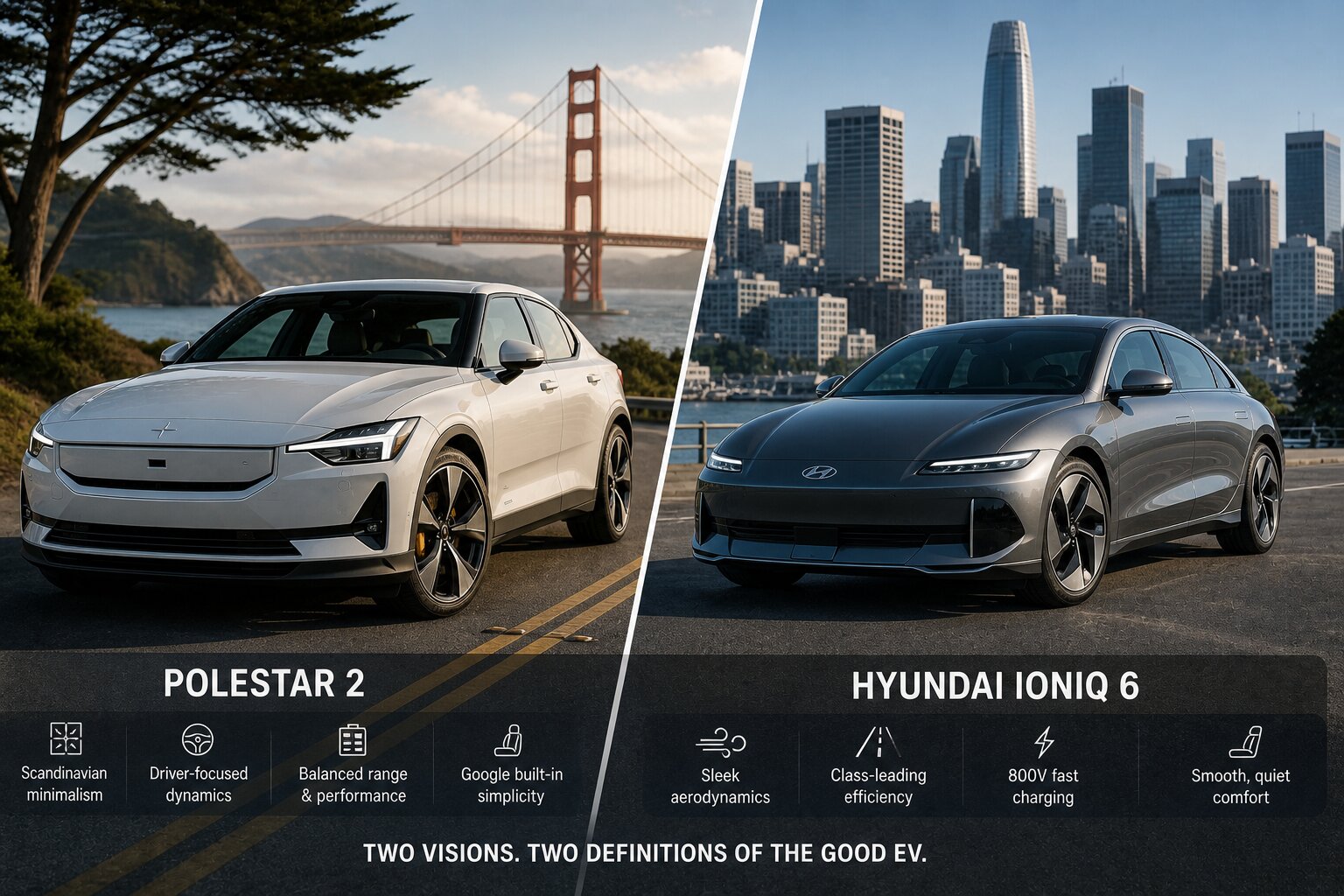
Minimalism vs. momentum: two very different takes on the “good EV”
I’m Samantha Reed, based in San Francisco, and I spend a lot of my year bouncing between EV press drives, Bay Area charging stations, and the very real messiness of ownership questions people ask once the honeymoon phase ends. The Polestar 2 and Hyundai Ioniq 6 sit in a fascinating overlap: both are midsize-ish electric sedans (Polestar calls the 2 a fastback; Hyundai sells the 6 as a streamlined sedan), both target buyers who want something more design-forward than a typical crossover, and both have credible charging and range stories just told in totally different accents.
But there’s an important caveat right up front: you asked for a “2026” comparison. As of my knowledge cutoff (2025), full, finalized U.S.-market specs for the 2026 model year versions aren’t universally published across trims. So where 2026 details aren’t confirmed, I’m going to lean on widely known, verified specs for the most recent model-year configurations (particularly the post-refresh Polestar 2 updates and the current Ioniq 6 lineup) and flag what isn’t yet locked in especially EPA figures, pricing shifts, and trim availability.
With that out of the way, here’s how these two feel in real life and what their spec sheets actually mean when you’re trying to get across town on a cold night with 18% battery left.
Design vibes: Scandinavian calm vs. slippery science project
The Polestar 2 is the one you choose if you want your EV to look like it was designed by someone who owns exactly one black turtleneck and never raises their voice. It’s tidy. Upright for a sedan. Almost Volvo-adjacent (not an accident Polestar shares roots with Volvo). The stance reads solid rather than swoopy, and that matters because it sets expectations: this is a driver’s car first, efficiency experiment second.
The Ioniq 6 is the opposite kind of confidence. Hyundai went full streamliner: long roof arc, tight tail, and surfaces that look like they were wind-tunnel negotiated rather than sketched. It’s not subtle. I’ve seen people do double takes at stoplights in SoMa sometimes admiration, sometimes confusion. Either way, it doesn’t disappear into traffic like most sedans do now.
And yes, that shape isn’t just theater. The Ioniq 6 is famous for being extremely aerodynamic; Hyundai has widely publicized a very low drag coefficient (commonly cited around 0.21 Cd, depending on configuration). That slipperiness is central to why it can go so far on a given battery size in EPA testing.
Powertrains: what “quick” means when one car prioritizes grip and the other prioritizes miles
Both cars offer rear-wheel drive and all-wheel drive variants in recent U.S. lineups, but their personalities diverge once you start talking output and how they deploy it.
Polestar 2 (recent model years) moved to a more efficient RWD setup as its mainstream configuration after its refresh, with AWD available for buyers who want more punch and all-weather confidence. Verified figures vary by trim/year, but broadly: single-motor versions have landed in the neighborhood of mid-200s horsepower, while dual-motor versions step into the 400+ hp realm (with performance-oriented packs pushing higher). That spread matters: the Polestar can be “quick commuter” or “quietly serious” depending on which box you check.
Hyundai Ioniq 6 in the U.S. has been sold with a single-motor RWD setup or a dual-motor AWD setup. Widely reported specs for recent model years put the RWD car around 225 hp, while AWD versions are commonly listed around 320 hp. The Hyundai is not slow especially off the line like most EVs but it doesn’t chase the same top-end shove as a high-output dual-motor Polestar configuration can.
In normal Bay Area driving short merges onto 101, quick lane changes around an Uber doing something unpredictable the Polestar’s throttle mapping tends to feel more “European sport sedan” in spirit: immediate but controlled. The Ioniq 6 feels tuned for smoothness first; it’s happy to surge forward, but it does it with less drama. If you’re coming from something like a BMW 3 Series, Polestar’s responses feel more familiar. If you’re coming from a Prius Prime or an Accord Hybrid and you just want EV torque without whiplash vibes, Hyundai’s calibration makes sense.
Towing and hauling reality: sedans still aren’t pickup trucks
This is where EV marketing sometimes collides with American weekend life. Neither of these cars is meant to be your tow rig.
Polestar 2 towing: In some markets outside the U.S., Polestar has offered towing capability ratings for certain configurations of the Polestar 2. In the U.S., towing ratings and hitch availability can be more limited and may vary by model year/trim; for many American shoppers, it effectively behaves like a “don’t plan your life around towing” vehicle unless you’ve verified an official U.S.-spec rating for your exact build. If you need to tow regularly, you’ll want to confirm current-year U.S. documentation rather than assume European numbers apply.
Ioniq 6 towing: Hyundai does not position the Ioniq 6 as a towing-focused vehicle in the U.S., and official tow ratings are not commonly emphasized in mainstream U.S. materials for this sedan. Practically speaking: treat it as minimal-to-no towing unless Hyundai publishes an explicit rating for your specific model year.
If your lifestyle includes e-bikes on a hitch rack or a small utility trailer once a year, you’ll still need to do homework especially around tongue weight limits and warranty implications because “it fits physically” isn’t the same thing as “the manufacturer supports it.” For anything beyond light accessory duty, these two aren’t your answer.
Efficiency and range: where the Ioniq 6 quietly flexes on almost everyone
If you care about road-trip math and if you live in California you probably do the Ioniq 6 has built its reputation on being one of the most efficient mainstream EVs sold in America.
Ioniq 6 EPA range (verified for recent model years): Depending on wheel/tire choice and trim, EPA-rated range has reached up to roughly 361 miles for certain RWD configurations with the larger battery (a widely cited figure for SE RWD with smaller wheels). Other trims land lower bigger wheels tend to cost range.
Polestar 2 EPA range (verified for recent model years): Range varies significantly by configuration; post-refresh single-motor variants have been rated into roughly the 300+ mile neighborhood depending on battery/trim/wheels, while dual-motor performance-oriented setups tend to come in lower due to extra power and often stickier tires.
You feel this difference most when you’re not trying to set records just living life. The Ioniq 6 asks fewer questions of your schedule. You can run errands across SF, head down to San Jose, come back over Skyline when it’s foggy and cold (range-killing conditions), and still not be obsessively watching percent remaining.
The Polestar 2 is absolutely road-trip capable but it feels more sensitive to configuration choices. Pick big wheels or higher-output dual motors and your range buffer shrinks faster than you expect if you’re used to an efficiency champ like the Hyundai.
Note on “2026”: EPA ratings for specific 2026 trims may not be released yet depending on timing; always check fueleconomy.gov once listings go live for that model year.
Charging: both are good at it, but Hyundai’s architecture is still a headline feature
This is where EVs stop being theoretical. In Northern California, charging is mostly fine until it isn’t and then your car’s peak rate matters less than how consistently it holds power and how easily it fits into whatever network reality you’re stuck with that day.
Ioniq 6 charging: The Ioniq 6 rides on Hyundai Motor Group’s E-GMP platform with an 800-volt-capable architecture. In plain English: when conditions are right (battery warm enough, charger actually delivering), it can charge extremely quickly at high-power DC fast chargers. Hyundai has widely advertised 10–80% in about 18 minutes under ideal conditions for E-GMP vehicles using high-power chargers.
Polestar 2 charging: Polestar 2 uses DC fast charging that is competitive but generally associated with lower peak rates than E-GMP’s best-case numbers (commonly discussed around ~150 kW peak depending on version/year). In practice that means: great for normal road trips, but less likely to deliver those “blink-and-it’s-done” sessions when everything aligns.
The bigger story in 2025–2026 America is also where you can charge. Tesla Supercharger access is expanding via NACS adoption across brands, but rollout timing varies by manufacturer agreements and model-year hardware readiness. For any specific 2026 build of either car, you’ll want to verify whether it ships with NACS or relies on adapters/CCS availability at purchase time. That detail can matter more than peak kW numbers if your local CCS station is flaky.
The way they drive: steering weight, body control, and that little hum through the floor
I’m going to say something slightly heretical for EV shoppers: outright horsepower matters less than chassis tuning once you’ve crossed “adequately quick.” Both of these cars are adequately quick in most trims. The difference is how they carry speed through an on-ramp or settle over rough pavement on I-80 near Emeryville where expansion joints never seem to get fixed.
Polestar 2: This one feels buttoned-down. The steering typically carries more weight than many mainstream EVs enough that your hands register effort without feeling artificially heavy. There’s also a sense of vertical control over bumps; even when the ride is firm (and it can be firm), it usually feels intentional rather than sloppy. The cabin stays calm at speed with that familiar EV quiet mostly wind noise and tire thrum but there’s also a subtle mechanical honesty through the seat base when you hit broken pavement. It reminds me more of a traditional European sport sedan than most EVs do.
Ioniq 6: The Hyundai leans into smoothness and efficiency vibes. Steering effort tends to be lighter, with less of that “front tires talking back” sensation through your palms. On highway cruises say US-101 down past SFO it feels stable and slippery through air; wind noise management is generally good for the segment, helped by that aero profile. Over rougher city streets, ride comfort depends heavily on wheel size; larger wheels can transmit sharper impacts with a quick slap through the suspension over pothole edges.
If your idea of fun is carving up Highway 1 early morning before traffic wakes up, I’d take the Polestar’s composure first (especially in higher-performance configurations). If your idea of fun is watching consumption numbers stay low while cruising at normal speeds with minimal fuss, Ioniq 6 feels like it was built exactly for that game.
The cabin mood: buttons, screens, and whether minimalism helps or annoys
The Polestar cabin is minimalist in that Scandinavian way where everything looks clean until you realize some basic functions live inside menus. Newer Polestars have used an Android Automotive-based infotainment system with Google built-in (Google Maps/Assistant style integration). When it works well and often it does it feels natural because Google Maps EV routing can be genuinely useful in unfamiliar areas. The screen layout tends toward simple blocks of information rather than visual fireworks.
The downside? Like any software-defined car experience, occasional glitches or lag can sour your day more than an old-school button ever would. Also worth noting: Android Automotive (the built-in OS) is not exactly the same thing as Android Auto mirroring; buyers sometimes confuse those two concepts when shopping.
The Ioniq 6 cabin feels more like modern Hyundai: lots of tech presence without going full minimalism-for-minimalism’s-sake. You typically get dual-screen layouts in many trims (instrument display plus central infotainment), physical controls where they matter more (volume/tuning style controls are often easier to hit without taking your eyes off traffic), and an overall vibe that says “mainstream luxury-adjacent.” The seating position is lower-slung than some people expect from an EV family car; taller drivers should spend time dialing in ergonomics before committing.
Sensory detail that stuck with me across similar Hyundais: many controls have that soft click-damped feel pleasantly engineered without feeling fragile while Polestar leans toward solid simplicity where fewer interactions exist at all.
Space and practicality: fastback versatility vs sedan sleekness
This might be where real households make their decision even if they don’t admit it out loud.
The Polestar 2’s fastback/hatch-style rear opening makes it easier to load bulky items than a traditional sedan trunk opening even if overall cargo volume isn’t SUV-big by any stretch. If you’re hauling camera gear for work or doing Costco runs without wanting everything stacked precariously through a narrow opening, hatch practicality matters more than brochures suggest.
The Ioniq 6’s sedan profile prioritizes aero first; trunk access is more conventional. Rear-seat room has been generally competitive but not class-leading; that swoopy roofline can nibble at headroom for taller passengers sitting behind tall drivers. Up front it tends to feel airy thanks to design choices and screen layout rather than sheer physical volume.
If you regularly carry adults in back seats or install child seats you should sit in both before deciding based purely on range numbers. Rooflines are lifestyle decisions now.
Sustainability notes: materials matter… but so does how long you keep it
Sustainability talk gets fuzzy fast because brands use different accounting methods and marketing language. What’s easy to say factually: both companies publicly emphasize sustainability efforts (material sourcing transparency from Polestar has been part of its brand identity; Hyundai highlights eco materials across its lineup), but consumers rarely see direct apples-to-apples lifecycle numbers presented identically across manufacturers.
The most sustainable move most drivers can make after choosing an efficient EV? Keep it longer. A car that stays in service for ten years beats one that gets traded every three because software updates got annoying or resale values spooked someone into bailing early.
The money part: price positioning, incentives (maybe), maintenance reality, resale unknowns
Pricing: Exact 2026 MSRPs may not be published yet depending on timing; pricing also shifts with trim strategy changes year-to-year. Historically in recent U.S. market positioning, Polestar 2 often plays closer to premium territory versus mainstream sedans, while Ioniq 6 tends to undercut European-branded rivals while offering strong tech/range value though higher trims can climb quickly too.
Incentives/tax credits: U.S. federal EV tax credit eligibility depends on complex rules including final assembly location and battery sourcing requirements that have changed over time and leasing sometimes routes credits differently than purchasing due to commercial clean vehicle rules used by some lessors. Because these rules evolve frequently (and vary by deal structure), I won’t claim either specific vehicle qualifies universally for buyers in 2026 without checking current IRS/DOE guidance at purchase time.
Maintenance: Both are EVs so no oil changes and routine maintenance tends toward tires (EVs eat tires faster if driven hard), brake fluid intervals per manufacturer schedules, cabin air filters, coolant checks for battery thermal management systems per service schedule, plus occasional alignment work if you live somewhere potholes breed like rabbits (hello again, Bay Area streets). In day-to-day ownership costs, expect tire replacement frequency to be one of your biggest variables between these two cars because wheel/tire choices differ widely by trim and because torque makes people drive like they’re late even when they aren’t.
Resale: Resale value forecasting is tricky right now across all EVs because rapid tech improvements plus shifting incentives have made depreciation less predictable than it used to be even compared with luxury gas sedans that traditionally drop fast anyway. Hyundai generally benefits from broad dealer networks and mainstream familiarity; Polestar benefits from brand cachet among design/tech-forward buyers but operates at lower volume in many regions which can cut both ways (rarity vs market uncertainty). If resale stability is top priority, look at current used-market trends close to purchase time rather than assuming past patterns will hold through 2026–2029.
The competitor context: who else cross-shops these?
If you’re looking at these two cars seriously in California, odds are good you’ve also clicked into listings for:
Tesla Model 3, because Supercharger convenience (and aggressive pricing swings) keeps pulling shoppers back into its orbit even when they prefer other interiors.
BMW i4, because it delivers classic sport-sedan cues with EV torque usually at higher prices depending on trim.
Kia EV6 / Hyundai Ioniq 5, because some people realize halfway through shopping that they actually want hatchback/crossover practicality.
Mercedes-Benz EQE / Audi A6 e-tron-class alternatives, depending on budget though those move into different price bands quickly.
The lived-with verdict: which one fits which kind of driver?
If your daily life includes long freeway stretches Sacramento runs, Tahoe-adjacent weekends where charging stops matter and you get satisfaction from seeing efficiency numbers behave like physics class promised they would? The Ioniq 6 makes a deeply rational case while still feeling modern and special-looking enough that you won’t confuse it with every other sedan in the parking lot.
If your priorities tilt toward steering feel, planted road manners, understated design discipline and you like the idea of Google-native infotainment baked into a cabin that doesn’t beg for attention? The Polestar 2, especially in stronger dual-motor configurations if budget allows (and if range tradeoffs fit your routine), still scratches an itch few mainstream EVs do.
I keep coming back to this momentary sensation each delivers at speed: the Ioniq 6 slips through air like it’s trying not to wake anyone up; there’s this calm glide that makes miles disappear. The Polestar feels like it wants you awake but not stressed hands lightly loaded by steering weight as if reminding you there’s still joy left in driving even when gasoline isn’t part of the story anymore.
A quick honesty check before you sign papers
If you’re shopping specifically for 2026 model year, verify these items against official window stickers or manufacturer spec sheets once available:
- EPA range by exact trim/wheel size (especially important on Ioniq 6 trims with larger wheels).
- DC fast-charge peak rates and whether any hardware updates changed curve behavior.
- Connector type (NACS vs CCS) and included adapters/access terms if applicable.
- Any official U.S.-market towing rating language (don’t assume non-U.S./older data applies).
- Warranty terms as written for that model year (both brands have offered competitive coverage historically but read what applies).
If it were my money in San Francisco…
I’d pick the Ioniq 6 if my weeks were packed with long stints down freeways plus unpredictable charging availability and if I wanted maximum miles per stop without paying luxury-brand premiums. It’s one of those rare EVs where efficiency isn’t just good “for an EV,” it’s good full stop.
I’d pick the Polestar 2 if my driving was more local-to-regional with occasional road trips and I cared about chassis tuning enough to notice small differences every single day leaving stoplights around Market Street or threading through Pacific Heights traffic circles at low speeds where steering calibration really shows its personality.
No bad choices here just two very different definitions of what progress should feel like behind the wheel.
0 comments
Join the discussion around this article.
Please login to comment.