Three rows, two vibes: the quick read from Detroit
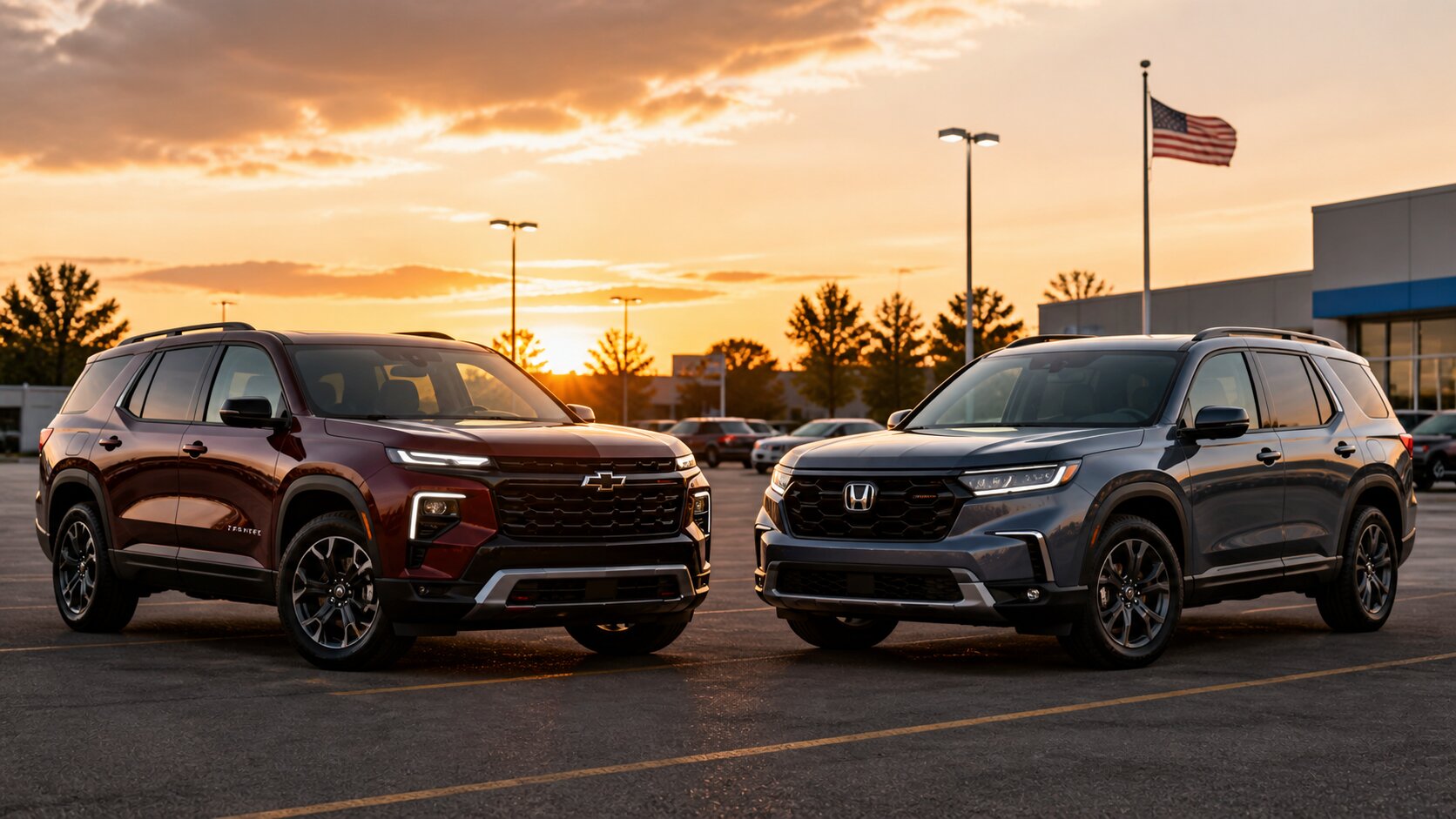
I’m Michael Turner, and I’ve spent most of my career bouncing between family haulers on Midwest roads that punish suspensions and expose flimsy interior trim. The 2026 Chevrolet Traverse and 2026 Honda Pilot land in the same practical universe three-row, mid-size crossovers built to swallow kids, gear, and the occasional Home Depot run. But they go about it with different personalities.
The Traverse is the extrovert: bigger-feeling, more screen-forward, and (in its current generation) clearly tuned to look and feel more “modern American family SUV.” The Pilot is the steady one: a little more traditional in its controls and demeanor, with Honda’s familiar V6 smoothness and an easygoing way of doing everything. If your week is a blur of school drop-offs, highway slogs, and weekend sports tournaments, either can work. Which one fits better depends on what you value when you’re the one behind the wheel and how often you’re towing, road-tripping, or playing Tetris with car seats.
First, the facts we can verify (and what’s still TBD)
Because we’re talking 2026 model-year vehicles, not every number you might want is locked in publicly at the time of writing especially fuel economy and final pricing for every trim. Where data isn’t confirmed or widely published yet, I’m going to say so plainly.
2026 Chevrolet Traverse (current-generation Traverse introduced for 2024): Chevrolet moved Traverse to a new turbocharged four-cylinder for this generation. The widely reported output for the new turbo 2.5-liter is 328 horsepower and 326 lb-ft of torque, paired with an 8-speed automatic. Front-wheel drive is available; all-wheel drive is offered. Chevrolet has stated a max tow rating of up to 5,000 pounds when properly equipped. EPA fuel economy varies by drivetrain/trim; for the newer Traverse generation it has been published for some configurations in prior model years, but final 2026 EPA figures may vary by trim and are not something I’m going to guess at here.
2026 Honda Pilot (current-generation Pilot introduced for 2023): Pilot sticks with a naturally aspirated 3.5-liter V6 making 285 horsepower, paired with a 10-speed automatic. Front-wheel drive is available; Honda’s i-VTM4 all-wheel drive is offered on many trims. When equipped appropriately, Pilot is rated to tow up to 5,000 pounds (AWD models; lower on some FWD configurations). EPA fuel economy depends on drivetrain/trim; I’m not treating any specific mpg number as “the” 2026 figure unless Honda/EPA has released it for that exact configuration.
Main competitors (same neighborhood): Toyota Grand Highlander (and regular Highlander), Kia Telluride, Hyundai Palisade, Ford Explorer, Mazda CX-90, Subaru Ascent, Jeep Grand Cherokee L, Volkswagen Atlas. If you’re cross-shopping seriously, Telluride/Palisade remain the value-and-features magnets; Grand Highlander is the space/efficiency wildcard; CX-90 is the driver’s-choice alternative.
Design: one looks like it packs a gym bag; the other brings a backpack
The Traverse wears its size with confidence. The current-generation styling leans squared-off and upright more truck-adjacent than older Traverses that tried to disappear in parking lots. In certain trims (especially the more rugged-looking ones), it reads like Chevy wanted a mini Tahoe vibe without actually giving you Tahoe running costs.
The Pilot’s shape is cleaner and more conservative. It’s still boxier than older Pilots Honda pushed it toward a more upright profile in this generation but it doesn’t shout about it. Park them side by side and the Traverse feels like it’s trying harder to be noticed; the Pilot feels like it’s trying harder to age well.
If you care about sightlines from the driver’s seat especially threading through tight school pickup lanes the Honda’s design philosophy tends to prioritize “I can see out” over “look at my grille.” The Chevy isn’t bad here, but its bolder exterior cues can translate into a slightly more imposing feel from behind the wheel.
Engines & transmissions: turbo torque vs V6 smoothness (and what you’ll actually feel)
This matchup is basically a personality test disguised as a spec sheet.
The Traverse’s turbocharged 2.5-liter four makes 328 hp and 326 lb-ft. On paper and typically in real life that torque number matters more than peak horsepower in daily driving. Turbo torque tends to show up earlier in the rev range than a naturally aspirated V6’s best work. Translation: when you roll into the throttle at 25–45 mph to merge or squirt through an opening in traffic on I-94, the Chevy should feel eager without needing a big downshift drama.
The Pilot’s 285-hp 3.5-liter V6 isn’t trying to win any bench-racing contests anymore. What it does well is predictability: linear response, familiar sound, and fewer moments where you feel a turbo spooling or a transmission scrambling to find the right gear. Paired with Honda’s 10-speed automatic, it generally has enough ratios to keep the engine in its comfort zone without feeling frantic.
If your week includes lots of short trips errands, daycare runs, stop-and-go the Traverse’s extra torque can make it feel lighter on its feet than you’d expect from a three-row family rig. The Pilot counters with that classic Honda “it just does what you ask” calibration that makes it easy to drive smoothly even when you’re distracted by back-seat negotiations over whose turn it is to pick the playlist.
Towing: both can hit 5,000 pounds how they get there matters
The headline is simple: properly equipped versions of both can tow up to 5,000 pounds. That number covers a lot of real family use small travel trailers, a pair of jet skis, or a modest boat.
The nuance lives in how they behave when loaded.
A turbo four like Chevy’s can feel stout when you’re climbing grades because torque arrives readily; it doesn’t need big rpm to pull. But turbos also tend to reveal themselves under sustained load: you may notice more audible effort when you’re asking for continuous power especially if you’re climbing long hills in summer heat with passengers and gear aboard.
The Pilot’s V6 tends to sound more “traditional” under load a steady growl that rises with rpm rather than the whoosh-and-hold character of many turbos. Some drivers find that more reassuring when towing because it feels mechanically straightforward: revs rise, speed holds. Either way, if towing is frequent (not once-a-year), pay attention not just to max tow rating but also payload limits and hitch/tow package availability numbers that vary by trim and equipment and should be checked on the door jamb sticker and official spec sheets for your exact build.
On the road: steering feel, ride quality, and that quietness you notice after hour two
This is where personalities sharpen.
Pilot: The Honda tends to major in calm competence. Steering usually has moderate weight enough that it doesn’t feel video-game light but not so much that parallel parking becomes an upper-body workout. Over broken pavement (hello, Michigan frost heaves), Pilots generally do a nice job rounding off sharp edges without turning floaty. There’s often a faint V6 hum when you lean on it more “background soundtrack” than intrusion and at highway speeds it settles into an easy rhythm.
Traverse: The Chevy feels like it wants to be perceived as more substantial and modern. The extra torque can make passing maneuvers feel effortless. Road isolation tends to be good for this class; still, tire choice and trim matter a lot here bigger wheels can look great but add thump over potholes. One thing I notice in newer GM crossovers is how they try to balance big-vehicle stability with lighter control effort; in day-to-day driving that often means steering that’s easy rather than chatty.
If your idea of “good steering” is actual feedback through your palms little hints about front tire grip the Honda usually gets closer. If your idea of “good steering” is simply low-effort accuracy while juggling coffee and navigation prompts, both will do fine, but Chevy often leans into effortless cruising as its core competency.
All-wheel drive: snow days don’t care about brand loyalty
Both offer AWD systems designed for family duty rather than rock crawling. For most people in metro Detroit or anywhere with real winter the question isn’t “can it off-road?” It’s “will this get me up my unplowed street without drama?” Either will if you run proper tires.
Honda’s i-VTM4 system (on AWD Pilots) has a strong reputation for smart torque distribution and confident behavior in slippery conditions. Chevy’s AWD setup varies by configuration; regardless of brand, remember that AWD helps you get moving but doesn’t magically help you stop on ice. If winter confidence matters most, budget for good all-season tires at minimum or dedicated winter tires if you live where lake-effect snow makes regular appearances.
Inside: where buttons meet big screens (and families meet crumbs)
The Traverse leans hard into modern GM interior themes: big screens, clean surfaces, an airy layout depending on trim. It feels designed around tech-first expectations like Chevy assumes your phone will be connected before your seatbelt clicks. When done right, it looks sharp at night too: crisp graphics, bright maps, clear camera views when you’re backing out past SUVs parked like they’ve never heard of center lines.
The Pilot takes a slightly more classic approach: functional layout, logical storage spots, controls that don’t require an owner’s manual to adjust basic climate settings mid-drive. There’s something quietly satisfying about physical controls when your kid spills something sticky and you don’t want to poke around glossy touch surfaces like you’re defusing a bomb.
Seating: Both offer three rows with multiple configurations depending on trim (bench vs captain’s chairs). Comfort comes down to cushion shape and driving position and here Honda typically nails “natural” ergonomics: pedals where you expect them, wheel where your shoulders relax instead of hunching up. Chevy tends to provide generous space up front too; its advantage often shows up in perceived roominess thanks to design choices like dash placement and window area.
Cargo & third row reality: These are family SUVs; they can fit adults in row three in a pinch but don’t pretend either turns into an airport shuttle van overnight. If third-row adults are frequent passengers (not occasional), bring them along for the test drive and have them climb back there themselves. The best spec sheet in the world won’t tell you whether their knees end up arguing with seatbacks after 20 minutes.
Tech & safety: what helps every day vs what shows off at night
This class lives or dies by daily usability tech: phone pairing that doesn’t drop out halfway through a call, cameras that make parking less stressful, driver assists that help without nagging.
Pilot: Honda Sensing driver-assist features are broadly available across trims (exact content can vary by model year/trim). In real use, Honda tends to tune lane-keeping and adaptive cruise control conservatively less herky-jerky than some systems when traffic compresses suddenly. That matters when your commute includes unpredictable merges around construction barrels.
Traverse: Chevy brings strong camera tech availability depending on trim/options useful because these vehicles are wide enough that tight garages become geometry problems. GM also offers its suite of driver assists broadly; availability varies by trim/packages so check what comes standard on your preferred model.
I’ll add one very human point: infotainment matters most when it doesn’t demand attention. If one system makes you take your eyes off Woodward Avenue longer than you’d like just to change audio sources or adjust seat heat levels that system loses points regardless of how pretty its home screen looks.
The weekly grind test: Monday commute vs Saturday road trip
Your Monday: You’re half-awake at 7:15 a.m., coffee in hand, backing out while negotiating who forgot their lunchbox again. This is where both shine simply by being easy family tools but they do it differently. The Pilot feels like an extension of routine: predictable throttle response from the V6/10-speed combo and controls laid out like someone actually drove it during development with gloves on in February.
The Traverse counters with effortlessness torque-rich acceleration that makes merging less dramatic and an interior vibe that feels fresh if your last SUV was from even five years ago. If your commute includes quick merges onto fast-moving highways (Detroit drivers aren’t exactly shy), having torque on tap can lower stress.
Your Saturday: This is where cabin packaging wins arguments before they start. Both will haul kids plus gear plus snacks plus something bulky someone insisted was essential. Practical details matter: how easily row two slides forward for third-row access; whether there are enough cupholders that nobody has to share; how intuitive it is to fold seats without pulling three different straps while holding a soccer bag in your teeth.
Fuel economy: important and not always fully published for every 2026 configuration yet
This is where I need to be careful and honest: EPA fuel economy figures depend heavily on drivetrain (FWD vs AWD), wheel/tire packages, and sometimes trim-specific calibration. For 2026 specifically, not every configuration may have final EPA numbers publicly posted at once early in the model year cycle.
Bigger picture trends still apply:
- A modern turbo four like Chevy’s can deliver decent efficiency when driven gently but real-world mpg often drops faster under heavy load or aggressive acceleration because boost isn’t free.
- A naturally aspirated V6 like Honda’s can be very consistent day-to-day; it may not have headline efficiency advantages against smaller turbo engines in every situation, but its behavior tends to be predictable across driving styles.
If mpg is high priority for your budget (or if gas prices spike again right as hockey season starts), check EPA ratings for your exact trim/drivetrain on fueleconomy.gov once posted and then assume real life will be slightly worse if your driving involves short trips or lots of idle time in pickup lines.
Pricing & trims: what we know and what still needs checking before signing papers
Pricing moves every year, and manufacturers also reshuffle standard equipment constantly sometimes quietly mid-year so I’m not going to toss out half-remembered numbers as if they’re gospel for 2026.
The safe guidance:
- Pilot typically spans from mainstream family trims up through TrailSport (more rugged styling/tires/suspension tuning) and Elite-style luxury-leaning models depending on year/market strategy.
- Traverse similarly ranges from value-oriented trims up through sportier or more off-road-styled variants depending on model year lineup.
Your best move is simple: decide which features are non-negotiable (AWD? captain’s chairs? panoramic roof? upgraded audio? built-in navigation?) and price those exact builds locally not just base MSRP headlines online. Three-row SUVs are discountable sometimes… until they aren’t.
Maintenance & reliability vibes: no crystal balls just realistic expectations
No responsible writer should promise long-term reliability outcomes for brand-new model years as if we’ve already watched them age for eight Michigan winters. What we can do is talk about risk factors and track record themes without pretending they’re guarantees.
Pilot ownership expectations: Honda has decades of experience building mass-market V6 family vehicles. A naturally aspirated V6 paired with a conventional automatic transmission is familiar territory for service departments nationwide and familiarity can translate into smoother ownership simply because fewer things surprise technicians over time. Routine maintenance costs are typically reasonable for this segment if you follow schedules and don’t skip fluid services.
Traverse ownership expectations: Chevy’s move to a turbo four brings modern performance benefits but adds complexity compared with older naturally aspirated setups more heat management demands and different long-term wear considerations (again: not predicting failure here). GM dealer coverage is broad; parts availability tends to be good given volume sales of mainstream Chevrolets.
Resale value: where Toyota usually smiles and where these two tend to land
If resale value sits near the top of your spreadsheet and I get it, because three-row SUVs aren’t cheap anymore the broader market pattern has been consistent: Japanese brands often hold value strongly in mainstream segments due to reputation and demand dynamics. Within this pair specifically, Pilot historically tends to have solid resale strength.
The Traverse can still hold up fine depending on incentives at purchase time (big discounts now can mean softer resale later), regional demand for large crossovers, and how desirable certain trims become used (rugged-looking packages often help).
If resale matters deeply:
- Avoid oddball configurations no one wants used (strange colors or unpopular options).
- If you finance long-term or drive high miles quickly, lean toward models with stronger historical residuals and compare lease residuals if available as another market signal.
The human recommendation: which one matches your week?
You’ll click with the 2026 Chevrolet Traverse if…
- You like effortless torque in everyday traffic the kind that makes merging feel like less of an event.
- You want an interior experience that feels very current-tech-forward without apologizing for being big.
- Your life involves frequent highway miles with passengers aboard and you appreciate that planted big-SUV vibe.
You’ll click with the 2026 Honda Pilot if…
- You value predictable responses over punchy power delivery the V6/10-speed combo behaves like an old friend.
- You prefer straightforward ergonomics controls that fall naturally underhand even when life gets chaotic inside the cabin.
- You’re thinking about ownership arc as much as first impressions: resale strength tends to favor this kind of vehicle long-term (though nothing is guaranteed).
A final note from one Detroit driveway to yours
If I had one piece of advice after years of testing three-row crossovers and after watching friends buy them based purely on horsepower or screen size it’d be this: bring your real life into the test drive. Install your car seat(s). Fold row two and climb into row three yourself. Load your stroller or hockey bag into the cargo area. Then take both over rough pavement at 35 mph where suspensions reveal their truth with a dull thump or a well-damped shrug.
The Traverse brings modern muscle-car torque energy into family duty without being obnoxious about it. The Pilot brings calm competence the kind you appreciate most when weeknight traffic turns ugly and everyone onboard wants something at once. Pick the one whose personality matches yours… because these things become part of your routine faster than any spec sheet suggests.
0 comments
Join the discussion around this article.
Please login to comment.