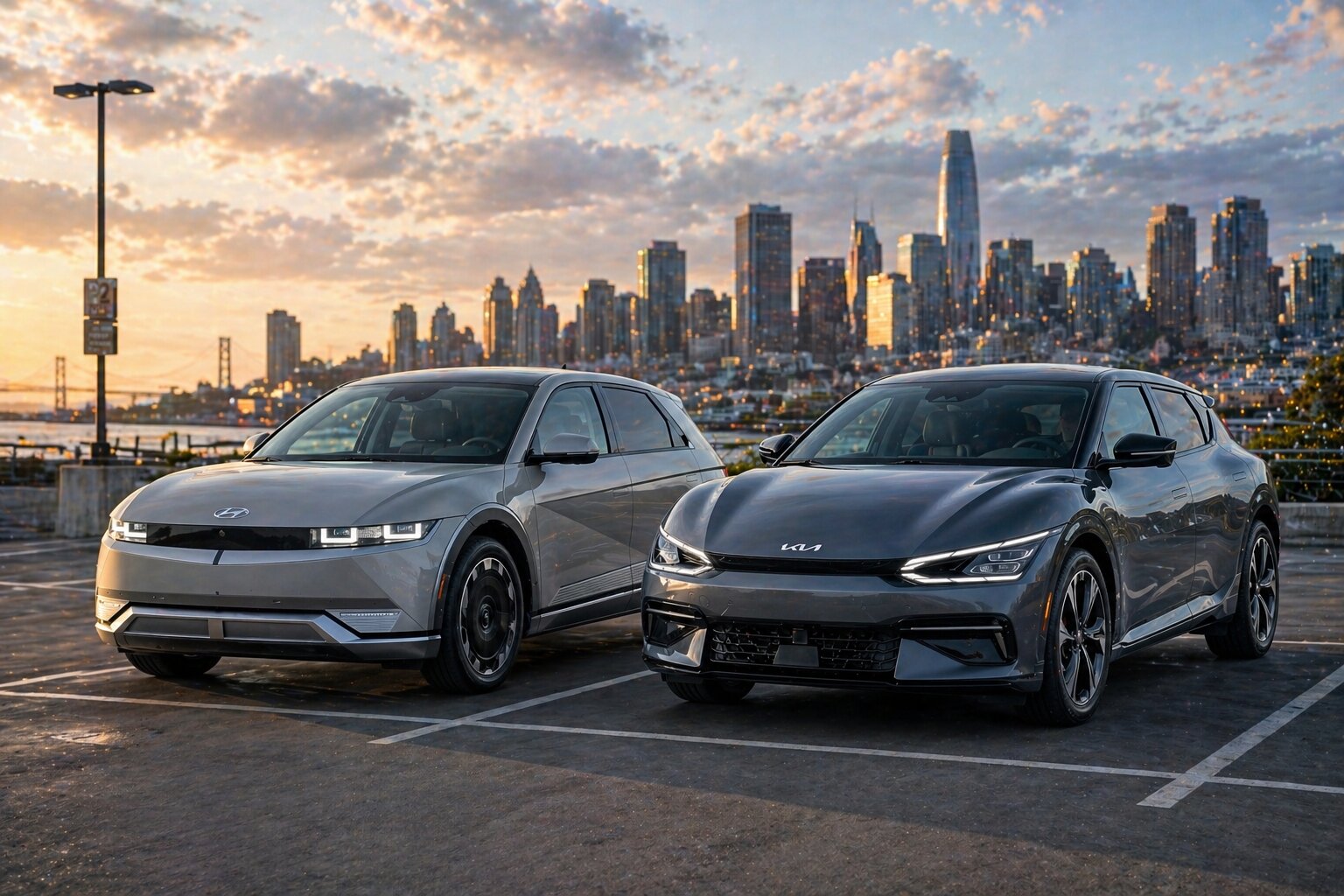
Same bones, different vibe
Hyundai’s Ioniq 5 and Kia’s EV6 are the kind of siblings you’d never confuse at a party. They share the same underlying architecture Hyundai Motor Group’s E-GMP electric platform and in many trims they even share the same battery sizes and charging tech. But spend a day in each, especially on real Bay Area roads where freeway expansion joints meet steep city grades, and the personalities diverge in ways that matter.
I’m Samantha Reed, based in San Francisco, and I spend most weeks bouncing between EV press cars, public fast chargers, and the same familiar loop of US-101, I-280, and the stop-and-go chaos around Market Street. The Ioniq 5 and EV6 both make a strong case for mainstream EV life in the U.S. not as science projects, but as actual daily drivers. Still, they don’t deliver that experience in the same way.
Quick context check before we get into impressions: both vehicles are sold in multiple trims and model years with differing outputs and ranges. Specs below reflect widely published U.S.-market figures for common configurations (especially 2022–2024 model-year vehicles), but exact numbers vary by trim (RWD vs AWD), wheel size, and whether you’re looking at performance variants like the Ioniq 5 N or EV6 GT.
The shared tech that quietly defines both: E-GMP and 800-volt charging
Underneath the styling and brand identity is E-GMP, Hyundai Motor Group’s dedicated EV platform. The big headline is its high-voltage charging capability commonly described as an “800-volt” class system paired with fast DC charging when you can find a charger that can actually deliver it.
In plain English: on a capable DC fast charger (think 350 kW-class stations), both the Ioniq 5 and EV6 are known for very quick peak charging compared with many mainstream EVs. Hyundai and Kia have both advertised very short 10–80% DC fast-charge windows under ideal conditions. Real life is messier charger sharing, station derates, temperature, battery preconditioning behavior, and even how full the site is all change the outcome but these two tend to be “good citizens” on road trips when the infrastructure cooperates.
Both also offer available vehicle-to-load (V2L) capability in many trims basically an onboard way to power small appliances or gear. It’s not a replacement for a home generator, but it’s genuinely useful for camping, tailgates, or keeping devices alive during outages. Availability can depend on trim and accessories; check the window sticker because not every version includes the same hardware.
Powertrains: similar ingredients, different seasoning
Most shoppers cross-shopping these two end up choosing between two familiar layouts: single-motor rear-wheel drive (RWD) or dual-motor all-wheel drive (AWD). Both brands have offered two main battery sizes in the U.S.: a smaller pack (often referred to as “Standard Range”) and a larger pack (“Long Range”). The larger pack is commonly listed at about 77.4 kWh gross capacity for many model years; the smaller pack has been around the upper-50 kWh range depending on year/trim. Exact usable capacity isn’t always published in consumer-facing materials, so I stick to what’s broadly stated by the manufacturers.
On output: in mainstream trims (not the GT or N), these cars typically land in a familiar neighborhood roughly 168 hp for some standard-range RWD versions; around 225 hp for long-range RWD; and about 320 hp combined for long-range AWD versions. Torque figures vary by configuration and are often quoted differently depending on source formatting; what matters behind the wheel is this: both deliver that immediate EV shove from low speeds, with AWD versions feeling properly quick merging onto I-80 even when traffic is doing that aggressive Bay Area accordion thing.
If you’re shopping halo variants, they split hard on intent. Kia’s EV6 GT is the factory hot rod of this pair, widely published at 576 hp in U.S. spec. Hyundai answered with the Ioniq 5 N (a separate model with track-focused hardware), published at up to 641 hp with N Grin Boost engaged. Those aren’t apples-to-apples with regular trims and they’re not priced like them either but they prove how much headroom E-GMP has when tuned for violence instead of efficiency.
Towing: yes… but keep expectations realistic
Towing is one of those topics where EV marketing meets physics fast. In the U.S., towing ratings vary by configuration and model year, but widely cited figures put both Ioniq 5 and EV6 at up to around 2,300 pounds when properly equipped in certain versions. Some trims may be rated lower or not rated at all depending on equipment and certification details.
Even when rated to tow, range takes a hit with a trailer behind you. That’s not unique to these two; it’s true across EVs (and honestly gas cars too). If towing is central to your lifestyle boats every weekend, long-distance towing through elevation changes you’ll want to plan charging stops more carefully than you would with an unladen commute car.
Efficiency and range: EPA numbers matter and wheel choice really matters
Neither car gets “mpg,” technically they’re rated in MPGe by the EPA (miles per gallon equivalent). EPA efficiency varies by trim and wheels; larger wheels tend to reduce range.
On range: both have been offered with EPA estimates that generally span from the mid-200-mile range to just over 300 miles depending on configuration. A commonly cited benchmark is that certain Ioniq 5 RWD long-range trims have reached up to about 303 miles EPA-estimated range in some model years. The EV6 has also posted strong numbers often just under or around the 300-mile mark in efficient configurations with AWD versions generally lower than RWD.
I’m being intentionally careful here because “Ioniq 5” isn’t one number any more than “F-150” is one number. If you’re comparing two specific window stickers on a dealer lot say an AWD on 20-inch wheels vs a RWD on smaller wheels the difference isn’t academic. It changes how often you’ll think about charging during a normal week.
In my day-to-day driving around San Francisco and down toward San Jose, both feel efficient enough that you can stop thinking about energy use most of the time until you do something very Bay Area like blast up Highway 17 behind an impatient pickup or run climate control hard on a foggy night while crawling through traffic. Then you remember: yes, it’s still energy coming from somewhere.
First impressions: one looks like a concept car, the other looks like it wants to race
The Hyundai Ioniq 5 still has that pixelated-retro-future look that makes people ask questions at chargers. It reads wide and squared-off in photos, but in person it feels like a modern hatchback stretched into crossover proportions clean surfaces, sharp creases, tidy lighting signatures.
The Kia EV6 goes for sleek and athletic instead: lower roofline vibe, more visual motion front-to-back, more “sporty crossover” than “design object.” Park them nose-to-nose and you can feel how each brand interpreted the same platform brief differently Hyundai leaning architectural; Kia leaning kinetic.
Seating position & visibility: where your eyes land changes everything
This is where the personalities become practical.
The Ioniq 5 gives you a more upright seating position with an airy cabin feel. The dash sits low enough that forward visibility feels natural in city traffic useful when you’re scanning for cyclists slicing between lanes or trying to judge whether that yellow light is going to turn red halfway through your left turn.
The EV6 sits lower and feels more cockpit-like from behind the wheel. It’s not sports-car low, but compared with the Ioniq 5 it puts your hips closer to the floor and wraps more console around you. The trade-off is that outward visibility can feel slightly more constrained by design choices like roofline and rear glass shape still fine day-to-day, just different. If you prefer feeling “in” a car rather than “on” it, Kia’s approach makes sense.
The feeling of dimensions: roomy box vs sleek wedge
E-GMP gives both cars generous wheelbases relative to overall length, which pays off inside. But they present space differently.
The Ioniq 5 has this lounge-like vibe up front open floor feel (especially in versions without an aggressive center tunnel), broad dash layout, big windows. Even if actual measured headroom/legroom ends up close depending on spec sheets you read, subjectively it feels bigger because of sightlines and shapes.
The EV6 uses its space more like a modern sport hatch: still roomy where it counts, but visually tighter. The sloping roofline contributes to that sensation even if rear-seat comfort remains adult-friendly in most cases.
Steering feel & road behavior: calm confidence vs eager turn-in
If you care about steering feel even casually you’ll notice differences within five minutes.
The Ioniq 5 tends to steer with a calmness that fits its design language. The wheel effort builds predictably; it doesn’t beg you to attack corners. On broken pavement (hello, San Francisco patchwork asphalt), it often feels composed rather than jittery. There’s still plenty of grip available in AWD trims with good tires, but its default mood is relaxed competence.
The EV6 feels like it wants to play more. Steering response comes across quicker off-center; it feels more eager to rotate into freeway cloverleaf ramps or quick lane changes on US-101. It’s not that one is objectively better it’s about what kind of feedback makes you comfortable. After an hour in traffic followed by a fast merge onto I-280, I found myself appreciating Kia’s willingness to respond immediately without needing extra steering input.
Suspension tuning: who smooths out real roads better?
This part depends heavily on trim level and wheel size (and tire choice), so any universal statement needs an asterisk.
Generally speaking, the Ioniq 5 often comes across as slightly more comfort-oriented in everyday driving especially over choppy urban pavement where repeated small impacts can make some EVs feel busy due to their weight. The best moments are when it glides over mild ripples without sending secondary motions through your seatback.
The EV6 tends to feel firmer and more tied down at speed. On smoother highway sections that can read as stability; on rougher city streets it can translate into sharper impacts depending on wheels/tires. If your commute includes lots of pothole dodging or steep driveway angles (SF residents know), pay attention during your test drive not just to ride comfort but also how quietly each suspension deals with sharp edges.
Noise levels: wind vs tire vs drivetrain hum
Both are quiet by normal-car standards because there’s no engine noise layering over everything else but quiet isn’t one thing.
At city speeds you mostly hear HVAC fans ramping gently or the faint electric whir when you roll into throttle from a stoplight. On highways, tire noise becomes dominant quickly depending on pavement type; certain concrete surfaces will make either car sound louder than you’d expect from inside an EV bubble.
I’ve found both competent for long stints at speed, though perceived quiet can vary by trim (and especially tire selection). If cabin hush is high priority for you Zoom calls parked at Ocean Beach counts as real life now test drive them on the exact freeway surfaces you use most often.
Inside the cabin: where buttons meet big screens
Hyundai and Kia share some infotainment DNA across their lineups, but execution differs here too.
The Ioniq 5’s interior design leans minimalist-modern: dual screens set into a clean horizontal layout with physical controls still present for key functions. There’s something satisfying about having real buttons/knobs for common tasks volume adjustments and climate tweaks shouldn’t require menu-diving while someone cuts you off near Daly City.
The EV6 interior feels sportier and slightly more dramatic from the driver’s seat more wraparound shapes, more visual separation between driver space and passenger space. Kia also integrates physical controls cleverly but sometimes asks you to adapt to multi-function panels depending on configuration (a design approach Kia has used elsewhere). It looks slick; occasionally it adds one extra beat of thought when all you want is to change temperature without taking your eyes off traffic.
Both support Apple CarPlay and Android Auto in many model years/trims (availability can vary by update cycles). If wireless connectivity matters specifically, verify on the exact vehicle year/trim because automaker implementations evolve over time.
Cargo & daily usability: grocery runs count
This is where body shape shows up as lifestyle math.
The Ioniq 5’s hatch opening and squarer rear profile make it feel easygoing for bulky items strollers, boxes from IKEA in Emeryville, awkward camera gear cases that never stack neatly. The load floor height is manageable; visibility out back is decent for parking lots when paired with cameras/sensors (which most trims include).
The EV6 still does practical hatchback things well it’s absolutely viable as your only car but its sleeker shape can change how tall items fit under the rear glass line. If your life involves tall plants from nurseries or frequent Costco runs where impulse purchases become furniture-sized problems, bring those mental scenarios into your test drive day.
Both offer front trunks (“frunks”) of varying size depending largely on drivetrain packaging (RWD often has more space than AWD). Don’t expect Rivian-level frunk utility here; think of it as bonus storage for charging cables or small bags rather than your primary cargo solution.
Charging in real life: speed is great… availability is everything
This platform’s fast-charging ability matters most if your routine includes road trips beyond home charging range or if you live without reliable home charging (still common in parts of SF with older garages or street parking).
In ideal conditions at powerful DC fast chargers, these cars are known for strong charging performance relative to many competitors using ~400-volt architectures. But “ideal conditions” do heavy lifting as a phrase. You need:
- A station that can actually deliver high power consistently
- A battery warm enough (or properly preconditioned) to accept fast charge
- A stall that isn’t sharing power aggressively
- A plan B if your first stop is down or crowded
I’ve had sessions where an E-GMP car feels like cheating in a good way because your coffee isn’t even cool yet before you’ve added meaningful range. And I’ve had sessions where infrastructure bottlenecks erase any advantage because every stall is occupied by ride-share drivers or someone charging past 90% while watching Netflix in their seat reclined flat-ish (respectfully: please don’t).
Competitors worth mentioning (because shoppers don’t cross-shop in pairs)
If you’re considering an Ioniq 5 or EV6 in the U.S., odds are high these were also on your list:
Tesla Model Y: Still defines expectations around Supercharger access and software simplicity for many buyers; ride comfort/build consistency debates continue depending on who you ask.
(Note: Tesla has been opening Supercharger access more broadly via NACS adoption across brands; timing depends on model year/adapters/network agreements.)
Ford Mustang Mach-E: Strong driving manners and brand recognition; DC fast-charging curve/peak rates differ by version compared with E-GMP strengths.
Volkswagen ID.4: Practical packaging; charging performance varies by model year/software updates.
Nissan Ariya: Comfort-focused alternative; generally not positioned as an ultra-fast-charging leader compared with E-GMP.
Chevrolet Equinox EV / Blazer EV: Newer entries shifting price expectations downward/upward depending on trim; availability varies regionally.
Toyota bZ4X / Subaru Solterra: More conservative approach overall; DC fast-charging reputation has been mixed versus class leaders.
Price reality: MSRP vs what people actually pay
MSRP varies widely by trim level and incentives fluctuate constantly based on region, inventory levels, lease programs, and eligibility rules around federal/state incentives. Because pricing changes faster than most spec sheets get updated (and because dealer markups/discounting have swung wildly since launch), I’m not going to pin this article to exact transaction prices that could be wrong next month.
What is fair to say: both models have historically occupied similar pricing territory when comparing equivalent trims (RWD-to-RWD or AWD-to-AWD). Performance variants like EV6 GT and Ioniq 5 N step into much higher pricing brackets relative to mainstream trims due to hardware upgrades and positioning.
If value per dollar is your main filter right now and for most people it is I strongly recommend comparing lease offers side-by-side. In recent years some EVs have seen especially aggressive lease support even when purchase incentives were complicated by sourcing rules. That reality can flip which one looks “cheaper” overnight.
Maintenance & durability expectations: simpler than gas… but not zero
Day-to-day maintenance should be lighter than an internal-combustion crossover because there are fewer fluids and no oil changes. You’re still looking at tires (EV torque eats rubber if you drive like me merging onto freeways), brake fluid checks over time, cabin air filters, coolant loops specific to battery/drive components per manufacturer schedules, plus normal wear items like wiper blades.
The bigger ownership question tends not to be maintenance cost it’s long-term software support experience and how painless warranty work feels if something goes wrong with sensors or charging components. Hyundai and Kia warranty coverage has traditionally been competitive in the U.S., but details vary by year/model/region; verify current warranty terms directly from Hyundai/Kia because they can change over time.
Resale value: still evolving as EV adoption matures
If there’s one area where I refuse to pretend certainty exists forever, it’s resale value for modern EVs during rapid tech change. Residual values depend heavily on broader market forces: new-EV price cuts across brands, interest rates affecting monthly payments, incentive changes, battery health perceptions among used buyers, plus charging standard transitions (CCS vs NACS) that influence shopper confidence even if adapters exist.
Tesla historically set resale expectations simply by selling huge volume and then also disrupted them via price adjustments. For Hyundai/Kia E-GMP models specifically, resale will likely track how buyers perceive long-term software support/charging compatibility alongside general brand strength in used markets.
If resale anxiety keeps you up at night: leasing can be a rational hedge right now because it outsources residual risk but again this depends entirely on lease terms offered at purchase time.
So which personality fits your life?
p>Ioniq 5 feels like the chill futurist: airy cabin vibe, relaxed road manners (in many trims), excellent everyday usability if your routine involves passengers or bulky cargo often. p>EV6 feels like the athlete: lower seating position impressionally sportier response off-center steering-wise; sleeker profile; still practical but less “living room on wheels.”
I keep coming back to this after swapping between them: they’re proof that platform-sharing doesn’t have to mean sameness. Same electrical backbone. Same general charging advantage story when infrastructure behaves itself. Yet one encourages calm cruising down Skyline Boulevard while thinking about regen settings; the other makes you take an extra glance at an empty ramp just because it turns nicely.
If you can test drive only one thing before deciding? Drive them back-to-back over your worst road surface at your normal speed and spend five minutes adjusting climate controls while moving slowly through traffic. That combination tells you more truth than any spec sheet ever will.
0 comments
Join the discussion around this article.
Please login to comment.