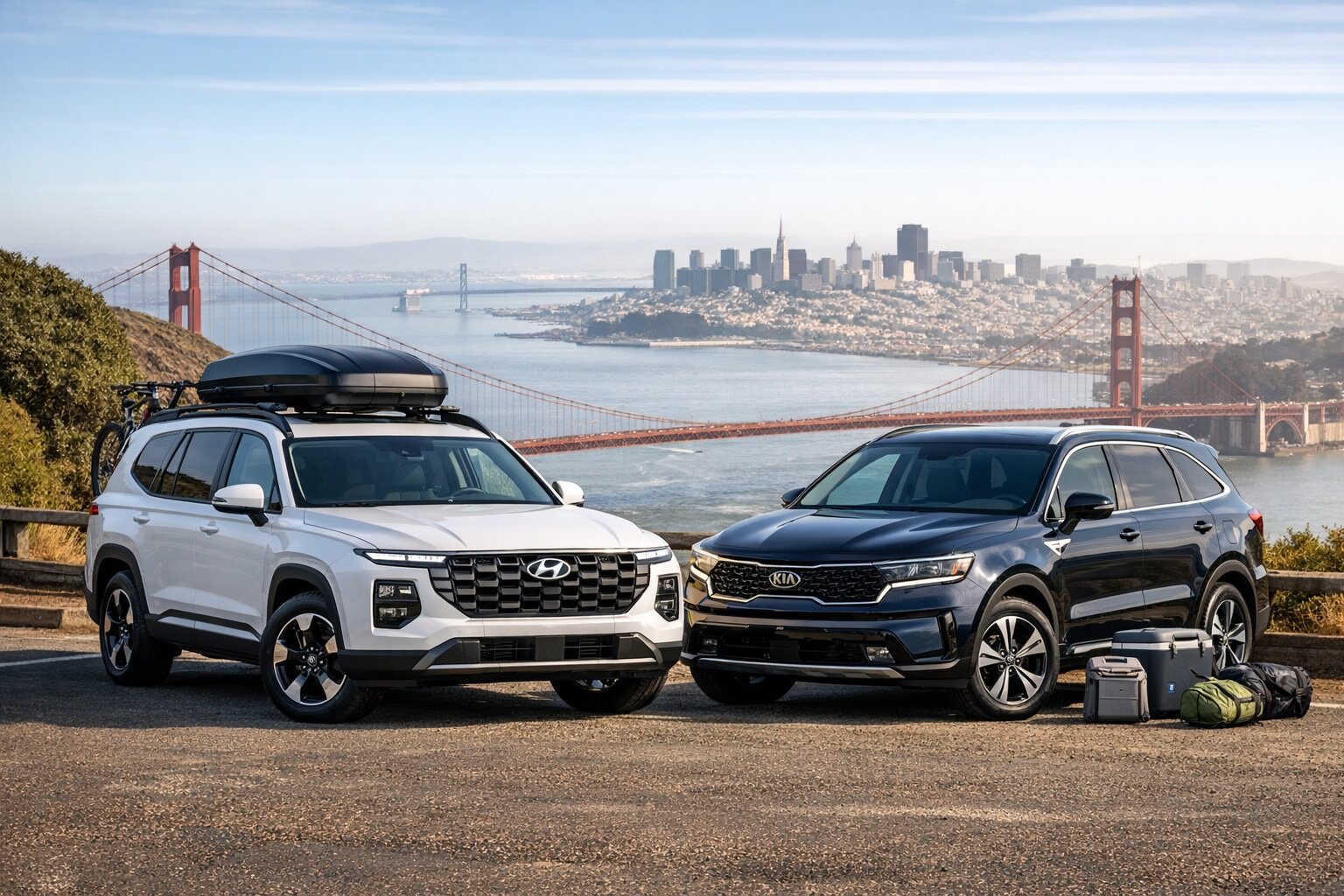
Hyundai Santa Fe vs Kia Sorento: same family mission, totally different vibes
I live in San Francisco, where a “family SUV” might spend one day creeping through school pickup lines in the Sunset and the next day grinding up 17 toward Santa Cruz with a roof box humming in the wind. In that kind of real life, the Hyundai Santa Fe and Kia Sorento look like they’re doing the same job: both are mainstream, mid-size crossovers with available three-row seating, available all-wheel drive, and a very similar “we need space but we still want something easy to park” footprint.
But they don’t feel interchangeable. The Santa Fe (especially the latest-generation model) leans hard into boxy, practical design and a lounge-like cabin mood. The Sorento plays it more traditional sleeker outside, a bit more “driver’s seat first” inside and it has historically offered a broader spread of powertrains, including hybrids and plug-in hybrids (PHEVs) that matter a lot if you’re trying to cut gas use without going full EV.
Quick note on scope and fact-checking: specs and availability vary by model year and trim. The most widely referenced, verified numbers below focus on current-generation vehicles sold in the U.S. market in recent model years. Where figures depend heavily on configuration or where up-to-the-minute EPA ratings for a specific refresh aren’t consistently published I’ll call that out directly rather than guessing.
The lineup reality check (and why year matters here)
Hyundai Santa Fe has been redesigned recently, shifting from rounded crossover to upright, squared-off family hauler. In the U.S., Santa Fe has offered gasoline engines plus hybrid options depending on year/trim. A plug-in hybrid Santa Fe has existed in other markets, but it hasn’t been a consistent U.S. staple the way Sorento PHEV has been.
Kia Sorento has kept a more familiar mid-size crossover shape and crucially for tech-forward shoppers has long offered multiple electrified choices in the U.S.: a conventional hybrid and a plug-in hybrid alongside gas-only models.
If you’re shopping used or cross-shopping leftover inventory, you’ll see different engine menus depending on year. That’s not trivia; it changes towing, fuel economy, and even how the vehicle feels in stop-and-go traffic.
Powertrains: what you feel merging onto I‑280 matters more than the brochure
In broad strokes, both families offer four-cylinder power, optional turbocharging, and available all-wheel drive. But their personalities diverge once you’re actually rolling.
Sorento gas models have commonly been offered with a 2.5-liter naturally aspirated four-cylinder (widely listed at 191 hp) or an available turbocharged 2.5-liter (commonly listed at 281 hp). That 281-hp turbo setup is the one you notice when you’re trying to dart into a tight Bay Area on-ramp gap: it feels more eager in the midrange, and it tends to deliver that “okay, we’re moving” shove without needing to wring it out.
Sorento Hybrid is widely published with a turbo 1.6-liter hybrid system making 227 hp. The Sorento Plug-in Hybrid is commonly listed at 261 hp. Those numbers don’t tell the whole story; what you feel is electric torque smoothing out low-speed driving. In school-zone crawling or parking-lot loops, the hybrid versions often feel calmer less transmission hunting, less rev flare because the electric motor can handle little surges without waking up the engine as aggressively.
Santa Fe powertrains depend heavily on model year. Recent U.S.-market Santa Fe generations have offered turbocharged four-cylinders and hybrids. Hyundai has also used dual-clutch transmissions on some turbo applications in prior years; those can feel crisp when you’re on throttle but sometimes less silky at low speeds than a traditional automatic especially when you’re inching forward behind a delivery truck.
If your daily routine includes lots of short trips where engines rarely warm up (hello, city life), hybrids tend to feel like they’re working with you rather than against you. If your routine includes long freeway hauls with a loaded cabin, the stronger turbo gas options can feel less strained at 70–80 mph grades.
Towing: boats, small campers, and that one friend who always needs help moving
Towing is one of those “you either care deeply or not at all” categories until you do. For verified baseline capability:
Kia Sorento is widely rated up to 3,500 lb when properly equipped on certain gas models (typically with the turbo engine). Hybrid variants are commonly rated lower; many listings show 2,000 lb for Sorento Hybrid/PHEV configurations, depending on year and equipment.
Hyundai Santa Fe towing capacity varies by engine and year as well; recent non-hybrid configurations have commonly been rated up to 3,500 lb when properly equipped. Hybrid versions are typically lower (often around 2,000 lb, depending on configuration). Because Santa Fe has gone through major changes recently, I’d treat towing as a “check the exact window sticker / owner’s manual” item rather than trusting generic internet summaries.
What that means in real life: either can handle a small utility trailer or a couple of jet skis with confidence when properly set up. If you’re eyeing a heavier travel trailer, these aren’t Tahoe/Suburban replacements and you’ll feel it in wheelbase stability and payload limits even before you hit the official tow rating ceiling.
Fuel economy: hybrids make sense here especially if you’re EV-curious but not ready
I’m an EV-and-tech person by beat and by bias; I watch charging infrastructure expand while also watching families realize that not everyone wants to plan road trips around charging stops yet. That’s why these two matter: they’re an on-ramp to electrification without demanding lifestyle changes.
Sorento Hybrid EPA ratings are widely published around 37 mpg combined (FWD; AWD can vary). Sorento Plug-in Hybrid has an EPA-rated electric range that’s widely listed around 32 miles, with combined MPGe figures published by EPA depending on year/trim. Those are established headline numbers people cross-shop against RAV4 Prime-style thinking: “Can I do most weekdays on electricity?” For many households with short commutes or lots of errands clustered within 10–15 miles of home, yes if you plug in consistently.
Santa Fe Hybrid EPA combined mpg figures vary by year; commonly published numbers for recent Santa Fe Hybrids land in the mid-30s combined (configuration dependent). Because Santa Fe has undergone significant updates recently and because trim/drivetrain choices swing ratings I’m not going to pin one single mpg number here as universal. Treat it as: Santa Fe Hybrid is competitive with mainstream two-row/three-row hybrid crossovers; verify exact EPA ratings for the trim you’re buying.
The practical takeaway: if your daily routine is school drop-off + commute + groceries + practice across town, hybrids reduce those “why am I burning gas just to move two miles?” moments. A PHEV goes further by turning those short loops into mostly-electric driving quiet starts in the morning, less engine noise pulling away from curbs assuming you have reliable home charging (even basic Level 1 overnight can cover many PHEV miles).
The school-run scene: steering feel, visibility, and low-speed behavior
This is where differences get weirdly emotional. The school run isn’t about lap times; it’s about stress levels.
Sorento tends to feel slightly more conventional from behind the wheel steering that builds weight predictably as speed rises, suspension tuning that aims for control without being harsh. In tight neighborhood turns and double-parked chaos, it generally behaves like a well-sorted modern crossover: light enough effort to one-hand into a curb spot while holding coffee (not recommended), but not so numb that it feels disconnected.
Santa Fe, especially in its newer boxier form factor, prioritizes visibility and “big windows / big shapes” confidence. That upright stance can make it easier to place in traffic because you sense the corners better. The tradeoff is that some drivers will perceive more body movement over uneven city pavement those little diagonal dips at intersections depending on wheel/tire choice and trim tuning.
If your day includes lots of stop-and-go creeping, pay attention to transmission behavior during test drives. Some turbo/DCT combinations (in various Hyundai/Kia products over recent years) can feel quick when accelerating but slightly hesitant during gentle roll-ons from near-stop. It’s not always an issue but when it is, it’s exactly the kind of low-speed annoyance that becomes part of your daily routine.
The weekend trip test: highway calm, seat comfort, and noise you’ll notice after two hours
The Bay Area has this specific kind of highway soundtrack: coarse concrete sections where tire roar rises like white noise. On longer drives say SF to Tahoe the difference between “fine” seats and truly supportive seats becomes obvious somewhere around hour two.
Sorento generally strikes me as composed at speed. It doesn’t try to be sporty; it just feels stable enough that passengers can nap without head toss. With stronger turbo powertrains available on some trims (281 hp), passing slower traffic on two-lane stretches can be less stressful because you don’t need as much runway.
Santa Fe leans into comfort-first vibes more lounge-like depending on trim and its newer design language suggests Hyundai wants this to feel like a modern family living room with USB ports rather than just “a car with three rows.” On long highway runs, what matters is how well road noise is managed and how naturally your hands fall onto controls without hunting through menus.
I won’t claim decibel readings here because they vary by test outlet and trim and I’m not going to invent numbers but subjectively these are both quieter than older body-on-frame SUVs at freeway speeds (think Silverado/Tahoe-era loudness), while still not reaching luxury-brand hush unless you step up price brackets significantly.
The third row reality: adults for 30 minutes?
This is where marketing photos lie politely.
Kia Sorento’s third row exists and it’s genuinely useful for kids or shorter adults for shorter stints but it’s still a compact third row compared with larger three-row SUVs (Telluride/Palisade class). If you regularly carry adults back there for 30 minutes or more, expect knees-up posture unless your second-row occupants slide forward generously.
Hyundai Santa Fe’s third-row availability depends on generation/trim strategy; historically Santa Fe has straddled two-row vs three-row identity across years and markets. In recent U.S.-market context it’s positioned as a three-row option again in its latest form. The honest advice: physically sit back there before you buy based solely on “three rows” being listed online.
The bigger usability point isn’t just legroom it’s access. How far does the second row slide? Can someone climb back without gymnastics? Are there grab handles placed where tired kids can actually use them? Those details decide whether your third row becomes part of daily life or stays folded down forever like an emergency spare tire you never touch.
Stroller + suitcases math: cargo space and how easy it is to use it
You don’t load cargo volumes you load objects. A stroller that refuses to fold flat. A weekender bag plus two rolling carry-ons plus a Costco pack of paper towels because why not.
Sorento, with its three-row packaging baked in for years now, tends to offer predictable cargo flexibility: third row folds down easily for day-to-day hauling; second row gives you options when you need long items like flat-pack furniture. The key is how flat things fold and whether there’s an annoying load floor step that makes sliding heavy bins awkward.
Santa Fe’s newer boxier shape suggests an emphasis on usable space more squared-off cargo area geometry tends to waste less volume behind curved glass. Even if official cubic-foot numbers differ by year/trim (and they do), square shapes usually translate into easier packing in real life: fewer odd gaps where nothing fits except air.
If you do frequent airport runs or weekend gear hauls (camp chairs + cooler + kid bikes), bring your actual stroller or suitcase set to the dealership if they’ll let you. It sounds extra until you realize how often families buy based on dimensions instead of lived reality.
Inside the cabin: where buttons meet big screens (and patience)
This is my tech-journalist home turf and also where I get mildly annoyed when automakers overdo touch controls for basic stuff like fan speed.
Kia’s infotainment approach in recent years has generally been strong: crisp graphics, logical menus once you learn them, and good smartphone integration via Apple CarPlay/Android Auto depending on trim/year (wireless availability varies). Kia also tends to do decent driver-assistance UI clear lane markers on-screen, sensible alerts not perfect but rarely baffling.
Hyundai’s cabin tech philosophy often mirrors Kia’s because they share corporate DNA but Hyundai sometimes swings harder into minimalist surfaces paired with big screens depending on generation/trim. When done well, it feels modern and airy; when done poorly (again: depends heavily on specific model year), it can mean more tapping through menus for simple tasks.
The small stuff matters daily: Are there rear-seat USB ports placed where cables don’t get kicked? Are there physical buttons for defrost? Does the climate control respond immediately or does it lag like an old iPad? Those are tiny friction points that become huge over three years of ownership.
Screens aside: driver assistance that actually reduces fatigue
Both Hyundai and Kia have built reputations for offering robust safety tech at mainstream prices: adaptive cruise control availability across trims (varies), lane-keeping assistance features (varies), blind-spot monitoring options (varies), and driver-attention alerts that sometimes nag but do keep people honest during long drives.
The real-world difference often comes down to tuning rather than feature lists:
Smoother adaptive cruise behavior feels less exhausting in traffic because it doesn’t brake late or surge awkwardly.
A calmer lane-centering system reduces steering corrections so passengers don’t get motion-sick from micro-wiggles.
A clear warning chime strategy matters when kids are asleep you want alerts that inform without startling everyone awake.
I’m keeping this general because calibration shifts by model year software updates and because I’m not going to pretend every trim behaves identically but both brands typically score well in this price class for offering these systems widely rather than hiding them behind luxury packages only.
If you’re EV-minded: why Sorento PHEV is still a big deal in 2026 shopping conversations
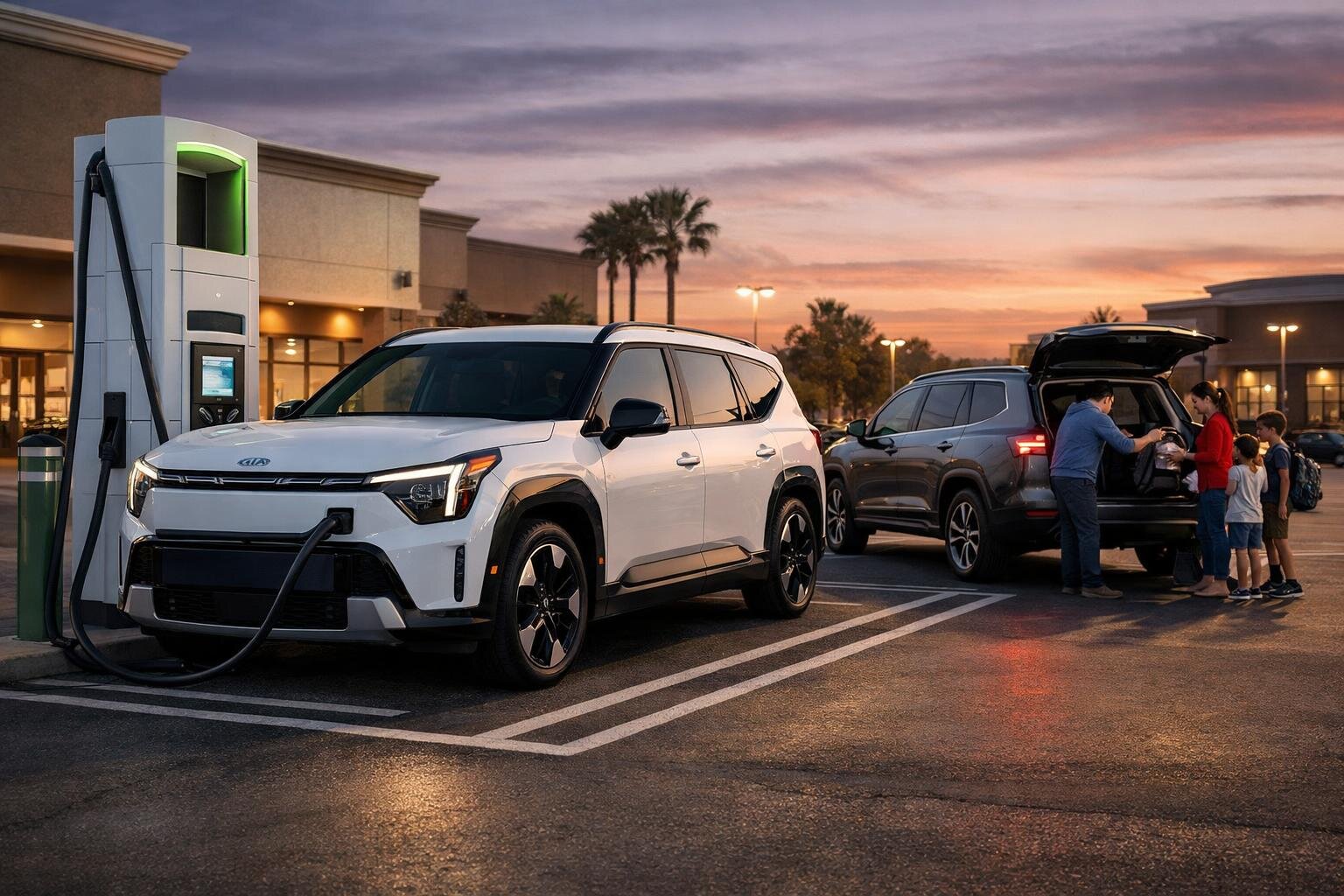
I spend most weeks thinking about charging networks and battery supply chains and I still understand why many families aren’t ready for full BEV life yet (especially renters without dedicated parking). That’s exactly where Sorento Plug-in Hybrid has carved out real relevance in the U.S.: it offers meaningful electric-only commuting capability without asking you to plan DC fast charging stops on road trips like an EV would.
The widely cited ~32 miles of EPA electric range means plenty of households can do weekday errands mostly electric if they plug in nightly. It won’t match a dedicated EV’s smoothness at highway speed under hard acceleration but around town it delivers that quiet initial roll-out EV people get hooked on fast.
The Santa Fe Hybrid can still be a smart sustainability step if charging isn’t realistic for your living situation; hybrids reduce fuel consumption without changing habits much at all. But if your goal is “I want my kid drop-offs to be electric,” Sorento PHEV remains one of the more accessible ways into that lifestyle in this segment availability permitting.
Price talk (without pretending every dealer behaves)
Mainstream three-row crossovers live in a world where MSRP matters… until dealer markups or incentives rewrite reality week by week. Both Hyundai and Kia typically price these vehicles competitively against other mid-size crossovers with occasional strong financing offers depending on market conditions.
I’m not listing exact MSRPs because they change by model year/trim and incentives fluctuate constantly and I’m not going to publish stale numbers as if they’re timeless truth. The better guidance:
Sorento Hybrid/PHEV trims often carry higher sticker prices upfront, but may pay back through fuel savings depending on your driving pattern and electricity rates.
A gas-only Santa Fe or Sorento may be cheaper upfront, especially if incentives stack but will cost more at the pump over time if your driving includes lots of city miles.
Total cost depends heavily on how long you keep cars. If you trade every three years, resale value matters more than maintenance minutiae; if you keep cars eight years, reliability history and warranty experience start dominating your satisfaction story.
Maintenance and ownership: warranties help… but resale tells its own story
Warranty coverage: Both Hyundai and Kia are widely known for long warranties in the U.S., including long powertrain coverage compared with many rivals. Exact terms can vary by year/model; verify what applies new vs certified pre-owned vs used private-party purchases because warranty transfer rules matter more than people expect.
Maintenance costs: Routine service is typical mainstream-crossover stuff oil changes for gas models; hybrids add complexity but often reduce brake wear thanks to regenerative braking behavior (more noticeable in PHEVs/hybrids). Long-term costs depend more on dealer labor rates in your area than anything magical about either badge.
0 comments
Join the discussion around this article.
Please login to comment.