The Contenders Step Up: Subaru Outback vs Volkswagen Tiguan
If you’ve spent any time in suburban America, the Subaru Outback and Volkswagen Tiguan are probably as familiar as the smell of fresh asphalt after a summer storm. For 2025, both models receive meaningful updates, and both target buyers seeking something a little more versatile than your average sedan, but with fewer compromises than a full-size SUV. I’ve spent years behind the wheel of these two nameplates sometimes in snow, sometimes in traffic, occasionally on a dirt trail. Here’s how they stack up for real-world drivers.
Engines and Powertrains: Two Approaches to Everyday Capability
The 2025 Subaru Outback carries forward its well-known powertrain choices. Base models come with a naturally aspirated 2.5-liter flat-four (182 horsepower), while higher trims swap in a turbocharged 2.4-liter flat-four churning out 260 horsepower. Both pair with Subaru’s Lineartronic CVT and standard all-wheel drive a long-standing Outback signature. The turbo engine, in particular, gives the wagon some welcome urgency off the line; you’ll feel a confident surge merging onto I-75, though the engine note remains more utilitarian than musical.
The 2025 Volkswagen Tiguan, redesigned for this model year, sticks with a turbocharged 2.0-liter four-cylinder engine producing around 184 horsepower (final U.S. specs may vary slightly, as VW’s U.S.-spec details were not fully released as of June 2024). Power routes through an eight-speed automatic transmission to either front- or optional all-wheel drive (VW’s “4Motion”). The Tiguan’s engine isn’t as punchy as Subaru’s turbo four, but it’s smoother and quieter at idle. On paper, acceleration is similar to the base Outback adequate but not thrilling.
When it comes to towing, the Outback holds the edge: Subaru rates its turbocharged models at up to 3,500 pounds when properly equipped. The Tiguan lags behind here; VW has not released final U.S. towing figures for 2025 but previous models maxed out around 1,500 pounds more utility trailer than camper hauler.
Fuel Economy: Numbers That Matter at the Pump
Efficiency is always part of the equation, especially for commuters or road-trippers. The EPA hasn’t finalized figures for either model as of this writing (June 2024), but based on prior years and preliminary data:
- The Outback 2.5-liter typically returns about 26 mpg city/33 mpg highway.
- The turbocharged Outback dips to around 23/30 mpg.
- For the outgoing Tiguan AWD: roughly 22 mpg city/29 mpg highway was typical; VW claims improvements for 2025 but hasn’t posted certified numbers yet.
So, expect similar efficiency from both base engines; Subaru’s optional turbo delivers more punch at a modest efficiency penalty.
Behind the Wheel: Steering Feel and Road Manners
The Outback has always leaned toward comfort and composure over sharpness. Steering feels light but accurate just enough feedback to keep you engaged on a winding Michigan two-lane, but relaxed during long highway stretches. The suspension quietly absorbs potholes and frost heaves without much fuss; there’s noticeable body roll if you push it hard into corners, but most drivers won’t mind.
Volkswagen tunes its chassis with more European flair a firmer ride and heavier steering compared to the Subaru. On smooth pavement, there’s a satisfying heft to the Tiguan’s wheel, and it tracks true at highway speed (quieter than some American crossovers I’ve tested). Road noise is low; wind rush is minimal even at extra-legal speeds. The tradeoff is that sharp bumps can jostle passengers more than in the Outback something I noticed after a weeklong test on Detroit’s less-than-perfect surfaces.
Inside the Cabin: Where Buttons Meet Big Screens
Step inside either vehicle and you’ll see how each brand interprets modern convenience. The Outback favors function: chunky climate knobs that click reassuringly beneath your fingers, straightforward menus on an available vertically-oriented touchscreen (11.6 inches on upper trims), plenty of physical buttons for core functions. Materials are durable even base cloth feels hard-wearing and outward visibility remains a strength thanks to thin pillars and large windows.
The Tiguan goes sleek and digital for 2025, with VW’s latest infotainment setup anchoring the dashboard expect a large central screen (up to 15 inches overseas; U.S.-spec size TBA) and touch-sensitive controls replacing many traditional buttons. It looks sharp but can be distracting; adjusting cabin temperature means navigating menus rather than simply twisting a dial a mild annoyance on chilly mornings when your gloves are still on.
Both offer wireless Apple CarPlay/Android Auto, USB-C ports galore, available wireless charging pads, and upgraded audio options (Harman Kardon in Subaru Touring XT). The Tiguan adds ambient lighting with customizable colors a fun party trick after dark but Subaru counters with available water-repellant StarTex upholstery for muddy adventures.
Space and Usability: Family-Friendly or Weekend Warrior?
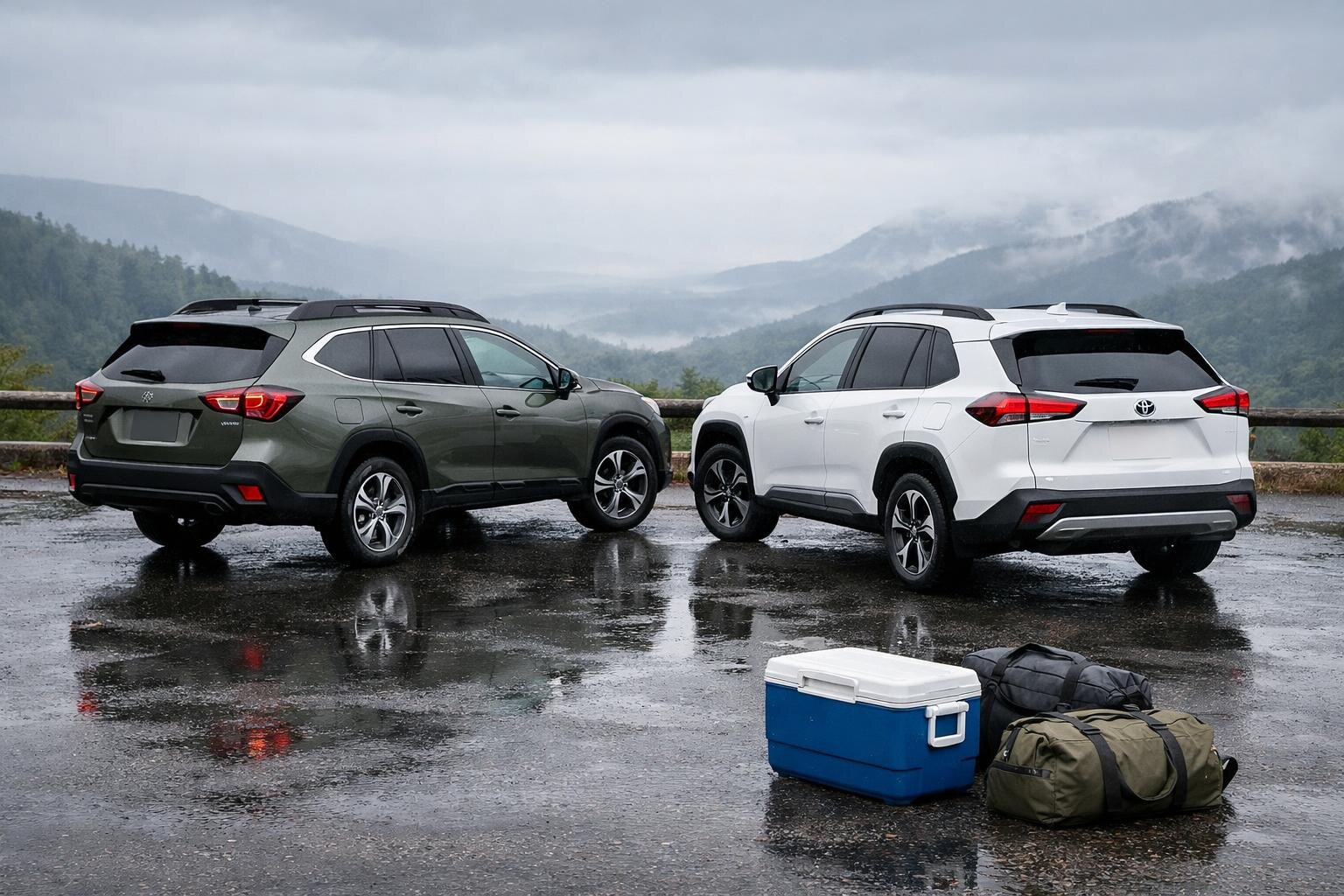
Here’s where each model leans into its own identity. The Outback blurs wagon and SUV lines it sits lower than many crossovers but provides excellent cargo volume (about 32.6 cubic feet behind the rear seats; expands to over 75 cubic feet folded). Rear-seat space easily fits adults or car seats without complaint. Loading gear feels easy thanks to a low lift-over height and wide rear hatch opening a detail I’ve come to appreciate during camping trips or Home Depot runs.
The Tiguan fights back with an optional third row unique among compact crossovers though it’s best reserved for kids or emergencies due to tight legroom (and note: third row availability for U.S.-spec 2025 models has not been officially confirmed as of June). With five seats up, cargo space is slightly less generous than the Outback (previously about 33 cubic feet), but flexibility wins points if you occasionally ferry extra passengers.
Features That Count: Safety Tech and Creature Comforts
Safety is non-negotiable these days, so it’s good news that both vehicles come loaded with driver aids. Subaru EyeSight brings adaptive cruise control, lane centering, pre-collision braking even base models have these features standard now. Volkswagen includes its IQ.DRIVE suite: adaptive cruise control with stop-and-go capability, lane keeping assist, blind spot monitoring. In practice, Subaru’s systems feel less intrusive; VW’s lane keep can get grabby during tight curves.
Luxury touches are increasingly common in mainstream crossovers heated steering wheels, ventilated front seats (on higher trims), panoramic sunroofs all present here depending on trim level. If you want genuine leather upholstery or premium audio, you’ll need to step up in either lineup.
Dollars and Sense: Pricing, Maintenance, Resale Value
No matter how cushy or capable a crossover feels inside the showroom, cost of ownership matters down the line. - For 2025 pricing: The Outback starts around $30,000 for base models (as of current guidance), stretching past $43K fully loaded.
- The new Tiguan hasn’t announced final pricing for U.S.-spec models yet; expect entry points near $30K based on outgoing versions. Subaru has built its reputation on low running costs maintenance is straightforward (and dealers are everywhere outside of Texas). Resale value remains strong; Outbacks consistently rank near the top among midsize utility vehicles. Volkswagen offers competitive warranties including four years/50K miles bumper-to-bumper but maintenance costs tend to run higher over time compared to Japanese rivals like Subaru. Historically speaking, Tiguans have depreciated faster than Outbacks once off warranty something worth considering if you like to trade up every few years.
The Verdict? It Depends Where You Point Your Compass
If your weekends mean trailheads or muddy soccer fields and you want maximum cargo space without SUV bulk the Subaru Outback remains an obvious choice. It rides softly over broken pavement and shrugs off bad weather with standard AWD confidence. If sharp styling and digital tech top your wish list or you occasionally need seven seats the new Volkswagen Tiguan deserves consideration. Its cabin feels upscale for the class; road manners are distinctly European. Neither is perfect the Outback could use more steering feel; the Tiguan needs simpler cabin controls but both deliver on their promises in ways that matter for real families. As always: take them for a spin yourself before making any final calls the best crossover isn’t just what looks good on paper; it’s what feels right behind your own wheel. Michael Turner
Detroit Automotive Journalist
0 comments
Join the discussion around this article.
Please login to comment.