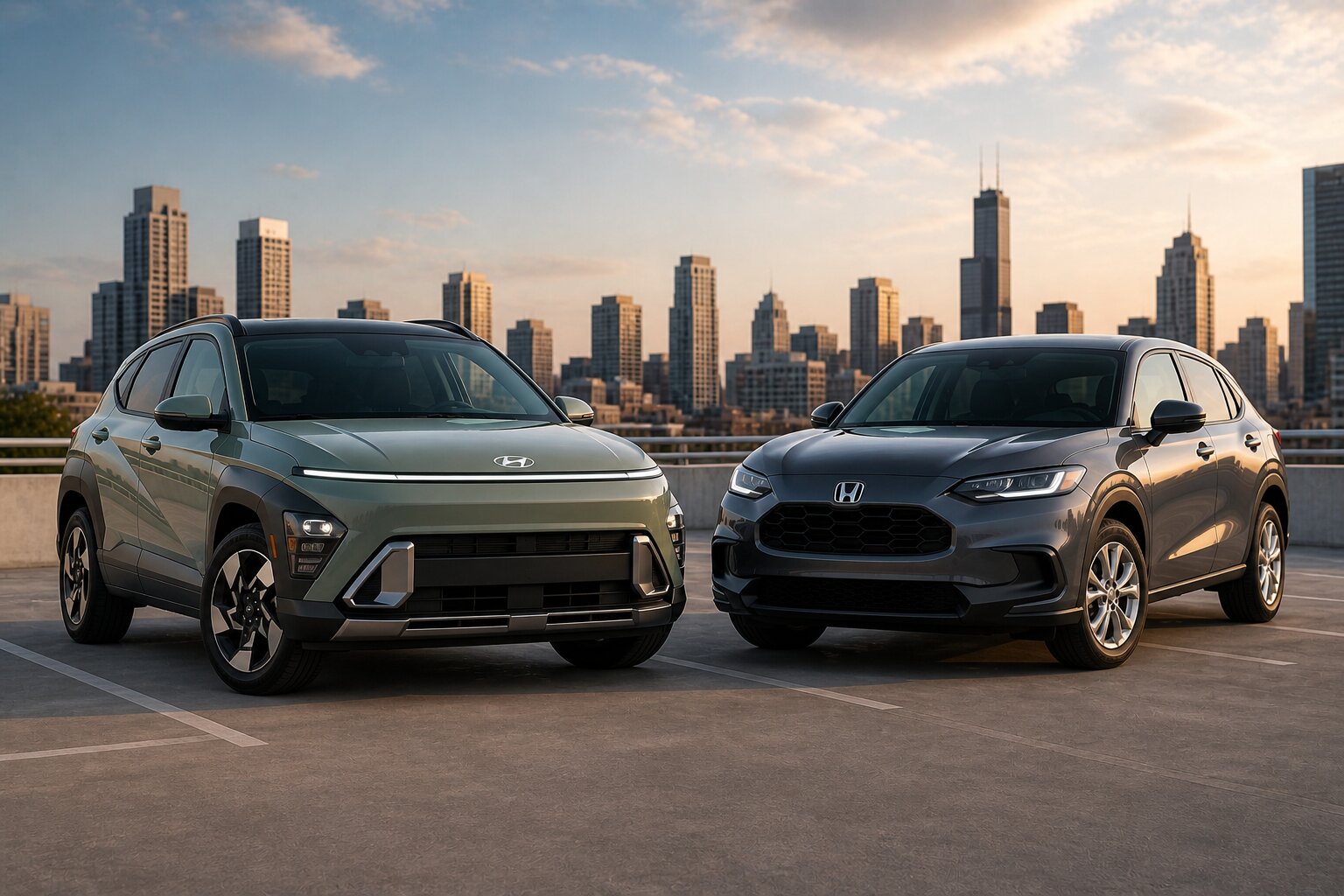
Two small crossovers, two very different “normal days”
I’m Michael Turner, based in Detroit, and I’ve spent enough years bouncing between press fleets and airport parking structures to know this: “small crossover” is a shape, not a personality. The 2026 Hyundai Kona and 2026 Honda HR-V land in the same general footprint easy to live with, easy to park, easy to justify but they go about the job in totally different ways.
The Kona tends to feel like it was engineered by people who enjoy gadgets and don’t mind a little edge in the driving experience. The HR-V feels like it was engineered by people who have watched normal Americans do normal American things commute, pick up kids, run errands, and forget to read the owner’s manual and then designed something that won’t nag you for it.
Before we get into the day-to-day stuff (commuting, tight parking, back-seat comfort, weekly-errand cargo, and controls/menus), a quick fact-checking note: full 2026 model-year specs and pricing are not always published at the time early comparisons like this get written. Where official 2026 numbers aren’t yet released, I’m leaning on widely known, established specs from the current generation and calling out what’s not confirmed. EPA fuel-economy figures for some 2026 trims may not be posted yet; if you’re shopping by the decimal point, verify on fueleconomy.gov once the exact trim is listed.
The vibe check: Kona’s “tech-forward” vs HR-V’s “don’t overthink it”
Hyundai’s Kona (second-generation design introduced for 2024) looks like it came from a sketchbook that also had a few sci-fi doodles on the same page. It’s bolder than it needs to be and that’s kind of the point. Even in traffic it has that modern, slightly angular presence that makes you think the owner probably knows what “OTA update” means.
The Honda HR-V (current generation introduced for 2023) is cleaner and more conservative. Not boring just calm. It reads like an appliance in the best way: you don’t buy a refrigerator because it’s thrilling; you buy it because it never ruins your day.
Competitor-wise, both live in the same crowded neighborhood: Toyota Corolla Cross, Mazda CX-30, Subaru Crosstrek, Kia Seltos (especially relevant since it shares corporate DNA with Kona), Chevrolet Trax/Trailblazer, Volkswagen Taos. But Kona and HR-V are interesting because they don’t chase the exact same buyer even when they’re cross-shopped.
Commuting: one wants to entertain you, the other wants to relax you
In commuter traffic around Metro Detroit where “smooth pavement” is more of a rumor than a promise the HR-V’s default setting is calm. The steering is light and predictable. The suspension generally rounds off sharp edges instead of underlining them with a highlighter. It’s not sporty in the classic sense; it’s competent and easygoing. After a long day, that matters more than most of us admit.
Power is where the HR-V shows its priorities. The HR-V has been widely sold with a 2.0-liter naturally aspirated four-cylinder making 158 horsepower (paired with a CVT in most trims). That output is adequate rather than eager. The sensation is familiar if you’ve driven modern Hondas tuned for efficiency: you press, there’s a moment of planning, then steady forward motion. Merging is fine if you drive it like an adult leave space, roll into the throttle early but it won’t flatter impatience.
The Kona gives you more personality options. In recent model years (and continuing as part of this generation), Kona has offered a base 2.0-liter four-cylinder around 147 horsepower on certain trims and an available turbocharged 1.6-liter four-cylinder around 190 horsepower on others (typically paired with an automatic rather than a CVT). Hyundai also sells an electric Kona variant in this generation; since we’re comparing Kona vs HR-V as mainstream small crossovers and Honda doesn’t offer an electric HR-V in the U.S., I’m focusing on gasoline models here.
In real commuting terms: if you end up in a turbo Kona, it tends to feel punchier when gaps open up. That extra torque-y shove (even without quoting torque figures here) is the difference between “I can merge” and “I can merge now.” The base Kona engine is closer to HR-V energy fine but Hyundai’s powertrain menu gives you more ways to tailor your normal day.
Noise-wise, both are generally civilized for the class, but they do it differently. The HR-V often comes across as mechanically unobtrusive engine note stays in the background unless you ask for everything at once. The Kona can feel slightly more “present,” especially with more aggressive tires or higher trims; not necessarily louder, just more communicative through the chassis over broken pavement.
Tight parking and city errands: sightlines vs sensors
Parking lots are where these cars earn their keep and where design decisions you didn’t think about become daily rituals.
The HR-V’s shape makes it easy to place. The hood line isn’t trying to impress anyone. You get a sense of where the corners are without doing geometry in your head. Steering effort at low speed is light enough that one-hand parking maneuvers feel natural.
The Kona counters with tech confidence. Depending on trim level (and package), Hyundai tends to offer strong driver-assistance availability in this segment useful camera views, parking sensors on higher trims, and generally modern infotainment hardware. I’m not going to claim specific camera modes or feature names for every 2026 trim without Hyundai’s final ordering guide in front of me; what I can say is that Hyundai has been aggressive about bringing higher-end convenience tech downmarket.
If your “normal day” includes tight garages or street parking near downtown restaurants where everyone else also had the same idea at 7 p.m., either will work but they’ll appeal differently. The Honda makes you feel like you’re good at parking. The Hyundai makes you feel like your car is good at parking.
Back-seat reality: adults back there? Be honest.
This class lives or dies on second-row honesty. Yes, they’re “small,” but plenty of people use them as primary family transportation.
The current HR-V has a reputation for using its space smartly especially for rear passengers thanks to its platform proportions and Honda’s knack for packaging. I’ve found adults fit back there better than you’d expect from something that looks tidy on the outside. Knee room feels workable; headroom generally doesn’t force anyone into an awkward slouch unless they’re very tall.
The Kona grew significantly with its current generation (introduced for 2024), which helped rear-seat livability compared with older Konas that felt more like tall hatchbacks than true small crossovers. In practice, that means fewer complaints from friends riding shotgun’s friends if you know what I mean and less negotiation about who sits where during dinner runs.
Seat comfort comes down to trim and taste. Honda tends to nail cushioning that works over time no single “wow” moment, but also fewer “why does my lower back hate this?” moments after an hour. Hyundai sometimes goes firmer or more stylized depending on trim; some people love that supportive feel, others want softer padding for daily use.
Cargo for weekly errands: groceries don’t care about brand loyalty
Your weekly-errand test is simple: can you load groceries without playing Tetris? Can you throw in a couple of reusable bags plus paper towels plus something awkward like a case of sparkling water without reorganizing your life?
Both do fine here because both are shaped like small crossovers should be: square-ish tailgate opening, usable floor height, folding rear seats when life gets bigger than planned.
I’m intentionally not quoting exact cargo-volume numbers because those vary by measurement method and configuration (and 2026 spec sheets may shuffle details by trim). What matters in practice is how easy it is to use: low lift-over height helps your back; wide opening helps bulky items; simple seat-fold releases help when your hands are full.
The HR-V usually wins points for straightforwardness less fussing with angles and Honda’s interior cubbies tend to be thoughtfully placed for everyday clutter (phone cables, sunglasses, receipts you swear you’ll file later). The Kona answers with clever storage too, plus an overall cabin design that often feels more contemporary more screens-forward which can make the interior feel airier even when dimensions are similar.
Controls and menus: buttons still matter when you’re late
This is where I start forming strong opinions, because infotainment isn’t entertainment anymore it’s how you control basic stuff while trying not to miss your exit.
Honda typically does clean logic well. Even when screens get bigger across the industry, Honda usually keeps menu structures relatively intuitive and avoids burying everything three layers deep just because it can. Physical controls especially for climate tend to be easy to find by feel after a week of ownership. That matters when you’re wearing gloves in February or juggling coffee in one hand.
Hyundai has leaned hard into big displays and modern interface design on recent products, including Kona’s current generation interior layout on many trims (often with large screens depending on model). When Hyundai nails it, it feels crisp and high-end for the money good resolution, quick responses, clear graphics. When it misses (and this can vary by model year/trim), it can drift toward touch-heavy interactions where you wish there were just one more knob.
If your normal day includes lots of quick adjustments defrost on/off, fan speed changes as weather swings the HR-V’s approach will likely feel less distracting. If your normal day includes lots of tech use navigation inputs, phone integration tweaks the Kona may feel more satisfying as long as its particular trim keeps key functions accessible.
Fuel economy: likely close in reality; verify by trim
Fuel economy is one of those topics where everyone wants a clean winner and real life rarely cooperates.
The Honda HR-V with its 2.0-liter engine and CVT has historically landed in competitive EPA territory for the segment (often high-20s combined depending on drivetrain). The Kona varies more because its lineup varies more: base engines tend to target efficiency; turbo engines trade some mpg for punch; AWD typically costs fuel economy versus FWD across both brands.
For 2026 specifically: EPA figures may not yet be released for every trim/drivetrain combination at the time you read this. If mpg is your top priority, shop by exact configuration (FWD vs AWD; base vs turbo) rather than by badge alone and confirm final EPA ratings once posted for the 2026 model year.
Towing: mostly “don’t,” unless your trailer is basically a bicycle rack
If towing is part of your normal day even occasionally this might not be your segment.
Small crossovers like these often have low towing ratings or aren’t marketed heavily around towing at all in the U.S., and ratings can vary sharply by engine/drivetrain/market rules. For many trims of vehicles in this class, towing capacity may be modest (or not recommended). Because 2026 official towing specs can vary and may not be fully published yet per trim level, I’m not going to toss out a number that might mislead you.
The practical advice: if you need to tow anything heavier than a small utility trailer now and then or you want confidence doing it look at something like a Honda CR-V or Hyundai Tucson (or even Subaru Forester depending on needs), verify factory tow ratings for your exact build, and consider cooling/brake requirements. For bikes and small cargo trays? Either Kona or HR-V will handle hitch-mounted accessories fine when properly equipped; just watch tongue-weight limits per manufacturer guidance.
Ride and handling: HR-V = smooth-and-steady; Kona = sharper edges (in a good way)
I’ll put it plainly: neither of these is pretending to be a hot hatch anymore not even when marketing tries but their road manners still have distinct flavors.
The HR-V leans into stability over sparkle. On Michigan’s patchwork highways, that translates into fewer fidgets over expansion joints and less busy body motion over mid-corner bumps. Steering feel isn’t talkative like an old Civic Si; instead it’s consistent and light enough that fatigue stays low during long commutes.
The Kona tends to feel more eager to change direction again depending on tire choice and trim and its chassis tuning often reads as slightly more European in attitude compared with Honda’s soft competence. There can be a mild tradeoff: sharper responses sometimes mean you notice rough pavement more clearly through the seat base or steering column. Whether that’s “engaging” or “annoying” depends entirely on your tolerance for feedback during rush hour.
If I’m choosing purely based on how I want my shoulders to feel after 45 minutes crawling down I-75? HR-V energy all day. If I’m choosing based on whether I enjoy taking an empty cloverleaf ramp at sane-but-fun speeds? Kona has an argument especially if equipped with its stronger engine option.
Ownership math: price realism, maintenance expectations, resale gravity
This is where brand personality becomes financial personality.
Price: Final 2026 pricing may not be published across all trims as you read this and incentives change weekly anyway but historically both models play in roughly similar affordability bands within subcompact crossovers once similarly equipped (with variation based on trim strategy). Hyundai often tempts buyers with feature content per dollar; Honda often holds firm on pricing because demand stays steady.
Maintenance: Both brands have strong dealer networks nationally. Honda has a long-standing reputation for straightforward ownership costs over time (routine service simplicity helps). Hyundai has improved dramatically over the last decade in product competitiveness; maintenance costs depend heavily on dealer labor rates locally and how complex your chosen trim becomes (bigger wheels/tires cost more; turbo powertrains can add complexity versus naturally aspirated setups).
Warranty: One widely known differentiator historically has been warranty coverage philosophy: Hyundai typically offers longer powertrain warranty coverage than many mainstream rivals in the U.S., while Honda’s warranty coverage tends to be more standard mainstream length but paired with strong resale performance historically. Exact warranty terms should be verified for the 2026 model year on manufacturer sites because details can change by year/model/market but this general pattern has been consistent for years.
Resale: If resale value is part of your plan (lease residuals or selling after five-ish years), Honda traditionally carries serious gravity here. HR-Vs tend to hold value well simply because Hondas are Hondas and because buyers trust them without needing an explanation at used-car time. Hyundai resale values have improved as product quality perception has improved; still, Honda usually remains one of the safest bets if resale predictability keeps you up at night.
The daily-driver verdict depends on which annoyances you hate most
I’ve learned that most crossover shoppers aren’t chasing joy they’re avoiding regret. So here’s how these two stack up when your calendar looks like everyone else’s calendar:
If your normal day is commuting + tight parking + occasional back-seat adults: The Honda HR-V makes an excellent case by being quietly competent everywhere without asking much from you. Its widely known 158-horsepower setup won’t win drag races but it also won’t surprise you with weird behavior at low speeds or make simple tasks feel complicated through menus.
If your normal day includes lots of tech use + you want extra punch available + you like your car to feel modern inside: The Hyundai Kona fits better particularly if you step up to its stronger turbo option (historically around 190 horsepower). It tends to deliver more “I chose this on purpose” energy rather than “this was sensible.”
The funny thing? Both choices are rational but they’re rational in different dialects. The HR-V speaks fluent practical calm. The Kona speaks fluent modern convenience with a side of attitude.
A few cross-shop notes from my Detroit notebook
If you’re still torn after driving both around your usual routes (which I always recommend), here are some real-world tie-breakers that come up again and again:
- If stop-and-go smoothness matters most: HR-V’s power delivery feels predictable even when traffic rhythm gets annoying.
- If passing power matters more than serenity: A turbo Kona typically feels less strained when opportunities appear.
- If you hate learning new interfaces: Honda’s layout usually asks less of your attention span.
- If cabin vibe matters every time you sit down: Kona often feels more visually contemporary; HR-V feels clean and functional.
- If resale anxiety is real: Honda historically eases that worry.
- If warranty length gives peace of mind: Hyundai traditionally leans into longer coverage (verify exact 2026 terms).
The bottom line: pick your “normal”
If all small crossovers were truly interchangeable, nobody would care about them and yet here we are because these two make everyday life feel different behind the wheel.
The 2026 Honda HR-V is what I’d recommend to someone who wants their car to disappear into their routine in a good way and come back out only when it needs gas or wiper blades. The 2026 Hyundai Kona fits someone who wants their routine upgraded: stronger available acceleration depending on trim, bolder design choices inside and out, and generally more tech-forward vibes per dollar when equipped accordingly.
You won’t accidentally buy either one if you drive them back-to-back on your own roads. One will feel like exhale; the other will feel like espresso. Choose accordingly.
0 comments
Join the discussion around this article.
Please login to comment.