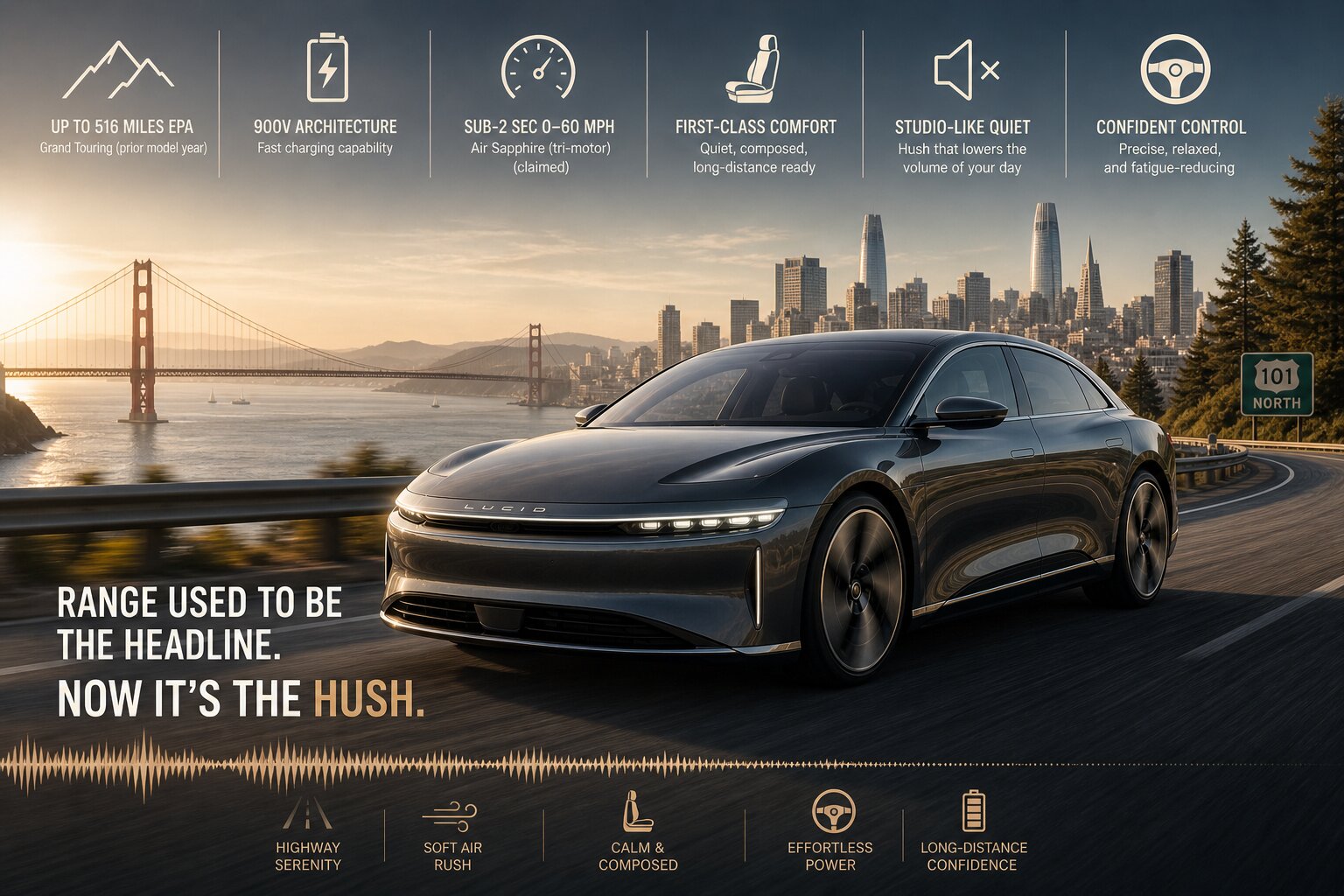
Range used to be the headline. Now it’s the hush.
I live in San Francisco, where EVs are as common as tote bags and double-parked delivery vans. I also spend a lot of time on California freeways, where “quiet” usually means you turned the podcast up enough to stop hearing tire roar. So when I say the Lucid Air’s defining trait in 2026 isn’t just its range it’s the way it lowers the volume of your whole day I mean it as a lived thing, not a spec-sheet flex.
There’s a moment in the Air that keeps repeating for me: you merge onto 101, settle into the lane, and realize you can hear the soft rush of air around the mirrors more clearly than the drivetrain. Not because the car is slow far from it but because the powertrain noise is basically a non-event. The silence becomes a feature you notice, then start relying on. It changes how you drive. It changes how tired you feel after two hours.
That’s also why this review is going to spend more time on comfort, visibility, UI quirks, and long-distance sanity than on bragging rights. Lucid already did the big range headline years ago. The interesting question now is whether the Air feels like a complete luxury sedan you’d choose even if every EV suddenly had “enough” miles.
What we can say with confidence about the 2026 Air (and what we can’t)
Lucid’s Air lineup has historically included versions like Pure, Touring, Grand Touring, and high-performance variants like Sapphire (with tri-motor hardware). Across recent model years, Lucid has been known for very high EPA range numbers most famously the Air Grand Touring at up to 516 miles EPA in prior model years and for using a 900V-class electrical architecture that enables fast DC charging under ideal conditions.
Here’s where I need to be precise: as of my knowledge cutoff (August 2025), Lucid had not published a complete, verified set of specs for a “2026 Lucid Air” across all trims in a way I can cite line-by-line here. Automakers often adjust trim names, battery sizes, features, and even charging curves year to year. So I’m going to anchor this review to widely reported, established Air traits and previously verified figures where they remain relevant and I’ll flag anything that may vary by trim or model year.
Verified/established Lucid Air facts from prior model years that are broadly trusted:
• The Lucid Air is a large luxury electric sedan with rear- or all-wheel-drive configurations depending on trim.
• It has been sold with very high EPA range ratings; notably, the Air Grand Touring has been rated up to 516 miles EPA in past model years (a widely cited benchmark in U.S. EV coverage).
• High-performance versions exist; the Lucid Air Sapphire (tri-motor) has been marketed as an ultra-high-output flagship with extreme acceleration (Lucid has claimed sub-2-second 0–60 mph performance for Sapphire in prior communications; exact figures depend on conditions and testing methodology).
• Lucid uses an advanced high-voltage architecture (commonly described as ~900V) supporting fast DC charging when paired with compatible chargers and favorable battery conditions.
Main rivals (segment-appropriate):
• Tesla Model S (range/performance benchmark, minimalist UI)
• Mercedes-Benz EQS sedan (luxury isolation, comfort-first tuning)
• Porsche Taycan (driver-focused dynamics, 800V charging)
• BMW i7 (traditional luxury feel and rear-seat experience)
• Audi e-tron GT (Taycan cousin with different flavor)
If you’re shopping cross-segment because pricing overlaps in real life, I’d also mention cars like the Genesis Electrified G80 and even loaded versions of mainstream EVs but the Air’s true peers are those big-name flagships above.
The first impression: big sedan energy, but not bulky
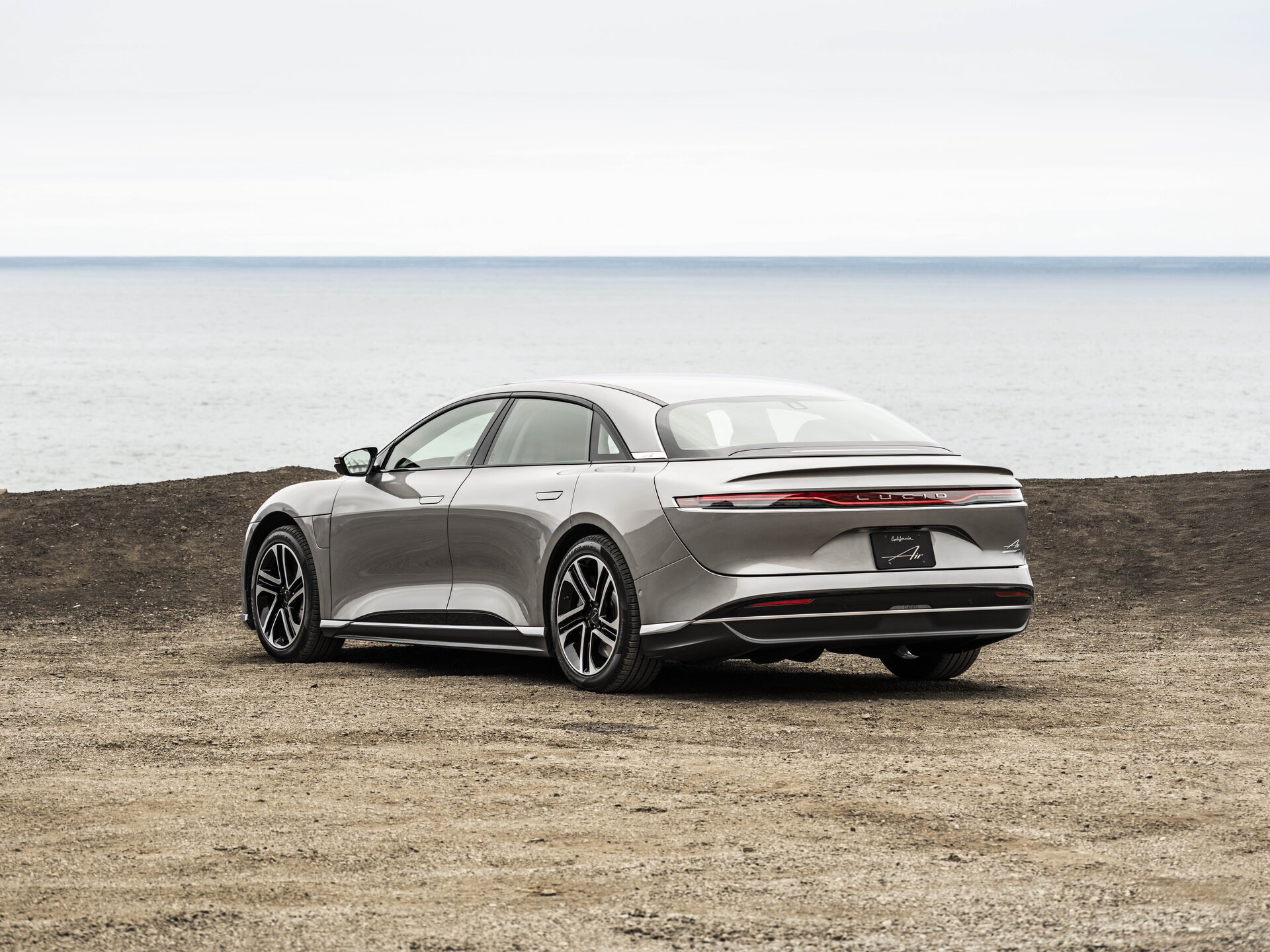
The Air looks long and low in that classic flagship-sedan way more “grand tourer” than “tech pod.” In person it reads cleaner than photos suggest. There’s still a bit of concept-car drama in the proportions, but it doesn’t scream for attention like some EVs do with fake grilles or sci-fi creases.
What surprised me early on is how easy it is to place on city streets for its size at least from the driver’s seat. You feel the length when you’re threading into tight curbside spots in North Beach, but once you’re rolling, it doesn’t have that barge-like delay between steering input and vehicle response that some big luxury sedans still carry around.
Silence isn’t just “no engine” it’s how the whole car behaves
A lot of EVs are quiet until they aren’t. You get wind noise around frameless glass. You get tire slap over expansion joints. You get a faint inverter whine that shows up at exactly the speed you happen to cruise at for two hours.
The Lucid Air’s party trick is that it makes quiet feel intentional. On smooth freeway pavement south of SFO, there’s an almost studio-like calm enough that you notice small sounds you’d normally miss: your jacket zipper tapping lightly against the seatbelt buckle; the soft thunk when you adjust your seating position; the low whoosh of HVAC air through vents that don’t need to shout.
This isn’t me saying it’s silent like a recording booth tires still meet asphalt but compared with many EVs (and plenty of gas cars), it feels less busy at speed. A Mercedes EQS is also excellent here; I’d call that car “pillowy.” The Lucid feels quieter without feeling floaty.
The way it rides: controlled comfort beats dramatic sportiness
If you’re expecting a Taycan-style lesson in chassis tuning where every steering input feels like it was translated through a racing engineer you might find the Air’s priorities different. The Lucid feels tuned for long stints: stable body control, calm reactions over mid-corner bumps, and suspension behavior that doesn’t constantly remind you it’s working.
Over broken sections of Bay Area freeway (you know the ones the concrete patches that look like someone repaired them during an earthquake), the Air stays composed. You still feel sharp hits because physics exists and wheels are round objects meeting square-edged damage. But there’s less secondary motion afterward. The car settles quickly instead of bobbing or shivering.
I’ll put it this way: some EVs handle rough pavement by feeling stiff and “sporty,” which reads great in a quick test drive but wears thin after an hour. The Air feels like someone tuned it for people who actually travel between cities.
Steering and handling: precise enough, but not trying to be your track buddy
The steering has good accuracy off-center helpful on long highway runs where tiny corrections matter but it doesn’t chase hyperactive feedback. That can read as slightly numb if you’re coming from something like a Porsche Taycan or even an Audi e-tron GT, both of which prioritize driver texture over serenity.
The upside is that it reduces fatigue. There’s less mental overhead in keeping it neatly in lane during crosswinds near bridges or when passing trucks throwing dirty air around. It feels planted without constantly asking you to participate.
Acceleration: yes, it’s fast but what stands out is how effortless it feels
The Lucid Air has been offered across a wide performance spectrum from more accessible trims to truly outrageous outputs in top variants (Sapphire being the famous one). Even without leaning on exact horsepower numbers here because they vary significantly by trim and year the character is consistent: immediate torque delivered smoothly, with an almost eerie lack of drama.
You press down to pass on I-280 and there’s no gear change pause, no crescendo, no vibration through pedals. Just forward motion arriving right now. If you’re used to gas-powered luxury sedans where passing power comes with a muted V6 hum or V8 swell (and maybe a downshift thump), this feels like skipping a whole chapter of sensation.
Tesla’s Model S can feel similarly instant, but its acceleration sometimes comes with more noticeable road noise intruding into the experience depending on tires and road surface. The Lucid tends to keep things calmer while still delivering serious shove.
The cabin vibe: modern luxury without trying too hard
I’ve sat in plenty of expensive EVs that feel like they were designed by committees arguing about minimalism versus traditional luxury cues. The Lucid Air lands in a sweet spot: airy design, clean lines, high visibility forward… but not so stripped-down that it feels unfinished.
You notice little tactile moments: the gentle resistance when adjusting seat controls; the quiet click when selecting drive; materials that don’t squeak when you lean into them getting out at awkward angles on steep SF hills. Those are small things until they aren’t.
Visibility and seating: surprisingly easygoing for such a low-slung sedan
The driving position works for long stints. You sit low enough to feel like you’re “in” the car rather than perched on top of a battery slab, yet outward visibility doesn’t feel claustrophobic. Forward sightlines are good for navigating city traffic; side visibility is solid; rearward visibility depends heavily on your seating height and whatever design choices are happening behind your headrest area (this varies across cars and options).
If you’re coming from an SUV say, a Rivian R1S or Model X you’ll miss that commanding view over traffic. But among luxury sedans, this one doesn’t punish you with tiny windows just to look sleek.
Screens and controls: impressive tech… plus some real-world quirks
The Lucid interface is one of those systems that looks gorgeous when parked and becomes more complicated once you’re actually driving through mixed city/highway chaos.
The core strengths: sharp graphics; lots of information available; generally modern responsiveness compared with older legacy systems that still lag behind phones. When everything works smoothly, it feels like piloting something thoughtfully engineered rather than bolted together from supplier parts.
The quirks are what show up after a week:
• Some functions live deeper in menus than you want while moving especially if you’re trying to do something simple like adjust certain driver assistance settings or dig into vehicle options without taking your eyes off traffic for too long.
• Touch interfaces still have that universal problem: there isn’t always a tactile “yes” moment like there is with a physical knob detent or button click. Even good haptics don’t fully replace muscle memory when your hands are cold and your brain is tired at 10 p.m. returning from Sacramento.
Tesla remains king of “fast UI thinking” in many ways simple layouts and quick responses but Tesla also leans harder into putting everything on one screen with fewer redundancies. Lucid feels more traditionally luxurious in presentation while still being very tech-forward; sometimes that means there are more places settings can hide.
The sound system effect: quiet cabins make audio better (and worse)
This is an odd truth about very quiet cars: they make good audio systems sound incredible and they also reveal bad recordings mercilessly. In the Air’s calm cabin environment, podcasts sound crisp at low volume. Music gets texture without needing brute-force loudness.
The flip side is that any rattle or buzz if present would be easier to detect than in noisier vehicles. On well-built examples this isn’t an issue; but as an ownership reality across any brand, ultra-quiet cabins raise your sensitivity level.
Long-distance comfort: where this car starts making sense emotionally
This is where I think the Lucid Air earns its keep beyond range headlines. Range matters because it reduces planning stress but comfort matters because it reduces human stress.
You settle into a rhythm: steady speed; light steering corrections; minimal vibration through seat base; HVAC doing its thing without blasting; driver assistance helping without feeling overly intrusive (system behavior varies by configuration and updates). After two hours you step out feeling more normal than wrung out.
I’ve done similar drives in other EV flagships:
• The Mercedes EQS can feel even more isolated in certain conditions, but its styling inside/outside is polarizing and its interface philosophy isn’t everyone’s favorite.
• The Tesla Model S remains brutally efficient at eating highway miles quickly especially with Supercharger routing ease but its cabin experience can feel less special as “luxury” depending on your expectations for materials and noise isolation.
• The BMW i7 nails traditional luxury theater (especially rear-seat vibes), but it carries more old-school heft in how it moves down the road.
A practical word about charging: fast hardware helps, but planning still matters
I’m keeping this practical and real-world: even if your EV can charge quickly under ideal conditions and Lucid’s high-voltage approach has been positioned exactly for that you still live inside U.S. infrastructure realities.
The good news is simple: if you start with lots of range headroom, charging becomes less frequent and less emotionally loaded. You can choose stops based on convenience instead of necessity more often than drivers of shorter-range EVs.
The other reality: public charging reliability varies by region and operator. In California metro areas it’s improving but still inconsistent enough that I plan stops around known-good sites when timing matters (late-night arrivals, tight schedules). Tesla Superchargers remain the gold standard for uptime and ease-of-use; access depends on vehicle compatibility/adapters/agreements which have been evolving rapidly across brands since 2023–2025. For any specific 2026 Lucid charging access scenario NACS integration details, adapter availability I’d want to verify the latest from Lucid at time of purchase because that landscape has been moving fast.
At home, if you can install Level 2 charging, the Air fits into life like any other EV: plug in, wake up full enough, stop thinking about it. That’s the dream, and it’s still the most important “infrastructure upgrade” most Americans can make if they want EV ownership to feel effortless.
Driver assistance and tech: helpful, but don’t buy it for a robot chauffeur fantasy
Lucid’s driver assistance features (which have included highway-centric assistance and safety tech typical of the segment) are best treated as fatigue reducers, not replacements for attention. In my experience across this category, the best systems are the ones that fade into the background: they center smoothly, they don’t ping-pong, and they don’t nag constantly when you’re doing everything right.
Tesla’s system is often the one people benchmark because of brand visibility; Mercedes has strong highway assistance in many models; GM’s Super Cruise (not in Lucid) is still one of my favorites for hands-free mapped highways because it feels clear about what it can and can’t do. The Lucid approach tends to feel more like “premium assistance” than “look what my car can do on TikTok,” which I consider a compliment.
Daily living stuff: storage, usability, and the little annoyances
A sedan is a sedan. You’re not buying an Air to haul mountain bikes upright without removing wheels. But for daily EV life work bag, groceries, weekend duffels it does the job, and Lucid has historically emphasized clever packaging thanks to its compact powertrain components.
The annoyances tend to be modern-EV annoyances rather than Lucid-specific sins:
• Touchscreen dependence can be mildly irritating when all you want is a simple physical control.
• Big wheels (if equipped) can trade some ride plushness for style. This is true across the segment; it’s not a Lucid-only story.
• Low-slung sedans always require a little more mindfulness around steep driveways and city parking blocks. If you live in SF, you already know which garage ramps to avoid.
How it stacks up against rivals (without turning this into a spreadsheet)
Versus Tesla Model S: The Tesla still wins on charging network simplicity in much of the U.S. and on an interface that feels ruthlessly streamlined. The Lucid counters with a cabin that feels more special and a serenity factor that’s hard to un-notice once you’ve lived with it. If you want your flagship sedan to feel like a luxury object, Lucid has an edge in vibe.
Versus Mercedes EQS: EQS is comfort royalty and can feel like a rolling lounge. The Lucid feels more driver-friendly in its layout and more emotionally “normal” if you prefer classic sedan proportions over egg-shaped aero maximalism. Both do quiet well; Lucid’s quiet feels paired with a bit more road discipline.
Versus Porsche Taycan/Audi e-tron GT: Those cars are for people who want their EV to feel like a sports sedan first and an EV second. The Lucid is quick sometimes absurdly so depending on trim but its core personality is grand touring calm rather than track-day sharpness.
Versus BMW i7: The i7 leans into traditional luxury theater and rear-seat indulgence. The Air feels more like the future of the driver’s car in this class still luxurious, but with a lighter-on-its-feet attitude and an EV-first packaging advantage.
The stuff I loved (and the stuff that bugged me)
What I kept appreciating:
• The quiet. Not just “no engine,” but low fatigue from noise and vibration overall.
• Effortless passing power delivered smoothly enough that you stop showing off and start using it responsibly.
• A sense that the car was engineered as an EV from day one, not adapted from a gas platform.
What occasionally pulled me out of the moment:
• UI depth: some settings feel one or two taps deeper than they should be when you’re actually driving.
• Like most modern luxury sedans, it asks you to accept screens as your primary relationship with the car. Some days I’m fine with that; some days I miss knobs.
Verdict: the 2026 Air feels like it’s graduating from “range king” to “best place to be”
The Lucid Air’s reputation was built on big numbers especially range and those numbers still matter because they reduce friction in real American driving. But what makes the Air stick in my mind is how it treats quiet as part of performance. Not acceleration performance. Human performance: how alert you feel after 150 miles, how calm your shoulders are after traffic, how easy it is to talk to someone in the passenger seat without raising your voice.
If you want the simplest charging-and-routing life today, Tesla still has gravitational pull. If you want old-school luxury theater with a legacy badge, BMW and Mercedes will happily oblige. But if your idea of luxury is arriving less tired and if you care about EV engineering done with real intention the Air belongs on your shortlist.
I’d just shop it with eyes open: verify the exact 2026 trim specs, range ratings, charging access details (especially around NACS/Supercharger compatibility), and feature availability at time of purchase. The core experience the hush, the stability, the effortless speed those are the things that feel most “Lucid.” And they’re the reasons range stops being the main story.

0 comments
Join the discussion around this article.
Please login to comment.