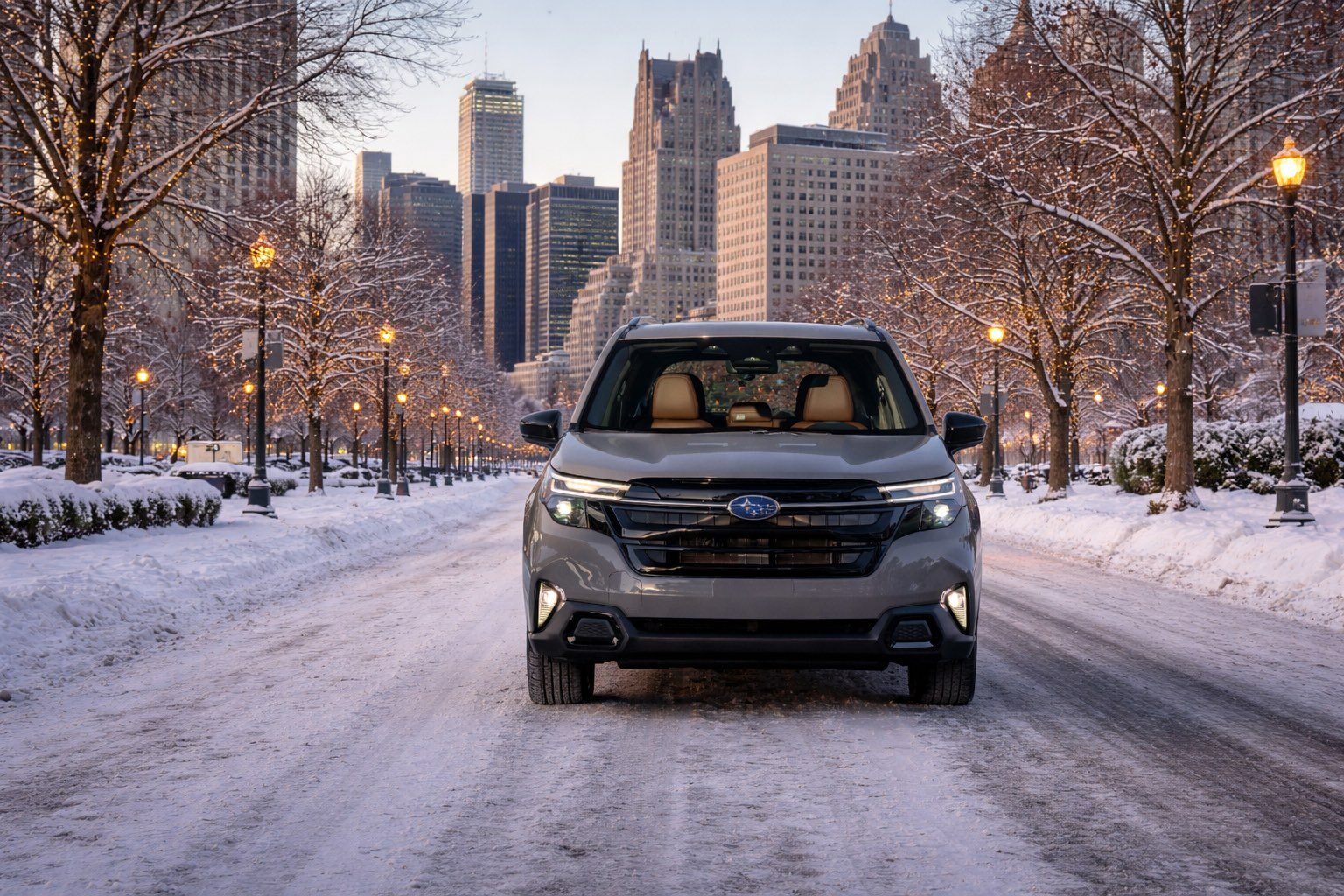
2025 Forester, same mission — new suit
I’ve been in and out of Subaru Foresters for most of my career, which means I’ve also spent a lot of time in their natural habitat: Michigan winters, wet parking lots, and the kind of cracked pavement that makes you wonder if your alignment is a suggestion. The Forester has never tried to be the most stylish compact SUV or the quickest. It’s been the sensible one the visibility champ with honest controls and standard all-wheel drive that works the way people expect it to work.
The 2025 Subaru Forester continues that theme, but it does so on a new-generation model that’s freshened inside and out. Subaru’s pitch is familiar: practical packaging, a high seating position, and everyday traction without forcing you into a larger, thirstier vehicle. The reality is also familiar: it’s still not the segment’s powerhouse, and its best traits show up in the small moments merging in heavy rain, loading a stroller without playing trunk Tetris, or simply seeing out of the thing like it’s 2005 and not every window has been sacrificed to styling.
Fact check note: Subaru released core details for the 2025 Forester (powertrain layout, safety suite, general positioning), but some specifications can vary by market and final U.S. certification. Where exact numbers (like final EPA mpg by trim) aren’t confirmed in official U.S. documents at time of writing, I’m calling that out rather than guessing.
What it is (and who it’s up against)
The Forester sits in the heart of the compact SUV segment, facing heavy hitters like the Toyota RAV4, Honda CR-V, Mazda CX-5/CX-50, Hyundai Tucson, Kia Sportage, Nissan Rogue, Ford Escape, Volkswagen Tiguan, and Chevrolet Equinox. Some of those rivals offer hybrid options (RAV4 Hybrid, CR-V Hybrid, Tucson/Sportage hybrids), some offer turbocharged punch (CX-50 turbo), and some lean hard into value or tech.
Subaru leans into a different mix: standard symmetrical all-wheel drive across the lineup (as it traditionally does with Forester), a reputation for winter competence, and a cabin that prioritizes outward visibility and straightforward use over fashion. If you live where weather is real or you just like sitting upright with a clear view of the road the Forester still makes a clean argument.
Design: boxy on purpose and I mean that as praise
The 2025 Forester’s styling doesn’t chase coupe-SUV drama. It reads like a tool designed by someone who actually loads gear and occasionally parallel parks. The proportions stay upright, with a tall greenhouse and relatively squared-off rear. That shape matters: it’s why you can see out of it so well and why cargo is easier to stack without fighting a plunging roofline.
I’ll admit this as a Detroit-based skeptic who sees too many “sport” SUVs pretending to be low-slung: there’s something refreshing about a vehicle that looks like it was designed from the inside out. You may not love every crease or cladding decision, but you won’t confuse it with an appliance shaped by wind-tunnel vanity alone.
The mechanical basics: familiar engine, familiar priorities
In broad strokes, Subaru keeps the Forester formula intact: a naturally aspirated 2.5-liter flat-four (boxer) engine paired with a continuously variable automatic transmission (CVT) and standard all-wheel drive. Subaru has used variations of this setup for years because it hits its targets for packaging and predictable traction.
Verified baseline: The U.S.-market Forester has historically used a 2.5-liter boxer four with a CVT and Subaru symmetrical AWD; competitors often make AWD optional. For 2025 specifically, Subaru has communicated continuity in powertrain approach for Forester rather than introducing a turbo or hybrid at launch.
What I won’t do: I won’t quote horsepower/torque figures or EPA mpg for 2025 unless they’re explicitly confirmed in official U.S. specifications for this model year and trim at publication time. Those numbers are often close to prior years but “close” isn’t good enough when readers are shopping monthly payments and fuel budgets.
What I can say confidently from experience with this drivetrain philosophy: it’s tuned for smoothness and efficiency rather than drama. The boxer layout helps keep mass low in the chassis; the CVT keeps revs where the engine can make usable torque; and the AWD system is calibrated for stability on mixed traction surfaces more than for off-road heroics.
A typical day in the driver’s seat: the visibility advantage is still real
The first thing you notice climbing into a Forester especially if you’ve been driving something sleeker like a CX-5 or even a newer CR-V — is how upright everything feels. The seating position is naturally high without being trucky. The hood line is easy to place in traffic. The A-pillars don’t feel like they’re trying to hide pedestrians behind them.
This matters more than brochure copy suggests. In downtown Detroit traffic where lane markings can be more “historical reference” than actual guidance being able to quickly glance left-right-left at intersections is calming. There’s less head bobbing around pillars, less guessing where that cyclist might reappear.
Subaru has long treated glass area as an asset rather than an enemy of style, and the Forester benefits every time you nose into tight parking or back out between two lifted pickups whose drivers believe reverse cameras are optional.
Inside the cabin: where buttons meet big screens
Subaru interiors tend to age well because they don’t gamble everything on one trendy interface idea. For 2025, Subaru modernizes design and tech while trying not to lose its ergonomic common sense.
Here’s what I look for on a “typical day” loop: Can I adjust temperature without hunting through menus? Can I change audio volume by feel? Can I pair my phone once and forget about it? Does the screen glare at me at 7:45 p.m. on I-94?
The Forester generally gets this right when it keeps key functions easy to access. In previous Subarus with large portrait-style touchscreens (like Outback/Legacy), some climate functions migrated into the screen functional but occasionally fiddly on rough roads with winter gloves on. If your 2025 Forester configuration relies heavily on touchscreen controls for HVAC or seat heaters, that’s worth verifying during your test drive because preferences here are personal and because rivals like Mazda still win points for tactile simplicity even when their infotainment logic can be stubborn.
Fact check note: Exact infotainment screen sizes and which trims get which interfaces should be verified against Subaru’s official trim walk for 2025 Forester (U.S.). Subaru typically offers multiple trims with different equipment levels; however, I’m not listing trim names or feature-by-trim promises here unless confirmed by official spec sheets available at publication time.
The little things you notice after an hour
On highway runs say Detroit to Ann Arbor and back the Forester’s strengths show up in low-stress behavior. The steering is light but consistent; there’s usually enough on-center stability that you’re not making constant micro-corrections. Wind noise tends to be more about mirror area than overall sealing; tire noise depends heavily on whatever rubber comes installed from the factory.
If there’s an annoyance that can crop up in this class, it’s powertrain sound under load. A naturally aspirated four-cylinder plus CVT combination can produce that familiar steady drone when you ask for more speed climbing an incline or passing at 70 mph. Some competitors mask this better with turbo torque (CX-50 turbo) or hybrid assist (CR-V Hybrid). It doesn’t mean the Forester is slow in normal commuting it means it communicates effort more audibly than some alternatives.
I also pay attention to seat comfort over time: cushion length under the thighs, lumbar support shape, whether headrests push your head forward like an overzealous chiropractor. Subaru seats have generally been supportive without being sporty; if you’re coming from something plush like a Tucson Limited or as firm as certain Mazdas, your body will have an opinion within 30 minutes.
Driver assists: EyeSight is still part of the deal
Subaru has built much of its modern safety reputation around EyeSight driver assistance technology camera-based systems supporting features like adaptive cruise control and lane-keeping assistance depending on trim/equipment.
In real use, what matters is calibration: Does adaptive cruise brake smoothly when someone cuts in? Does lane centering ping-pong between lines or hold steady? Does it nag appropriately when hands drift off the wheel?
Historically, EyeSight has been competitive in this class sometimes conservative with following distances but generally confidence-inspiring in bad weather compared with systems that rely heavily on radar alone or get confused by road grime. That said, camera-based systems can struggle when visibility drops dramatically (heavy snow squalls are the classic Midwestern stress test). No system replaces attentive driving; they just reduce fatigue when conditions are merely annoying rather than dangerous.
Tight parking: this is where shape beats swagger
A lot of compact SUVs have grown wider and more stylized over time while pretending they’re still city-friendly. The Forester’s upright shape pays dividends here. When you pull into a tight lot outside a coffee shop in Royal Oak cars angled weirdly because no one agrees what “parking lines” mean you appreciate being able to judge corners through glass instead of relying entirely on cameras.
Cameras still matter, of course; blind-spot monitoring matters too when you’re backing out between tall vehicles. But there’s something inherently safer about simply seeing more with your own eyes before electronics get involved.
Rainy-day reality: AWD that behaves like adults are driving
I’m not interested in AWD marketing stunts; I care about what happens when M-10 turns glossy after an afternoon storm and traffic compresses fast near an exit ramp.
The Forester’s standard symmetrical AWD tends to deliver exactly what most drivers want: predictable traction without drama. Pulling away from slick intersections feels composed rather than scrambly; mid-corner stability is reassuring when pavement grip changes unexpectedly over painted lines or puddles.
This is also where Subaru earns its premium over front-drive competitors that offer AWD only on higher trims or not at all on certain configurations. If you truly don’t need AWD where you live, rivals can undercut the price or beat fuel economy with front-drive models or hybrids. If you do need it or simply want it every day without thinking Subaru keeps things simple: it’s part of the identity rather than an add-on package.
Snow isn’t required to appreciate ground clearance but it helps
The Forester has traditionally offered generous ground clearance for its class (historically around 8-plus inches depending on model year), which helps with rutted winter roads and steep driveway aprons as much as it does with light trail duty.
Fact check note: Confirm exact ground clearance for 2025 via Subaru’s official specs; Subaru often highlights this number prominently because it’s part of Forester positioning versus CR-V/RAV4/CX-5 class peers.
Even without going off-road intentionally, extra clearance reduces those cringe moments when snow piles harden at driveway edges or when construction zones leave uneven transitions that scrape lower vehicles’ front lips.
Cargo and loading: square openings make life easier
A good compact SUV should swallow everyday chaos without complaint: groceries plus gym bag plus two backpacks plus whatever long cardboard box you forgot was in there from last weekend.
The Forester’s cargo area benefits from its upright roofline and practical hatch opening geometry. You don’t have to angle bulky items through a narrow aperture as often as you do in more tapered designs. Loading height matters too especially if you’re lifting heavier objects like bags of salt or dog food and Subaru typically keeps this manageable compared with taller three-row SUVs.
If you’re shopping specifically for family duty, bring your stroller to the test drive. Try loading it one-handed while holding keys in winter gloves. That tiny scenario reveals more about real usability than any cargo-volume number ever will even though cargo volume remains an important cross-shop metric against CR-V and RAV4 leaders.
Child seats: LATCH access and door openings matter more than leather type
If you’ve ever installed a rear-facing child seat while kneeling in slush next to your car, you know what makes a family vehicle good: wide-opening rear doors, accessible LATCH anchors that aren’t buried under stiff upholstery seams, and enough rear legroom so front passengers aren’t punished for having kids.
The Forester has historically been strong here thanks to its tall roofline and square door openings you can lean in without doing yoga poses against the B-pillar. During your own evaluation, check how easily your child seat clicks into place and whether top tether anchors are easy to reach without fishing around behind headrests.
How it drives: calm competence over charisma
The best way I can describe the Forester driving experience is “calmly competent.” It doesn’t egg you on like a Mazda CX-5/CX-50 might on a curving two-lane road. It doesn’t isolate you like some soft-riding crossovers do either it communicates enough through steering and suspension that you feel connected to what tires are doing without feeling every expansion joint as personal criticism.
The ride tuning typically favors comfort over sharpness. Over broken urban pavement Detroit has plenty the suspension does its job without sounding hollow or crashing through bumps like some stiffer setups can when paired with larger wheels. Wheel-and-tire choices can change this dramatically; larger wheels tend to bring sharper impacts and more tire noise regardless of brand.
Power delivery is adequate for daily use but not quick by segment standards if competitors’ turbos or hybrids are your reference point. If your commute includes short merge lanes or if you regularly drive loaded with people and gear you’ll want to do your passing tests during the drive rather than assuming “it’ll be fine.” Usually it is; sometimes “fine” feels busy at high throttle because CVTs keep engine speed elevated under demand.
Highway noise: what you hear at 75 mph
This segment has gotten quieter over time; Honda and Toyota have invested heavily in refinement on newer CR-Vs and RAV4s (though RAV4 road noise varies widely by trim/tire). The Forester tends to land mid-pack: acceptable wind noise levels given its shape but not necessarily hushed-luxury quiet.
I listen for three things on concrete freeways: tire roar (the low-frequency hum), wind rush around mirrors/A-pillars (the hiss), and powertrain note during small grade changes (the drone). On long trips those details become fatigue multipliers or reducers if they’re well controlled.
Infotainment & phone life: daily usability beats novelty
If there’s one place compact SUVs have become needlessly complicated, it’s infotainment menus layered inside infotainment menus while basic tasks get harder.
The best systems let you do three things quickly: set navigation without lagging inputs, switch audio sources cleanly (especially between Bluetooth streaming/podcasts), and adjust climate without taking eyes off traffic for more than a heartbeat.
Subaru typically supports Apple CarPlay and Android Auto across most trims these days; verify whether wireless connectivity is standard or trim-dependent on 2025 Forester using Subaru’s official equipment list because this varies across brands and within brands year-to-year.
Trim levels & options: verify before you sign
The compact SUV market loves bundling must-have features into expensive packages heated seats here, power liftgate there and Subaru isn’t alone in playing that game sometimes.
Important: For 2025 Forester trim levels (names such as Base/Premium/Sport/Limited/Touring/Wilderness have been used historically), confirm exact availability directly from Subaru’s official U.S.-market specifications for model year 2025 before purchase because trim structures can change at redesigns even if names stay familiar and features may shift between standard/optional status.
If there is a Wilderness variant offered for 2025 (Subaru has used Wilderness branding across several models), treat any off-road-oriented hardware claims carefully until Subaru publishes full specs tires, gearing/drive modes, skid plates, tow rating changes because those details define whether it’s genuinely more capable or mostly appearance-and-marketing grit.
Towing & ownership math: what shoppers really ask about
Towing capacity matters because people buy compact SUVs as do-everything vehicles even when physics disagrees slightly. Historically many compact crossovers including prior Foresters have offered modest towing ratings compared with larger SUVs; some rivals now push higher ratings depending on engine choice (and proper equipment).
Fact check note: Confirm 2025 Forester towing capacity via Subaru’s official specs before planning trailer duty; tow ratings can change based on cooling capacity, drivetrain calibration, brakes, and regional certification requirements.
Ownership costs aren’t only fuel economy; they’re tires (AWD means replacing tires as matched sets if wear differs significantly), insurance rates influenced by safety tech availability, maintenance schedules, resale value trends in snow-belt states, and repair complexity tied to electronics density.
The Forester traditionally holds value well in many regions where AWD demand stays strong year-round not just during snow season and where Subaru brand loyalty runs deep enough to make used inventory competitive.
Subtle rival comparisons where they matter
Toyota RAV4: The RAV4 is often the rational benchmark due to resale strength and available hybrids that deliver excellent real-world efficiency. If fuel economy is priority one and especially if your driving skews urban the RAV4 Hybrid can feel like cheating versus non-hybrid rivals. The Forester counters with standard AWD simplicity and typically better outward visibility than many RAV4 trims thanks to its greenhouse-first design approach.
Honda CR-V: The CR-V has become impressively refined with strong packaging; its hybrid option adds smooth torque around town. The Forester fights back with traction confidence baked into every model plus that unmistakable “I can see everything” vibe Honda sometimes
0 comments
Join the discussion around this article.
Please login to comment.