 DriveSense
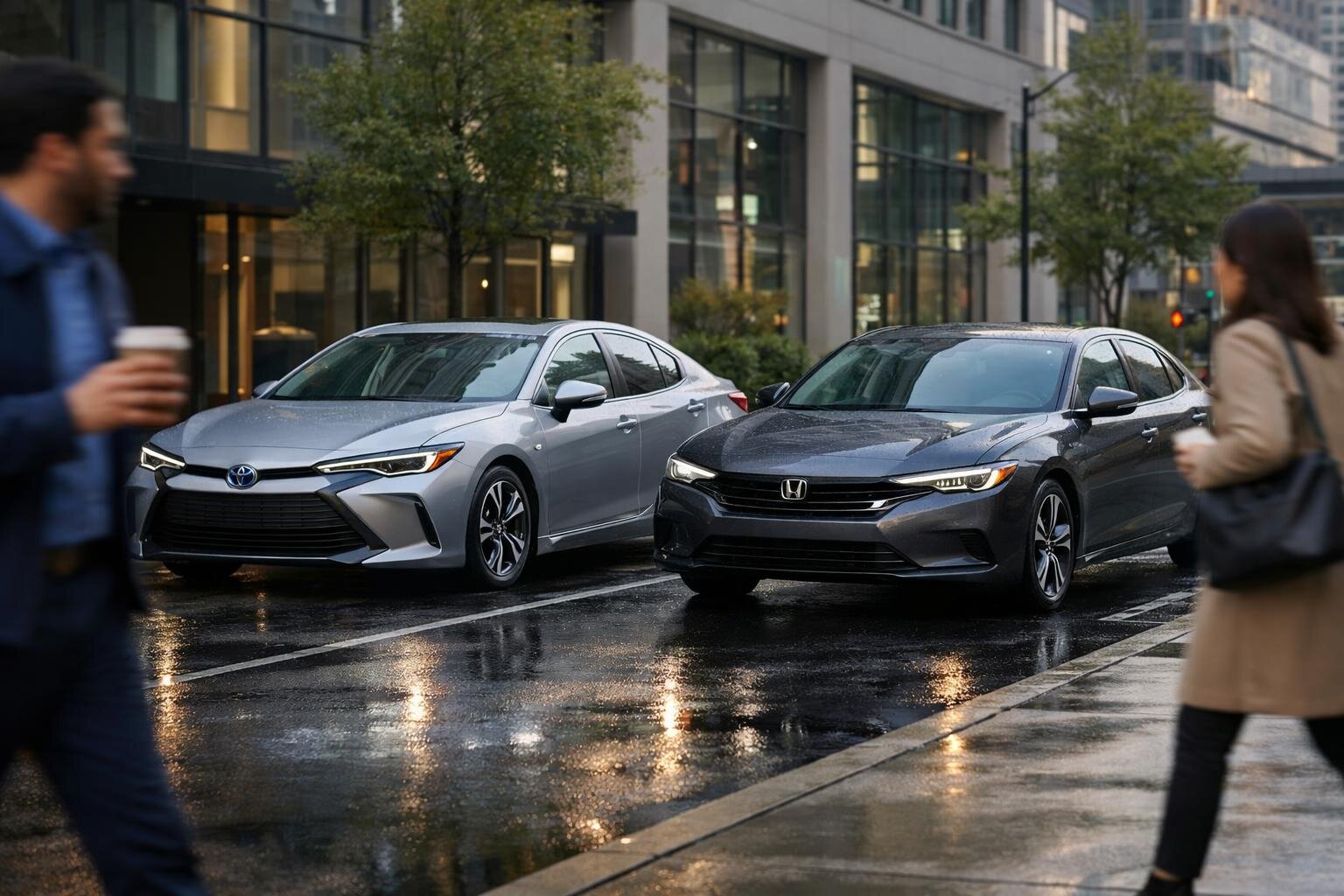
I am David Ramirez, based in New York, and I spend a lot of time thinking about the kind of cars that make the daily grind easier. For a long commute, two midsize hybrids sit right in the center of the conversation: the Toyota Camry Hybrid and the Honda Accord Hybrid. Both are mainstream sedans built around saving fuel without asking you to plug in.
Before getting into the commuter math, a necessary editorial note: a model year badge only matters if you can verify it. Toyota has a live U.S. model page for the 2026 Camry, which gives shoppers an official starting point. For Honda, this article now includes an official Honda Cars U.S. model hub link so readers can confirm current Accord and Accord Hybrid positioning directly with the manufacturer, but you still need to verify that Honda is explicitly presenting a 2026 Accord Hybrid at the time you shop.
Authoritative sources used for this comparison
These are the anchors for what can be stated confidently and what should be verified before purchase:
- Toyota (official): https://www.toyota.com/camry/
- Honda (official model hub): https://automobiles.honda.com/
- EPA fuel economy lookup (FuelEconomy.gov): https://www.fueleconomy.gov/feg/findacar.shtml
- Safety ratings (NHTSA recall and ratings portal): https://www.nhtsa.gov/ratings
- Safety ratings (IIHS ratings portal): https://www.iihs.org/ratings
A commuter-first reality check on 2026 claims
This is a 2026-labeled comparison, but not every data point for both vehicles can be verified from the sources above at all times. FuelEconomy.gov and safety rating sites update on their own schedules, and manufacturers sometimes publish model-year pages before final EPA entries or safety results are visible to the public.
So I am treating anything that requires a numeric value as a verify-before-you-buy item unless it is available on these official portals for the exact year and exact variant you are shopping.
Cited comparison table: what to confirm for MPG, powertrain, safety, cargo, and commute basics
The table below is intentionally conservative. It points you to where each commuter-relevant spec should be confirmed using authoritative sources, without guessing values or importing older-model-year numbers.
| Spec that matters on a long commute | 2026 Toyota Camry Hybrid (verification) | 2026 Honda Accord Hybrid (verification) | Authoritative source(s) |
|---|---|---|---|
| Model-year presence (U.S.) | Toyota shows a live U.S. Camry page presented as 2026. | Confirm on Honda Cars U.S. whether Accord Hybrid is explicitly shown as 2026 at time of shopping. | Toyota Camry page; Honda Cars U.S. |
| MPG (city/highway/combined) | Look up by year, make, model, and specific trim once posted. | Look up by year, make, model, and specific trim once posted. | FuelEconomy.gov Find a Car |
| Powertrain type and output (engine/motor system details) | Verify on Toyota specs for your exact trim. | Verify on Honda specs for your exact trim. | Toyota Camry page; Honda Cars U.S. |
| Safety ratings (crash test results) | Check NHTSA and IIHS entries for the exact vehicle and year when available. | Check NHTSA and IIHS entries for the exact vehicle and year when available. | NHTSA ratings; IIHS ratings |
| Cargo volume and cabin dimensions | Confirm on Toyota specifications for the exact trim. | Confirm on Honda specifications for the exact trim. | Toyota Camry page; Honda Cars U.S. |
| Commuter equipment (driver assistance packaging, wheel size effects) | Confirm standard vs optional features by trim; verify wheel size because it can affect MPG ratings. | Confirm standard vs optional features by trim; verify wheel size because it can affect MPG ratings. | Toyota Camry page; Honda Cars U.S.; FuelEconomy.gov |
Decision snapshot: which one fits a long commute better?
If your priority is reducing uncertainty while you shop, the Camry has an advantage right now because Toyota is already presenting a 2026 Camry page through Toyota USA channels. That does not automatically make it the better car for every commute, but it does make it easier to validate what you are actually buying before you sign paperwork.
The Accord Hybrid remains an obvious rival in real-world shopping. The problem is not the car. The problem is publishing. If you cannot tie a claim to Honda’s official site or an EPA or safety portal entry for the exact year and variant, it should not be treated as settled fact in a model-year-specific comparison.
The most important commuter number: EPA MPG (and how to keep dealers honest)
I have watched commuters get pulled off course by big MPG talk that turns out to be based on another trim, another wheel package, or another model year entirely. The clean baseline in the U.S. is FuelEconomy.gov, which publishes EPA fuel economy ratings once vehicles are certified and indexed.
If you are shopping soon, do this before you get attached to any window sticker story:
- Open the EPA lookup tool: https://www.fueleconomy.gov/feg/findacar.shtml.
- Select year (2026), then make (Toyota or Honda), then model (Camry or Accord).
- Select the exact hybrid variant and trim that matches what is physically on the dealer lot. Pay attention to wheel size and drivetrain notes shown in EPA listings when they appear.
If you cannot find a 2026 listing yet, that does not prove anything negative about either sedan. It just means you are early relative to certification posting or indexing timelines. In that case, treat any numeric MPG claim as provisional until it shows up in the government database.
Merging and passing: what matters when your commute includes real traffic
pA long commute is not just steady-state cruising. It is merges, short on-ramps, and that one uphill stretch where everyone suddenly realizes their lane is slower than they thought.
At a high level, both nameplates compete with hybrid powertrains designed to deliver strong everyday efficiency while keeping acceleration within mainstream expectations. Electric assist typically helps at low speeds and during initial throttle tip-in. That is one reason hybrids can feel more eager leaving a light than older non-hybrid four-cylinders.
I am not publishing horsepower or torque figures here because they are not provided in the current article context and should be verified from each manufacturer for the specific model year and trim you intend to buy. If your commute regularly demands quick merges with passengers aboard, put power output on your must-verify list via Toyota’s Camry page and Honda’s official specs pages reachable from its model hub.
Cargo space and cabin usability: commuting turns small details into daily rituals
pA long commute turns minor ergonomic choices into habits you repeat twice a day. Cupholders get used constantly. Phone charging becomes non-negotiable. Seat comfort stops being theoretical after week three.
This revised article does not publish cargo volume numbers or interior dimensions because none were included in the original draft and they need model-year confirmation from official specs pages to avoid accidental carryover from earlier years. Still, there are practical ways to compare these two sedans without pretending we have all measurements:
- Seat comfort: Spend enough time adjusting seat base angle and lumbar support (if equipped) to see whether pressure points show up after fifteen minutes. A quick loop near the dealership rarely reveals that.
- Storage reality: Check door pockets for bottle fitment, center console depth, and whether your phone actually sits securely where you plan to keep it during stop-and-go traffic.
- User interface friction: Pair your phone once, set navigation once (if applicable), adjust climate controls once. If basic tasks require too much menu hunting while moving, that irritation tends to compound over months of commuting.
The safety homework: use NHTSA and IIHS before you treat any claim as fact
pSedans in this class typically come with modern driver assistance features depending on trim and options, but crashworthiness ratings are still something I want from independent sources when available.
If safety results are central to your decision, check both major U.S. rating portals:
ulIf either site does not yet show results for a specific 2026 hybrid variant, do not backfill with assumptions. Treat it as pending information and focus your shopping on verifiable equipment lists and your own priorities until those entries populate.
The commute feel: ride comfort, straight-line tracking, road noise
pThis is where long-distance sedans earn their keep. A good commuter car disappears under you so you arrive less tired than expected.
I am not claiming firsthand test-drive impressions here because none were provided in the original article context. What I can do is outline what to watch for when you drive both cars back-to-back on roads that resemble your actual route:
ulTowing capacity: usually irrelevant here, still worth verifying if it matters to you
pTowing is not why most people buy a hybrid midsize sedan. Still, some commuters want occasional trailer capability or hitch-mounted gear solutions.
pNo verified towing capacities were included in the original draft for either vehicle as a 2026 model-year claim. If towing matters even occasionally, confirm ratings in official documentation for your exact trim before adding hitch equipment or planning loads around assumptions.
pThis kind of detail sounds small until it becomes an insurance or warranty conversation later. It is easier to check up front than argue afterward.
pToyota Camry context: what is verifiable right now
Toyota’s U.S.-market Camry page provides an official starting point for trims and feature packaging tied to how Toyota is presenting the car today: https://www.toyota.com/camry/. For shoppers who want clean documentation before committing money, that matters.
If you want additional background reading that stays within this site’s archive context about how Toyota has been framing Camry’s efficiency-first direction recently, see our related piece here: 2026 Toyota Camry review.
Honda Accord Hybrid context: verify model-year specifics before treating them as facts
The Accord Hybrid is widely recognized as a direct competitor in U.S.-market shopping conversations with Camry Hybrid buyers. To keep this comparison factual at the model-year level, confirm key details directly through Honda’s official site hub first: https://automobiles.honda.com/.
If you are seeing claims online about “the 2026 Accord Hybrid,” here is what I would verify before relying on them:
- Model-year confirmation: Make sure Honda itself presents an Accord Hybrid specifically as a 2026 model year in U.S.-market materials at time of purchase.
- EPA ratings: Confirm FuelEconomy.gov listings once posted: https://www.fueleconomy.gov/feg/findacar.shtml.
- Safety ratings: Confirm NHTSA and IIHS entries when available: NHTSA ratings, IIHS ratings.
If your commute looks like mine around New York: what I would prioritize
A New York area commute often mixes rough pavement patches with brief high-speed openings followed by sudden compression near bridges or tunnels. In that environment I would prioritize ride composure over ultimate cornering sharpness because pothole impacts add up physically over weeks.
I would also prioritize stable straight-line tracking because constant micro-corrections get tiring fast when traffic density stays high all week. Fuel economy still matters of course; it just should not be treated as the only metric of comfort or quality of life behind the wheel.
The bottom line: how to choose without guessing at specs
If all you have today is verified model-page presence plus an official starting point within these sources, start with the Toyota Camry research path simply because Toyota is already presenting a live U.S. Camry page labeled for the current model year shown there: https://www.toyota.com/camry/.
The smarter commuter move if you are truly cross-shopping both brands is straightforward: wait until both vehicles’ EPA entries appear on FuelEconomy.gov for your exact trims (and confirm safety results through NHTSA and IIHS when available), then drive both cars on roads that mimic your actual route rather than doing an easy dealership loop. When two hybrids land close on paper, calmness at speed and day-to-day usability tend to decide which one fits your long commute better.
Keep the conversation going
What would you ask next?
Read the discussion or share your experience.