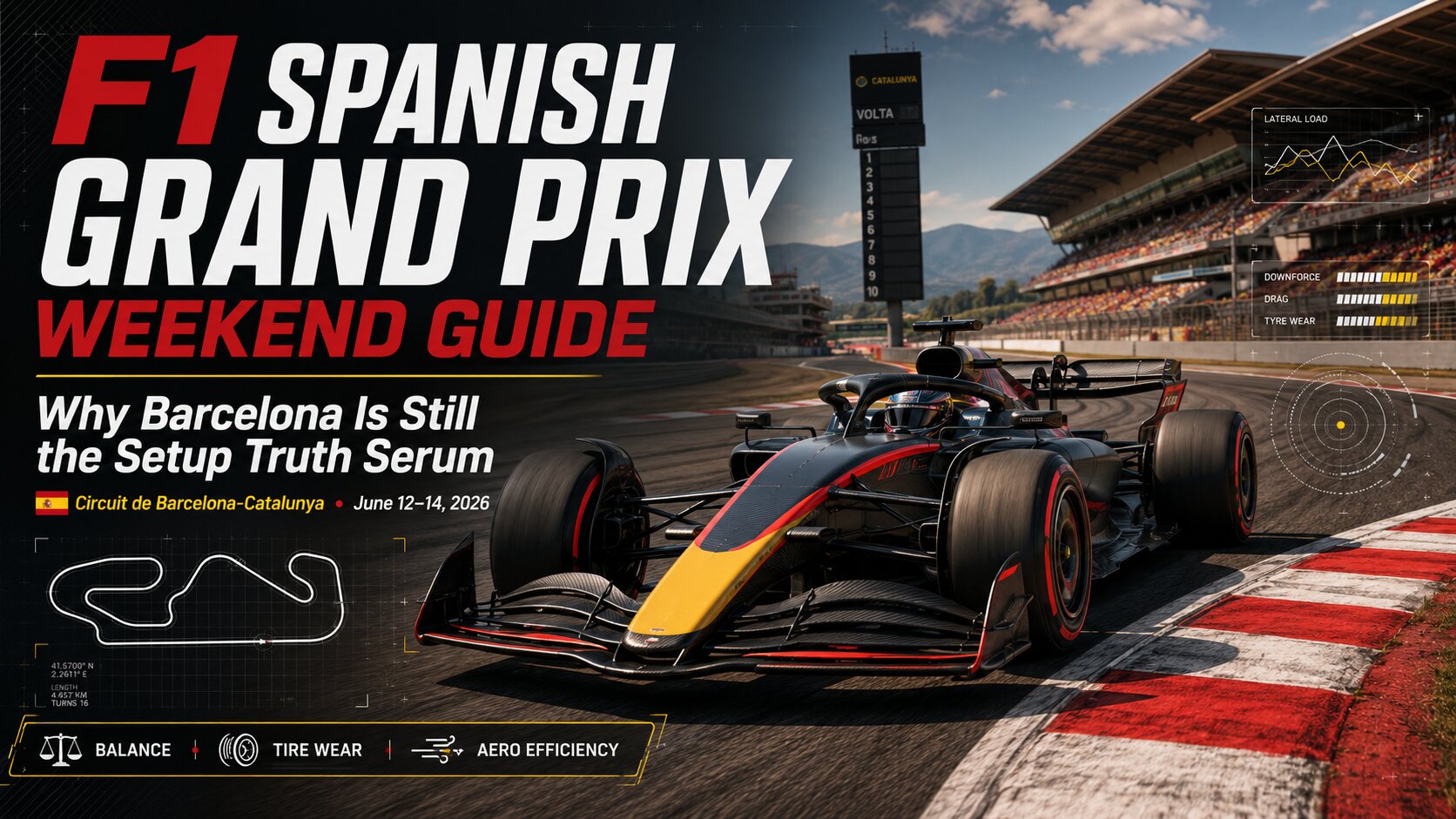
F1 Spanish Grand Prix Weekend Guide: Why Barcelona Is Still the Setup Truth Serum
Some F1 weekends feel like pure theater. Barcelona tends to feel like a lab report, the kind you cannot sweet talk your way through. The 2026 Formula 1 calendar lists the Spanish Grand Prix at Circuit de Barcelona-Catalunya for June 12-14, and if you care about who has a real car versus who has a one-lap wonder, this is still one of the best reality checks on the schedule.
The track is not new, not glamorous in a Monaco way, and it rarely flatters a flawed setup. That is exactly why it matters.
Weekend basics (June 12-14, 2026)
Officially, the Spanish Grand Prix runs June 12-14, 2026 at Circuit de Barcelona-Catalunya (per Formula 1’s published 2026 race calendar). Sessions follow the usual Grand Prix weekend structure with practice on Friday, qualifying on Saturday, and the race on Sunday. Exact session times vary by broadcast and local scheduling; F1 typically publishes detailed timetables closer to the event.
Why Barcelona exposes balance like few other tracks
Barcelona-Catalunya is a classic “does your car do everything?” circuit. It mixes long loaded corners with slower sections that punish traction and front end response. When a car has a narrow operating window, you tend to see it here: understeer that cooks the front tires, rear instability that forces conservative wing choices, or a platform that cannot stay consistent as fuel burns off.
Teams love to talk about “correlation” between wind tunnel, simulator, and track. Barcelona has traditionally been one of the places where those claims get tested because you need an honest aerodynamic platform and predictable mechanical grip to put together a full lap. If either end of the car is fussy, the lap time bleeds out over multiple corners instead of hiding in one braking zone.
Tire behavior gets loud here
If you watch one thing this weekend, watch tire management trends across stints. Barcelona’s sustained cornering loads tend to stress tires in a way that makes degradation patterns obvious. You can see whether a team is sliding the fronts on entry, overheating rears on exit, or simply asking too much of the compound over long runs.
That has knock-on effects for strategy and qualifying. A car that is gentle on its tires can look merely “fine” on Saturday, then suddenly become a Sunday problem when others fall off. Conversely, a car that lights up the tires might still grab headlines in qualifying trim but struggle to repeat pace once temperatures stabilize and everyone is managing.
Aero efficiency: not just downforce, but usable downforce
Barcelona rewards downforce, but it also punishes drag if your car cannot carry speed cleanly. This is where aero efficiency becomes more than a buzzword. You want load in medium and high speed corners without paying too much on the straights, and you want that load to be stable when the car rolls and pitches.
For fans who also follow performance cars in the U.S., think of it like dialing in a track-day setup where adding wing angle helps your corner speed but starts to hurt you on long straights. The best setups are not just “more grip.” They are balanced packages that let you brake straight, rotate predictably mid-corner, and put power down without scrubbing speed.
What to watch: clues that translate beyond Spain
Long-run pace in practice: If a team looks calm on tire wear while maintaining consistent lap times, that is usually real performance. It often travels well to other circuits.
Qualifying compromises: Pay attention to who looks edgy over curbs or struggles with rear stability. Those are classic signs of a car that needs a narrow setup window to be fast.
Overtaking reality: Barcelona has historically been sensitive to track position. When passing is tough, teams lean harder on strategy execution and pit stop timing. It becomes a pressure test for operational sharpness as much as raw pace.
The competition context
This weekend tends to sharpen the pecking order because it is hard to fake a complete package here. That does not mean it predicts every future result; street circuits and low-grip tracks can flip form quickly. But if one team shows up with clean balance, stable aero behavior, and controlled tire degradation at Barcelona, it is usually a sign their baseline is strong.
As for “competitors,” it is less about naming one rival and more about separating archetypes: high-downforce specialists versus efficient all-rounders; cars that are quick over one lap versus cars that stay polite over 60 plus laps; teams that can change setup direction without getting lost versus teams that chase their tail all weekend.
Why U.S. fans should care (even if you never race in Spain)
American motorsport culture understands truth-serum tracks. Think of places where chassis balance matters more than hero braking: Road America in endurance trim, Barber when grip falls away, even certain NASCAR road courses when tire falloff becomes the story. Barcelona sits in that same category for F1.
And if you are the type who does track days or follows performance-car setup debates online, this weekend is relatable. It is about fundamentals: platform control, aero stability, tire temperature discipline. The flashy stuff can wait for Monaco or Vegas. Barcelona tells you who built a car you can actually lean on.
Quick take
The Spanish Grand Prix weekend (June 12-14) is not always the loudest race on the calendar, but it is one of the clearest mirrors F1 holds up to itself. If your car has balance, it shows. If your tires are fragile, everyone sees it. And if your aero map only works in perfect conditions, Barcelona has a habit of calling your bluff.
0 comments
Join the discussion around this article.
Please login to comment.