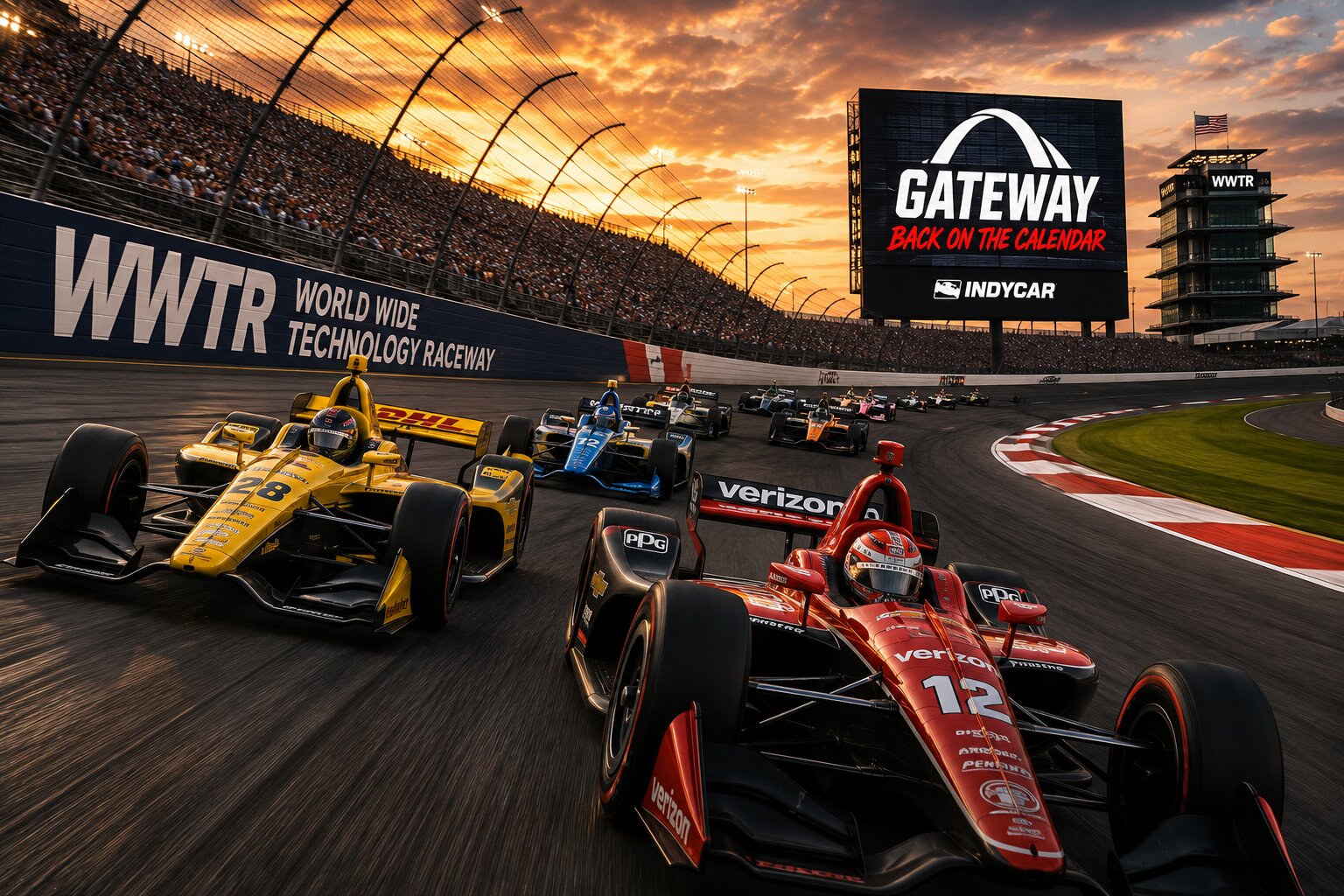
Gateway is back on the calendar, and it never races like you think it will
IndyCar’s annual stop at World Wide Technology Raceway (WWTR) in Madison, Illinois, looks straightforward on paper: a 1.25 mile oval just across the river from St. Louis, big grandstands, big speeds, and plenty of room to pass. Then the green flag drops and it turns into something more specific and more frustrating: a draft, brake, and patience test where the fastest car is not always the one leading at lap 50.
Official timing for the 2026 WWTR weekend is posted on IndyCar’s schedule page (times are listed there in local event time). If you are planning travel, or just setting your streaming reminders, use that page as the source of truth because session times can shift with TV windows and weather.
The shape matters: why this oval feels “pointy”
WWTR is an egg shaped 1.25 mile oval with noticeably different corner radii. That asymmetry is the whole deal. Drivers talk about how you cannot run identical lines in Turns 1 and 3, and it shows up in how teams trim the car and manage balance over a stint. You see cars that look planted in one end of the track and a little nervous in the other, especially as tires age and traffic builds.
Compared with Indianapolis Motor Speedway’s 2.5 mile rectangle, Gateway asks for more steering input and more brake commitment per lap. Indy is its own kind of precision at huge speed, but WWTR feels busier. The corners come at you faster, the closing rates in traffic feel more urgent, and there is less time to “reset” mentally on the straights.
Drafting plus braking zones equals constant chess
This place rewards drivers who can live in dirty air without cooking the front tires. The aero wake off an IndyCar at oval speed steals front downforce, so following closely can push you up the track. The catch is that you need to follow closely to get the tow. That tension creates long stretches where a driver sits half a car length back, waiting for the moment when the lead car finally misses an apex by a foot or has to lift earlier than planned.
Gateway also has real braking compared with superspeedway style running. Nobody calls it a road course, but you do see distinct lift and brake phases into the corners. That makes passes feel more like outbraking setups than pure slingshots. It is one reason late race restarts can get messy: everyone arrives at Turn 1 with a draft run, limited visibility, and just enough brake pressure to create accordion effects if somebody checks up.
Traffic is not background noise here; it is the race
If you are used to Indy where clean air can be king for long stretches, WWTR tends to compress things. Leaders catch lapped traffic sooner relative to stint length because of the shorter lap and the way packs form. That brings strategy into play even when nobody wants it. A well timed caution can flip track position quickly, but even without cautions, getting trapped behind slower cars can cost a leader their rhythm and invite challengers right back into range.
It also changes how drivers defend. You will see more lane choice games, especially on corner entry. Give up the bottom too easily and someone will fill it. Pin yourself too low and you might burn your right front tire trying not to drift into marbles.
Pit strategy: clean exits and timing over hero fuel numbers
On ovals like WWTR, pit lane execution is often worth more than theoretical pace. A slightly slow stop hurts because you can rejoin in traffic and lose the draft train you need to attack. Conversely, a clean stop and a good merge can drop you into a pocket where you can run qualifying style laps until the cycle shakes out.
I am not going to throw out fuel window numbers here because they depend on caution patterns, engine mapping, and team approach, and IndyCar does not publish a single fixed “right” answer for fans to rely on. What is consistent is the mindset: teams chase track position but have to respect that fresh tires can be powerful if you rejoin with clean air or at least clean space.
Why it matters for the championship picture
Gateway has a habit of rewarding complete weekends: qualifying that avoids mid pack chaos, race craft that survives restarts, and pit work that does not give away momentum. For contenders, it is one of those nights where banking solid points can be smarter than forcing a three wide move that only works if everyone else agrees to it.
For fans who care about performance culture beyond IndyCar, WWTR is also a reminder of what “oval racing skill” really means in America. It is not just holding it wide open. It is managing aero wash like you would manage understeer in traffic at a track day, choosing when to attack so your tires still exist at the end, and understanding that patience can be a performance advantage.
Check IndyCar’s official schedule page for 2026 session times at WWTR, then settle in for a race where drafting helps you close, braking helps you pass, and patience helps you finish with something left to fight with.
0 comments
Join the discussion around this article.
Please login to comment.