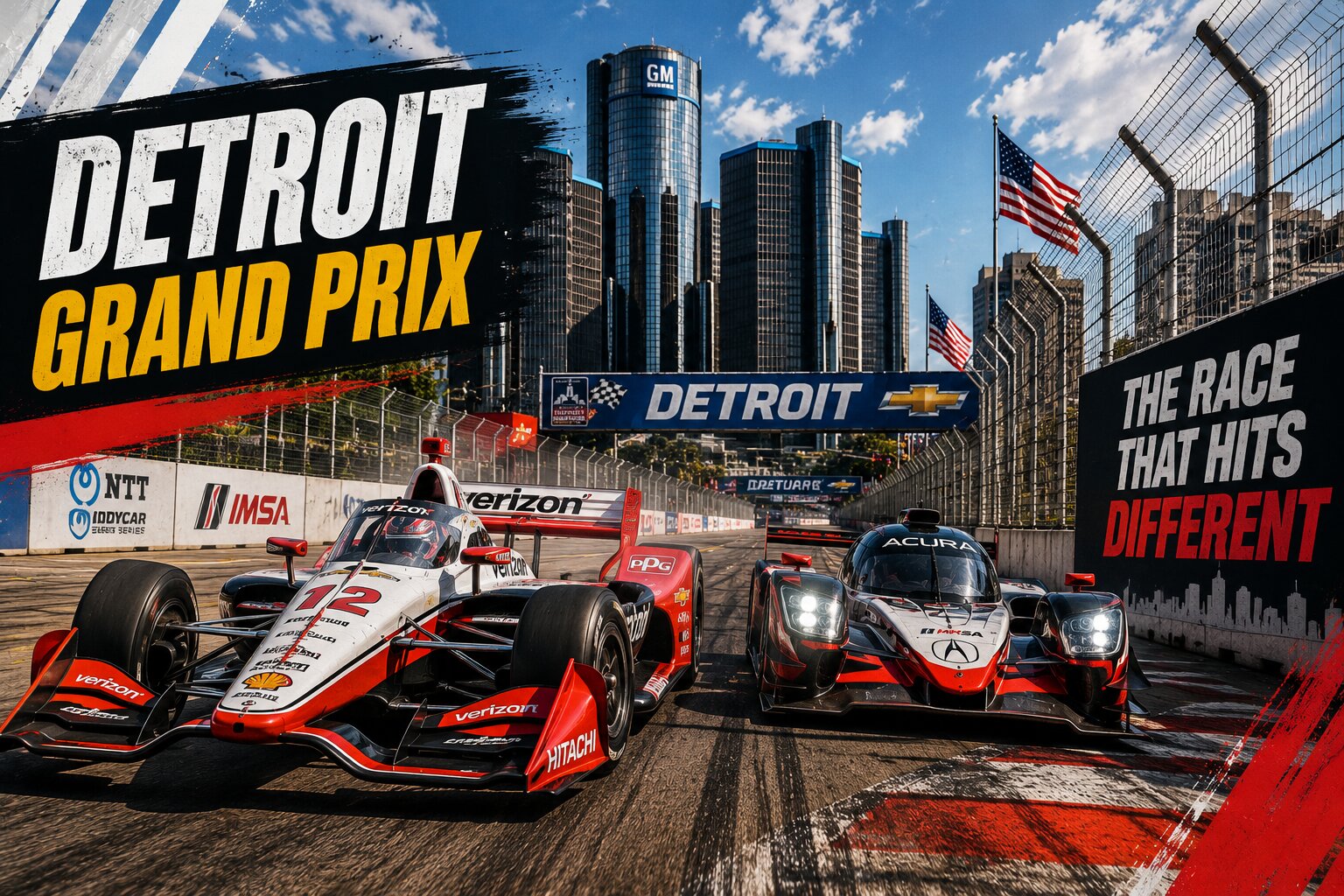
Detroit Grand Prix Weekend Guide: what’s racing, when it happens, and why this place bites
Downtown Detroit is back in race mode on the current street circuit around the Renaissance Center, with IndyCar headlining and IMSA bringing the sports car noise. The vibe is very different from a permanent road course. There is no “settling in” here. Every lap is a negotiation with concrete walls, manhole covers, paint stripes, and braking zones that change as rubber goes down and the surface heats up.
If you are a casual viewer, Detroit is an easy sell: short lap, close barriers, big consequences for tiny errors. It’s also a useful reminder for anyone who does track days. Precision matters everywhere, but on a street circuit the penalty box is literally a wall.
The official schedule: where to get it, and what the weekend structure looks like
For exact session times, use the official Detroit Grand Prix event schedule and the official IndyCar and IMSA weekend schedules. Those are the only sources I trust for publishable times because they can shift with TV windows, weather, or series operations. (If you are going in person, check again the morning of each day.)
Structure-wise, the rhythm is consistent even when times move around:
Friday is about opening practice for both series plus qualifying prep. You will see teams doing short runs on sticker tires to find grip fast, then longer stints to understand how the surface changes.
Saturday typically stacks qualifying and support races earlier in the day, with at least one major headline session (often IndyCar qualifying and/or race activity depending on the year’s format). This is also when the track feels most “alive” because rubbering-in happens quickly on a tight street layout.
Sunday is race day energy. Expect sharper strategies and fewer freebies. Cautions are common on street circuits across IndyCar and IMSA because there is so little runoff.
Why Detroit drives nothing like Road America (or your local track day)
A permanent road course gives you margin. Wide exits, predictable curbing, consistent pavement, and usually more visibility through corners. Detroit gives you almost none of that. The racing line can be narrow, and it moves as grip comes and goes. Braking zones feel shorter because walls compress your sense of speed, and because there is no room to “save it” once you are off line.
The surface is another big deal. Street circuits tend to be bumpier and less uniform than purpose-built tracks. That affects everything: how early a driver can commit to throttle, how stable the car stays under trail braking, how much curb a team dares to use, and how aggressively engineers can run ride height without risking bottoming or upsetting the platform.
IndyCar: qualifying matters more than people want to admit
IndyCar on a street circuit turns qualifying into a pressure cooker. Passing exists, but clean air and track position still matter because one small mistake can stack up into a yellow that flips strategy or traps faster cars behind slower ones.
What to watch even if you are not deep into setups: look for drivers who can consistently place the car within inches of corner entries without brushing the wall. That sounds simple until you see how little steering correction you can get away with on cold tires or in traffic.
IMSA: different cars, same problem, no room for errors
IMSA brings multi-class complexity to an already high-consequence environment. Faster prototypes carving through GT traffic is always part chess match, part trust exercise. On streets it gets spicier because closing speeds arrive at awkward places: corner entry bumps, narrow chicanes, and exits where everyone wants the same piece of pavement.
If you are new to IMSA viewing, focus on how patient the lead-class drivers are in traffic. The best ones do not just “send it.” They time passes so they do not compromise their own exit or force a GT car into a wall with nowhere to go.
Street circuits punish small mistakes for real mechanical reasons
This is not just drama talk. A tiny lockup can flat-spot a tire enough to shake the car under braking for the rest of a stint. A brush with concrete can bend suspension or knock toe out of spec. Even if it does not end your day immediately, it can turn a fast car into something that chews tires or refuses to rotate.
For performance-car folks watching from home, it’s also a good reminder about setup tradeoffs you feel at track days: softer compliance helps over bumps but can dull response; stiffer platforms sharpen turn-in but punish you when pavement gets ugly. Street circuits force those compromises into the spotlight.
The quick viewer checklist
Watch Turn 1 chaos potential: starts and restarts compress everyone into narrow real estate.
Look for tire management clues: drivers who keep it clean often climb late when others fall off from damage or vibration.
Pay attention to pit timing under cautions: street races reward teams that stay calm when strategy gets scrambled.
Why it matters
Detroit is one of those weekends where execution beats raw pace more often than fans expect. It’s American motorsport at its most honest: big power, tight walls, zero patience for sloppy inputs. Whether you are tuning in for IndyCar’s knife-edge qualifying or IMSA’s multi-class traffic ballet, this is a weekend where “almost” is usually not enough.

0 comments
Join the discussion around this article.
Please login to comment.