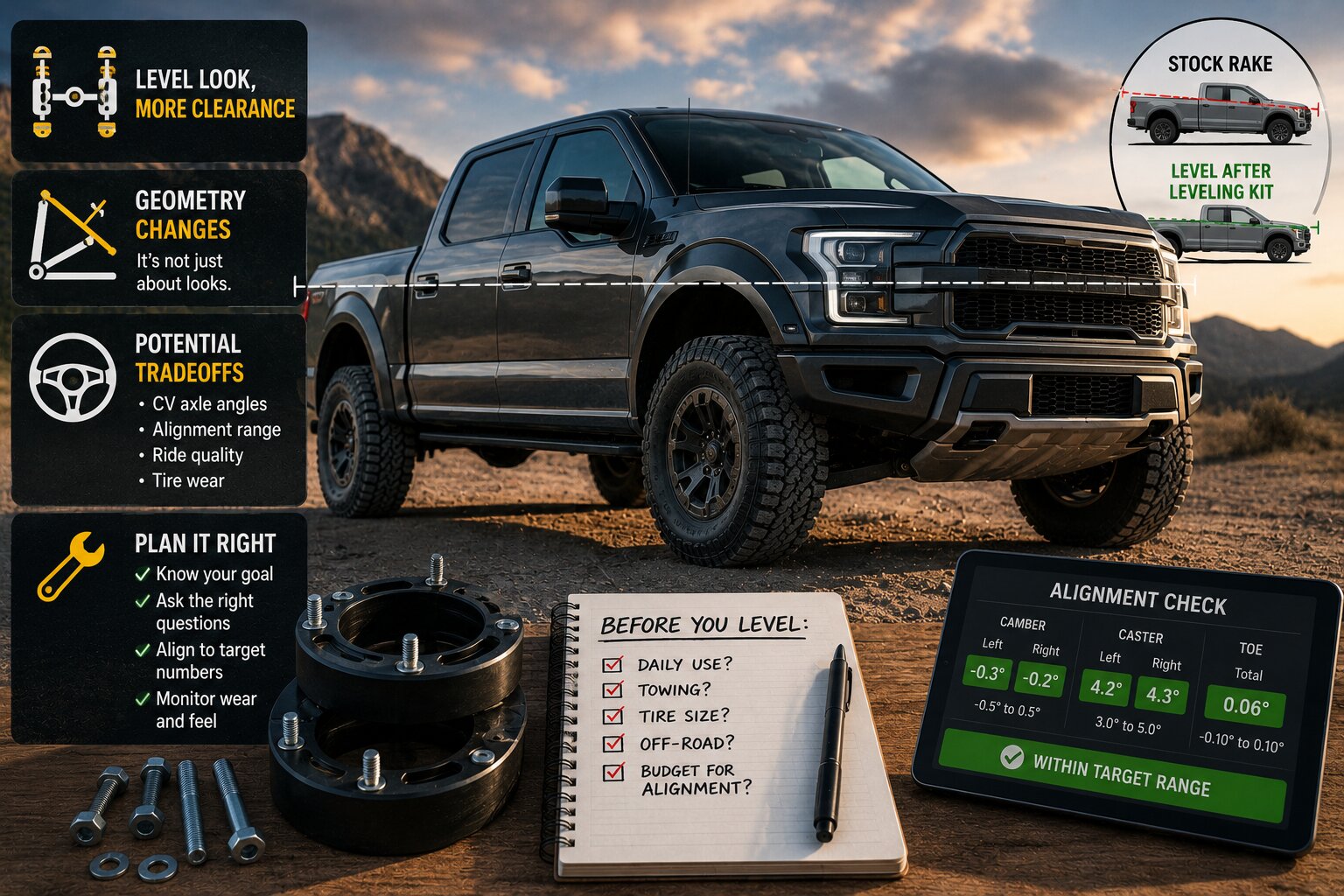
The leveling kit temptation (and why it’s so common)
Walk any dealer lot in the U.S. and you’ll see it: most half-tons and full-size SUVs sit nose-down from the factory. That rake is intentional. Automakers build it in so the truck looks level once you hook up a trailer, load the bed with gravel, or toss a slide-in toolbox behind the axle. It also helps keep headlight aim legal when the rear squats under load.
But the day-to-day reality for a lot of owners is commuting, errands, and weekend projects, not constant towing at max capacity. So that nose-down stance starts to feel like wasted ground clearance and a missed opportunity for tire fitment. Enter the leveling kit. Usually it’s a front spacer, sometimes a different spring or strut setup, installed to raise the front ride height so the truck “sits right.”
The part nobody says out loud is that you’re not just changing how it looks. You’re changing suspension geometry. And geometry always sends a bill later, usually in steering feel, alignment numbers that won’t quite land where you want them, and wear items that start living a harder life.
Verified basics: what a leveling kit typically does mechanically
Most leveling kits on modern independent front suspension trucks and SUVs raise the front by spacing the strut assembly down from the frame or changing spring preload (depending on design). On many popular U.S.-market platforms, that means you are effectively pushing the suspension closer to its droop limit at rest. The control arms sit at a different angle than stock. The CV axles also run at a steeper angle than they did before.
On solid-axle front ends (common on heavy-duty pickups), leveling can be done with taller coil springs, spacers, or torsion bar adjustment on older designs. The details change, but the theme stays the same: you are moving the axle or control arms away from their factory “happy place,” then asking everything attached to keep behaving normally.
One important note up front: exact lift amounts vary by kit and application, and manufacturers publish different limits for different suspensions. Rather than pretend there’s one universal safe number, treat lift height as a lever. The more you add, the more every angle changes.
The geometry tradeoffs nobody mentions at checkout
A leveling kit is often sold like it’s just cosmetic. It’s not. Here are the big three tradeoffs that show up in real ownership.
1) CV axle angles and boot life (4x4 and AWD especially)
On an IFS 4x4 or AWD truck, each front wheel is driven by a CV axle with joints designed to operate smoothly through suspension travel and steering angle. When you raise the front ride height without relocating the differential, you increase the operating angle at rest. That means the joint spends its entire life working harder than it did stock.
What owners notice first is usually not “my CV angle is steep.” It’s small stuff: a new vibration under load, a faint clicking on turns if something is already worn, or torn CV boots earlier than expected because they’re flexing more all the time. Not every leveled truck eats CVs, but the risk goes up as angles get steeper and as tire size and traction increase.
2) Alignment range (caster and camber) gets tighter
Lifting the front changes where your upper and lower control arms sit in their arc. That affects camber (tilt of the tire) and caster (the fore-aft steering axis angle that helps trucks track straight). Many trucks can be aligned after a mild level using factory adjusters, but sometimes you end up with numbers that are technically “within spec” yet not ideal for how you use the truck.
Caster is a big one for steering feel. Less caster often means lighter steering and less self-centering. It can also mean more wandering on crowned highways or in crosswinds, which is exactly when you want your truck to feel calm. If your alignment tech can only get caster barely into range after leveling, you may feel it every day even if nothing is “wrong.”
3) Ride quality changes because you changed where travel lives
On many IFS setups, raising ride height with spacers reduces available droop travel because you’re starting closer to full extension. That can make the front end top out over sharp dips or washboard roads. It can also change how quickly the suspension hits bump stops on compression depending on design.
The subjective result varies: some trucks feel firmer and busier over broken pavement; others just feel different in a way that’s hard to describe until you’ve lived with it for a week. The point is simple: you didn’t just lift it, you shifted its operating range.
How this shows up in daily driving: steering feel, tire wear, noise
Most owners don’t crawl under their truck with an angle finder after installing a leveling kit. They drive it to work, hit an on-ramp, then start noticing little personality changes.
Steering that feels lighter or less planted
If caster drops compared to stock, straight-line stability often takes a hit. A half-ton that used to track cleanly might now need more small corrections at 70 mph. It’s not dramatic for everyone, but it can be annoying if you do long highway stretches or tow frequently.
Tire wear that starts talking back
Camber that ends up slightly off can chew shoulders faster than expected, especially with heavier all-terrain tires that already have chunky tread blocks. Toe settings matter too; toe that is even slightly out can scrub tires quickly on a heavy front end.
The frustrating part is how it sneaks up on you. The truck drives “fine,” then 8,000 miles later your front tires look like they’ve been sanding asphalt on one edge.
More road texture through the wheel
Changing angles can change bushing preload and how forces feed back into the chassis. Add heavier tires or different offsets and you amplify it further. Some people like that more direct feel; others just hear more thump over expansion joints and wonder why their new stance came with extra noise.
Capability-first reality check: ground clearance vs usable clearance
A level does increase approach clearance at the nose because you physically raised the front bumper area relative to the ground (exact gains depend on lift amount and tire size). For trailheads with ruts or steep driveway transitions, that can be genuinely useful.
But there’s another side to capability: how well your suspension keeps tires planted when terrain gets uneven.
If your leveling method reduces droop travel up front, you may lift a tire sooner when crawling over diagonals or washouts. Traction control systems can help mask that by braking spinning wheels (many modern trucks do this well), but there’s no substitute for keeping rubber on dirt.
This is where “truck-first” thinking matters. If your use case is fire roads, mild overlanding loads, and snow-covered county roads, a mild level plus good tires can make sense. If your weekends involve articulation-heavy trails or high-speed desert chatter bumps where droop control matters, geometry choices start to matter more than stance.
Towing and hauling: why rake existed in the first place
Factory rake is basically future planning for payload and tongue weight. Leveling removes some of that reserve visual stance.
Hook up a trailer after leveling and many trucks will squat more noticeably in back unless you address rear support separately (how people do that varies widely). Squat changes headlight aim, steering geometry at speed (because now both ends are altered), and overall confidence when merging or braking hard with weight behind you.
This isn’t about shaming leveling kits; it’s about being honest about priorities. If towing is frequent and heavy for your setup, ask yourself if looking level empty is worth being tail-low loaded.
Independent front suspension vs solid axle: different headaches
IFS trucks and SUVs
IFS dominates half-tons and most full-size SUVs because it rides well on pavement and packages nicely around engines and crash structures. It also means CV joints exist on 4x4/AWD models, alignment settings are more sensitive to ride height changes, and control arm angles matter constantly.
Solid-axle heavy-duty pickups
Many HD trucks use a solid front axle for strength under heavy loads. Leveling here often changes caster through link geometry or requires correction methods depending on design. Steering stabilizers sometimes get blamed for wander when caster is really the underlying issue. The parts differ from IFS problems, but alignment still matters just as much.
The shop conversation that separates good installs from headaches
If you want fewer surprises after leveling, treat it like any other functional modification: ask questions before parts go on.
Questions worth asking your shop:
“Can you align it to target numbers, not just green boxes?”
Many alignment racks show “in spec” ranges in green even when settings are at the edge of acceptable. Ask what caster they expect to achieve after leveling for your truck’s use case (daily highway vs off-road vs towing). If they sound unsure or dismissive, that’s information.
“Will this reduce droop travel or cause top-out?”
A good tech will understand what method is being used (spacer vs spring change) and what that does to travel limits on your specific suspension layout.
“Do I need additional parts to keep alignment stable?”
Depending on platform and lift amount, some setups benefit from components that restore adjustability or correct angles. I’m not naming brands here because fitment depends heavily on model year and suspension design; what matters is whether your shop knows when factory adjusters run out of room.
“What happens to CV angles on this truck at this height?”
Even if they don’t measure angles precisely (most shops don’t), they should be able to explain whether your chosen height tends to accelerate wear on your platform based on experience.
Real-world symptoms after leveling (and what they usually mean)
You’ll see patterns across owners because physics doesn’t care about trends.
Highway wander or less return-to-center: often points to caster reduced compared to stock or uneven caster side-to-side.
Squeaks/clunks over sharp bumps: can be sway bar end link angles, control arm bushings now working at a different preload position, or top-out events depending on setup.
Vibration under acceleration in 4x4/AWD: sometimes related to CV operating angles or wear revealed by new geometry.
Uneven front tire wear: commonly toe or camber issues after install or after components settle.
The emotional arc here is predictable too. At first you’re satisfied because it looks right in the driveway and clears those tires better. Then annoyance creeps in if it starts feeling nervous at speed or if tires wear faster than expected. Neither reaction is wrong; they’re both part of paying attention to what changed mechanically.
Trim differences matter more than people admit
This gets missed in online advice because everyone talks in generalities like “F-150” or “Silverado,” but trims vary widely in real hardware: wheel diameter options change sidewall height; off-road packages may have different shocks; some models use adaptive dampers; some have heavier skid plates; some have different factory ride heights; some have different tire load ratings from new.
I’m not going to claim specific trim-by-trim specs here because they vary by year and configuration and are easy to misstate without pulling exact build data. The practical takeaway is simple: leveling results depend on what your truck started as.
A grounded approach: how to decide if leveling fits your use case
I look at leveling kits like any other mod: define your mission first.
If your truck spends most of its life unloaded with occasional light towing, a mild level can be reasonable if you budget for an alignment done by someone who cares about target settings. If your plan includes larger tires plus lots of 4x4 use under load (snow plowing driveways, muddy fields, steep forest roads), pay extra attention to CV angles and long-term wear expectations.
If towing heavy is routine, consider whether keeping some rake actually serves your capability goals better than looking perfectly flat empty. A truck that looks aggressive but feels loose with a trailer behind it gets old fast.
The part I wish more people said out loud
A leveling kit isn’t automatically bad engineering. It’s just an engineering change made for aesthetics plus clearance goals rather than for balanced factory targets like stability under load, component life across warranty periods, and predictable alignment margins across millions of builds.
If you go into it eyes open, ask your shop better questions than “can you slap this on,” then pay attention afterward with an honest read of steering feel and tire wear patterns, leveling can be part of a capability build instead of just driveway fashion.
The best feeling isn’t seeing a level stance in a parking lot mirror. It’s driving straight down an interstate in crosswind with one hand relaxed on the wheel, knowing your alignment is right and your front end isn’t quietly protesting every mile.
0 comments
Join the discussion around this article.
Please login to comment.