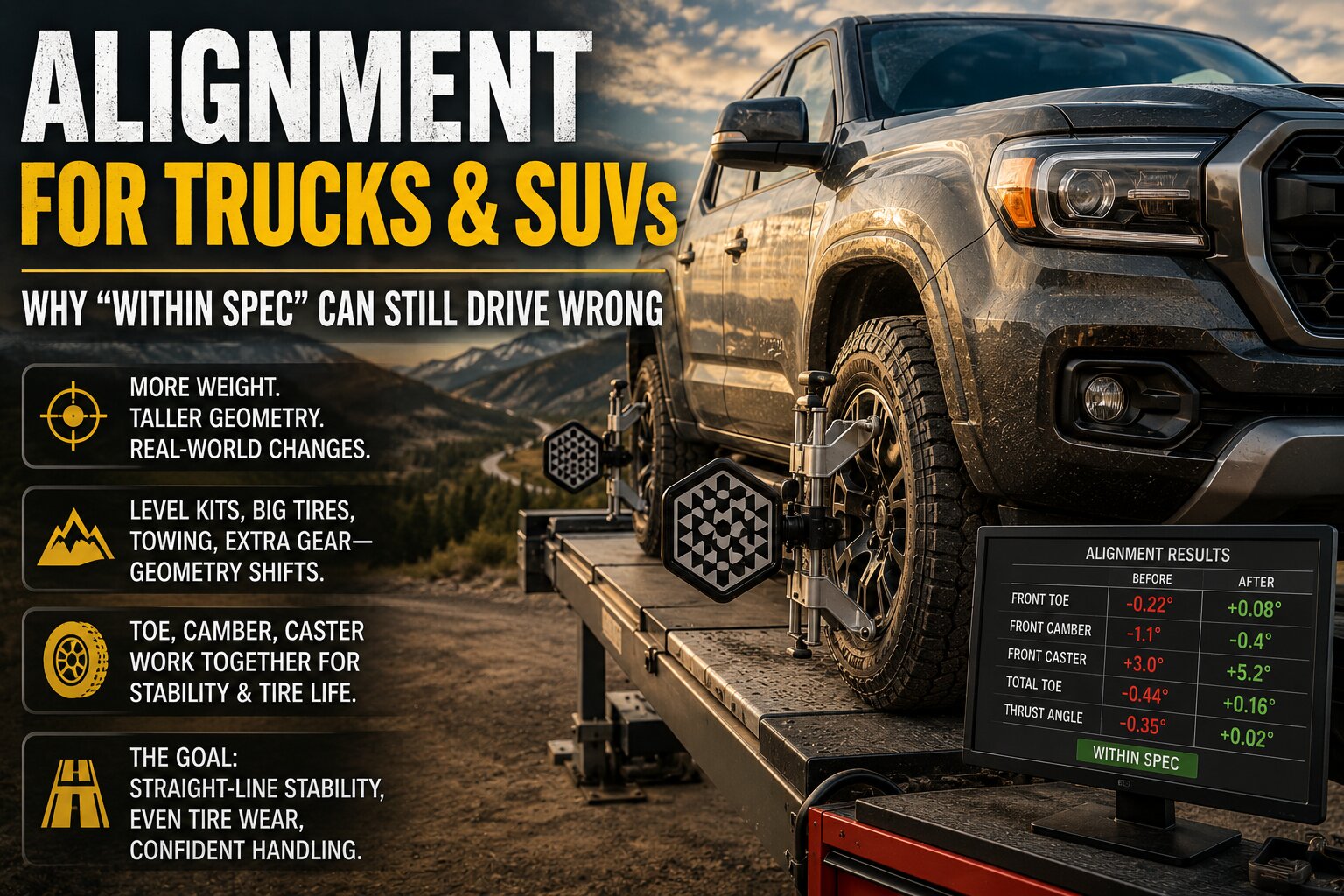
Why this topic keeps coming up in truck and SUV circles
Alignment sounds like a set it and forget it service, the kind of line item you approve while waiting on tires. For trucks and SUVs, it rarely stays that simple. These vehicles carry more weight, run taller suspension geometry, and often see real-world changes that sedans never do: a leveling kit to fix factory rake, larger all-terrain tires, heavier wheels, a front bumper or winch, towing on weekends, and sometimes a mild lift that is mostly about driveway presence. Each of those changes shifts the relationship between toe, camber, caster, and ride height. The frustrating part is that an alignment printout can show every number “within spec” and the vehicle can still feel wrong.
This is not a track setup problem. It is a street problem. The goal is predictable straight-line stability at highway speeds, calm steering on crowned pavement, even tire wear, and braking that feels consistent. When those boxes are checked, a truck feels expensive again. When they are not, it can feel nervous or sloppy even if nothing is technically broken.
Verified facts: what “spec” usually means for trucks and SUVs
Most modern light trucks and SUVs sold in the U.S. use independent front suspension (often double wishbone or strut-based layouts depending on the platform) with adjustable toe and at least some camber adjustment at the front. Many also have adjustable caster at the front via eccentrics or slotted mounts, though adjustment range varies by design. Rear suspensions vary widely: solid rear axles with leaf springs on many pickups, multi-link coils on some SUVs, and independent rear suspensions on others. Rear toe and camber may be adjustable on independent setups; on solid axles they typically are not without aftermarket parts.
Alignment specifications are published by manufacturers as acceptable ranges for toe, camber, and caster (and sometimes thrust angle). Those ranges are designed around stock ride height, stock wheel and tire sizes, and normal load assumptions. They also allow for production tolerances and bushing compliance. That “range” is important: it means there is no single magic number that fits every use case.
Common competitors in the U.S. truck and SUV market include models such as the Ford F-150 and Ranger, Chevrolet Silverado 1500 and Colorado, Ram 1500, Toyota Tacoma and Tundra, Jeep Wrangler and Gladiator, Toyota 4Runner, Chevrolet Tahoe and Suburban, GMC Yukon, Ford Expedition, Toyota Highlander and Grand Highlander (crossover-based), Honda Pilot, Kia Telluride, and Hyundai Palisade. These vehicles span very different suspension designs and weights. The alignment principles are shared even when the hardware is not.
Specific numeric specs vary by model year and trim; publishing exact target angles without a vehicle-specific service manual risks being wrong. The useful takeaway is how each angle behaves on the road and how to choose targets within the allowed range based on symptoms.
The three angles you actually feel: toe, camber, caster
Toe is the direction the tires point relative to the centerline of the vehicle when viewed from above. Toe-in means the fronts of the tires point slightly toward each other; toe-out means they point away.
On the street, toe is often the biggest contributor to steering feel and tire wear. Too much toe-in can make a truck feel stable but reluctant to turn in. It can also scrub tires if excessive. Too much toe-out can make initial turn-in feel sharp but can also make a vehicle wander or dart with road grooves. Many drivers describe it as having to constantly “manage” the wheel on the highway.
Camber is the inward or outward tilt of the wheel when viewed from the front of the vehicle. Negative camber means the top of the tire leans inward; positive camber means it leans outward.
Camber affects cornering grip balance and tire wear across the tread. Too much negative camber tends to wear inner shoulders faster in typical commuting if toe is not well controlled. Too much positive camber can reduce cornering confidence and can contribute to outer shoulder wear depending on driving style and inflation pressure.
Caster is the fore-aft tilt of the steering axis when viewed from the side of the vehicle. More positive caster generally improves straight-line stability and steering self-centering. It also increases steering effort somewhat.
Caster is one reason trucks can feel planted at speed when tuned well. It is also one reason a lifted truck can feel oddly light or vague if caster drops after ride height changes (a common outcome depending on suspension design). Even when toe is perfect, low caster can leave you with a steering wheel that does not naturally return to center or a vehicle that feels busy on long highway stretches.
Why “within spec” can still drive wrong
An alignment machine prints green boxes because each measured value falls somewhere inside an acceptable window. That window can be surprisingly wide because manufacturers need to account for component tolerances, bushing deflection under load, fuel tank level assumptions, and different tire options across trims.
If one side of the front axle sits near one end of the range while the other side sits near the other end, you can get a vehicle that technically meets spec but still pulls or feels inconsistent left versus right. Cross-camber (difference side to side) and cross-caster matter for how a vehicle tracks on real roads with crown.
Road crown itself complicates diagnosis. Most U.S. roads slope slightly for drainage; many vehicles will drift gently right even when aligned correctly because gravity is doing its job. A tech may aim for slight cross-caster or cross-camber to counteract typical crown behavior (within manufacturer limits). If they do not ask where you drive or what you feel, they may set everything centered in range but not optimized for your reality.
Then there is load. A truck that spends weekdays empty but weekends towing will squat differently at speed than one that carries tools every day. Ride height changes alter control arm angles; control arm angles alter camber gain through suspension travel; that changes how tires meet pavement during braking and bumps. A single static alignment snapshot cannot capture every dynamic condition.
The modification trap: lifts, leveling kits, bigger tires
The most common street modification affecting alignment is a front leveling kit or mild lift. The intent is usually cosmetic or practical: fit slightly larger tires without rubbing; reduce factory nose-down stance; improve approach angle for light off-road use.
The tradeoff is geometry. On many independent front suspensions, raising ride height changes where control arms sit in their travel range at rest. That frequently reduces available positive caster unless corrected with adjustable arms or specific hardware designed to restore geometry (what parts exist depends heavily on platform). Camber curves change too; you might regain static camber with adjustment but still have different camber behavior over bumps than stock.
Larger tires add another layer. Heavier all-terrain tires often have stiffer sidewalls than highway tires; they can follow grooves differently (tramlining) and transmit more feedback through steering components. Larger diameter also changes effective gearing; while that is more powertrain than chassis tuning (engine rpm at speed shifts), it matters because drivers sometimes mistake altered acceleration feel for alignment-related drag or “binding.”
None of this means you should not modify a daily-driven truck or SUV. It means your alignment target should be chosen intentionally after modifications instead of defaulting to “green boxes.”
How alignment angles show up as symptoms
Wandering or constant corrections at highway speeds: Often linked to toe settings that are too close to zero or into toe-out for that vehicle’s compliance characteristics; low caster after ride height changes can amplify it. Tire construction matters too; some aggressive tread patterns simply require more attention.
Dartiness over expansion joints: Can be toe-related but also shows up when bushings are worn or when tire pressures are high relative to load (common after installing LT-rated tires on an SUV). Alignment cannot fix every harshness complaint; it can only ensure geometry is not making it worse.
Pulling left or right: Sometimes crown related; sometimes cross-camber or cross-caster related; sometimes brake drag or tire conicity (a tire itself pulling) masquerading as alignment trouble. A simple diagnostic step many shops use is swapping front tires side-to-side to see if pull direction changes.
Steering wheel off-center: Usually toe adjustment not centered properly relative to steering rack position (or rear thrust angle issues on vehicles with adjustable rear toe). This matters more than aesthetics because some driver assistance systems expect accurate steering angle calibration.
Tire wear: Feathering across tread blocks often points to toe issues; inner shoulder wear often involves negative camber combined with toe; cupping can involve dampers/shocks as much as alignment.
A street-first approach to targets (without pretending there’s one perfect number)
A sensible street alignment for many trucks and SUVs prioritizes stability and tire life over razor-sharp turn-in. That usually means aiming for a modest amount of total toe-in within factory allowances rather than running near-zero toe just because it looks tidy on paper. It also often means pushing caster toward the higher end of allowable range if adjustability exists, especially after a leveling kit or lift where self-centering may have softened.
Camber targets depend heavily on tire choice and how much adjustment range remains after ride height changes. For typical daily use with regular rotations, staying near factory-recommended camber values tends to preserve tread life better than chasing aggressive negative camber for cornering grip you may never use on public roads.
The key is consistency side-to-side unless there is a deliberate plan to counter road crown within safe limits set by manufacturer guidance.
Communicating with an alignment tech: what helps them help you
The best alignments I have seen start with a short conversation that sounds almost too basic: what changed since it drove well? What tires are on it? Is there a lift or leveling kit? Do you tow? Do you carry weight daily?
If you want better results than “set it to spec,” give specific symptoms in plain language:
Describe speed and conditions: “It wanders most at 65 to 75 mph,” or “it darts when I hit bridge joints.” This points them toward toe stability versus bump steer tendencies.
Name directionality: “It pulls right even on flat parking lots,” versus “it drifts right only on crowned highways.” That distinction matters because crown compensation strategies differ from true pull fixes.
Mention steering return: “The wheel does not self-center after turns,” often points toward low caster (or friction in steering components).
Tire wear evidence: Bring photos of tread shoulders if possible; say whether wear shows feathering you can feel by running your hand across tread blocks (carefully). That helps separate toe scrub from camber bias.
Ask for printouts: Request before-and-after sheets so you can see where within range they set each angle. This keeps everyone honest without being adversarial.
The challenges shops face (and why patience pays)
Even good shops fight constraints: rusted eccentrics on older trucks; limited adjustment range after lifts; worn ball joints or control arm bushings that make readings unstable; aftermarket wheels with unusual offsets that change scrub radius feel without changing measured alignment angles.
A common frustration is paying for an alignment only to learn afterward that worn parts prevented accurate adjustment. Many shops will inspect first but not all do so thoroughly unless asked. If your truck has higher mileage or has seen salted winters, it is reasonable to request a quick check of tie rod ends, ball joints, control arm bushings, wheel bearings (where applicable), and ride height symmetry before numbers get dialed in.
If driver assistance features are involved (lane keeping assist or adaptive cruise systems that rely on steering angle sensors), calibration may be required after certain adjustments depending on manufacturer procedures. Requirements vary widely by model year and system design; if your dash lights up after an alignment or your steering wheel angle seems inconsistent with lane centering behavior, ask whether recalibration is recommended by OEM service information for your vehicle.
A realistic outcome: what “better” feels like
A good street alignment does not transform a body-on-frame SUV into a sports sedan, and it should not try to. What it can do is remove little irritations that accumulate into fatigue: fewer mid-corner corrections in freeway ramps; less sawing at the wheel in crosswinds; calmer tracking behind semi-trucks; more consistent braking feel over uneven pavement because tire contact patches are doing predictable work.
The emotional shift is subtle but real. When steering stops feeling like an ongoing negotiation with road texture, you relax your grip without thinking about it. That matters in typical American driving where long highway runs are normal and where trucks often serve as family transport as much as work tools.
Maintenance implications: alignments are part of tire strategy
Tires are expensive now across most popular truck sizes, especially load-rated all-terrain options in larger diameters that many owners choose after lifting or leveling. Alignment settings directly influence whether those tires wear evenly enough to reach their expected service life under normal rotation intervals.
If you change ride height significantly or add substantial front-end weight (steel bumpers, winches), plan for another alignment soon after installation once springs settle. If you rotate tires regularly but still see rapid shoulder wear or feathering returning quickly after an alignment, treat that as a sign something else may be moving under load: worn bushings, loose tie rods, incorrect torque on suspension fasteners at ride height (a real issue with bonded rubber bushings), or even mismatched tire pressures for your actual axle weights.
The takeaway: treat “spec” as a starting point
The manufacturer’s spec range exists for good reasons: safety margins, predictable handling across conditions, compatibility with stability control tuning, reasonable tire life under normal use. But trucks and SUVs live messy lives compared with test procedures: they get modified lightly but meaningfully; they tow; they carry uneven loads; they run tires chosen more for durability than silence.
A street-focused alignment works best when you approach it like any other tuning decision: understand what each adjustment changes in feel; choose targets within safe OEM ranges based on your symptoms; communicate clearly with the tech doing the work; fix worn parts first so settings stay put. One spec sheet cannot capture every use case, but an informed conversation plus careful settings usually gets you closer to what most owners want from a daily-driven truck: steady hands-off tracking when conditions allow it, honest steering feedback when they do not.
0 comments
Join the discussion around this article.
Please login to comment.