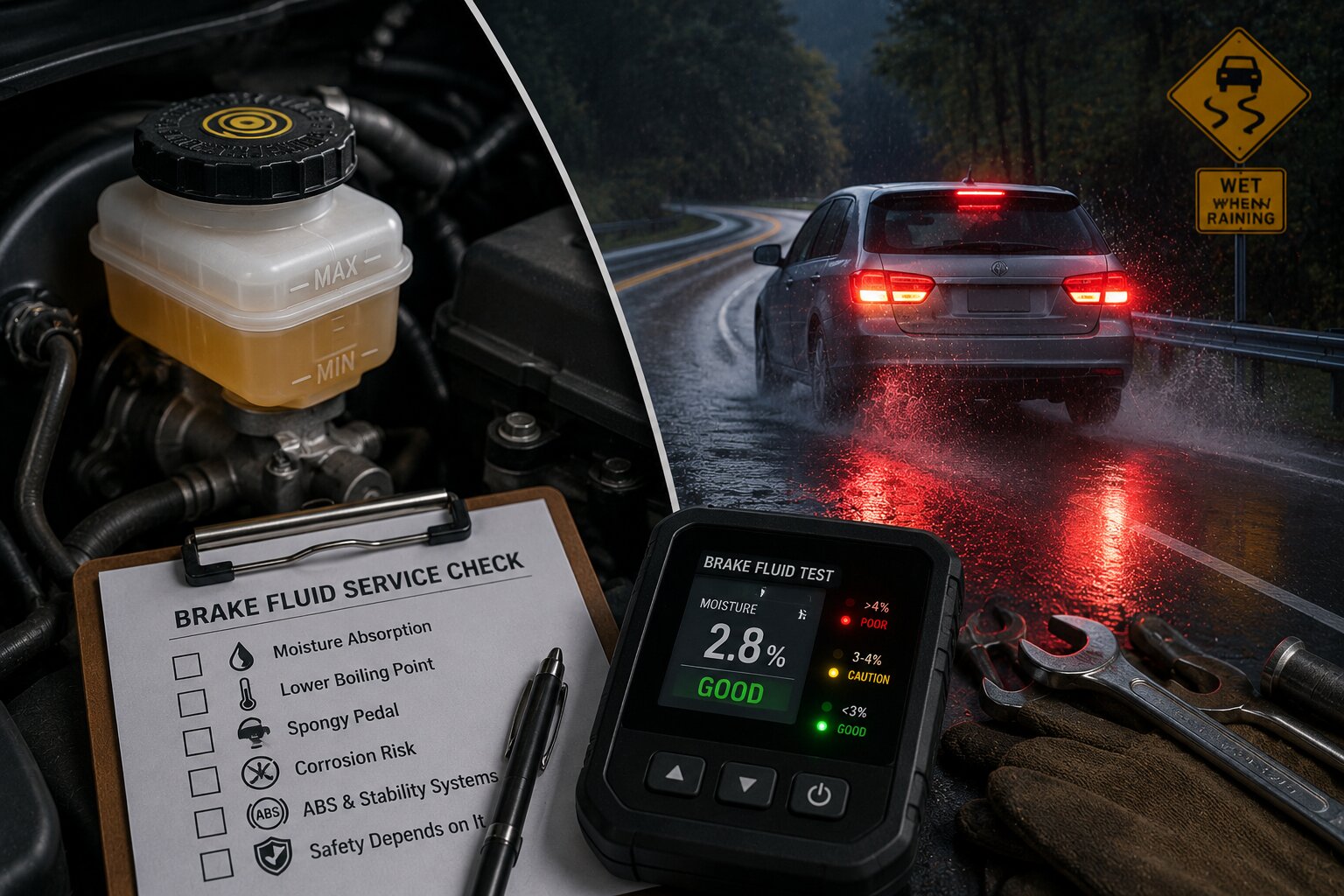
Brake fluid is not “lifetime,” even if your car feels fine
Many modern cars go years with little more than oil changes, tires, and wiper blades. That convenience can make brake fluid easy to ignore, especially when the reservoir is tucked under a plastic cowl and the pedal still feels normal. But brake fluid is a maintenance item, not a forever fill. In typical daily use, it slowly absorbs moisture from the air, and that changes how the pedal feels and how systems like ABS and stability control behave when you need them most.
This is not about chasing perfection or doing unnecessary service. It is about protecting the one system you rely on in every drive cycle, in every season, with every load in the car. The frustrating part is that moisture contamination often builds quietly. You might not notice it until a hard stop on a wet highway or a long downhill grade with passengers and luggage.
The basic physics, in plain English: why moisture matters
Most brake systems in U.S. passenger vehicles use glycol based brake fluids such as DOT 3, DOT 4, or DOT 5.1. These fluids are hygroscopic, meaning they absorb water over time. They do this by design because it helps keep small amounts of water from pooling in one spot where it could freeze or corrode components aggressively. The tradeoff is that as water content rises, the fluid’s boiling point drops.
Brake systems work by transmitting force through an incompressible liquid. When you press the pedal, the master cylinder builds hydraulic pressure, caliper pistons clamp pads against rotors (or wheel cylinders push shoes against drums), and friction converts motion into heat. Under normal braking, the fluid stays liquid and the pedal feels firm and consistent.
Add moisture, then add heat. Water boils at a much lower temperature than fresh brake fluid. Under heavy braking, especially repeated stops or long descents, parts of the system can get hot enough that contaminated fluid begins to boil locally. Boiling creates vapor bubbles, and vapor compresses easily. That is when a firm pedal can turn longer and softer because some of your pedal travel is compressing gas instead of moving pistons.
Even before outright boiling, moisture can contribute to a slightly “spongy” feel because dissolved gases and microbubbles are harder to manage in older fluid. Moisture also promotes internal corrosion in steel lines, caliper bores, ABS hydraulic modulator passages, and the master cylinder. Corrosion debris can damage seals and valves over time.
What “wet boiling point” means for real driving
You will sometimes see brake fluid discussed in terms of “dry” and “wet” boiling points. Dry boiling point refers to new fluid straight from a sealed container. Wet boiling point refers to fluid that has absorbed a standardized amount of water (commonly cited around 3.7 percent by volume in industry tests). The exact numbers vary by specification and brand, and your car’s actual water content depends on climate, storage conditions, service history, and how often the reservoir cap has been opened.
The practical takeaway is simple: as brake fluid ages and absorbs moisture, its margin against heat related fade shrinks. In flat commuting with gentle stops you may never feel a difference. In mountain driving, towing (where permitted by your vehicle’s ratings), emergency braking from highway speeds, or repeated stop and go descents, that margin becomes safety relevant.
This is one reason performance oriented trims and heavy duty applications often specify more frequent brake fluid service or higher temperature rated fluids (commonly DOT 4). It is not only about track days. It is about heat capacity under stress.
How moisture changes pedal feel (and why it can come and go)
A common complaint with old fluid is a pedal that feels softer than it used to or takes more travel before the brakes bite. Drivers often describe it as “mushy,” “spongy,” or “needing an extra inch.” That sensation can be inconsistent because temperature changes everything.
On a cool morning with light braking, old fluid may feel acceptable. After a series of hard stops or descending a grade where you are riding the brakes instead of using engine braking (or regenerative braking in an EV or hybrid), the system heats up and symptoms appear. Then after cooling down at a stoplight or parking lot, the pedal can feel closer to normal again. That on again off again behavior is one reason people delay service until something worse happens.
Also keep in mind that modern cars often have brake assist logic that senses rapid pedal application and boosts pressure quickly for emergency stops. If the underlying hydraulic system is compromised by vapor formation or internal seal issues worsened by contamination, that assist cannot create firmness out of thin air.
ABS and stability control: why old fluid can make interventions feel odd
ABS (anti lock braking) works by rapidly modulating brake pressure at individual wheels to prevent lockup during hard braking. Stability control uses many of the same components to apply brakes selectively to help keep the vehicle pointed where you intend during understeer or oversteer events. Both systems rely on precise hydraulic control through an ABS hydraulic modulator with valves and pumps.
Moisture contaminated fluid can affect this in two broad ways:
1) Pressure control becomes less consistent under heat. If parts of the circuit develop vapor bubbles during high temperature events, pressure response can become less predictable. ABS may cycle more aggressively than expected because wheel slip thresholds are being met while overall braking force feels inconsistent at the pedal.
2) Internal corrosion risk increases inside expensive components. The ABS modulator contains small passages and valves that do not tolerate debris well. Moisture driven corrosion can contribute to sticking valves or reduced efficiency over time. It does not mean every car with old fluid will lose ABS function; many do not. But it raises risk in a component that is costly to replace when problems do arise.
If you have ever felt ABS pulsing on rough pavement at low speeds when you were not braking very hard, there are multiple possible causes (wheel speed sensor issues among them). Old brake fluid is not the first suspect for that specific symptom. Still, keeping fluid fresh removes one variable from an already complex system.
DOT 3 vs DOT 4 vs DOT 5 vs DOT 5.1: what matters for most owners
For most U.S. market cars using conventional hydraulic brakes, DOT 3 and DOT 4 are common factory fills; some European brands specify DOT 4 more often due to higher temperature requirements. DOT 5 is silicone based and generally not compatible with systems designed for glycol based fluids; it also behaves differently with moisture management. DOT 5.1 is glycol based like DOT 3 and DOT 4 but with higher boiling point targets; compatibility depends on manufacturer guidance.
The safest rule is also the simplest: use what your owner’s manual specifies for your vehicle’s brake system. Do not “upgrade” casually without confirming compatibility because seal materials and system design assumptions matter.
If your manual allows more than one specification (some do), your driving context should guide your choice within those approved specs. Frequent mountain driving, high loads within rated limits, aggressive driving habits, or repeated short trips with heavy braking can justify choosing an approved higher performance spec like DOT 4 if permitted by the manufacturer.
Warning signs: stop driving vs schedule service
Brakes rarely fail without any warning at all, but they do fail fast once certain thresholds are crossed. These guidelines are conservative by design; if you are unsure, treat it as urgent.
Stop driving (or drive only as needed to reach immediate help)
Brake warning light illuminated red, especially if accompanied by a noticeable change in braking performance. A red brake light can indicate low fluid level or other serious faults depending on the vehicle; either way it warrants immediate attention.
Pedal goes to the floor or suddenly requires pumping to build pressure. That suggests significant hydraulic failure or severe vapor formation under heat; both are unsafe.
Visible brake fluid leak near a wheel (wetness on tire sidewall or inside wheel), along brake lines under the vehicle, or near the master cylinder area (fluid around the booster). Brake fluid is typically clear to amber when fresh but darkens with age; it also feels slick between fingers (avoid skin contact when possible).
Strong burning smell plus rapidly worsening pedal feel after braking on a descent or after repeated stops; pull over safely as soon as practical and let brakes cool without setting the parking brake if you suspect overheated rear brakes (vehicle specific cautions apply). If pedal feel does not return promptly after cooling down, do not continue driving.
Schedule service soon
Softer than normal pedal feel that persists across drives without obvious pad wear issues or tire traction explanations.
Brake fluid appears very dark in the reservoir compared with new fluid color expectations; darkness alone does not measure water content precisely but it often correlates with age and contamination.
You have no record of brake fluid service and the vehicle is several years old. Many owners buy used cars with incomplete maintenance history; brake fluid rarely shows up on dealer window stickers yet it matters for long term reliability of calipers and ABS components.
You drive in humid climates or see winter road salt. Humidity accelerates water absorption; salt accelerates corrosion risk once moisture is present inside vulnerable parts of the system.
The maintenance reality: what manufacturers typically recommend (and what varies)
Brake fluid service intervals vary by automaker and model year; some specify time based replacement such as every two or three years regardless of mileage, while others emphasize inspection or testing rather than fixed replacement intervals. Because these recommendations are vehicle specific and change over time, the only verified source for your car is its owner’s manual or official maintenance schedule for your exact model year.
If you cannot find clear guidance in your documentation, many independent shops use moisture testing tools as part of routine inspections and recommend replacement when water content exceeds their threshold (often around a few percent). That approach can be sensible because it ties service to condition rather than guessing based on age alone.
A fair caution: quick strip tests vary in accuracy; electronic testers vary too depending on calibration and method. Still, even imperfect testing can flag obviously overdue fluid before it becomes a problem.
Driving habits that quietly punish old brake fluid
A lot of drivers assume they are easy on brakes because they do not drive fast. Heat does not only come from speed; it comes from energy converted repeatedly into heat without enough cooling time between events.
Long downhill grades: Riding brakes keeps them hot for minutes at a time rather than seconds. Using lower gears in an automatic (or selecting a lower range) helps reduce brake load in many gasoline vehicles; hybrids often blend regenerative braking but still rely on friction brakes when regen limits are reached or battery state of charge restricts regen capability.
Towing within rated limits: More mass means more energy to shed at each stop. Even if your truck or SUV has strong engine torque figures on paper, stopping performance depends on brakes staying within thermal limits.
Stop-and-go traffic with short gaps: Frequent moderate stops can build heat steadily because there is little airflow for cooling between applications.
Aggressive street driving: A couple of hard stops may be enough to expose marginal wet boiling point if conditions are right.
A note for EVs and hybrids: regen helps but does not eliminate brake-fluid aging
Regenerative braking reduces friction brake use in many situations; pads and rotors can last longer as a result depending on driving style and calibration. It is tempting to assume that means brake fluid lasts indefinitely too.
The moisture absorption process does not require heavy braking events; it happens gradually through hoses, seals, reservoir venting strategies (design varies), and service exposure over time. Also EVs still need full friction braking capability for panic stops at highway speeds when regen alone cannot provide enough deceleration quickly enough or when traction control logic requires rapid modulation at individual wheels.
If anything, some EV owners run into an opposite annoyance: friction brakes used less frequently can develop surface rust on rotors in wet climates, which encourages occasional firm stops to clean them off safely. That does not directly fix old brake fluid; it just highlights that friction brakes remain part of the safety equation regardless of powertrain type.
What you should ask for at service (without turning this into a DIY tutorial)
You do not need to request a specific bleeding sequence at the counter desk; you do want clarity about scope so you pay for real work rather than vague promises.
Ask whether they are performing a full fluid exchange, not just topping off the reservoir. Topping off adds fresh fluid above old contaminated fluid; it does little for boiling point where it matters most: throughout lines and calipers.
Confirm they will use manufacturer-specified fluid type. This avoids compatibility mistakes such as mixing silicone DOT 5 into glycol systems (generally inappropriate unless specifically designed for it).
If your vehicle has advanced driver assistance features tied into stability control, ask whether any post-service procedures are required per factory instructions (some vehicles require scan tool functions for certain ABS module operations during service). This varies widely by make and model; an experienced shop will know where special procedures apply.
The ownership tradeoff: small maintenance now vs expensive parts later
A brake-fluid exchange typically costs far less than replacing seized calipers or an ABS hydraulic modulator assembly if corrosion takes hold over years of neglected maintenance. Exact pricing varies by region and vehicle design; some cars have easier access than others.
This cost-benefit picture looks even clearer if you keep vehicles beyond warranty periods or buy used cars where prior maintenance habits are unknown. A modest preventive service can stabilize pedal feel consistency and reduce risk factors inside complex safety systems that you cannot see during a quick driveway inspection.
A simple way to think about it
If your car has airbags you hope never deploy but still want ready every day, brake fluid belongs in that same mental category: invisible until suddenly essential. Fresh pads matter too; so do good tires because traction sets stopping distance limits long before any laboratory spec sheet does. But none of those compensate for contaminated hydraulic fluid that boils under stress or corrodes critical valves from within.
If you cannot remember when your brake fluid was last exchanged, check your owner’s manual for interval guidance and consider having it tested at your next service visit. It is one of those quiet maintenance items that rarely feels urgent until it becomes urgent all at once.
0 comments
Join the discussion around this article.
Please login to comment.