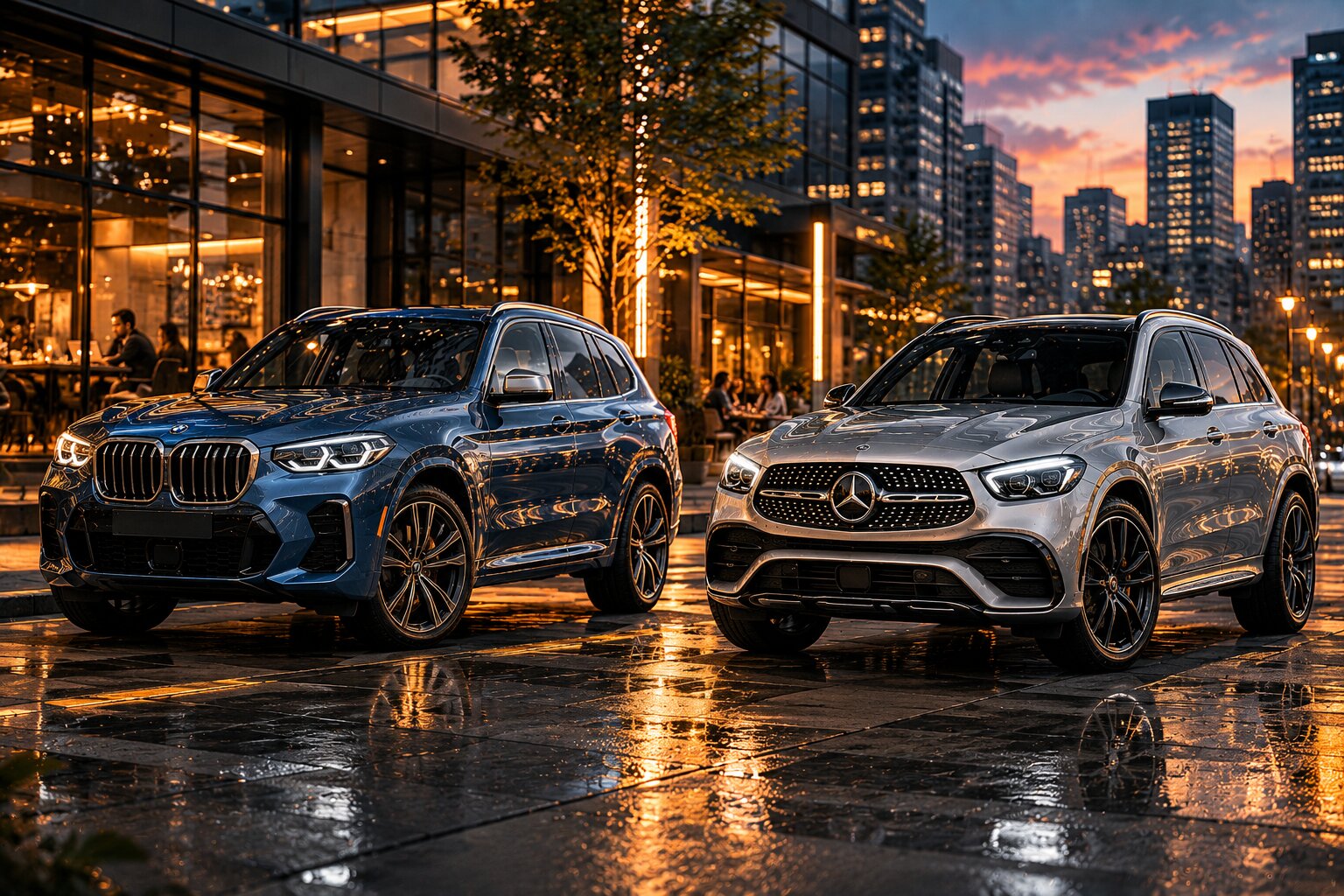
Two luxury crossovers, two versions of “normal”
The BMW X3 and Mercedes-Benz GLC sit in the heart of the U.S. luxury crossover market, the part where “premium” has to show up in day-to-day life. These are family-haulers that also have to feel special on a commute, quiet on a highway run, and easy to live with when you are tired and just want the car to cooperate.
For 2026, both nameplates continue to represent their brands’ mainstream definition of refinement and technology. The challenge in writing a truly fair comparison right now is that some 2026-model-year specifications for the U.S. market are not yet fully published in a single, final set of EPA and SAE-certified numbers across all trims. Where official figures are not available, this piece calls it out plainly rather than guessing.
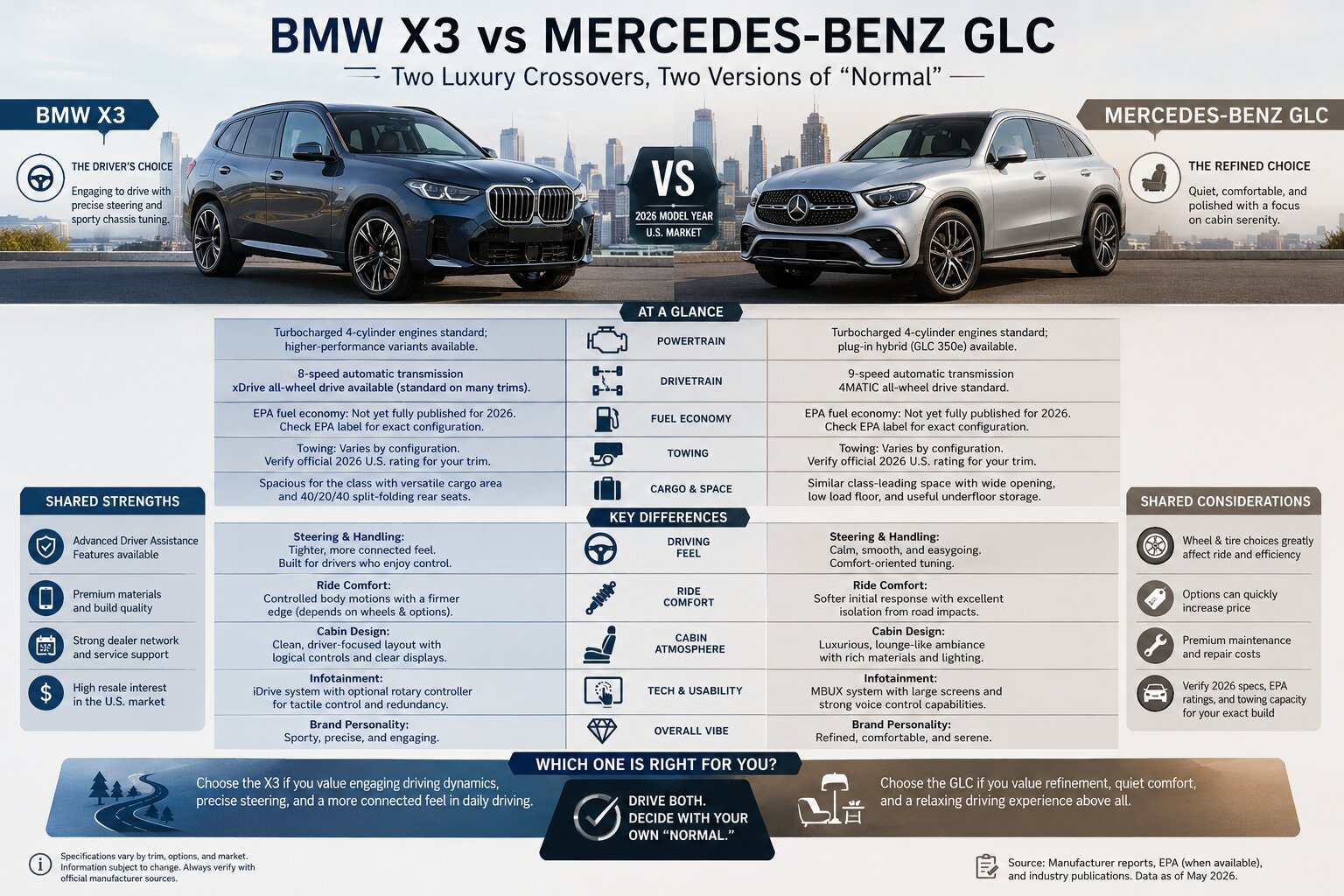
Even with that limitation, the personalities come through clearly. The X3 has long been the driver’s-choice entry in this class, with steering and chassis tuning that typically prioritize clarity and control. The GLC, by contrast, tends to lean into isolation, polish, and a cabin experience that feels like it was designed from the inside out. Both approaches can make for a great “normal day.” They just make it great in different ways.
Where they sit in the segment, and who else matters
In the U.S., the X3 and GLC compete directly with the Audi Q5, Lexus NX, Acura RDX, Volvo XC60, Genesis GV70, Cadillac XT5 (and newer Cadillac compact entries depending on shopper cross-shopping), and increasingly well-equipped mainstream options at the top end of brands like Mazda. If you are shopping plug-in hybrids in this size class, you will also run into versions of the Volvo XC60 Recharge and Lexus NX PHEV variants depending on availability.
Both BMW and Mercedes sell these vehicles as core products rather than niche choices. That matters because it usually translates into broad dealer availability, lots of configuration variety, and strong aftermarket support. It also means you will see them everywhere, which is either reassuring or slightly deflating depending on how much you value exclusivity.
Powertrains: what we can say with confidence, and what is still pending
BMW’s U.S.-market X3 lineup in recent years has centered on turbocharged four-cylinder power for volume trims, with higher-output variants above that depending on model year strategy. Mercedes’ GLC similarly anchors around turbocharged four-cylinder engines, with a plug-in hybrid offered in the current-generation GLC family for the U.S. market.
Verified reality for shoppers: both lines are built around modern turbocharged four-cylinders paired with automatic transmissions and all-wheel drive availability (often standard depending on trim). Both brands also offer higher-performance derivatives in their broader compact crossover families, but those are not always directly comparable trim-for-trim against the mainstream X3 and GLC models most buyers actually choose.
What cannot be responsibly pinned down here: final 2026 U.S.-spec horsepower and torque figures by trim for both vehicles in a way that is guaranteed accurate at publication time. Automakers sometimes revise packaging or output ratings year to year; without finalized 2026 U.S. specification sheets for each trim line in front of us, quoting exact numbers risks being wrong.
What matters more than peak output on paper is how these engines behave at everyday speeds. In typical use, turbo fours like these deliver their best work in the midrange. That means easy merging and quick gaps in traffic without needing high rpm theatrics. The tradeoff is sound quality under load; even very good turbo fours rarely sound expensive when you ask for full throttle up an on-ramp.
Towing: capability versus confidence
Towing is one of those specs that looks simple until you try to use it. A number on a brochure does not tell you how stable the vehicle feels when a trailer starts pushing back through a crosswind or over expansion joints.
Towing capacity for 2026: official 2026 U.S.-market towing ratings vary by configuration and have not been comprehensively published in a way that can be cited here trim-by-trim without risk of error. If towing is central to your purchase decision, treat this as a must-verify item at the dealer using the exact VIN configuration or official manufacturer towing guide for your model year.
That said, both vehicles tend to be used for light-duty towing rather than heavy work: small utility trailers, a pair of motorcycles, or a lightweight camper. In that context, wheelbase length, cooling capacity provisions, hitch integration, trailer stability programming (where equipped), and rear suspension control often matter as much as raw tow rating. BMW typically aims for secure body control under load; Mercedes often prioritizes calmness and reduced cabin disturbance. Either can work well if properly equipped; neither is intended to replace a body-on-frame SUV or pickup when towing becomes routine.
Fuel economy: why waiting for EPA figures matters
EPA fuel economy figures for many 2026 variants may not be released at time of writing. That is not unusual early in a model year cycle or during packaging transitions. For shoppers who track fuel costs closely or have strict commuting budgets, wait for EPA ratings for your exact drivetrain (including wheel size and option packages) before treating any mpg claim as settled.
In general terms only, turbocharged four-cylinder luxury crossovers tend to land in competitive territory among peers when driven gently and can drop meaningfully when driven hard or loaded up at highway speeds with passengers and cargo. Plug-in hybrid versions can dramatically reduce fuel use on short trips if you actually charge them consistently at home or work; without charging discipline they can carry extra weight without delivering their best-case efficiency.
Road manners: two philosophies you feel within the first mile
The easiest way to separate these two is not by spec sheet but by what they emphasize when you are just driving to dinner.
The X3’s typical appeal: BMW has historically tuned its compact SUVs to feel tied down and responsive even when they are riding on comfort-oriented tires. Steering effort tends to build naturally as speed rises; body motions are usually controlled without feeling brittle (depending heavily on wheel size and whether adaptive dampers are fitted). For many drivers that reads as confidence. You place it accurately in your lane without constant micro-corrections; you feel like you are driving the vehicle rather than supervising it.
The GLC’s typical appeal: Mercedes usually aims for calm first: low noise intrusion, gentle isolation from sharp impacts, and a sense that the vehicle is smoothing over rough pavement rather than reporting every detail back to you. In daily use that can be deeply satisfying. The GLC’s “normal day” often feels quieter at moderate speeds; its controls tend to prioritize ease over sharpness.
If your commute includes broken urban pavement followed by fast freeway stretches, either approach can win depending on what annoys you more: feeling every texture through the chassis (a common frustration with larger wheels) or feeling slightly less connected when you ask for quick direction changes.
Ride comfort: wheel choice matters more than most people admit
A reality check for both models: showroom cars frequently wear large wheels because they look right under bright dealership lights. In real life they can cost you ride compliance and tire replacement money later.
On typical luxury crossover suspensions, smaller wheels with taller tire sidewalls usually improve impact absorption and reduce sharp-edge harshness over potholes. Adaptive dampers can help broaden comfort range if available on your chosen trim; they cannot fully undo physics if the tire sidewall is thin.
The X3 often earns praise for controlling body motion without feeling floaty; the GLC often earns praise for its composure and cabin serenity. Either one can be made too stiff with an aggressive wheel-and-tire package if your roads are rough enough.
Steering feel: accuracy versus ease
This is where brand DNA still shows up even as modern electric power steering homogenizes everything.
The X3’s steering has typically been calibrated to feel quicker and more immediate off-center than many rivals. That makes lane placement feel intuitive on narrow roads or in construction zones where lines shift unexpectedly. Some drivers will call it “sporty,” others will simply call it less tiring because it requires fewer corrections.
The GLC’s steering generally favors smoothness over bite. It tends to be light enough to make parking lots painless while still stable at speed. The tradeoff is that some drivers who enjoy feedback may find it less talkative through their hands than BMW’s approach.
Cabin design: businesslike clarity versus lounge-like polish
BMW interiors in this class often read as purposeful: clear sightlines forward, sensible storage solutions around the center console depending on configuration, and an overall layout that tries to keep primary controls within easy reach. Mercedes tends to design cabins that feel more decorative: richer-looking surfacing, more ambient lighting drama (depending on options), and an emphasis on making the cabin feel like an upscale room rather than a cockpit.
This difference shows up at night and during long drives. A calmer layout with fewer visual distractions can reduce fatigue; an interior that feels special can make daily errands feel less like chores. Neither approach is inherently better; it depends on whether you value minimal friction or maximum ambiance.
Infotainment and tech friction: powerful systems still need good ergonomics
Both BMW iDrive-based interfaces (as used across recent BMWs) and Mercedes’ MBUX systems are among the most capable infotainment suites in the segment. They offer sharp graphics, strong navigation integration depending on subscriptions and connected services availability, smartphone compatibility (Apple CarPlay and Android Auto availability varies by exact configuration but is broadly expected in this class), and voice assistants that have improved over time.
The practical question is not whether they can do everything; it is how quickly they let you do one thing while driving.
BMW’s approach has often benefited from redundant control methods when equipped with both touchscreen capability and a rotary controller interface (availability depends on model year design). Redundancy matters because reaching for a screen over rough pavement is not elegant; tactile controls reduce eyes-off-road time for many drivers once muscle memory sets in.
Mercedes tends to lean into screen-first interaction paired with strong voice control features when configured appropriately. When voice recognition works well it feels effortless; when it does not it becomes one more task competing with traffic.
A note of caution: exact 2026 interface layouts (screen sizes, control schemes) should be verified on the specific vehicle you plan to buy because mid-cycle updates can change physical controls significantly year to year.
Space and family practicality: what matters beyond cubic feet
Cargo volume numbers are useful but incomplete without understanding shapes: how wide the opening is, how high the load floor sits relative to your knees, whether there is underfloor storage for charging cables (on plug-in hybrids), how flat seats fold, and whether rear-seat space works with real child seats installed behind tall front occupants.
Verified limitation: official 2026 U.S.-spec interior volume figures for each trim are not consistently published across sources at time of writing; quoting precise cubic-foot numbers risks mixing model years or configurations incorrectly.
Still, some everyday truths apply across both models:
Rear seat comfort: Both generally provide adult-usable rear seating for typical trips around town. The deciding factor tends to be seat shape and foot space under front seats rather than raw legroom claims. If you routinely carry adults back there for hours rather than minutes, spend time sitting behind your own driving position before signing anything.
Cargo usability: Both are sized well for strollers, weekly grocery runs, airport luggage sets for two adults plus kids’ bags, or bulky sports gear like coolers and folding chairs. The difference often comes down to how low-stress loading feels: lift-over height and bumper shape matter when you do this twice a week in work clothes.
Noise control: luxury lives here
This class has become impressively quiet compared with even ten years ago. Still, there are layers to cabin noise: tire roar on coarse concrete highways; wind noise around mirrors; engine sound under load; suspension thumps over broken pavement.
The GLC’s brand identity suggests an advantage in perceived isolation when similarly equipped because Mercedes traditionally puts real effort into suppressing harshness frequencies that make cabins feel cheap. The X3 typically counters with tighter body control that can prevent secondary motions from becoming noise events over rough surfaces.
If your daily route includes long stretches of grooved concrete freeway common across parts of the U.S., tire choice may dominate everything else. A test drive on perfect dealer-loop asphalt will not reveal much about highway roar at 70 mph plus.
Driver assistance: verify packages carefully
Both BMW and Mercedes offer advanced driver-assistance features such as adaptive cruise control systems with lane-centering assistance (names differ by brand). Availability often depends on option packages rather than being standard across all trims. Functionality also changes year-to-year via software updates or sensor-suite revisions.
If these features matter because of heavy commuting or long interstate travel, treat them as a must-test item rather than assuming parity from marketing language alone. Some systems excel at smoothness; others excel at maintaining lane position but can feel busy about steering corrections depending on road markings quality.
Ownership implications without price talk: maintenance reality and resale patterns
Avoiding price discussion does not mean ignoring ownership consequences. Luxury crossovers carry luxury running costs even when nothing goes wrong: premium tires sized for style packages cost more; brakes can be expensive depending on specification; dealer labor rates tend to be high; some routine services require specific fluids or procedures.
Maintenance: BMW’s modern turbo engines generally rely on strict oil service discipline using correct specifications; Mercedes similarly expects adherence to service intervals using approved lubricants and filters. Skipping maintenance rarely pays off later with either brand. If you plan to keep either vehicle beyond warranty coverage periods typical for new-car owners (varies widely), consider an independent specialist shop near you before buying so you know what local support looks like outside dealership service lanes.
Resale: Historically both BMW X3 and Mercedes GLC have held strong interest because demand remains high in this size category. Actual resale outcomes depend heavily on condition history, mileage patterns (city wear vs highway miles), accident records reported through vehicle history services, color combinations buyers actually want later (often conservative), wheel size condition (curbed wheels hurt), tire life remaining at sale time, and whether advanced driver-assistance packages were originally optioned.
The way each one fits American life
The X3 tends to suit buyers who drive actively even when they are not trying to drive fast: people who notice steering response while threading through tight parking garages downtown or navigating fast-moving suburban interchanges where gaps appear briefly then vanish again. Its “normal day” feels organized. You point it where you want it; it goes there without fuss; it makes mundane driving slightly more satisfying than expected from an SUV shape.
The GLC tends to suit buyers who want their car to lower stress rather than raise engagement: people who spend real time behind the wheel in traffic or who value arriving less tired after long highway runs. Its “normal day” feels buffered from irritation: fewer sharp edges from bad pavement noise-wise (depending on wheels), an interior ambiance that reads upscale even when parked outside a grocery store at night under harsh lights, controls designed around ease rather than sportiness cues.
A few buying-trip realities worth acknowledging
You will see option variability within each nameplate. A lightly optioned example can feel surprisingly ordinary inside compared with what online configurators imply; an aggressively optioned one can feel like a different vehicle altogether in terms of audio quality impression, seat comfort features (ventilation availability varies), driver-assistance capability breadth, lighting sophistication, and wheel-and-tire tradeoffs.
Tires quietly define character. Two vehicles wearing different tire types can drive like different trims even if they share suspension hardware. If possible during shopping, ask what tires are fitted (all-season vs performance-oriented) because this affects ride harshness perception as much as suspension tuning does in many cases.
The verdict: choose your definition of premium normal
If your ideal luxury crossover makes everyday driving feel precise and composed without requiring effort from you as a driver, the 2026 BMW X3 remains the natural draw based on its long-standing strengths in steering calibration and chassis discipline (subject to confirmation once full 2026 U.S.-spec details are finalized).
If your ideal luxury crossover makes everyday driving feel calmer than it has any right to feel given American road conditions and traffic density, the 2026 Mercedes-Benz GLC is hard to ignore based on its brand-typical emphasis on refinement and cabin experience (again subject to verifying exact 2026 packaging).
The best advice here is almost boring but accurate: drive both back-to-back on roads similar to your actual commute using similarly sized wheels if possible; confirm towing rating requirements using official manufacturer documentation for your exact configuration; wait for EPA figures if fuel costs matter materially; then pick the one whose version of “normal” aligns with yours.
0 comments
Join the discussion around this article.
Please login to comment.