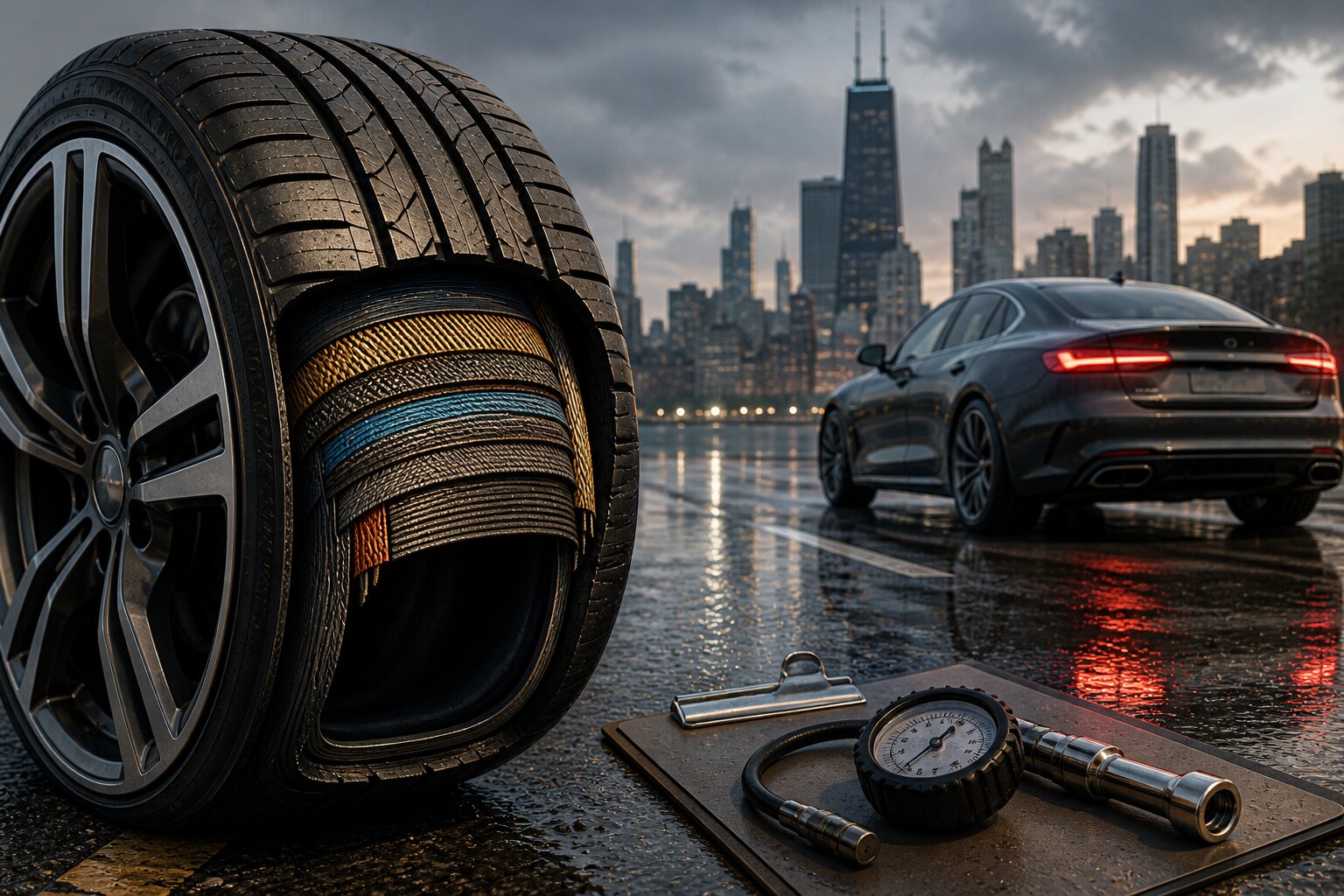
The “same size” trap (and why your car suddenly feels weird)
I’m Brian O’Connor, based in Chicago, and I’ve lost count of how many times I’ve heard some version of: “They’re the same size tire, so it shouldn’t matter.” Then the owner comes back after a tire swap and says the steering feels heavier, the ride got busier over broken pavement on Lake Shore Drive, or the truck feels a little squirmy with a trailer. Same size on the sidewall. Different tire in real life.
Here’s the thing: the big size string (like 225/45R17) is only part of the story. Load index and speed rating those little numbers and letters most people ignore change how much weight a tire can safely carry, how much heat it’s built to tolerate, and often how stiff the casing feels. That feeds directly into safety, handling, ride comfort, and even how your ABS/traction control behaves when you’re right at the edge.
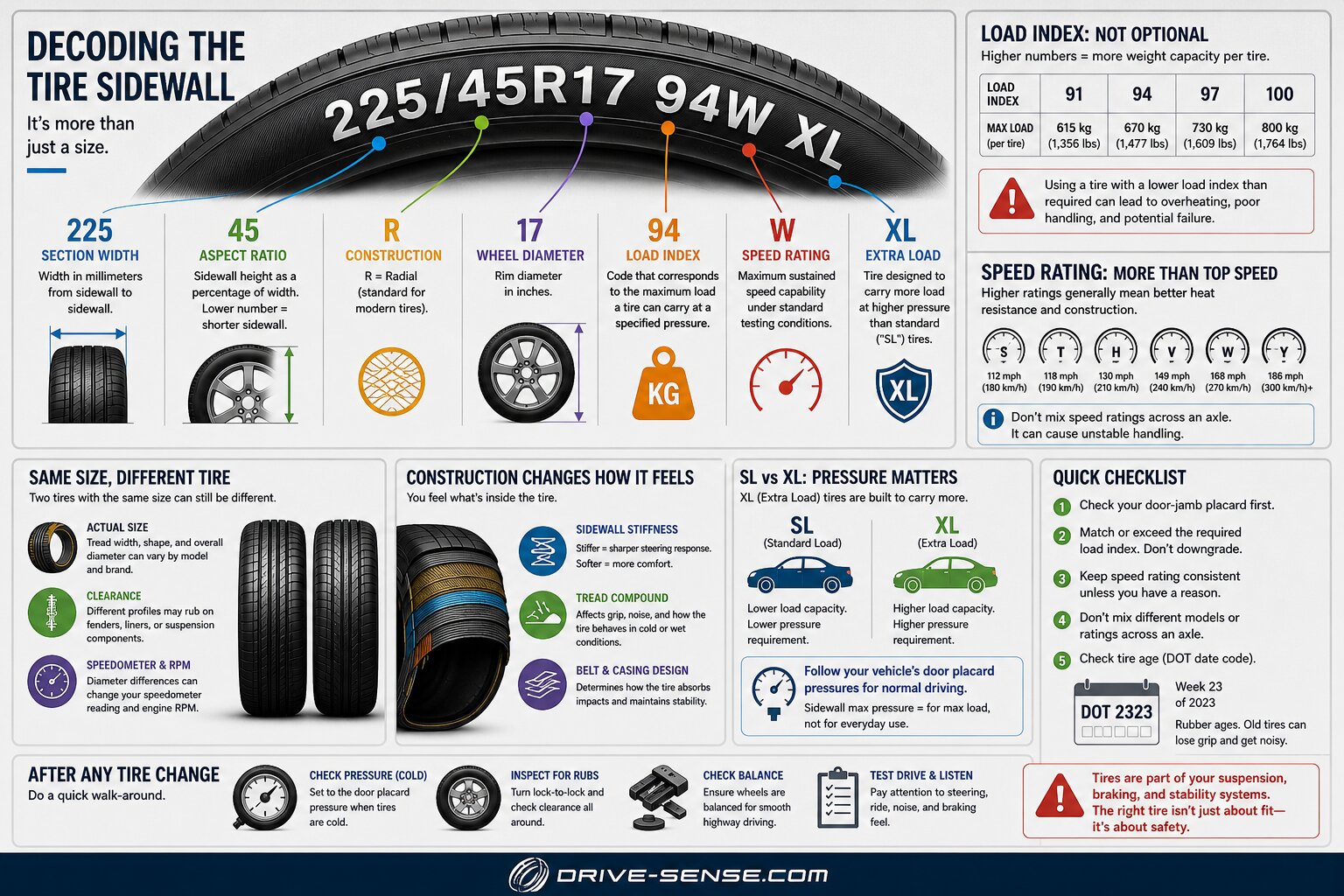
Let’s decode a real-looking sidewall: 225/45R17 94W XL (example)
Sidewalls vary by brand and model, but most passenger tires follow the same core format. I’ll use a common example you might see on a sporty sedan or hatchback:
225/45R17 94W XL
Here’s what each piece means:
225 = section width in millimeters (roughly the tire’s width at its widest point, measured on a specified rim width). Wider usually means more potential grip, but also more sensitivity to alignment and road crown.
45 = aspect ratio (sidewall height as a percentage of width). So 45% of 225 mm gives you about 101 mm of sidewall height. Less sidewall generally sharpens response but can make potholes feel like personal insults.
R = radial construction (almost everything on the road today).
17 = wheel diameter in inches.
94 = load index (a coded number that maps to a specific weight capacity per tire at a specified pressure). This is where “same size” starts to fall apart.
W = speed rating (a letter that corresponds to a maximum sustained speed capability under standardized testing). It also tends to correlate with heat resistance and construction choices.
XL = Extra Load (a marking indicating the tire is designed to carry more load at higher inflation pressure than a standard-load tire in the same size).
Important honesty note: The exact pounds/kg for each load index number comes from standardized tables (ETRTO/ISO/T&RA). I’m not going to guess your specific number from memory. If you want the exact capacity for “94,” look up a load index chart from a tire manufacturer or Tire & Rim Association reference it’s quick and reliable.
Load index: the quiet number that decides whether your tire is actually appropriate
The load index is not optional trivia. It’s a safety spec tied to how much weight each tire can carry when properly inflated. Your vehicle’s required load rating is based on its Gross Axle Weight Ratings (GAWR) and overall Gross Vehicle Weight Rating (GVWR), plus engineering margin.
A few practical takeaways:
1) Same size, different load index = different capability. You can find two tires both labeled 225/45R17 where one is a lower load index (standard-load) and another is higher (often XL). They mount the same. They do not behave the same under weight.
2) Load index affects feel. Higher load versions often have stronger carcass construction and may run higher pressure. That can translate into crisper turn-in and sometimes more impact harshness over expansion joints. In Chicago springtime, when potholes breed like rabbits, that difference is not subtle.
3) Under-rating load is where trouble starts. A tire with insufficient load capacity can overheat under sustained load (passengers, cargo, towing), which increases failure risk. Even before anything dramatic happens, you may notice vague steering or a “wallowy” feel because you’re working the tire outside its intended envelope.
4) Don’t confuse “ply rating” with passenger-car load index. On light trucks you’ll see “Load Range C/E” style markings; on passenger tires it’s typically load index + SL/XL. Different systems, same goal: define safe carrying capacity at defined pressures.
Speed rating: not just for top-speed heroes
The speed rating letter (S, T, H, V, W, Y… among others) indicates the maximum speed capability under standardized lab testing with proper load and inflation. Most drivers will never see those speeds. But that letter still matters because it hints at how the tire manages heat and how it’s constructed.
A few grounded points:
A higher speed rating often brings a different personality. Not always “better,” just different. Many higher-rated tires use construction choices that can improve steering precision at highway speeds nice when you’re threading through fast traffic on I-90 but they can also transmit more road texture into the cabin.
You can’t assume equal wet traction or braking from speed rating alone. Wet grip depends heavily on compound chemistry and tread design. Two H-rated tires can behave completely differently in a cold rain.
Mismatching speed ratings across an axle is asking for weird handling. Even if sizes match perfectly, mixing constructions can make one end of the car react faster than the other in an emergency maneuver. The steering wheel might feel normal in gentle driving… until it doesn’t.
If your car came with a specific speed rating, treat it as an engineering requirement unless you have a good reason not to. Some vehicles specify minimum ratings for stability and heat management at sustained highway speeds or under high loading. If you’re unsure what your vehicle requires, check the driver-door placard or owner’s manual rather than guessing based on what “fits.”
The letters after the size: SL vs XL, and why pressure isn’t just a suggestion
If you see SL, that generally means Standard Load. XL means Extra Load built to carry more weight at higher pressure compared with SL in the same size category.
This is where people get mildly annoyed because it feels like splitting hairs… until you drive it back-to-back:
An XL tire often wants (and sometimes needs) different inflation behavior to feel right. Your car’s door placard pressure is set for OE fitment assumptions. If you switch from SL to XL or vice versa especially if you change brand/model you may notice changes in ride and steering even at the same PSI reading. That doesn’t mean you should freeload with random pressures; it means you should start at placard pressures and adjust only within safe bounds while watching wear patterns and keeping within tire limits.
The placard wins for normal driving. Engineers pick those pressures for load capacity, stability control calibration assumptions, ride quality targets, and tread wear balance. The tire sidewall shows maximum pressure for max rated load not your everyday target.
A quick reality check: “Same size” isn’t always the same physical size
This surprises enthusiasts all the time: two tires with identical labeled size can measure differently once mounted and inflated. Why?
Tread width and section width vary by design. The labeled width is nominal on a specified measuring rim width; change rim width or tire design intent and actual dimensions shift. One 225 may look chunky; another looks stretched on the same wheel.
Tire models have different shapes. Shoulder profile, rim protector thickness, sidewall bulge those details change clearance to struts, fender liners, or suspension arms. On some cars there’s barely room as-is; one “same-size” replacement suddenly kisses a liner at full lock when backing out of an alley parking spot.
Overall diameter differences aren’t huge but they’re real. Manufacturing tolerances plus model-to-model differences mean your speedometer and gearing feel can shift slightly even if you didn’t change sizes on paper. Usually it’s small; occasionally it’s enough to notice engine RPM at cruise or how quickly an automatic transmission wants to upshift on gentle throttle.
The construction stuff you don’t see in big print (but you feel immediately)
If you’ve ever swapped tires and thought, “Why does my suspension suddenly feel cheaper?” you’re not imagining things. Tires are part of the suspension system. They’re basically flexible springs and dampers made of rubber and cords.
Sidewall stiffness changes steering response. A stiffer sidewall tends to sharpen initial turn-in. The steering wheel feels like it has less delay between input and reaction satisfying on an on-ramp cloverleaf when you’re leaning on the front end just enough to feel weight transfer build smoothly.
Tread compound changes noise and cold behavior. Some compounds get hard in cold weather; others stay pliable longer. In Chicago shoulder seasons 40°F mornings turning into 70°F afternoons that can be the difference between quiet competence and that faint droning hum that creeps into your ears at 55 mph on coarse asphalt.
Belt angles and internal damping affect ride “texture.” Two tires can absorb sharp impacts differently even if they’re both “touring” tires on paper. One will thump over pothole edges; another will round them off with less drama. That’s engineering choices inside the casing stuff no one sees until they drive it.
If you drive a truck or tow: load ratings stop being theoretical fast
I’m not going to throw towing numbers around without your specific vehicle because capacities vary wildly by model year, axle ratio, drivetrain configuration, cab/bed length the whole alphabet soup. But here’s what holds true across trucks and SUVs:
Towing loads heat up tires quickly. Long highway pulls in summer put real thermal stress into rubber. A tire that’s fine commuting empty can feel sloppy or run too hot when you hook up a trailer or fill the bed with pavers from Home Depot.
P-metric vs LT-metric matters when applicable. Many half-tons come with P-metric tires from the factory for comfort; LT tires often bring stiffer construction for work use but can ride harsher when unloaded. If your truck spends most of its life empty, going “more truck” than you need can make every cracked slab of concrete feel louder through the seat base.
A simple way to sanity-check what your car actually needs
You don’t need to become a tire engineer to make smart decisions. Here’s an enthusiast-friendly checklist that keeps things safe without turning into a shopping guide:
1) Read your door-jamb placard first. That label typically lists original tire size plus recommended cold inflation pressures for front/rear. Some vehicles list multiple sizes depending on trim or wheel package.
2) Match or exceed required load index and don’t downgrade casually. If your OE spec was XL with a certain load index, replacing with an SL lower-load version because it was cheaper or “still fits” is where problems start. If you want exact comparisons, use a reputable load index chart rather than guessing what numbers mean.
3) Keep speed rating consistent unless you know why you’re changing it. For normal street cars, staying at OE speed rating avoids unintended handling differences. If you live somewhere with brutal winters or rough roads and choose a different category of tire seasonally, keep ratings appropriate for that use case and don’t mix mismatched ratings left-to-right on an axle.
4) Don’t mix drastically different tire models across an axle if you care about stability in emergencies. AWD systems also tend to be picky about rolling circumference matching; check your manual for guidance if you’re replacing only one or two tires due to damage.
The little codes people ignore: DOT date code and why old rubber drives like old rubber
You’ll find a DOT code on one sidewall; within it is a four-digit date code indicating week/year of manufacture (for example, “2323” would mean week 23 of 2023). That part is widely standardized in the U.S., and it matters because rubber ages even if tread depth looks fine.
An older tire often gets noisier and harder-feeling as compounds age out especially if it lived through temperature swings outdoors. I’ve driven cars that felt oddly skittish in wet conditions until I checked dates and realized the tires had been quietly aging for years despite decent tread depth left.
A quick walk-around test after any tire change
This is what I do after mounting new tires or switching seasonal sets nothing fancy:
- Cold pressure check: set pressures when tires are cold (parked for hours), using an accurate gauge not just TPMS readings alone.
0 comments
Join the discussion around this article.
Please login to comment.