 DriveSense
Summary: Backup cameras moved from upscale convenience to everyday expectation because they solve a stubborn visibility problem that mirrors cannot. In the U.S., they are also required on new light vehicles under a federal rear-visibility rule administered by NHTSA, which accelerated broad adoption and reshaped used-car shopping priorities.
When the mirror was the whole plan
For most of American driving history, backing up was a little ritual you learned early and then refined forever. Left hand on the wheel, right arm stretched across the passenger seat, chin turned over your shoulder. A quick check of the inside rearview mirror, a glance at each side mirror, and then you rolled. If you were in something long and formal, a big sedan with a thick trunk lid or an SUV with a tall tailgate, you simply accepted that part of the world behind you was guesswork.
That guesswork became a kind of cultural muscle memory. Drivers talked about “getting used to” a car’s blind spots as if it were a personality trait, like heavy steering or a stiff clutch. In parking lots, you could watch it play out: people creeping backward in tiny increments, stopping, leaning forward to see around headrests, then continuing. Mirrors were not just equipment. They were the method.
Even as cabins got quieter and more insulated and rear glass areas shrank for styling and structure, the habit stayed. It had to. A mirror is passive and honest, but it can only show what the geometry allows. Anything low and close behind the vehicle is easy to miss, especially if it sits below the rear window line.
Rear visibility becomes a safety conversation
At some point, “that’s just how backing up works” stopped being an acceptable answer. Rear visibility turned into a safety issue that regulators and engineers could actually address with technology rather than driver folklore.
The key shift was conceptual: backing up is not only about convenience or avoiding a bumper scuff. It is about preventing crashes in a situation where sightlines are inherently compromised. As vehicles evolved, many gained higher beltlines, thicker roof pillars, taller rear ends, and more substantial head restraints. Those changes can bring benefits in other areas of vehicle design, but they also make it harder to see what is directly behind you from the driver’s seat.
This is where modern driver assistance features enter the story. NHTSA groups technologies that support safer driving under the umbrella of driver assistance technologies and emphasizes a simple truth: these systems are meant to help drivers, not replace them. That framing matters because it captures what backup cameras really are in daily use: an aid that gives you information you did not have before, at exactly the moment you need it most. (NHTSA driver assistance technologies overview)
The first time you trust the screen
If you learned to drive before camera screens were common, the first encounter can feel oddly intimate. You drop the shifter into reverse and suddenly there is a live view of the world behind you. Not reflected. Not guessed. Actually there.
The emotional beat is subtle but real. You realize how much your old routine depended on inference. The camera does not make you a better driver by magic, but it changes your information set. You can see a low curb that would have been hidden by a high trunk line. You can spot a stray shopping cart sitting in that no-man’s-land directly behind the bumper. In tight urban parking or crowded school pickup lanes, that extra visibility feels less like luxury and more like basic situational awareness.
It is also where expectations begin to form. Once a driver gets used to seeing that close-in area behind the vehicle on demand, going back to mirrors alone can feel like stepping out of a well-lit room into dusk.
From premium add-on to standard equipment (and why regulation mattered)
Backup cameras did not become an everyday expectation because drivers suddenly forgot how to turn their heads. They became expected because they solve a specific problem in a way mirrors cannot: they reveal what is low and close behind the vehicle.
Cultural momentum played its part too. Features often start as novelties in higher-end vehicles where buyers are already paying for comfort and technology; over time, shoppers begin to treat them as table stakes rather than indulgences. But rear cameras also have something many luxury options do not: a clear federal through-line.
In the U.S., NHTSA issued Federal Motor Vehicle Safety Standard No. 111 updates that require rear visibility technology on new light vehicles (often described as requiring backup cameras). That requirement is widely credited with pushing rear cameras from “nice to have” into true baseline equipment across segments. For readers who want the authoritative regulatory text and agency explanation, NHTSA maintains dedicated pages for both the rulemaking and consumer-facing context on rear visibility requirements and backover prevention efforts. (NHTSA rear visibility information)
A timeline that holds up: how expectations hardened into habit
The history here is easy to oversimplify because adoption happened in waves: early availability on select models (often as an option), broader spread as infotainment screens became common, then near-universality once federal requirements took effect for new vehicles.
Rather than leaning on fuzzy memories or brand lore, it is safer to anchor the timeline to primary sources:
- Regulatory baseline: NHTSA’s rear visibility rulemaking for FMVSS No. 111 establishes what must be installed on new light vehicles sold in the U.S., along with performance requirements for what drivers need to be able to see behind the vehicle. (NHTSA rear visibility information)
- Why it happened: NHTSA’s backover prevention materials explain the safety problem regulators were trying to reduce and how rear visibility technology fits into that effort. (NHTSA rear visibility information)
- Safety framing: NHTSA’s broader driver assistance guidance reinforces responsible use: these aids support safer operation but do not replace attentive driving behavior. (NHTSA driver assistance technologies overview)
This matters for shoppers because it helps explain why model-year cut lines feel so real on dealer lots. Depending on year and trim strategy, two otherwise similar vehicles can differ sharply in day-to-day ease of use simply because one was built after rear visibility requirements became standard practice across new inventory.
Used-car shopping: “Does it have a camera?” becomes question one
Walk any used-car lot in America and listen to how people talk about features now. The backup camera comes up early, often before engine size or trim level. For many buyers it is not about bragging rights; it is about confidence pulling out of driveways, navigating tight garages, and dealing with crowded parking lots without relying solely on mirrors and luck.
This has changed how shoppers evaluate older vehicles too. A clean older SUV with leather and a strong service history can still lose out if it lacks rear visibility aids that buyers have come to rely on in daily life. People who routinely carry passengers also tend to be more sensitive to rearward visibility because headrests and cargo can further block sightlines through the rear glass.
There is another practical layer: when you are buying used, you are also buying whatever safety-related updates or omissions came with that model year and configuration. Even if you are focused on rear visibility tech, it is smart to zoom out and check for open recalls while you are doing your homework.
NHTSA’s recall lookup tool lets you search by VIN (or by year, make, and model) so you can see whether there are open safety recalls on a particular vehicle before purchase or shortly after bringing it home. It is not glamorous work, but it is part of modern ownership literacy in the same way checking tire tread depth is. (NHTSA recall lookup)
A familiar pattern: safety tech changes habits
Backup cameras fit into a broader story about how technology quietly rewires driver behavior over time. Once a feature becomes common enough, drivers stop thinking of it as technology at all. It becomes part of “driving.”
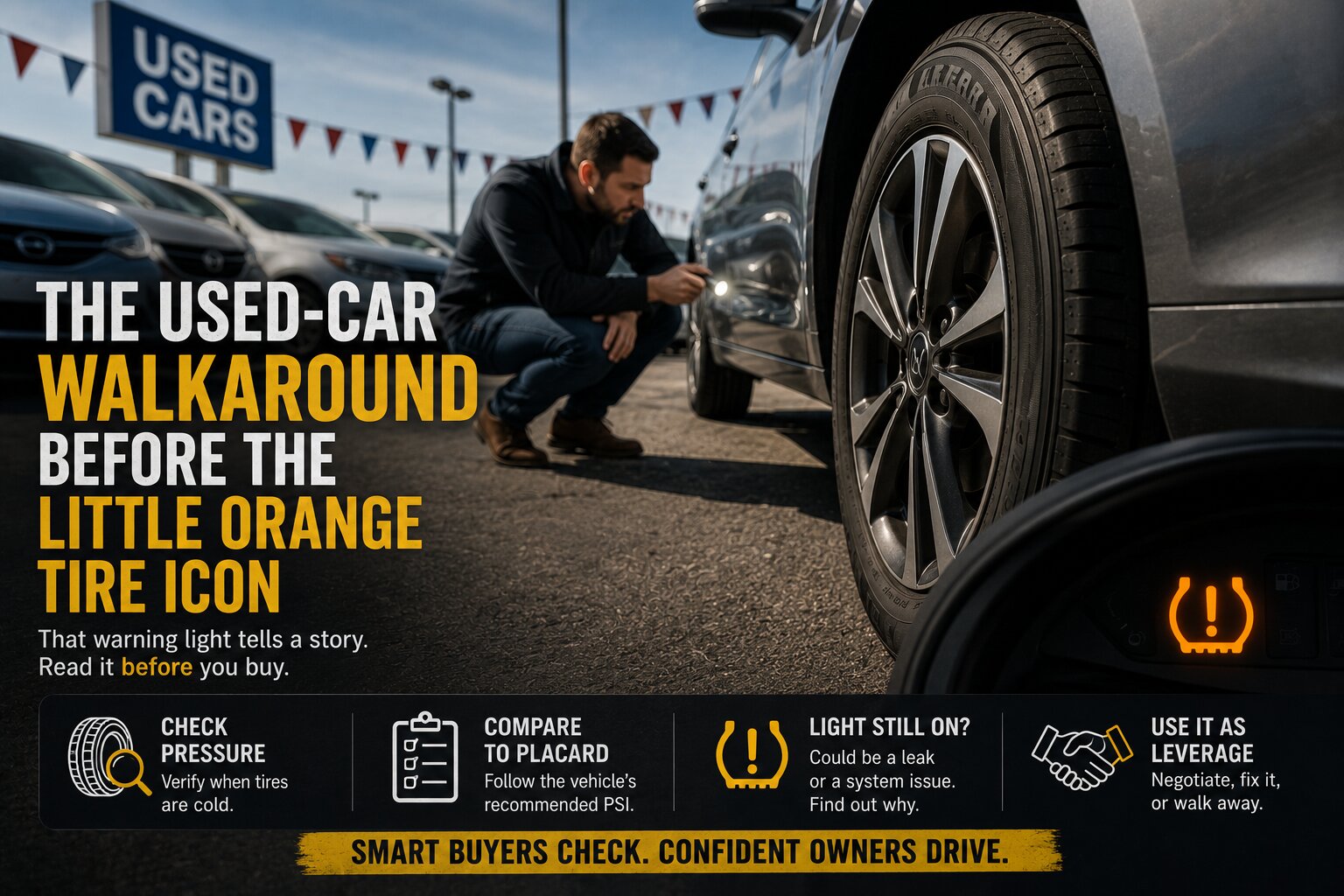
You can see this same habit shift with tire pressure monitoring systems, which turned tire inflation from an occasional maintenance chore into something many drivers think about whenever a warning light appears on the dash. If you want another example of how quickly expectations harden into routine, our piece on how TPMS changed driver habits traces that arc from novelty to normal.
The common thread is not gadgetry for its own sake; it is feedback at the right moment. A backup camera gives immediate visual feedback when reversing; TPMS gives immediate feedback when pressure drops or drifts out of range (depending on system design). Both reduce uncertainty in everyday driving tasks.
What cameras still cannot do for you
Here is where responsible expectations matter. A backup camera shows what its lens sees; it does not guarantee that everything around you is safe or visible at all times.
Cameras can be obscured by dirt, snow, road salt film, or water droplets that distort the image at night under parking-lot lights. Bright sun can wash out contrast on some displays depending on angle and screen quality. And like any single viewpoint, a rear camera has limits outside its field of view.
NHTSA’s framing of driver assistance technologies reinforces the right mindset: these systems assist; they do not replace attentive driving. In practice that means using the camera as one more source of information while still checking mirrors and looking around before moving. (NHTSA driver assistance technologies overview)
The new baseline for everyday confidence
The most interesting part of this story is not that we added another screen to the dashboard; it is how quickly drivers recalibrated what “normal” feels like.
A generation ago, reversing was taught as an exercise in spatial imagination supported by mirrors. Now many U.S.-market drivers treat a rearview camera image as basic equipment for maneuvering in tight spaces and busy environments. That expectation shows up everywhere: in used-car listings where sellers highlight cameras alongside air conditioning and Bluetooth; in buyer skepticism when an older vehicle lacks modern rear visibility aids; in the way people instinctively glance at the screen even after turning their head out of habit.
The mirror never went away because it still matters every mile you drive forward and backward alike. But culturally speaking, we have moved from accepting blind spots as fate to expecting technology to help us see around them.
Keep the conversation going
What would you ask next?
Read the discussion or share your experience.