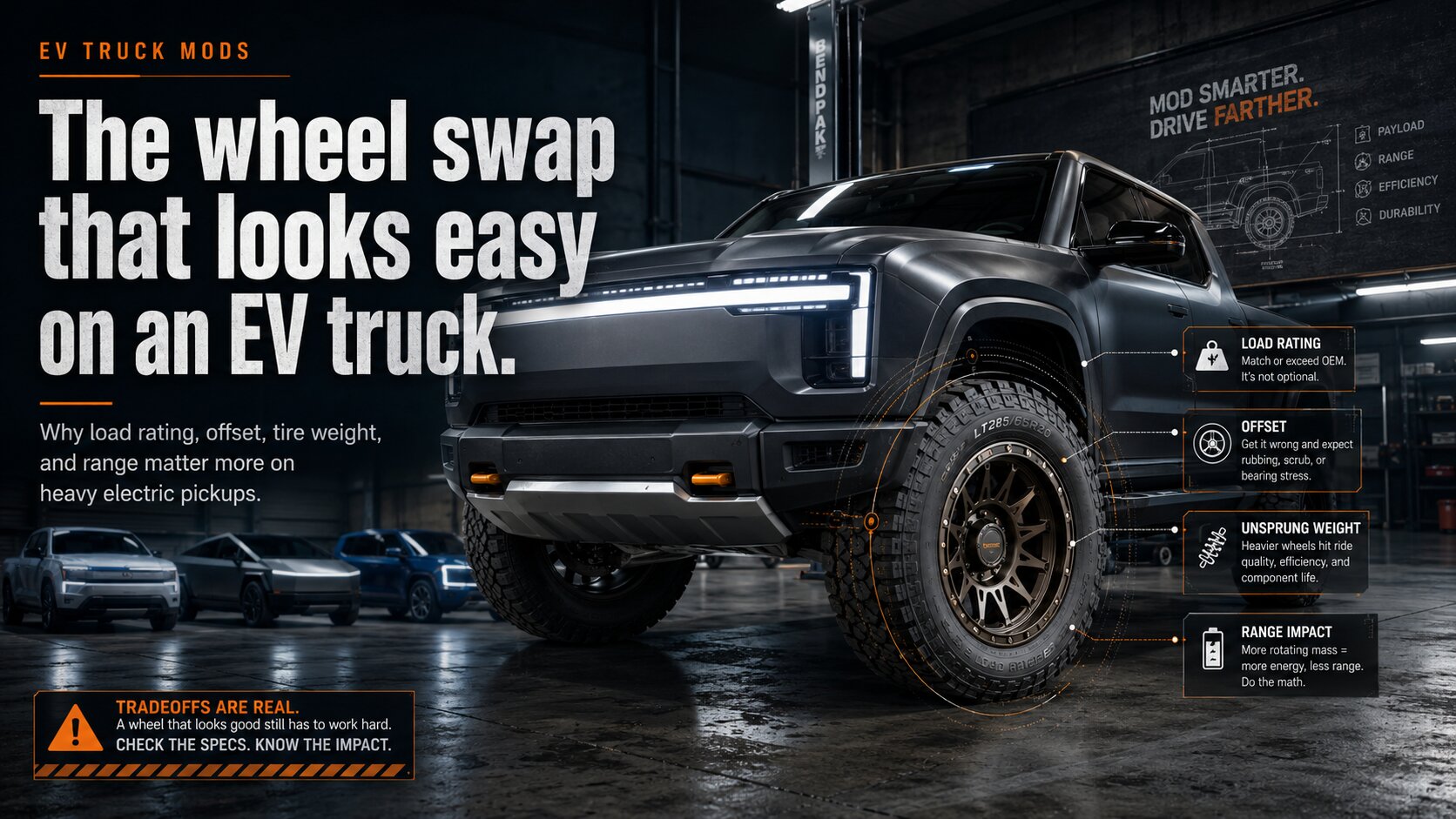
The wheel swap that looks easy on an EV truck
Aftermarket wheels are the first “real truck” mod a lot of us reach for. They’re visible, they change the stance, and they’re a clean way to tailor an EV pickup to actual work or trail use. The catch is that EV trucks are heavy, torque-rich, and efficiency-sensitive in a way half-ton gas trucks just aren’t. A wheel and tire change that feels harmless on a Silverado 1500 can turn into a range haircut, a ride-quality downgrade, or a load-rating problem on something like a Ford F-150 Lightning (2022-present), Rivian R1T (2022-present), GMC Hummer EV Pickup (2022-present), or Tesla Cybertruck (deliveries began in late 2023).
Those are the big players most U.S. shoppers cross-shop today, with the Silverado EV and Sierra EV arriving later and still ramping up depending on trim and availability. The point is not which badge you’re wearing. It’s that every one of these trucks starts with a big battery pack under the floor, high curb weight relative to many gas half-tons, and instant torque that loads tires hard at low speed. Wheels are no longer just “style.” They’re part of your suspension, your efficiency package, and your safety margin.
Verified basics: what we know about the trucks and why it matters
A few widely known facts set the stage:
EV pickups are heavy. Exact curb weight varies by trim, battery, and options, but it’s common knowledge that these trucks carry thousands of pounds of battery and structure. That extra mass raises the stakes for wheel load rating, tire load index, braking heat, and impact resistance.
They make big torque right now. Lightning, R1T, Hummer EV, and Cybertruck all deliver strong low-speed shove compared with typical gas half-tons. You do not need exact horsepower numbers to understand what that does: it stresses sidewalls and can make a too-wide, too-soft setup feel squirmy under acceleration while also chewing tread if alignment is off.
Range is sensitive to rolling resistance and aero. EPA range numbers exist for these trucks in various trims, but they vary widely with wheel size and tire type. What’s consistent is the physics: bigger, heavier wheels and more aggressive tires usually increase energy use in typical driving.
Competitors matter because owners use them similarly. People tow boats with Lightnings, camp out of R1Ts, crawl Hummer EVs over rocks, and daily-drive all of them in traffic. The same wheel decisions follow you from Costco runs to trailheads to towing ramps.
Load rating: the part nobody wants to talk about at the wheel shop
If you only take one thing from this story, make it this: wheel load rating is not optional on an EV truck.
A wheel has a maximum load rating (often stamped on the back of a spoke or listed in documentation). Your tires also have a load index that corresponds to how much weight each tire can carry at a specified pressure. For a pickup that might haul payload in the bed or put tongue weight on the hitch while towing, you need enough capacity for real use cases, not just “empty truck cruising.”
Here’s where people get tripped up:
1) Curb weight is only the start. Add passengers, tools, a bed rack, camping gear, or a trailer tongue load and each corner can see more than you think depending on weight distribution.
2) Dynamic loads spike. Hit a pothole at speed or drop into a washout off pavement and the instantaneous load on one wheel can be far higher than static weight. Heavy EVs amplify this.
3) Some aftermarket wheels are marketed for looks first. That doesn’t mean they’re unsafe by default. It means you have to verify ratings yourself instead of assuming “truck wheel” equals “truck duty.” If you cannot find an official load rating from the manufacturer for the exact size and offset you’re buying, that’s a red flag. If the seller can’t provide it clearly, walk away.
I’ve watched otherwise careful owners get laser-focused on diameter and finish while hand-waving load capacity because it’s boring. Then they hook up a trailer or toss a pallet of pavers in the bed and suddenly that boring spec is the whole game.
Offset and scrub radius: when stance changes steering feel
Offset is where the tuning story gets real. Offset is basically how far the mounting surface sits relative to the wheel’s centerline. Change offset enough and you change track width (stance), but you also change suspension geometry effects like scrub radius.
The practical version: push wheels outward for that flush look and you may get heavier steering effort at low speeds, more kickback over bumps, and more stress on bearings over time. Pull wheels inward too far and you risk rubbing on suspension components or losing clearance for brake hardware depending on the truck.
On EV trucks with big brakes (common because they’re heavy) and often tight packaging around control arms and knuckles, offset mistakes show up fast as rubbing at full lock or under compression. Even if it “clears in the driveway,” it can rub when you hit a dip with steering input or when the truck squats under payload.
The other piece people don’t expect is how offset interacts with driver-assist calibration feel. I’m not claiming systems will fail because of wheels alone; manufacturers design some tolerance in. But lane-keeping behavior and steering response are tuned around factory tire characteristics. Change contact patch shape and compliance enough and you can make the truck feel busier on-center. Not dangerous by default, just less relaxed.
Unsprung weight: why your EV truck suddenly feels like it lost suspension travel
EV owners talk about range constantly; they talk less about ride quality until it goes sideways. Wheels are unsprung mass along with tires, brakes, hubs, and part of the suspension links. Add weight here and your shocks have to work harder to control motion over bumps.
The classic mistake is going bigger diameter with a heavier wheel because it looks tough behind big fender openings. Then you add an all-terrain tire with deeper tread blocks. Now you’ve stacked weight in exactly the place your suspension least wants it.
What changes in typical daily use:
Sharp impacts get sharper. Expansion joints that were a muted thump can become a crack through the cabin floor.
The truck feels less planted on broken pavement. Instead of tracking smoothly, it can hop slightly over mid-corner bumps because the tire cannot follow quick road contours as easily.
You may hear more noise. Some of this is tread pattern (more on that below), but heavier assemblies can also transmit more harshness through bushings.
This part frustrates people because EV trucks already have a different feel than traditional pickups due to battery mass low in the chassis. Many drive surprisingly composed stock. A heavy wheel setup can undo that calmness quickly.
Aero matters more than you want it to
If there’s one truth about range loss from wheels that owners quietly learn then stop bragging about online, it’s aero. Open-spoke wheels look great; they also stir air around brakes and wheel wells. On an EV truck doing highway miles between chargers or job sites, that drag adds up.
Bigger diameter wheels often come with lower-profile tires if overall diameter is kept similar to stock. That can reduce sidewall flex slightly but also exposes more wheel face area to airflow depending on design. Conversely, going to a taller sidewall all-terrain tire may increase frontal turbulence around tread blocks as well as create more aerodynamic disturbance at speed.
You do not need exact percentage losses here to make good decisions because results vary by truck shape (Lightning versus R1T versus Cybertruck are very different aerodynamically) plus wheel design plus tire choice plus driving speed. What is consistent is directionally obvious: more turbulence usually means worse efficiency at highway speeds.
Rolling resistance: where tires quietly take your miles
Tires do most of the damage to range after a wheel swap because many aftermarket builds pair wheels with aggressive rubber. All-terrain tires bring tougher carcasses and chunkier tread blocks for gravel roads, snow traction, forest service routes, and jobsite mud. They also tend to increase rolling resistance compared with highway-focused tires designed for efficiency.
This is where I see owners get caught between identity and reality. The truck looks ready for Moab or elk camp year-round; meanwhile 90 percent of miles are commuting at 70 mph with an empty bed. The tire choice becomes an always-on tax for an occasional hobby day.
If you actually need off-road traction or puncture resistance for rocky trails or construction debris, that tradeoff can be worth it. But if your “off-road” is mostly wet grass at kids’ sports fields or snow-packed county roads twice a year, you might be buying noise and energy use you never asked for.
The range hit nobody wants to admit
You’ll hear plenty of confident claims online about “no noticeable range loss.” Sometimes that’s true within normal variability because weather swings range hard anyway (cold temperatures especially). Sometimes it’s cope because admitting range loss feels like admitting you made your expensive truck worse at its core job: covering distance between chargers while hauling life around.
The honest answer is messier:
Your range impact depends on speed profile. City driving leans more into rolling resistance and stop-and-go losses; highway leans harder into aero drag. If your life is mostly interstate miles, open wheels plus aggressive tires tend to show up plainly in consumption numbers over time even if day-to-day feels noisy due to wind and temperature changes.
Your range impact depends on tire pressure discipline. Underinflation increases rolling resistance quickly; overinflation can hurt ride quality and traction depending on conditions. With heavier trucks, staying near manufacturer-recommended pressures (adjusted appropriately for load) matters even more.
Your range impact depends on how honest your baseline was. Stock EPA numbers are not what most people see every day at 75 mph with cargo aboard. If your baseline was already optimistic in your head, any mod feels like betrayal when reality shows up on your dash display.
I won’t throw out made-up percentages here because they vary wildly by setup and conditions. But I will say this: if someone tells you wheels and tires never affect EV range in meaningful ways, they are either very lucky with their choices or they are not paying attention across enough miles to average out weather noise.
The fitment headaches: rubbing, sensors, torque specs
The practical challenges come fast once you move away from factory sizing:
Rubbing under compression shows up when you hit dips at speed or turn into driveways at an angle. It’s not just annoying; repeated rubbing can damage liners or even chew into wiring harnesses depending on location.
Tire diameter changes affect speedometer accuracy, odometer readings (which affects maintenance intervals), and can influence how traction control behaves at the limit since systems infer slip partly from wheel speed data. Most modern trucks tolerate minor changes; big deviations are where headaches start.
Tire pressure monitoring systems usually carry over fine if sensors are transferred correctly, but sensor compatibility varies by model year and system design. If you end up with warning lights after installation, it becomes less “fun mod” and more “why is my dash yelling at me.”
Lug torque matters more than people treat it, especially with heavy vehicles producing strong acceleration forces through hubs repeatedly. Correct torque spec comes from the vehicle manufacturer; using an impact gun until “it feels tight” is how studs get stretched or rotors get warped later from uneven clamping force.
A capability-first way to choose wheels for an EV pickup
If your goal is rugged function without turning your EV into an inefficient pogo stick, here’s what tends to hold up well in real American use cases like towing small campers, hauling tools, running forest roads to trailheads, or dealing with winter slop:
Start with load rating margins. Verify wheel load rating from official documentation for your exact size configuration. Match tires with appropriate load index for your truck’s axle ratings (check your door jamb placard). If you tow regularly or carry payload often, build margin instead of skating close to minimums.
Avoid extreme offset moves unless you have a reason beyond looks. A slightly wider stance can help stability feel off pavement; pushing too far often brings rubbing risk plus steering kickback plus extra spray down the body sides in rain or slush (a real annoyance if you live where roads get treated).
Watch total package weight. A modest-looking setup can still be heavy if both wheel and tire are beefy. Ask for weights when available; if they’re not available from trusted sources for that exact size model combo, assume nothing.
Select tread pattern based on actual terrain frequency. If you run gravel roads weekly or deal with sharp rock often enough to justify tougher rubber, accept some efficiency loss as part of capability budgeting. If not, consider less aggressive patterns that still offer wet traction without turning every highway trip into an energy penalty plus extra noise.
The emotional part: wanting tough looks without losing what makes an EV truck good
I get why people do this mod first. An EV pickup can look almost too clean stock depending on trim; some factory wheels scream “tech demo” when what you want is “workhorse.” Wheels fix that instantly.
The annoyance comes when style tweaks start messing with what makes these trucks genuinely useful: quiet cruising when loaded up for a weekend trip; predictable ride comfort over broken county roads; confidence that your remaining range will actually match your plan between chargers when you’ve got kids in back or gear in the bed.
The good news is there’s no rule saying aftermarket wheels have to ruin efficiency or comfort. The win happens when you treat wheels like real hardware instead of jewelry: verify ratings like you would with tow straps or recovery points; respect geometry like you would when leveling a truck; choose tires based on where you actually drive rather than where you wish you drove every weekend.
A last check before you buy
If I were standing next to someone in a parts store parking lot looking at their cart full of shiny new wheels for an EV truck, I’d ask four questions:
What’s the confirmed load rating?
What offset change are we making relative to stock?
What does this do to total assembly weight?
What kind of miles do you actually drive each month?
If those answers are solid, aftermarket wheels can be a legit capability mod even on an EV pickup. If those answers are fuzzy, that’s usually where the “range hit nobody wants to admit” starts living rent-free in your head every time you pass a charger with 12 percent left.
0 comments
Join the discussion around this article.
Please login to comment.