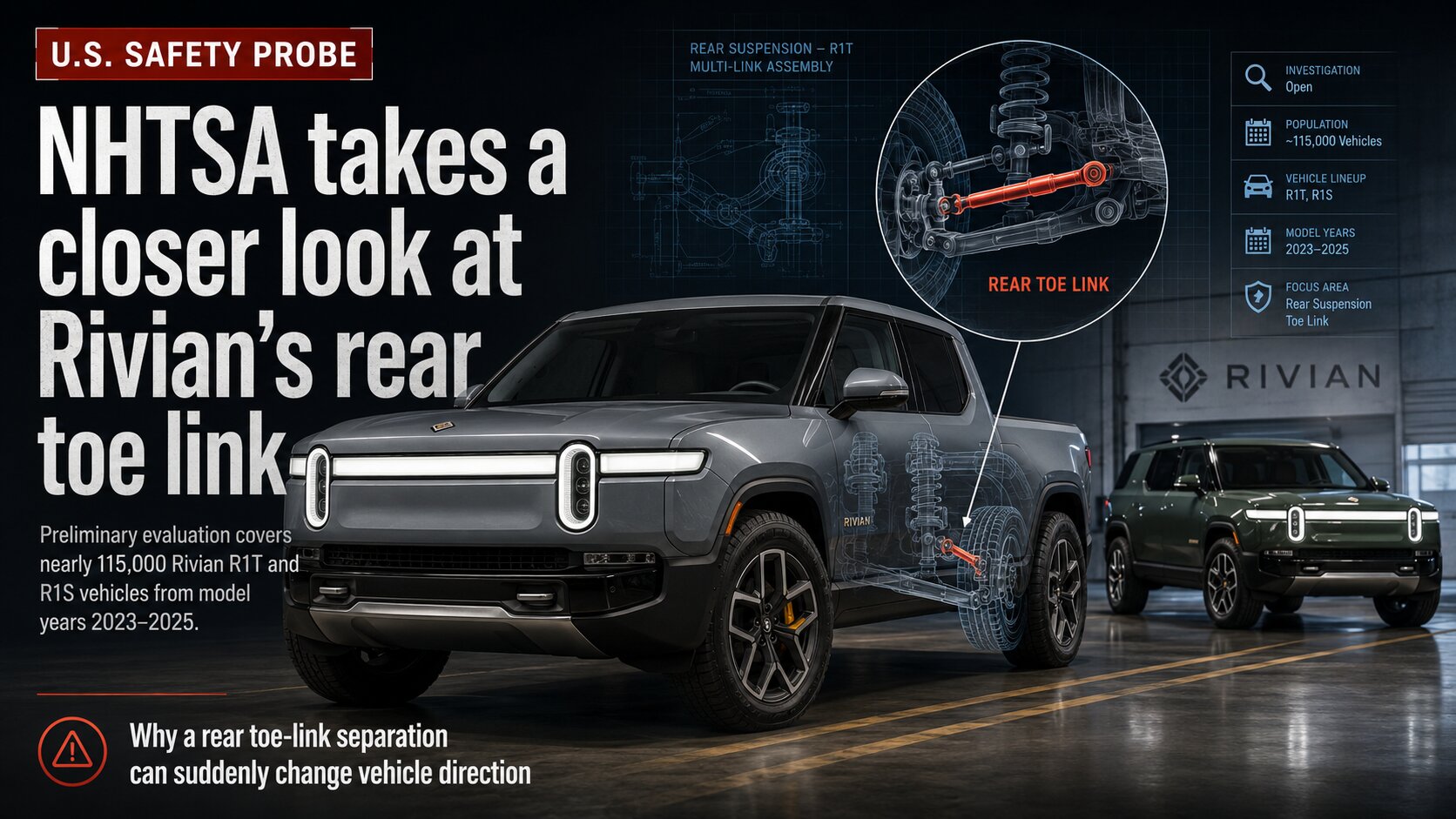
NHTSA takes a closer look at Rivian’s rear toe link
U.S. safety regulators are taking a fresh look at a small but important piece of hardware on Rivian’s electric trucks and SUVs. The National Highway Traffic Safety Administration (NHTSA) has opened a preliminary evaluation into nearly 115,000 Rivian vehicles after reports that a rear suspension component called a toe link can separate, according to Reuters.
The probe covers the Rivian R1T pickup and R1S SUV from model years 2023 through 2025, Reuters reported, citing NHTSA. The agency’s Office of Defects Investigation (ODI) said it had received complaints alleging the rear toe link separated, which drivers said led to a sudden change in vehicle direction.
That last part is why this is getting serious attention. EVs are heavy, quick to respond, and often tuned for stable highway cruising. If a rear suspension link lets go, you can end up with an abrupt steering effect from the back of the vehicle. It is the kind of failure that can turn an ordinary lane change into a real problem.
What a toe link does, in plain English
“Toe” is the alignment angle that describes whether a wheel points slightly inward or outward when viewed from above. Toe settings help a vehicle track straight, feel stable at speed, and behave predictably when you turn. A toe link is part of the suspension that helps control that toe angle as the wheel moves up and down over bumps.
On many modern vehicles, especially independent rear suspensions, links like this are doing constant quiet work. They resist forces from cornering, braking, acceleration, potholes, and even crosswinds. You do not notice them until something changes.
If a rear toe link separates or fails in a way that allows the wheel to shift position, the rear wheel can steer itself. Not gently. Depending on how it fails and at what speed, it can produce an unexpected yaw moment that feels like the back of the vehicle is trying to step out. Drivers may describe it as a sudden pull, a swerve, or the vehicle “darting” within its lane.
Why separation matters more than “a noise” or “a vibration”
A lot of suspension issues start as annoyances: clunks over speed bumps, uneven tire wear, steering wheel shimmy. A toe link separation allegation is different because it points to an immediate change in wheel control rather than gradual degradation.
Rear suspension geometry is one of those things you normally take for granted on American roads. It has to handle expansion joints on interstates, broken pavement in winter states, and long-distance cruising with a full load of people and gear. In an EV like the R1T or R1S, add high curb weight and strong torque response and those components live a demanding life.
NHTSA’s concern here is straightforward: if the rear wheel’s toe changes abruptly because a link comes loose or breaks, the driver may have less time to react than they would with most wear-and-tear issues. That is especially relevant on highways where Rivian owners are likely using driver assistance features and covering long distances between chargers.
What NHTSA’s “preliminary evaluation” actually means
A preliminary evaluation (PE) is an early stage investigation. It is not a recall and it is not a finding that a defect exists. Think of it as NHTSA saying: we have enough information to ask formal questions and gather more data.
In a PE, ODI typically requests information from the automaker and reviews complaints, field reports, warranty data (if provided), production details, engineering changes, and any related service bulletins. Investigators may also look for patterns: build dates, supplier batches, specific trims or configurations, mileage at failure, road conditions reported by drivers, and whether warning signs were present beforehand.
If the agency believes risk remains after reviewing what it learns in the PE phase, it can upgrade the matter to an engineering analysis. That step goes deeper into root cause and potential remedies. Or NHTSA can close the PE if evidence does not support further action.
For owners reading headlines and wondering whether they should park their vehicle immediately, this stage usually means “stay alert,” not “panic.” If there is an urgent safety risk identified during an investigation, regulators have tools to escalate quickly. For now, this is about gathering facts.
The vehicles involved: Rivian R1T and R1S (2023 to 2025)
Rivian’s R1T pickup and R1S SUV have carved out a distinct corner of the U.S. EV market: premium pricing, adventurous styling, real utility cues (especially on the truck), and battery-electric powertrains aimed at buyers who might otherwise shop high-end gas trucks or SUVs.
Reuters’ report specifies model years 2023 through 2025 for both nameplates in this probe. Rivian has also introduced newer products since then (including its smaller R2 platform announcement), but this NHTSA action centers on the current generation R1 vehicles already on American roads.
Rivian sells directly rather than through traditional franchised dealers. That direct model can make updates and service campaigns feel different compared with legacy brands: sometimes faster communication through apps and owner accounts; sometimes longer waits depending on service center capacity and parts availability in certain regions. None of that indicates fault here; it just shapes how owners experience any investigation-related fixes if they happen.
The competitive backdrop: big EVs competing with big expectations
In practice, shoppers cross-shop Rivian with other large electric SUVs and trucks even when specs do not line up perfectly trim-to-trim. Ford’s F-150 Lightning is an obvious alternative for an electric pickup buyer who wants familiar proportions and widespread service infrastructure. Tesla’s Model X overlaps more with R1S buyers looking for a three-row-ish premium EV experience (depending on configuration), while GM’s large electric trucks (like Chevrolet Silverado EV) aim at similar use cases even if availability varies by region and build timing.
Rivian also competes indirectly with gas-powered heavy hitters like the Ford F-150 (including off-road oriented trims), Jeep Wagoneer family SUVs, and luxury full-size SUVs from established brands. That matters because many buyers are still deciding whether they trust EVs for long trips or towing days where energy use climbs fast.
This is why suspension integrity stories cut through the noise. For many customers paying premium money for an electric adventure vehicle, confidence is part of what they are buying: stability at speed, predictable handling on rough pavement, and calm behavior when loaded up for a weekend away.
EV reality check: why chassis parts live a hard life in heavy electric vehicles
Even without quoting specific curb weight figures (which vary by trim and battery), it is widely understood that large EVs tend to be heavy because batteries add mass. That weight can be managed well with good suspension tuning and strong components; plenty of EVs drive beautifully day to day. But physics does not take days off.
A rear toe link sees repeated load cycles every time you hit broken pavement or transition onto freeway ramps at speed. Add passengers, cargo, maybe even towing depending on how owners use these vehicles; loads climb further. If there is any weakness in design margin, manufacturing consistency, corrosion protection, fastener retention strategy, or assembly process control (all hypothetical until proven), suspension links are exactly where problems can surface.
None of this proves what happened in these Rivian cases. It just explains why NHTSA treats “separation” language seriously across any brand or powertrain type.
How drivers might notice something wrong
NHTSA’s summary referenced by Reuters centers on alleged separation leading to sudden direction change. In real-world terms, drivers often describe rear alignment problems as instability: the car feels like it wants to wander; it needs constant small corrections; it feels nervous in crosswinds; it may feel odd under braking or quick acceleration.
If something actually separates rather than loosens gradually, symptoms could be more dramatic: an abrupt pull or swerve sensation that does not match steering input. That kind of event tends to stick in your memory because it feels like the vehicle made its own decision for a split second.
If you own one of the affected model years and feel new instability or hear new suspension noises (especially from one corner), the conservative move is simple: schedule service promptly rather than hoping it goes away. Also check NHTSA’s database for updates as investigations evolve.
Road trips, charging stops, and why stability matters at 75 mph
The reason EV owners care about chassis confidence may be even more practical than performance talk suggests: road-trip planning already asks you to think ahead. You watch charging locations; you plan food stops around them; you keep an eye on weather because cold temperatures can reduce range; you factor elevation changes because they affect energy use both ways.
Add towing or roof cargo boxes and your efficiency assumptions can get shaky fast. That makes most drivers more sensitive to anything that adds stress behind the wheel. A vehicle that tracks straight and feels planted reduces fatigue during long interstate stints between charging sessions.
Home charging helps smooth out daily ownership for most EV drivers who can install Level 2 charging in a garage or driveway (equipment choice depends on electrical capacity and local permitting). But big electric trucks and SUVs still spend meaningful time on highways where stability issues are not just annoying; they can be unsafe.
What happens next for Rivian owners
Because this is a preliminary evaluation rather than a recall announcement, there may be no immediate action required beyond staying informed. If NHTSA escalates its review or if Rivian decides to take voluntary action based on what it learns internally (a path automakers sometimes take during investigations), owners could see communications through official channels such as mailed notices or app-based messaging tied to their VINs.
If you are shopping used or considering an R1T or R1S now, this probe becomes one more item on your due diligence list alongside normal EV questions: battery warranty terms (as stated by the manufacturer), service access near your home routes, charging network compatibility for your typical travel corridors, tire costs (big wheels are rarely cheap), and whether your household has realistic home-charging capacity.
A toe link probe does not automatically change those fundamentals; it does remind buyers that new-nameplate vehicles sometimes go through early-life learning cycles in public view.
The bigger picture: small parts can define trust
The most interesting thing about stories like this is how unglamorous they are. Suspension links do not sell cars in ads. Yet they shape how safe you feel when traffic compresses suddenly around you or when you have to make one quick move to avoid debris in your lane.
NHTSA opening an evaluation does not assign blame; it signals attention. Over the next steps regulators will look for patterns and causes using data rather than vibes. For Rivian owners who bought into the brand’s big-sky promise of electric capability with everyday usability, clarity matters almost as much as any eventual fix.
If one rear suspension part can change the whole lane story in an instant, it deserves careful scrutiny before anyone jumps to conclusions.

0 comments
Join the discussion around this article.
Please login to comment.