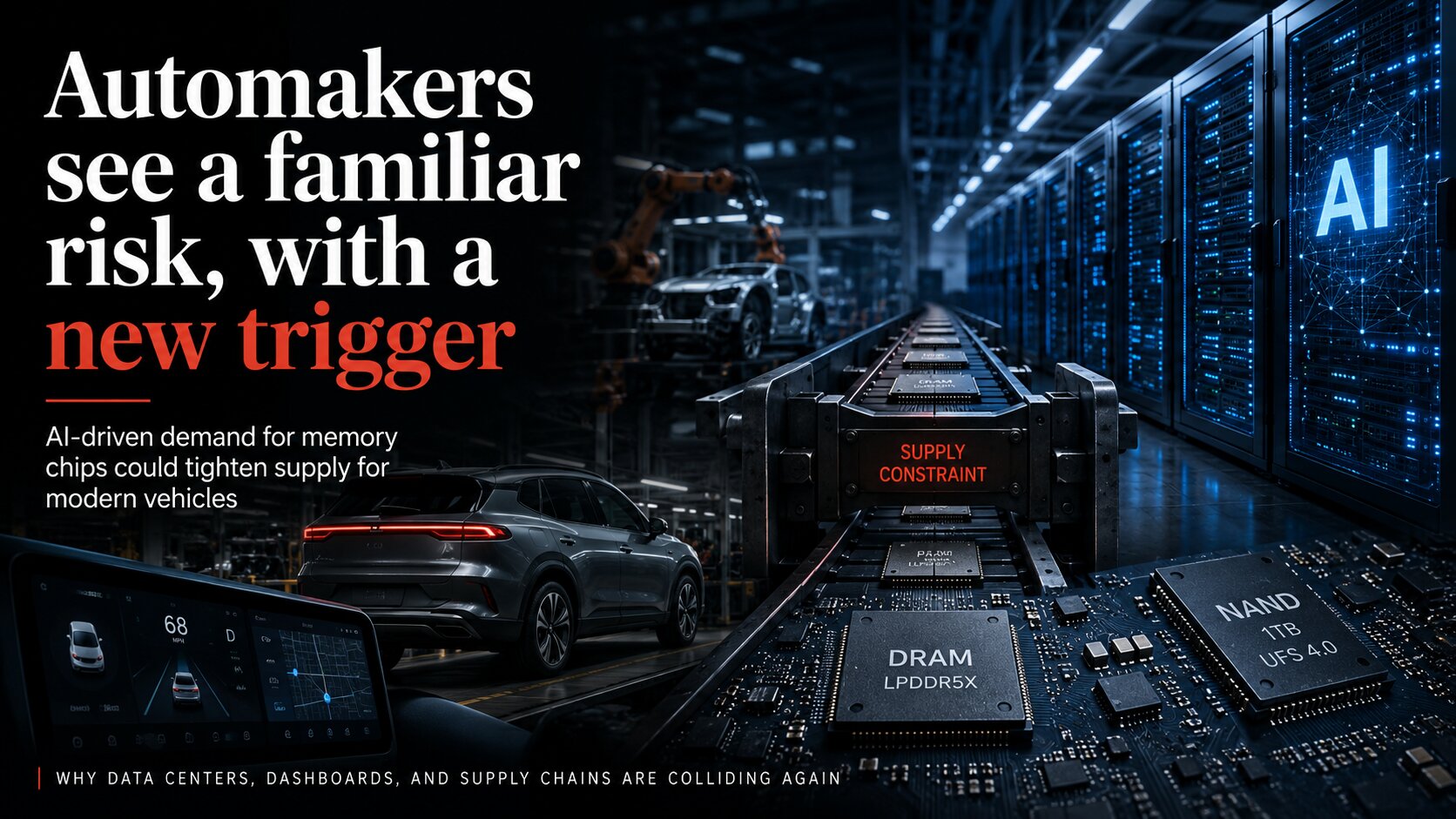
Automakers see a familiar risk, with a new trigger
NEW YORK. Automakers and major retailers are warning that the world’s appetite for memory chips, supercharged by artificial intelligence data centers, could tighten supplies of the components that quietly keep modern vehicles running. The concern is not a sudden shutdown tomorrow. It is a supply chain squeeze that could show up first as longer lead times, higher costs, and tougher allocation fights for the kinds of memory semiconductors used across dashboards, safety systems, and powertrain controllers.
The warning surfaced in industry discussions reported by Reuters on June 3, 2026, as companies flagged the possibility that memory shortages could influence product availability and pricing dynamics. The core message is straightforward: as AI infrastructure expands, chipmakers may prioritize the highest margin segments, and that can leave automakers competing for capacity in parts of the semiconductor market that are less glamorous but critical.
For U.S. buyers, it lands with some déjà vu. The pandemic era chip crunch taught the industry how quickly a small part can idle a big assembly plant. This time, the risk centers on memory rather than the microcontrollers that became household words in 2021.
What “memory chips” do in today’s vehicles
Memory is not one thing in automotive electronics. In plain terms, it is where a vehicle stores data and instructions so its computers can boot up, run software, log events, and keep features responsive. Without memory devices paired to processors and controllers, many systems simply cannot operate.
Common categories include DRAM (dynamic random-access memory) used as working memory for compute-heavy tasks, NAND flash used for longer-term storage such as operating systems and maps, and NOR flash often used for reliable code storage and fast boot functions in embedded systems. Automakers also rely on specialized automotive-grade versions designed to handle temperature extremes, vibration, long service life expectations, and functional safety requirements.
In practical vehicle terms, memory shows up everywhere:
Infotainment and digital cockpits rely on DRAM and flash to run graphics-intensive interfaces, store apps and profiles, and manage navigation databases. Advanced driver assistance systems use memory to buffer sensor data streams from cameras and radar so processors can interpret the world in real time. Telematics modules store logs and handle over-the-air update packages. Even traditional control units for engines, transmissions, airbags, or body electronics use embedded memory to hold firmware and diagnostic information.
Buyers do not see those chips on a window sticker. They feel them when a screen boots quickly on a cold morning, when a driver assistance feature does not stutter in heavy rain, or when an over-the-air update completes without drama.
Why AI data centers matter to Detroit and beyond
The AI boom has pushed data center operators to buy huge volumes of high-performance hardware. That includes GPUs and accelerators, but also large amounts of memory. Training and running modern AI models can be memory intensive; data must move fast between compute and storage to keep expensive processors busy.
This matters to automakers because semiconductor manufacturing capacity is finite at any given moment. When demand spikes in one sector, suppliers may shift production toward products with better margins or stronger contractual commitments. Automakers are then left trying to secure components that may be viewed as lower priority compared with high-end server parts.
The uncomfortable nuance is that automakers often need older or specialized nodes for certain automotive-grade parts, plus strict qualification standards that make last-minute substitutions difficult. Even if overall semiconductor output rises globally, mismatches between what is being made and what vehicles require can still produce bottlenecks.
There is also a timing problem unique to cars. Vehicle programs are planned years out. A model-year refresh might be locked into specific electronics architectures long before it reaches dealer lots. If the supply base tightens after those decisions are set, automakers have fewer easy pivots than consumer electronics brands that refresh hardware more frequently.
A warning is not the same as an assembly line stop
It is tempting to read “chip shortage” headlines as an immediate production halt. The reality is usually messier and slower moving.
A supply warning often signals that lead times are stretching or that suppliers are cautioning customers about allocation limits for future quarters. Automakers can respond by building inventories of critical components where feasible, rewriting sourcing contracts, qualifying alternate suppliers or parts (a process that can take time), or adjusting build mixes toward trims that use fewer constrained components.
In the pandemic-era crunch, some plants did stop because missing chips prevented completion of vehicles already scheduled for production. The current concern described by industry groups is better understood as a risk curve: if AI-driven demand keeps pulling memory supply toward data centers while automotive demand remains steady or rises with more screens and driver assistance features, pressure builds until something gives. That “something” could be cost increases first, then sporadic part shortages for specific modules rather than a uniform industrywide shutdown.
For consumers walking lots in typical daily life, the earliest visible sign is often not an empty showroom but an odd trim mix: fewer vehicles with certain tech packages or delayed availability of popular configurations.
Software-defined vehicles increase the stakes
Automakers have been moving toward software-defined vehicle architectures where more functions run on centralized compute platforms rather than many isolated electronic control units. That shift can increase demand for higher-capacity memory because centralized computers handle richer graphics, more sensor fusion for driver assistance, more logging for diagnostics, and more frequent software updates.
At the same time, buyers have come to expect phone-like behavior from cars: quick boot times, stable connectivity, seamless voice assistants (even when they are imperfect), and navigation that does not feel dated. Those expectations push manufacturers toward more powerful processors paired with larger memory footprints.
There is also an EV angle. Electric vehicles depend heavily on power electronics control and battery management software. While battery cells dominate EV cost discussions, the computing backbone matters too. Features like route planning tied to charging stops or thermal management strategies rely on robust electronics platforms that include memory devices.
Competitors are not just other automakers
The competitive set for memory chips now includes hyperscale cloud providers and AI-focused technology companies building out data centers at scale. From an automaker’s perspective, this is a different kind of rivalry than fighting another brand for showroom traffic.
In prior cycles, consumer electronics launches could create seasonal swings in component pricing or availability. AI infrastructure spending has the potential to be broader based and more persistent because it ties into corporate computing strategies rather than holiday sales cycles.
This does not mean automakers are helpless. Large vehicle manufacturers buy enormous volumes of semiconductors across many categories and have become more sophisticated customers since 2021. Some have pushed deeper into direct purchasing relationships with chipmakers instead of relying solely on tier-one suppliers to manage sourcing invisibly in the background.
The policy backdrop still shapes supply chain behavior
The semiconductor supply chain remains shaped by government policy debates around domestic manufacturing capacity and resilience. In the United States, federal efforts to expand chip production have been framed around economic security as much as industrial competitiveness.
Even with new investment announcements over recent years across the broader industry (not all specific to memory), new fabs take time to build and ramp. Automotive-grade qualification adds another layer of time because reliability expectations are high and validation cycles are strict.
For automakers selling into the U.S., policy also intersects with trade rules and sourcing strategies across North America and Asia. Companies can diversify suppliers on paper; doing it in practice without disrupting quality targets is harder than it sounds.
What this could mean for vehicles Americans actually shop for
The U.S. market continues to lean heavily toward trucks and SUVs loaded with technology features that quietly increase semiconductor content: larger displays; multi-camera surround views; hands-free or semi-automated driver assistance systems; premium audio; rear-seat entertainment; connected services; digital keys; expanded safety sensor suites.
A full-size pickup configured with advanced towing aids typically carries more sensors and computing capability than its simpler predecessor from a decade ago. A three-row family SUV often has multiple screens plus connectivity hardware expected to serve several devices at once on road trips. Even compact crossovers now commonly ship with standard driver assistance features that depend on reliable electronics modules.
If memory supplies tighten unevenly, automakers could prioritize high-volume models or high-margin trims first while limiting availability of certain option packages elsewhere. That kind of quiet reshuffling can frustrate buyers who want a specific combination rather than “close enough.” It also changes how dealers stock inventory because they sell what they can get allocated.
Why substitution is difficult in cars
A fair question from anyone who lived through recent electronics shortages is why automakers cannot simply swap in another chip.
The answer lies in qualification requirements and system design dependencies. Automotive electronics must meet strict performance across temperature ranges and long lifetimes; they also must comply with functional safety practices depending on application. Software stacks may be tuned to specific memory configurations for timing behavior or reliability characteristics.
Changing a memory component can require revalidation at the module level and sometimes at the vehicle level. That process takes engineering resources and time that product teams would rather spend improving features or addressing warranty issues elsewhere.
The near-term watch list
The Reuters report reflects growing concern among automakers and retailers about how memory supply constraints could feed into broader market conditions if AI demand continues to accelerate. In day-to-day industry terms, several indicators will matter most:
Supplier lead times for automotive-grade DRAM and flash categories; allocation notices from tier-one module makers; evidence of automakers adjusting build plans due to constrained infotainment or ADAS modules; and whether chipmakers expand dedicated capacity for automotive-qualified memory products at a pace that matches vehicle technology growth.
If those indicators worsen, disruptions may appear first as delays in specific high-content modules rather than wholesale factory closures across an entire brand portfolio.
A familiar lesson returns: small parts decide big outcomes
The modern vehicle is a rolling network of computers wrapped in steel or aluminum (and increasingly glass). Memory chips are among the least visible components inside it, but they influence everything from startup speed to safety system reliability to whether software updates arrive smoothly.
Automakers raising flags now are trying to avoid repeating the scramble of earlier shortages where missing semiconductors forced painful production decisions after consumer demand had already shifted back toward normal buying patterns. The current warnings do not guarantee an immediate crisis; they do underline how quickly external forces like AI infrastructure spending can reach into something as grounded as an assembly plant schedule in Michigan or Kentucky.
David Ramirez covers the U.S. auto market from New York.
0 comments
Join the discussion around this article.
Please login to comment.