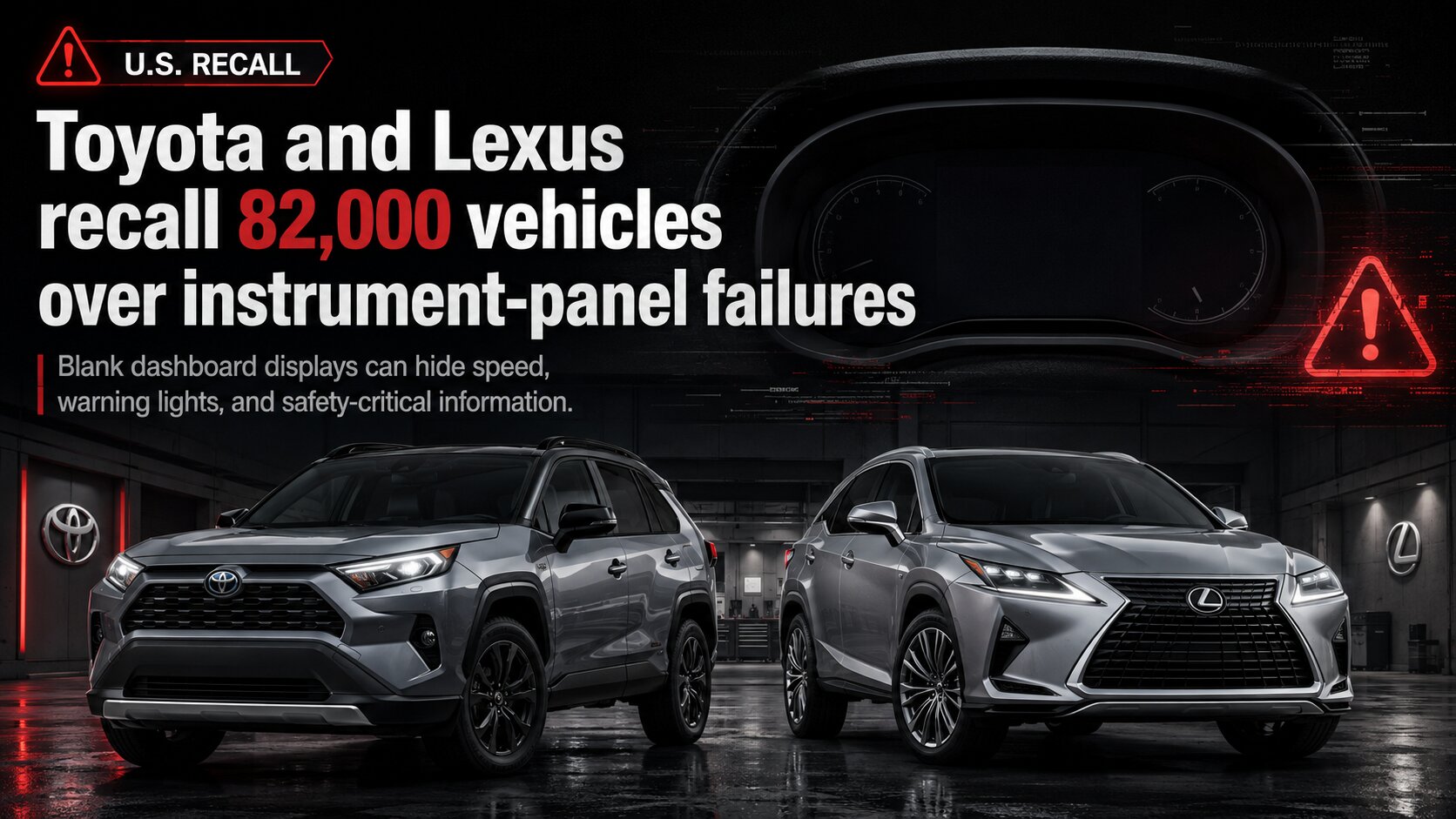
Toyota and Lexus recall 82,000 vehicles over instrument-panel failures
Toyota is recalling about 82,000 vehicles in the U.S. across its Toyota and Lexus brands because the instrument panel can go blank, taking away critical information the driver relies on every second. The action covers a mix of Toyota and Lexus models, and it reflects a broader truth about modern vehicles: the dashboard is no longer just a convenience feature. It is a safety system.
The recall, reported by Cars.com and based on manufacturer and federal safety filings, addresses an issue where the instrument panel display may not illuminate or may go dark. When that happens, the driver can lose the speedometer readout, warning lights and telltales, and status information for key systems. That is not a minor annoyance. It changes how quickly a driver can recognize a developing problem and respond.
Owners should check their VIN and follow the remedy instructions once notified. Toyota and Lexus typically provide VIN lookup tools on their brand websites, and the National Highway Traffic Safety Administration (NHTSA) maintains a public recall database as well.
Why a blank cluster matters more than it used to
In older cars, an instrument cluster was mostly analog needles and a handful of bulbs. A failure could still be serious, but many drivers had redundancy built into habit: engine sound, shift feel, or a mechanical speedometer that rarely disappeared all at once. In 2026, that is not how most new vehicles work.
Today’s clusters are digital displays tied into the vehicle’s communications network. They are where drivers see not just speed and fuel level but also warnings for brake system faults, power steering issues, overheating, low oil pressure, airbag readiness, charging status on hybrids, driver-assistance alerts, and messages about malfunctioning sensors. Depending on model and equipment, the cluster can also be where lane-keeping status, adaptive cruise settings, road sign recognition cues, and other advanced driver-assistance system information appears.
If that screen goes blank at startup or while driving, the driver loses a lot at once. The risk is straightforward: you might not know your speed in a school zone or work zone; you might miss a low tire pressure warning until handling changes; you might not see an overheating alert until it is too late to avoid damage. Even when a vehicle remains drivable, the absence of warnings changes decision-making in typical daily use.
What we know about the affected vehicles and what we do not
The Cars.com report describes an 82,000-vehicle recall involving Toyota and Lexus models for an instrument panel issue that can result in a blank display. The story references official recall documentation rather than owner anecdotes. That matters because instrument-panel complaints can be messy in online forums, ranging from software glitches to battery issues to isolated part failures.
At the time of writing this article, model-by-model details such as exact model years, trim levels affected, production ranges, and the precise technical root cause should be confirmed directly through NHTSA recall documents or Toyota’s recall bulletins. Those specifics tend to be listed in the official filing along with remedy steps and owner notification timelines. If you are shopping used or leasing one of these vehicles now, that paperwork is the cleanest source of truth.
What is clear from the recall description is the failure mode: loss of instrument-panel illumination or display functionality. That is enough to trigger safety concern because federal rules require certain telltales and indicators to be visible to the driver under normal operation.
The dashboard has become part of compliance
There is a policy angle here that often gets overlooked outside engineering circles. As regulators push for more safety content in new vehicles and as automakers add more standard driver-assistance features to meet consumer demand and competitive pressure, drivers are being asked to interpret more information from screens.
The instrument cluster is central to that experience because it is still the most natural place for immediate alerts. A center touchscreen can show plenty of data too, but it is not always within the same sightline as speed and warning telltales. When clusters become fully digital and highly integrated with software updates and networked modules, recalls increasingly look like technology campaigns rather than traditional mechanical fixes.
This does not mean digital clusters are inherently unsafe. Many are bright, legible, and configurable. The issue is that when they fail, they can fail comprehensively. A single glitch can take out multiple readouts that used to be separate components.
Competitive context: nearly everyone has moved to screens
Toyota and Lexus are hardly alone in leaning into digital displays across their lineups. Ford’s trucks and SUVs have shifted toward larger clusters on many trims; General Motors has rolled out expansive digital cockpit designs across Chevrolet, GMC, Cadillac, and Buick; Hyundai Motor Group has made dual-screen layouts common across Hyundai and Kia; German luxury brands have treated digital instrumentation as table stakes for years.
For buyers cross-shopping mainstream Toyota models against Honda, Subaru, Hyundai-Kia, Ford, Chevrolet, or Nissan alternatives, digital instrumentation is now part of the baseline expectation on many trims. In luxury segments where Lexus competes with Acura, BMW, Mercedes-Benz, Audi, Volvo, Genesis, and Cadillac, it is effectively mandatory.
That competitive reality creates an uncomfortable tradeoff: screens offer flexibility and modern presentation but also introduce new failure modes that feel foreign compared with analog gauges that rarely went completely dark.
What owners should do now
If you own a Toyota or Lexus vehicle that might be included in this recall campaign:
First: check your VIN. Use Toyota’s or Lexus’ official recall lookup page or NHTSA’s VIN search tool at nhtsa.gov/recalls. A model name alone does not confirm inclusion because recalls often apply only to certain production windows.
Second: watch for an official notification letter if you have not received one yet. Automakers typically mail notices once remedy parts or software updates are available and dealer procedures are finalized.
Third: if your cluster goes blank while driving before you get the fix done, treat it seriously. Even if the vehicle seems to run normally otherwise, you have lost speed indication and warning telltales. If it happens repeatedly or persists after restarting the vehicle (where safe), contact your dealer service department promptly.
Dealer reality: recalls collide with busy service lanes
In New York, where I cover the U.S. market closely and spend plenty of time tracking dealer activity across brands, recall campaigns like this tend to land at awkward moments for consumers. Service departments are already balancing routine maintenance demand with warranty work and technology-related repairs that take more diagnostic time than traditional mechanical jobs.
The practical advice for owners is simple: schedule early once remedies are available. Even when fixes are straightforward from a technician’s standpoint (often software updates or replacement of an electronic component), appointment availability can become the bottleneck.
A small failure with big consequences
A blank instrument panel sounds like something you could live with temporarily if you had to get home from work or finish an errand run. In reality it creates cascading uncertainty for many drivers because it removes instant feedback about speed and removes alerts designed to prompt quick action.
The broader takeaway is that modern dashboards are doing more than displaying information; they are communicating safety-critical status across multiple systems at once. When they go dark unexpectedly, it undermines one of the most basic promises of a new vehicle: clear communication between machine and driver.
If your Toyota or Lexus vehicle falls under this 82,000-unit recall population described by Cars.com’s reporting on the official filings, use your VIN to confirm status and get on your dealer’s schedule as soon as a remedy is available.

0 comments
Join the discussion around this article.
Please login to comment.