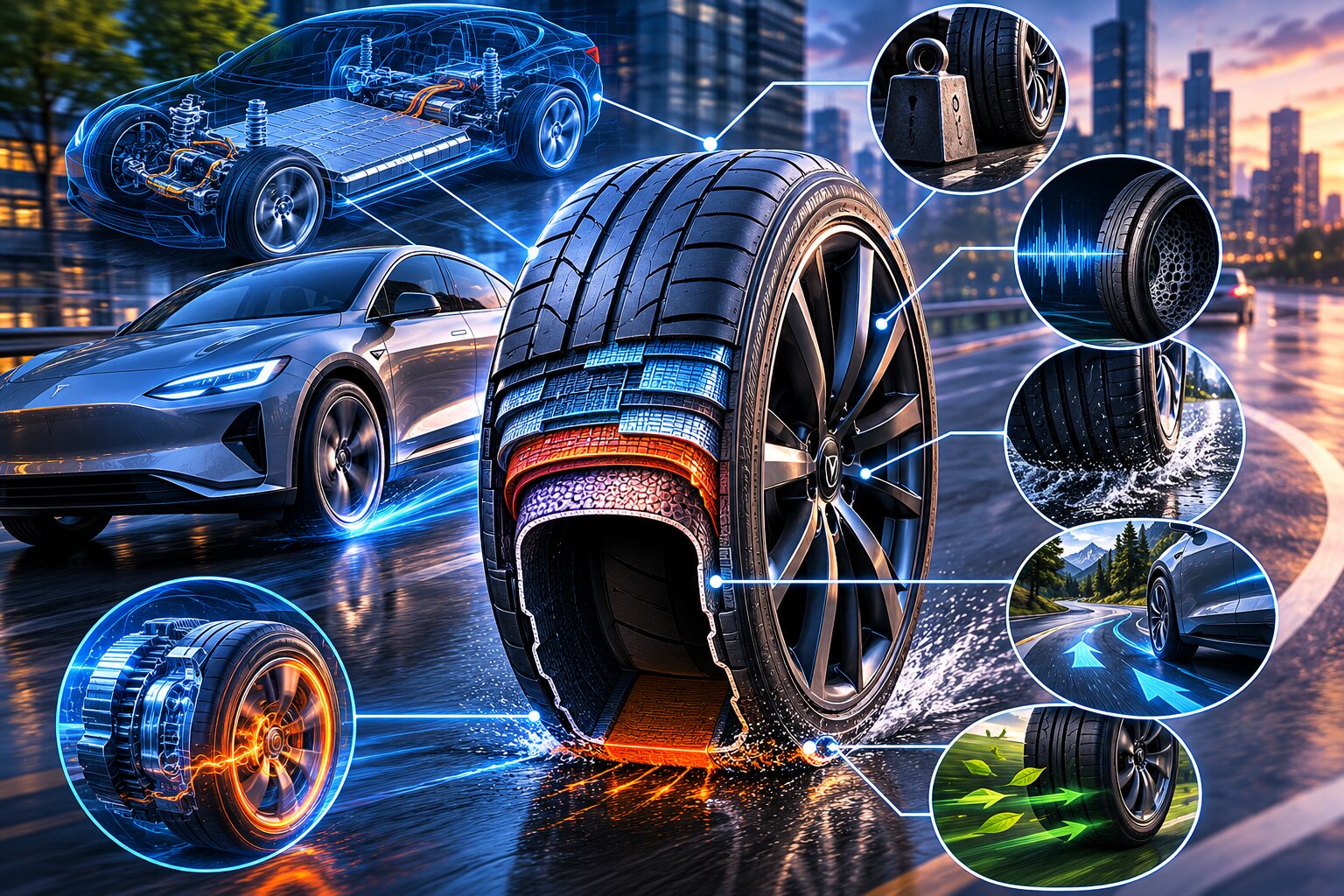
EV tires are not “quiet tires.” They are the drivetrain’s last gear.
I’m Brian O’Connor, based in Chicago, with an engineering background in automotive design. I spend a lot of time explaining powertrains and suspension to people who already love cars, and lately I keep coming back to the same underappreciated EV truth: the tire is doing more work than most owners realize.
On an internal-combustion car, you can hide a lot behind engine noise, a slipping torque converter, or a lazy throttle map. On an EV, the tire gets put on stage. It has to carry more mass, deal with instant torque at near zero rpm, keep cabin noise in check in a quieter vehicle, and still deliver wet grip and steering feel that doesn’t make the whole thing feel like a rolling appliance.
So when people say, “EV tires are just quiet tires,” I wince a little. Quiet is part of it. But load capacity, sidewall stiffness, rolling resistance, tread pattern, and even acoustic foam can change the whole car. Swap tires without understanding those tradeoffs and you can accidentally tune your EV into something you did not ask for.
Verified facts first: what’s different about the cars
Let’s ground this in widely known basics that apply across mainstream EVs rather than pretending there is one magic spec sheet. Battery electric vehicles typically weigh more than comparable gasoline cars because battery packs are heavy. A Tesla Model 3 Long Range is roughly in the low 4,000-pound range depending on year and configuration (published curb weights vary by model year and wheels). A Ford Mustang Mach-E and Tesla Model Y are commonly higher still. Trucks like the Ford F-150 Lightning and Rivian R1T push much further up the scale. Those are not obscure facts; you can see them on manufacturer specs and reputable road tests.
Torque delivery is also fundamentally different. An EV motor can deliver peak torque from very low speed, often effectively from a stop. That’s why even modest-power EVs feel punchy around town. It is also why traction control is busy and why tires see big longitudinal forces early in the launch.
Competitors matter here because tire strategy tends to converge within segments. The Tesla Model 3 competes with cars like the BMW 3 Series and Mercedes C-Class on size and mission, but its tire priorities skew toward range and low noise more than most sport sedans. The Model Y and Mach-E live in that compact crossover space where buyers want quiet cruising and decent winter manners. Big electric trucks compete with each other on towing ratings and payload, which makes load index selection less optional than it is on a sporty sedan.
I’m not going to throw out a table of exact ranges, charging speeds, or acceleration times because they vary by year and trim, and they are not the point of this tire story anyway. The point is that EVs put unusual combined demands on tires at the same time: mass, torque, noise sensitivity, and efficiency pressure.
The “tuning mod” nobody treats like tuning: changing tires
Enthusiasts talk about tuning like it starts at software. On an EV, sure, software matters. But tires are a physical calibration point you can actually touch. A tire swap changes effective gearing (via diameter), spring rate at the contact patch (via sidewall stiffness), damping behavior (via construction), aero drag (sometimes), rolling resistance (almost always), and cabin noise (often dramatically). That’s before we even get into how modern stability control uses wheel-speed signals to infer slip ratio.
The frustrating part is how easy it is to do this wrong while thinking you’re doing something simple. Plenty of owners swap because they want more grip or because they found a deal on a different size. Some do it for looks, chasing a wider stance or a meatier sidewall. In typical daily use, that decision can snowball into range loss, harsher ride, tramlining on grooved pavement, or weirdly inconsistent regen feel when traction is lower than expected.
Load index: the boring number that keeps your EV honest
If you take one thing away from this piece, make it this: load index matters more on many EVs than owners expect.
Because EV curb weight is high and weight distribution can be different from an ICE equivalent (battery mass low and spread across the floor), each tire has to carry serious static load before you even add passengers or cargo. Load index is the standardized rating that tells you how much weight a tire can support at its specified pressure. Go too low and you’re not just risking premature wear; you’re risking heat buildup under sustained load. Heat is what kills tires quietly.
This becomes extra relevant for EV crossovers and trucks that might tow or haul. Even if you never tow, Chicago potholes do not care about your intentions. A tire that is marginal on load capacity can be more vulnerable to impact damage because it may require higher pressures to carry load safely while still having less structural margin in the casing.
I’m not going to claim specific failure rates or tell horror stories I cannot verify. What I can say confidently is that engineers select original-equipment load ratings for reasons beyond bureaucracy. When you change size or model, you have to keep that load capability aligned with what the vehicle actually asks of it.
Instant torque: why EVs chew through rubber differently
EV torque delivery changes how a tire lives its life.
On many ICE cars with automatic transmissions, there’s some cushioning at launch through converter slip and gear changes. On an EV, especially one with strong low-speed output, the tire sees high longitudinal force right away. Traction control will manage it, but that management often comes through micro-corrections that still generate heat and wear at the tread blocks.
This is one reason some EV owners report faster rear-tire wear on powerful rear-drive-biased setups or dual-motor cars that favor rear torque under acceleration (the exact torque split strategy varies by manufacturer and drive mode). It’s also why “more grip” isn’t just about shorter stopping distances; it changes how much work stability control has to do to keep things tidy when you roll into throttle mid-corner on cold pavement.
There’s a personal observation here that doesn’t require me to claim I tested anything: when you drive performance cars long enough, you learn to read how a chassis talks back through the contact patch. With EVs, that conversation can get muffled by heavy isolation tuning and then suddenly sharp again if you change tires. Sometimes it feels like you gained steering feel; sometimes it feels like you gained nervousness.
Acoustic foam: helpful tool or weird compromise?
The acoustic-foam conversation gets oversimplified fast.
Many EV-focused tires use an internal foam layer bonded to the inside of the tread area to reduce cavity resonance noise. That resonance is basically the air inside the tire acting like a drum at certain frequencies. In quieter EV cabins where there’s no engine masking sound, that “whoomp” or “hum” becomes more noticeable at highway speeds.
Foam can help reduce certain noise bands in typical cruising conditions. The challenge is that foam does not change every kind of noise equally. Road texture noise from aggressive tread patterns still comes through structure-borne paths into suspension arms and subframes. And foam introduces real-world service considerations: if a tire gets punctured and needs an internal repair patch, shops sometimes have to cut away foam locally for proper bonding (procedures depend on manufacturer guidance). That’s not a deal breaker; it’s just one more detail owners do not think about until they are stuck at a tire shop at 6 p.m. on a Tuesday.
I’ve also seen confusion where people assume foam equals “EV rated.” It doesn’t. Foam targets one symptom: interior noise at specific frequencies. It does not automatically mean higher load index or better torque handling or lower rolling resistance.
Sidewall stiffness: ride comfort vs steering precision vs efficiency
If there’s one place where swapping tires changes the personality of an EV immediately, it’s sidewall behavior.
EVs often run relatively stiff sidewalls for two reasons: they need to carry weight without excessive deflection (which generates heat) and manufacturers want crisp response despite tall curb weights. A stiffer sidewall reduces delay between steering input and lateral force buildup at the contact patch. That makes the car feel more alert.
The downside shows up on broken pavement. Chicago streets are basically an NVH lab disguised as infrastructure. Stiff sidewalls transmit more impact harshness into the cabin unless suspension tuning compensates for it with damper valving and bushing compliance. If you swap from a stiffer OE-style construction to something softer (even if it fits), you might love the ride improvement but notice vaguer turn-in or extra squirm under regen braking at low speeds.
And yes, regen braking matters here because it changes how decel forces are applied through driven wheels compared with coasting in gear on an ICE car (where engine braking exists but behaves differently). Depending on calibration and drive mode, strong one-pedal regen can load the front or rear axle heavily during decel events in ways drivers feel as stability changes on wet roads or over expansion joints.
Wet grip: where efficiency-focused tires can surprise you
Wet grip is where I see the most mixed expectations among enthusiasts moving into EVs.
Tires optimized for low rolling resistance often use tread compounds and constructions aimed at reducing energy loss as they deform against the road surface. That helps range in typical highway cruising because less energy turns into heat in the tread package.
The tradeoff is that maximizing efficiency does not automatically maximize wet traction margin during aggressive maneuvers or emergency braking on cold rain-soaked asphalt. Modern all-season compounds can be very good; I’m not saying efficient equals unsafe. But if your baseline expectation comes from sticky summer tires on a lightweight sport sedan, an efficiency-first OE tire can feel numb in wet conditions when you ask for lateral grip quickly.
This becomes especially noticeable in EVs because they can mask speed so well. You look down and realize you’re going faster than your ears told you. Then you ask for braking or turn-in on wet pavement and get reminded that physics didn’t sign up for your quiet cabin experience.
The real results people notice after swapping
I cannot claim instrumented before-and-after numbers without testing data in front of me, so I won’t fake it with percentages or decibel readings. What I can do is describe consistent patterns enthusiasts report across platforms when they move away from OE-style EV-oriented tires:
Cabin noise character changes. Sometimes overall volume goes up only slightly but tone shifts from a low hum to a sharper hiss over coarse asphalt. That tonal change can be more annoying than raw loudness because your brain locks onto it during long highway slogs.
Range typically moves. Many drivers see range drop when switching to grippier compounds or wider sizes because rolling resistance increases and aero drag can rise with wider tread footprints (plus heavier wheel-and-tire assemblies increase rotational inertia). How much depends heavily on speed, temperature, inflation pressure, alignment settings, wheel size changes, and driving style.
Steering feel either wakes up or gets twitchy. A tire with stiffer shoulders might deliver better initial response but also follow road grooves more readily (tramlining). On crowned highways around Chicagoland, that can mean constant small corrections instead of relaxed tracking.
Ride quality shifts fast. Softer sidewalls smooth small impacts but may feel floaty over big undulations if dampers were tuned around stiffer OE casings.
Traction control behavior feels different. With higher grip levels traction control intervenes later; with lower grip it intervenes earlier and sometimes more abruptly because torque arrives instantly.
The challenge nobody wants to hear: OE tires are part of chassis calibration
This is where my engineering brain gets stubborn.
Carmakers tune suspension kinematics, damper curves, steering assist maps (especially electric power steering), ABS logic, stability control thresholds, and sometimes even motor torque ramp rates around specific tire characteristics delivered by OE suppliers for each trim level and wheel size option.
If you change those characteristics materially by altering size class (aspect ratio), construction type (stiffer casing), compound intent (efficiency versus performance), or even tread pattern aggressiveness for water evacuation versus quietness, you’re changing inputs those systems expect.
That does not mean “never swap.” Enthusiasts swap everything all the time; half my career has been watching people make cars better for their tastes by changing parts thoughtfully. It means treat tires like a tuning change with consequences rather than consumables with branding attached.
A practical street setup mindset (without shopping advice)
If your goal is a street-focused tune for an EV rather than track heroics or maximum range bragging rights, I’d think about priorities in this order:
1) Safety margins first: correct load rating for your vehicle’s weight class plus whatever passenger/cargo use you realistically have; speed rating appropriate for what was engineered into the car; no weird underspec shortcuts because “it fits.”
2) Wet confidence: Chicago weather makes this non-negotiable for many buyers who daily-drive year-round; hydroplaning resistance comes from tread design but also from maintaining proper inflation pressure.
3) Noise character: not just loud versus quiet but what kind of sound it makes at 40 mph versus 75 mph; some patterns drone more than others depending on road surface frequency content.
4) Ride feel: sidewall compliance should match what you want from your suspension; if your EV already rides firm due to weight management tuning, piling stiffness onto stiffness rarely ends well for daily comfort.
5) Efficiency: important for many owners; just understand that chasing grip usually spends energy somewhere else.
The emotional part: why this mod frustrates me (and why I still love it)
Tires are expensive enough that people want certainty before spending money. I get it. What frustrates me is how often EV discourse treats tires as accessories instead of core hardware while simultaneously obsessing over software updates measured in tenths of a second or single-digit miles of range estimate variance.
The satisfying part is that tires give enthusiasts something refreshingly analog in an increasingly digital segment. You change four rings of rubber and suddenly your steering feels different pulling onto Lake Shore Drive ramps; your cabin sounds different over concrete seams; regen feels smoother or more abrupt depending on traction; even your confidence merging in rain shifts slightly because feedback through the wheel changed.
No app update delivers that kind of immediate mechanical personality shift.
If swapping changes “the whole car,” that’s because it kind of does
An EV magnifies tire choices because everything else got quieter and heavier while delivering torque faster than most street tires were historically asked to handle every day.
If you keep load capacity correct and think through torque behavior, acoustic strategy (foam or no foam), sidewall stiffness, wet grip needs, and ride feel goals as one connected system rather than isolated checkboxes, tire swaps become legitimate tuning tools instead of expensive surprises.
That’s what makes this topic worth taking seriously: four contact patches still decide whether your high-tech electric car feels calm and confident or oddly wrong in ways no screen menu can fix.

0 comments
Join the discussion around this article.
Please login to comment.