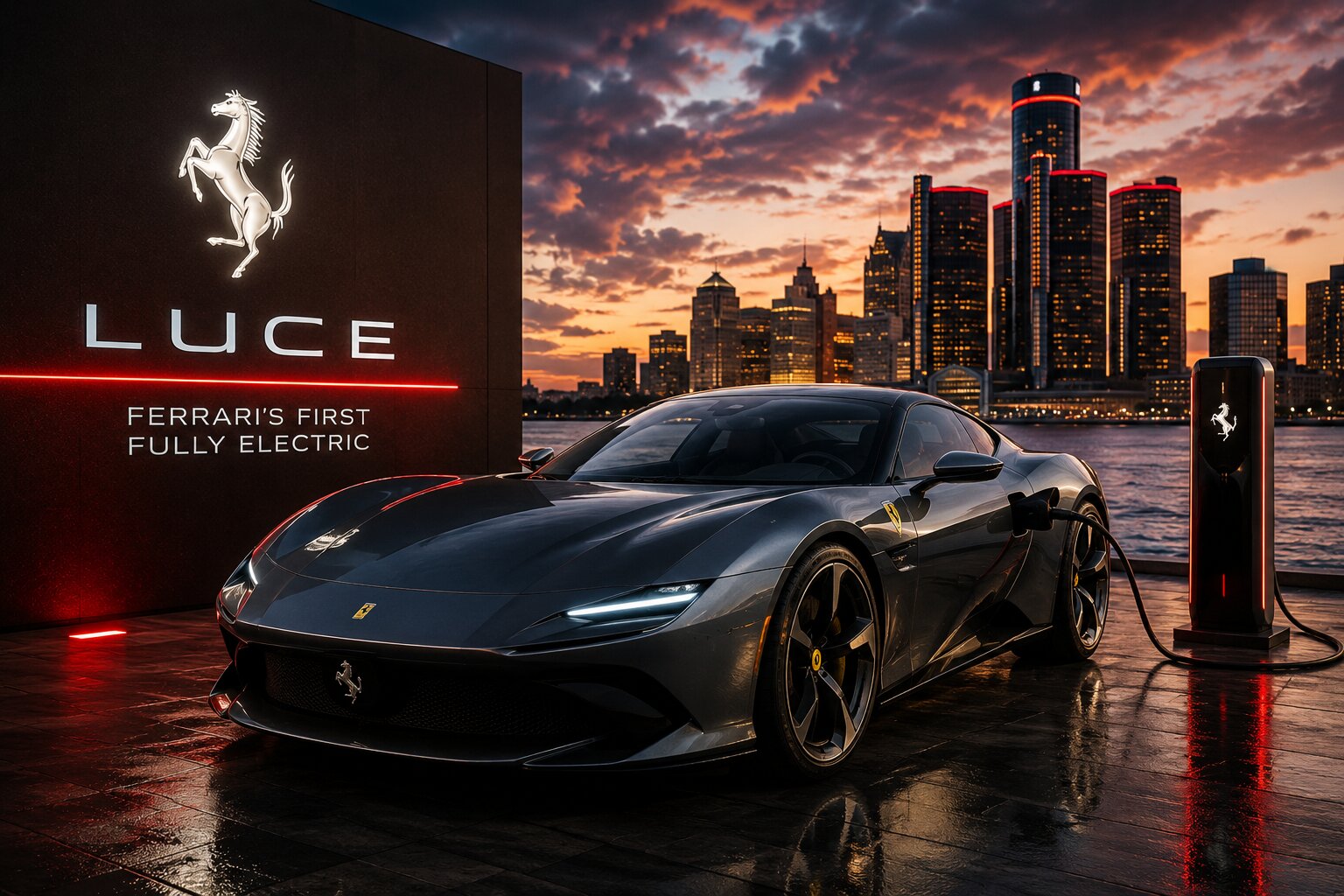
Ferrari’s first EV arrives, and the stakes are bigger than volume
Ferrari has built its reputation on sensation as much as speed: the metallic rasp of a high-revving V12, the crisp snap of an upshift, the peculiar intimacy of a cockpit that feels tailored around the driver’s shoulders. That heritage makes any step toward electrification inherently charged. On May 25, 2026, Reuters reported that Ferrari has now introduced its first fully electric model, the Luce, marking a watershed moment for the Italian marque and for the upper reaches of performance luxury.
The Luce is not expected to become a mainstream electric car in the way a high-volume luxury SUV might. It does not need to be. For Ferrari, a low-volume halo EV can do something more strategic: demonstrate that the brand’s design language, craftsmanship, and performance intent can survive the shift in propulsion while meeting tightening emissions expectations and buyer curiosity in key markets such as the United States.
What is verified so far, and what is not
Based on the Reuters report dated May 25, 2026, Ferrari has introduced its first battery-electric vehicle and it is called the Luce. Reuters reporting also frames the launch in the context of industry electrification pressure and Ferrari’s longer-term product planning.
Beyond that headline reality, many of the details U.S. buyers typically want to know remain either unconfirmed in widely available public sources or were not included in the Reuters item: official EPA range, battery capacity, charging speeds, curb weight, power output, 0 to 60 mph times, pricing, and U.S. on-sale timing. Ferrari historically releases specifications in stages and often avoids discussing certain performance figures until later communications. Until Ferrari publishes full technical data or U.S. certification documents appear, those numbers should be treated as unknown.
This matters because EV discourse is unusually spec-driven. Range and charging are not trivia; they shape how owners actually use these cars between Los Angeles and Palm Springs or on a long weekend from New York to the Hudson Valley. Still, for Ferrari’s first EV, the more immediate story is less about one number and more about what it signals.
Why Ferrari could not wait much longer
Even brands with waiting lists feel gravity. Regulation tightens. Cities experiment with restrictions. Corporate average emissions targets and fleet compliance grow harder to finesse with incremental gains alone. In that environment, an EV is not merely an engineering project; it is a permission slip for future product planning.
Ferrari has already been living in an electrified world via hybrids. The company’s recent supercar era has shown that electric assistance can coexist with drama when it is done with intent. The difference now is philosophical as much as mechanical: a full EV removes the engine note that has long served as Ferrari’s signature.
For U.S. luxury buyers who treat their cars as part of an identity rather than a commute solution, that raises an uncomfortable question: if a Ferrari does not sound like a Ferrari at idle, what makes it one? The Luce exists to answer that question in metal and software rather than in marketing copy.
The Luce’s real job: protecting brand meaning
A halo car is often misunderstood as a vanity project. In practice it is closer to an anchor tenant in a high-end retail district. It shapes perception even for customers who will never buy it.
The Luce matters because it will inevitably influence how future Ferraris feel inside and how they present themselves outside. EV packaging can change proportions dramatically: shorter front overhangs become possible without an engine bay; cabins can move forward; underfloor batteries push engineers toward new seating heights and floor structures. Those physical shifts ripple into sightlines over the hood, door cutlines, and even how you step down into the seat while wearing dress shoes after dinner.
Ferrari also has to protect something less measurable: craftsmanship cues that justify its place at the top of the market. An EV powertrain can be quieter by nature; that quiet can either read as serenity or as emptiness depending on how carefully the cabin is tuned and how thoughtfully materials are chosen. If you have ever sat in a truly special grand tourer at night with only tire noise on the pavement and soft illumination across stitched leather, you know silence can be luxurious when it feels deliberate.
Sound will be scrutinized in America
No market talks about sound quite like the United States. A significant slice of American Ferrari ownership involves weekend drives where theater matters as much as speed: canyon roads outside Malibu, early mornings on Route 9W north of Manhattan, or simply arriving at a hotel valet stand where everyone turns their head.
A battery-electric Ferrari cannot rely on combustion acoustics for presence. That does not mean it must be silent or artificial; it means Ferrari has to decide what kind of feedback replaces engine harmonics. Some brands have experimented with synthesized soundtracks or enhanced mechanical tones routed into cabins through speakers or resonators. Whether Ferrari chooses augmentation, restraint, or something entirely new will define how convincing the Luce feels to traditionalists.
Reuters did not provide technical specifics about any sound strategy for the Luce in its May 25 report. Until Ferrari explains its approach publicly, any claim about what it sounds like would be speculation. What is safe to say is that this will be one of the most emotionally debated elements of the car among U.S. enthusiasts and collectors.
Design and proportion: EVs expose weak styling fast
High-end EVs have taught an awkward lesson: remove grilles and exhausts and many designs lose their narrative thread. For a brand built on instantly recognizable silhouettes, this is not a small risk.
The Luce gives Ferrari an opportunity to show that its design language can evolve without resorting to generic EV tropes. If it succeeds visually, it will do more than sell itself; it will give cover to future models across Ferrari’s lineup as electrification expands.
Ferrari customers also tend to care about finish quality in places casual shoppers never look: paint depth under showroom lighting, panel alignment around complex curves, tactile consistency across switchgear. The EV era brings new surfaces and interfaces into focus because there are fewer mechanical distractions. A quiet drivetrain tends to amplify every squeak, every coarse texture choice, every poorly damped control.
Performance expectations are different at this altitude
A fast EV is no longer surprising in straight-line terms. What separates truly elite performance vehicles now is repeatability under heat load, steering fidelity at speed, brake feel after hard use, and chassis communication when grip builds gradually rather than abruptly.
This is where Ferrari’s reputation will be tested most severely by informed buyers who already know what top-tier electric torque feels like from other flagships on the market. They will expect more than acceleration headlines; they will expect coherence between throttle mapping, suspension tuning, brake calibration (especially if blended regenerative braking is involved), and stability control logic.
No verified specifications from Reuters establish output figures or track-focused capabilities for the Luce at this time. That absence itself becomes part of the story: until numbers arrive, Ferrari’s credibility rests on trust built over decades of dynamic excellence rather than on easy comparisons.
The competitive set: halo EVs are already here
Ferrari enters an arena where several prestige competitors have already put serious money behind electric flagships.
Porsche’s Taycan remains a reference point in premium performance EVs because it pairs strong straight-line capability with repeatable driving manners and a brand narrative rooted in motorsport engineering. Tesla’s Model S Plaid sits differently in this conversation but cannot be ignored in America because it normalized extreme acceleration at scale and forced legacy brands to respond publicly even when they would prefer not to share oxygen.
At higher price strata where craftsmanship becomes part of performance luxury identity, Rimac’s Nevera represents an extreme benchmark for electric hypercar engineering (though it occupies a different niche than most series-production luxury cars). Lotus has also pushed into electric hypercar territory with Evija (limited production), again illustrating that exclusivity does not insulate brands from electrification expectations.
The point is not that these cars are direct substitutes for a Ferrari buyer shopping for brand heritage and bespoke personalization; many are not. The point is that wealthy American buyers now arrive educated about what electrons can do. A first-time electric Ferrari must therefore win both on emotion and on technical credibility.
Charging reality for U.S. luxury owners
For many high-net-worth owners in the U.S., daily charging convenience will hinge less on public infrastructure than on home setup: garage space, electrical service capacity, whether they live in single-family homes or high-rise condos with complicated HOA approvals.
A low-volume halo EV does not need to solve America’s entire charging problem to be relevant. It does need to fit plausibly into premium ownership patterns: arriving home late after dinner and topping up quietly overnight; leaving early for Napa or Palm Springs without turning trip planning into a spreadsheet; trusting that public fast-charging works when needed.
Reuters did not publish verified charging rates or connector standards for Luce in its May 25 report. Until official information appears regarding peak DC fast-charging power, charging curve behavior, and network partnerships (if any), it would be premature to claim real-world trip advantages or limitations versus rivals.
Why low-volume halo EVs matter even if they never dominate sales
The most important impact of cars like the Luce may be downstream:
Technology transfer: Even if production volume stays modest by mass-market standards, lessons learned about thermal management, battery packaging safety structures, software calibration, and high-voltage architecture can influence future hybrids and eventual broader EV offerings within Ferrari’s portfolio.
Supplier ecosystem: A flagship program forces suppliers to meet stricter standards around materials quality, consistency, and traceability for high-voltage components. That discipline can improve quality across other models over time.
Brand permission: Perhaps most critically, it gives Ferrari permission to keep selling desire while complying with evolving regulatory frameworks. In luxury markets including California and parts of the Northeast corridor where policy signals matter culturally as well as legally, having an EV halo model helps keep Ferrari present in conversations among younger affluent buyers who want performance but also want modernity.
A delicate balancing act inside Maranello
A first EV forces uncomfortable tradeoffs that are easy to underestimate from outside: battery mass versus agility; cooling requirements versus aerodynamic cleanliness; screen-based interfaces versus tactile controls; acoustic feedback versus serenity.
The risk is not simply that traditionalists complain online. The real risk is subtler: creating a car that feels technically competent yet emotionally anonymous once novelty fades. Luxury buyers are ruthless about this because they have options and because many already own multiple vehicles for different moods.
If Ferrari can make an electric flagship feel special at 30 mph in traffic as well as at higher speeds on open roads by delivering thoughtful steering weighting (even with electric assistance), careful pedal tuning (even with regeneration), and cabin detailing that feels human rather than gadget-forward for its own sake then Luce becomes more than a compliance exercise.
The U.S.-market lens: status still matters, but so does usability
American luxury performance ownership often blends aspiration with practicality more than outsiders assume. Yes, there are collectors who trailer cars or store them like art objects. There are also owners who actually drive them between meetings or take them out on imperfect pavement where ride quality matters more than lap times.
An EV powertrain can improve daily usability through smoothness and low-speed refinement if chassis tuning matches that character rather than fighting it with unnecessary harshness. At the same time, added weight from batteries can challenge ride composure over broken surfaces if damping is not expertly calibrated.
No verified ride comfort assessments exist yet for Luce based on Reuters’ May 25 report alone; road testing impressions will come later from independent outlets once vehicles are available. Still, this is precisely where Ferrari can surprise skeptics: by making something genuinely elegant in motion rather than merely shocking on paper.
What comes next
The debut of Ferrari’s first fully electric model does not close an era so much as open several new chapters at once: design evolution without engines dictating proportions; brand sound reimagined; software becoming as important as metallurgy; ownership patterns shifting from fuel stops to charging routines.
The Luce will be judged by enthusiasts who want continuity with Maranello’s past and by new customers who want proof that tradition can coexist with modern propulsion. It may never be common on American roads, even in affluent ZIP codes where exotic cars cluster near boutique hotels and private clubs. That scarcity does not diminish its significance.
If anything, it heightens it: halo cars carry symbolism disproportionate to their build numbers. For Ferrari in 2026, launching an EV is less about chasing mainstream adoption than about defending what “Ferrari” means when gasoline no longer gets the final word.

0 comments
Join the discussion around this article.
Please login to comment.