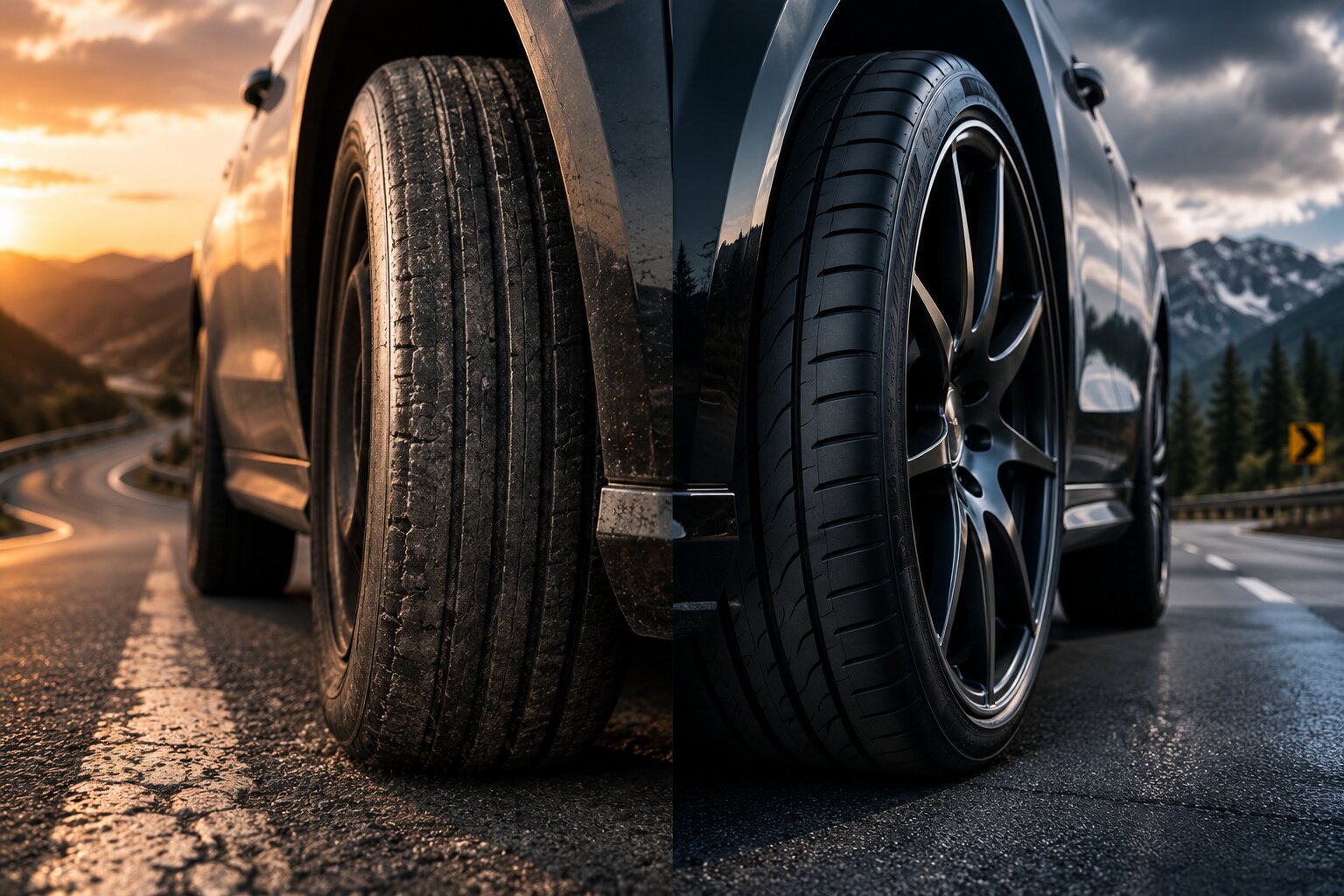
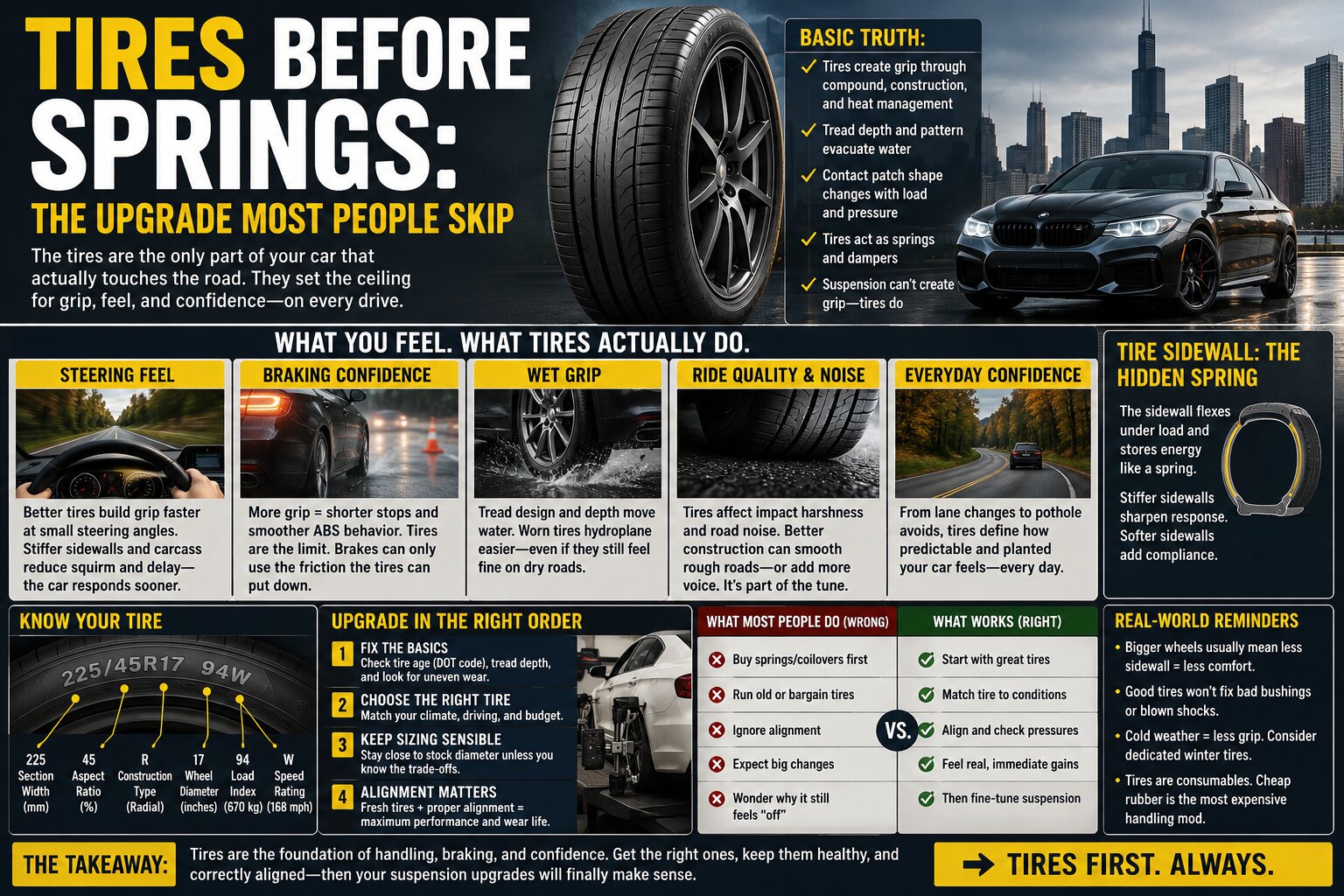
Tires Before Springs: the upgrade most people skip
I have an engineering background, I live in Chicago, and I spend a lot of time talking to enthusiasts who want “better handling” in the most visible way possible. Springs. Coilovers. Sway bars. Anything that looks like it belongs in a build thread.
Meanwhile, the car is still rolling around on whatever tires came on it, sometimes worn, sometimes heat cycled, sometimes a bargain set chosen because rent is due. I get it. Tires are not glamorous, and they do not photograph well. But if you care about steering feel, braking confidence, wet grip, and even ride quality, tires are the first handling upgrade most drivers underestimate.
This is not a hot take. It is basic vehicle dynamics. The tire is the only part of your car that actually touches the road, and its behavior sets the ceiling for everything else you do.
Verified facts: what we can say without guessing
Let’s ground this in widely accepted, easy to verify fundamentals rather than internet lore.
Fact: A tire’s grip comes from its compound and construction, plus how it manages heat and water. Tread pattern and depth matter a lot in the wet because they evacuate water to reduce hydroplaning risk.
Fact: Tire size is defined by section width, aspect ratio, and wheel diameter (for example 225/45R17). Load index and speed rating are standardized markings that indicate how much weight a tire can carry and the maximum speed capability under specified conditions.
Fact: The contact patch area does not simply increase because a tire is wider; it depends heavily on load and inflation pressure. A wider tire often changes contact patch shape rather than dramatically increasing total area.
Fact: Tires contribute to spring rate (through sidewall stiffness), damping feel (through hysteresis), and steering response (through carcass stiffness and slip angle characteristics).
Fact: Suspension changes like lowering springs or coilovers primarily alter geometry, roll stiffness distribution, ride height, and damper control. They cannot create grip that the tire cannot deliver.
What I am not going to do: I am not going to invent lap times, braking distances, or noise readings for a specific tire model. Those results vary by car, surface, temperature, alignment, and driving style. If you want numbers, use instrumented tests from major outlets or manufacturer data for a specific product on a specific vehicle.
The “handling” you feel every day is mostly tire behavior
Most daily driving happens well below the limit, which is exactly why tires can feel like a bigger change than springs. At normal speeds you are living in small steering angles, gentle braking events, lane changes in traffic, wet on ramps, pothole dodges, and those uneven Chicago expansion joints that make you question every life decision.
Tires show up in those moments immediately because they change the car’s response before you ever reach body roll limits or shock absorber control limits.
Here’s how that plays out in real terms.
Steering feel: why a tire can make your rack feel “faster”
Drivers often describe better tires as making the steering “more direct.” The steering ratio did not change. What changed is how quickly the tire builds cornering force as you add steering input.
A tire generates lateral force at a slip angle (a small difference between where the wheel is pointed and where it is actually going). Different tires build that force differently. A stiffer sidewall and carcass construction can reduce the squirm you feel at initial turn-in. That translates to less delay between your hands moving and the car taking a set.
You also tend to notice it as cleaner on-center behavior on the highway. Some all-season tires have soft tread blocks designed for broad temperature ranges and long wear. That can feel slightly vague around center because those blocks deform before they bite. A performance oriented tire often has larger tread blocks and more rigid construction; it resists deformation and answers sooner.
The funny part is that people will install stiffer springs to chase that same immediacy while leaving a compliant tire sidewall as the dominant spring in the system. Then they wonder why it still feels rubbery.
Braking: pedal confidence starts at the contact patch
If you have ever driven a car that “stops fine” but never feels settled under hard braking, tires are usually part of that story.
The braking system can only use as much friction as the tires can transmit to the road. Modern ABS is very good at keeping wheels from locking up by modulating brake pressure when it detects slip beyond an optimal range. With better grip available from the tires, ABS has more room to work with before it intervenes aggressively. That often feels like smoother deceleration with fewer pulses through the pedal on rougher surfaces.
Tire compound matters here because peak friction changes with temperature and surface conditions. In typical daily use, wet braking is where drivers notice the biggest difference after swapping from a worn or low-grip tire to a higher-grip one with healthy tread depth. You do not need track speeds to appreciate shorter stops when it is 38 degrees and raining on Lake Shore Drive.
Wet grip: tread depth is not optional in Chicago weather
Chicago gives you four seasons sometimes in one week. Wet roads are common; standing water happens; slush shows up; cold pavement changes everything.
A tire’s ability to resist hydroplaning depends heavily on tread design and depth because water has to go somewhere. As tread wears down, water evacuation capacity drops sharply even if dry grip still feels acceptable. That mismatch tricks people into thinking their tires are “fine” until they hit pooled water at speed and suddenly steering goes light.
This is also where suspension mods can create false confidence. Lowering a car might reduce weight transfer slightly or change how it feels in transitions, but it does not give you more water evacuation or cold-wet compound performance. If anything, aggressive alignment settings often paired with lowering can worsen wet behavior by reducing contact patch effectiveness in straight-line braking if toe or camber gets out of spec for street use.
Noise: why your “handling mod” changes your cabin vibe
Tire noise is real quality-of-life stuff. It also ties directly into construction choices that affect handling.
A more performance focused tread pattern may generate more road noise on certain surfaces because of block arrangement and how air pumps through grooves as the tire rolls. Some compounds transmit more texture through the chassis too; you hear more of what the pavement is doing.
I have had friends do suspension work first and then complain their car got louder or harsher without getting much sharper in return. Sometimes that harshness was always there; their old tires were masking it with soft sidewalls and squishy tread blocks. Sometimes they simply added stiffness elsewhere while leaving noisy or cupped tires untouched.
If your daily commute includes concrete highways with grooved surfaces or rough asphalt patches (hello again, Chicagoland), tire choice can change your fatigue level more than an extra millimeter of sway bar thickness ever will.
Ride quality: yes, tires are part of your suspension
This one surprises people: upgrading tires can improve ride quality depending on what you start with.
If your current tires have stiff sidewalls paired with heavy wheels or high inflation pressures (common when people chase crispness without considering compliance), impacts get sharper. Conversely, some performance oriented tires manage impact harshness well because their internal construction controls deformation predictably rather than bouncing off sharp edges.
The big lever most drivers ignore is wheel diameter changes tied to tire swaps. Going to a larger wheel usually means a shorter sidewall if overall diameter stays similar; that reduces compliance and makes potholes more dramatic. In Chicago that matters because potholes are not theoretical hazards; they are recurring events that bend wheels and bubble sidewalls.
If you want handling without punishing yourself daily, staying reasonable on wheel size while choosing a well-matched tire often beats lowering springs alone.
The practical tuning path: what to change first (and what not to mess up)
I like simple sequencing because it keeps you honest about cause and effect.
Step 1: Fix basics before upgrades. If your tires are old, unevenly worn, or mismatched across axles, no suspension part will make the car feel right. Check tread depth across the width of each tire; uneven wear can point to alignment issues or worn suspension bushings. Also check age via DOT date code if you are troubleshooting weird grip behavior (rubber hardens over time).
Step 2: Choose the right category for your climate and use. This is where I refuse to play hero with one-size-fits-all advice. In Chicago-area conditions many drivers run dedicated winter tires because cold temperatures reduce grip even on dry pavement when compounds stiffen. Others run all-seasons for simplicity. Some run summer tires seasonally for maximum warm-weather response. Each choice has tradeoffs in cold traction, wet behavior, noise, wear rate, and cost per mile.
Step 3: Keep sizing sensible. Staying close to factory overall diameter helps keep speedometer accuracy reasonable and avoids upsetting stability control calibrations. Going wider can increase tramlining (following road grooves) depending on tire design and alignment settings; it can also increase hydroplaning risk if you go too wide for your conditions because pressure per unit area drops slightly at similar loads (again this depends). If you do change size significantly, do it deliberately with an understanding of clearance at full lock and full compression.
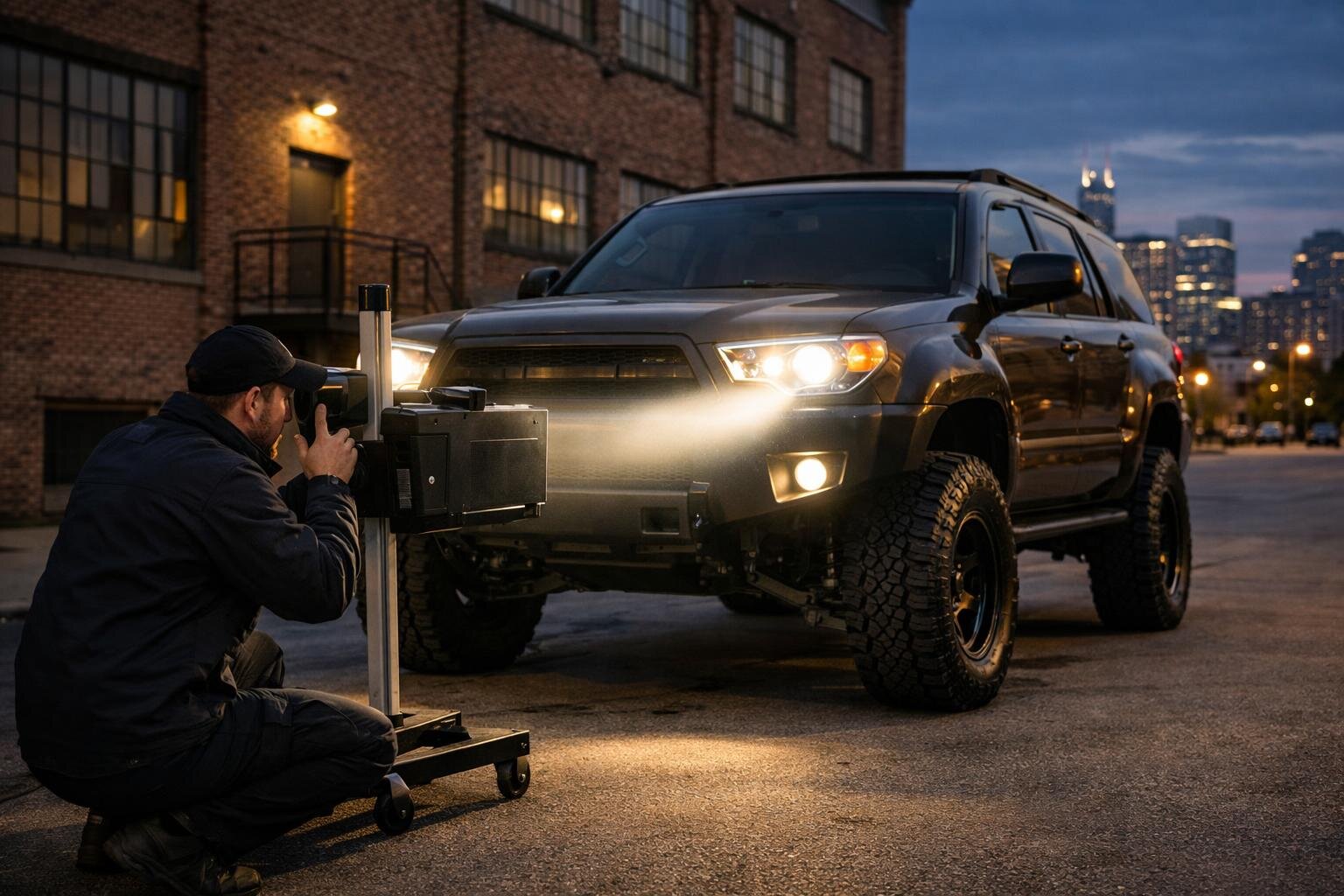
Step 4: Do an alignment after major changes or if wear says so. Tires tell the truth about alignment faster than most drivers want to admit. Even without lowering springs involved, fresh rubber deserves correct toe settings so you are not scrubbing away expensive tread while wondering why the steering wheel sits crooked.
The results most drivers actually notice
You do not need track jargon to describe what happens next because it shows up in normal driving immediately:
The car feels smaller. Not physically smaller; more like it shrinks around you when you place it in a lane change or thread through traffic cones in a construction zone. Steering inputs require less correction because initial response matches expectation better.
The brake pedal feels calmer. You still have the same calipers and pads (assuming they were healthy), but deceleration feels more linear because available grip rises and ABS intervention often becomes less intrusive on imperfect pavement.
You trust wet corners more. Not “send it” confidence; just normal adult confidence when merging onto an expressway ramp in rain without feeling like the front end wants to float wide unexpectedly.
You hear different things. Sometimes more noise, sometimes less depending on what you replaced. Either way it becomes part of your relationship with the car because sound is feedback too; it tells you about surface texture and load changes even when you are not consciously analyzing them.
The challenges nobody brags about
Tires are also where reality shows up fast: budgets, availability, lead times, mounting costs, storage space if you run seasonal sets, and pothole anxiety if you go too low profile for your roads.
I have watched friends get excited about “fixing body roll” with springs while ignoring that their current tires were near end-of-life or had uneven wear from neglected alignments. Then they spend real money twice because once they finally buy decent rubber they realize how much handling was missing all along.
The other challenge is expectation management. Tires will not fix sloppy bushings, blown dampers, or bent components from curb hits (another Chicago classic). If your car clunks over bumps or wanders under braking on smooth roads, inspect suspension joints and bushings before blaming rubber alone.
Why springs still matter later
This is not an anti-suspension piece; it is an order-of-operations piece.
Once tires are sorted and aligned properly, suspension tuning starts making clearer sense. Lowering springs can reduce ride height and alter roll behavior; dampers control motion; sway bars tune balance between understeer and oversteer tendencies depending on chassis layout; bushings tighten response but can add noise and vibration; chassis braces may sharpen feel but rarely transform grip by themselves.
The point is that all those parts work through the tires anyway. If your contact patch cannot hold on consistently across temperature swings and wet pavement patches, fancy hardware becomes an expensive way to discover limits sooner rather than move them meaningfully outward for street driving.
The feeling that sticks with me
I have been around enough modified cars to recognize a pattern: when someone finally puts real attention into their tires after chasing suspension parts first, there’s this quiet moment of annoyance followed by relief. Annoyance because they realize they could have gotten most of what they wanted earlier with less drama; relief because now the car behaves like their brain thinks it should behave when they turn a wheel or press a pedal.
If handling is your goal and your car still wears compromised rubber (wrong category for your climate, low tread depth, mismatched sets), start there. Tires are not just consumables; they are chassis components made of rubber instead of steel. Treat them that way first, then decide whether springs deserve your money next time around.
0 comments
Join the discussion around this article.
Please login to comment.