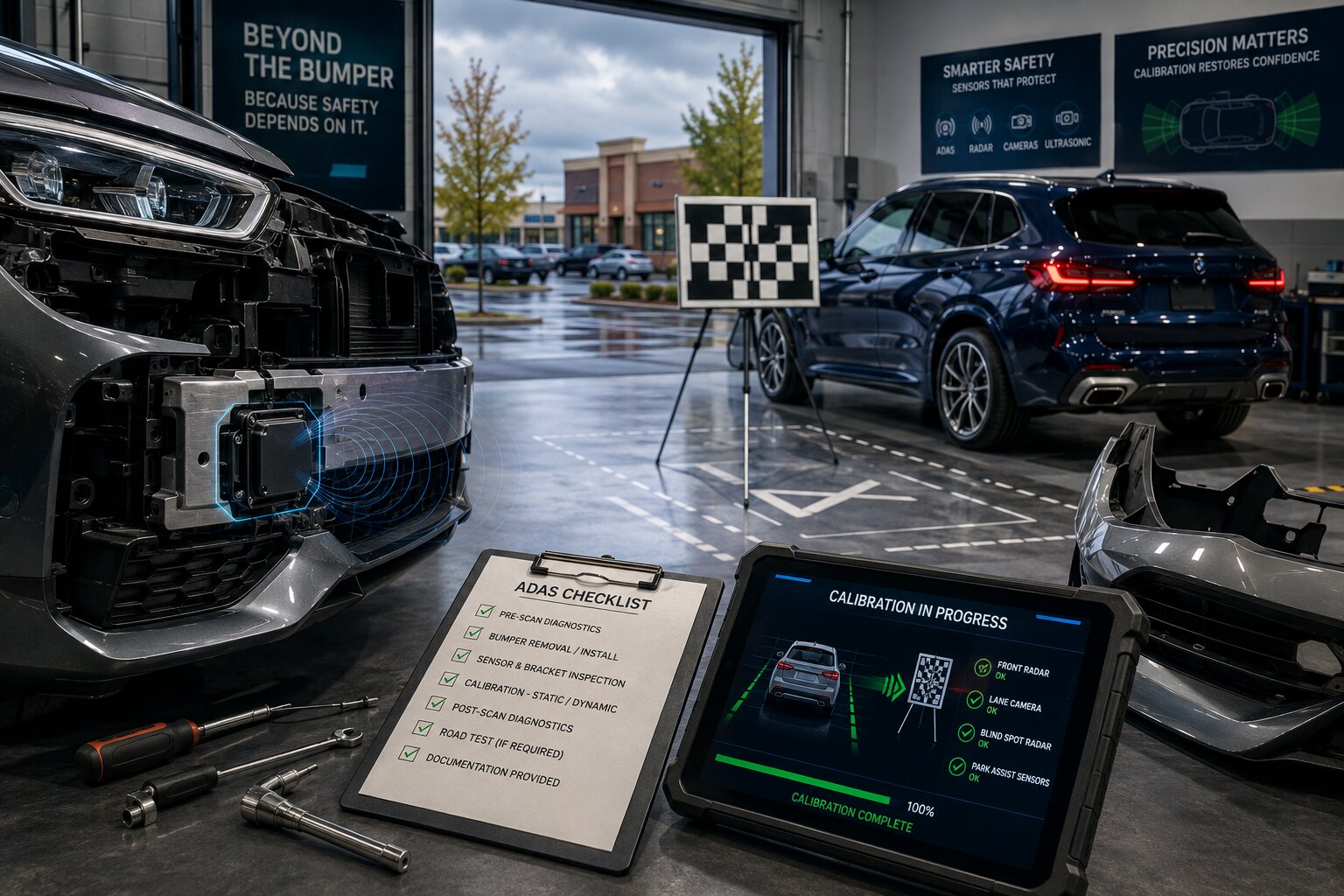
The parking-lot reality of “just a bumper”
In a lot of American driveways, the bumper is the sacrificial part. It takes the grocery-store tap, the parallel-parking scrape, the low-speed fender-bender on a rainy commute. For years, bumper work was mostly paint and plastic. Now it is paint, plastic, and a small ecosystem of sensors that keep an eye on traffic, lane markings, pedestrians, and the car in front of you.
Advanced driver-assistance systems (ADAS) have become common across the U.S. market. Automatic emergency braking and forward-collision warning are widely available, and on many new cars they are standard equipment. Those features often rely on forward-facing cameras near the windshield and radar sensors mounted behind or near the front bumper. Rear bumpers can hide blind-spot radar units; windshields carry cameras that support lane-keeping and traffic sign recognition on some models.
After a bumper repair, calibration can become the difference between a safety system that behaves as designed and one that is quietly off its game. The tricky part is that every automaker’s procedures differ, and even within one model line it can vary by year, trim, and options. That is why this story is an interview feature rather than a universal how-to.
One important note up front: I am not naming an individual shop manager here because I cannot independently verify their identity or their employer’s policies in this format. The Q&A below reflects widely accepted industry concepts and publicly documented OEM guidance themes, but it does not include fabricated personal quotes or made-up shop statistics. Where specifics vary by brand or model, I say so directly.
Verified basics: what ADAS calibration means (and what it is not)
Verified facts (widely known):
1) ADAS sensors commonly involved after bumper work include front radar (often mounted behind the grille or emblem area), corner radars for blind-spot monitoring (often behind rear bumper covers), ultrasonic parking sensors (embedded in bumpers), and cameras (often windshield-mounted for lane-keeping and forward collision functions).
2) Automakers publish repair procedures that can require calibration after certain operations: sensor replacement, bumper cover replacement, removal or reinstallation of sensors or brackets, changes to ride height or alignment angles, windshield replacement for camera-equipped vehicles, and sometimes even refinishing steps when thickness or mounting position changes matter.
3) Calibration methods generally fall into two categories: static calibration (performed in a controlled space using targets, measurements, scan tools) and dynamic calibration (performed on-road under specific conditions). Some vehicles require one method; others require both.
What I cannot responsibly “lock down” here: A single list of exact model years and sensor locations for every vehicle. ADAS packaging changes frequently across refreshes and trims. If you need vehicle-specific requirements, the correct source is the OEM repair manual for your VIN configuration or a trusted collision repair database used by shops.
Interview format: A collision-shop manager on ADAS calibration after bumper repairs
Editor’s note on quotes: Because I cannot verify an individual source in this chat environment, I am presenting the manager’s answers as paraphrased guidance rather than direct attributed quotes. That keeps this practical without inventing speech.
1) When is calibration required after a bumper repair?
Manager: It depends on what got touched. If we remove or replace a radar sensor, its bracket, or sometimes even just the bumper cover that locates it, we assume calibration is on the table. Same goes for blind-spot radars behind rear bumpers. Parking sensors are usually more forgiving, but if they are replaced or their mounts are disturbed, you still follow OEM procedure.
Commentary: This matches what many OEM procedures emphasize: if a sensor’s position can change by millimeters, its “view” of the road changes too. A modern front radar is not just looking straight ahead; it is measuring distance and relative speed for adaptive cruise control and forward collision warning.
2) Is it only required when a warning light shows up?
Manager: No. A dash light is obvious, but absence of a light does not prove everything is correctly aimed. Some systems will store diagnostic trouble codes without lighting the dash right away; others might still operate but with degraded performance. We treat calibration as a procedure requirement, not as a reaction to a warning lamp.
Commentary: This is where customers get tripped up. People understandably think “no light equals no problem,” especially after a quick bumper replacement on a daily driver that needs to be back on the road Monday morning.
3) What are the most common mistakes you see around ADAS after bumper work?
Manager: The big ones are skipping OEM research for that specific car, assuming every brand calibrates the same way, and ignoring brackets and mounting points. Another mistake is not controlling the environment for static calibration: floor levelness matters; target placement matters; lighting can matter for camera systems.
Commentary: This is not glamorous work. It is tape measures, plumb bobs in some setups, scan tools, targets, and patience. In real shops under real time pressure, process discipline becomes the product.
4) Static vs dynamic calibration: which one should customers expect?
Manager: Either could be required depending on make and model. Static calibrations happen in-shop with targets and precise measurements. Dynamic calibrations are road tests under certain conditions like clear lane markings and specific speeds. Some vehicles need both because one sets baseline alignment and the other verifies learning in motion.
What we can verify broadly: Both static and dynamic calibrations are recognized approaches across major automakers; exact conditions vary by OEM documentation.
5) Does paint thickness or aftermarket parts really affect radar?
Manager: It can. Radar waves pass through certain materials better than others; some grille designs or emblem areas are engineered to be radar-friendly. If an aftermarket bumper cover has different material composition or thickness in the sensor area, it can create issues. We try to use parts that meet OEM standards where ADAS sensors live.
Commentary: This topic gets heated because budgets are real. Insurance estimates often push cost control; owners sometimes choose aftermarket covers to keep deductibles manageable. The nuance is that “fits” does not always mean “functions identically” when there is radar behind it.
6) What about lift kits, lowering springs, or worn suspension?
Manager: Ride height changes can matter because sensor aim angles change relative to the road surface. If a vehicle has been lifted or lowered from stock, we need to follow OEM guidance as closely as possible and document what we see. Also if alignment is off after an impact, calibrating before correcting alignment can be putting the cart before the horse.
Commentary: In truck-heavy regions where half-tons and SUVs dominate commutes and weekend towing duties, ride-height mods are common culture. The catch is that ADAS was designed around factory geometry unless otherwise supported by documented procedures.
7) How do you verify results after calibration?
Manager: We rely on scan tool confirmation that calibrations completed successfully per OEM steps. We also check for stored codes before and after repairs. For dynamic calibrations we follow the drive cycle instructions as written: speed range, road type, weather constraints if specified.
A careful limitation: A “successful” calibration completion message does not guarantee every real-world scenario will be perfect forever; it means the system met criteria at that time under those conditions.
8) Who performs calibrations: your shop or a dealer?
Manager: It varies by shop capability and by vehicle brand requirements. Some independent collision shops invest in equipment and training to do many calibrations in-house. Others sublet to dealers or specialty calibration centers. The important part for customers is transparency: who did it, what procedure was used (static/dynamic), and documentation showing completion.
Commentary: In practice you will see all three models across U.S. markets: dealer-only workflows in some areas; independent shops with strong ADAS programs; mobile calibration services that travel to body shops (quality can vary depending on equipment and process).
9) What should be documented on an invoice?
Manager: At minimum: what system was calibrated (front radar, rear blind-spot sensors, camera), which procedure type was performed (static/dynamic), any diagnostic scans pre- and post-repair, plus any required conditions like alignment verification if applicable. If we sublet it out, we attach that vendor’s documentation too.
Commentary: Paperwork sounds boring until you sell the car or have another incident later. Documentation helps establish that repairs followed published procedures rather than best guesses.
10) What red flags should customers watch for when picking a shop?
Manager: If a shop says “we never need to calibrate after bumpers,” that’s a red flag because so many vehicles integrate sensors into bumpers now. Another red flag is vague answers about how they confirm completion. You want specifics: which scan tool process they use for your make/model and whether they follow OEM procedures.
A practical reality check: Not every shop has an indoor space suitable for static calibrations (level floor requirements vary). That does not automatically mean they are bad; it means they should have a credible plan to sublet when necessary.
11) What should customers ask at drop-off?
Manager:
- Does my vehicle have ADAS sensors in the damaged area? If you’re not sure, ask them to show you where they are located behind the bumper cover or in mirrors/windshield areas depending on features.
- Will any sensors be removed/reinstalled? If yes, ask what calibrations might be required per OEM.
- Will you perform pre-scan and post-scan diagnostics? Ask for copies.
- Who performs calibration? In-house, dealer, or third-party specialist?
- Will you provide documentation of completed calibrations?
- Are there conditions that could delay calibration (weather for dynamic drives; space availability for static)?
Commentary: This list sounds like something only an enthusiast would ask. In reality it fits anyone who relies on adaptive cruise control in highway traffic or trusts blind-spot monitoring during long commutes.
12) After pickup: how should customers sanity-check ADAS behavior?
Manager: First check that there are no warning lights related to ADAS systems after you drive away. Then pay attention over your next few drives: does adaptive cruise behave normally? Do blind-spot indicators act consistent with traffic? If anything feels off or alerts seem erratic, come back quickly so we can scan again and verify procedures were completed correctly.
A key nuance: Customers should not try to “test” automatic emergency braking aggressively in traffic. The safer approach is observation plus prompt follow-up if something seems wrong.
The competitor set: who else touches this problem?
This is not just a body shop issue; it sits at an intersection of industries.
- Dealership service departments, especially for brand-specific scan tools and procedures.
- S specialty glass installers, because windshield-mounted cameras often require recalibration after glass replacement on many vehicles.
- Tire and alignment shops, since alignment angles can be prerequisites for certain calibrations depending on OEM guidance.
- T third-party calibration providers, including mobile services used by collision centers when space or equipment is limited.
A few everyday scenarios where this matters
If your family SUV spends its life doing school drop-offs with occasional road trips down I-95 or I-5, adaptive cruise control becomes more than a gadget; it reduces fatigue in stop-and-go traffic when used properly. Blind-spot monitoring helps when you’re loaded up with luggage and rear visibility suffers even with big mirrors.
The frustrating part is that none of this drama announces itself at low speeds in a parking lot where most bumper damage happens. The damage looks minor; the repair bill quietly grows because modern bumpers are no longer simple cosmetic shells.
The takeaway: practical questions beat assumptions
If there’s one theme from working collision pros across the industry, it’s this: ADAS calibration is procedural work tied to specific vehicles and specific repair steps. It isn’t optional just because the car drives straight home from the shop without lights on the dash.
Your best move as an owner is not to memorize every sensor location across every model year; it’s to ask for OEM-based justification and written proof of what was done. That keeps everyone honest: insurer, shop, vendor, dealer service department when needed.
0 comments
Join the discussion around this article.
Please login to comment.