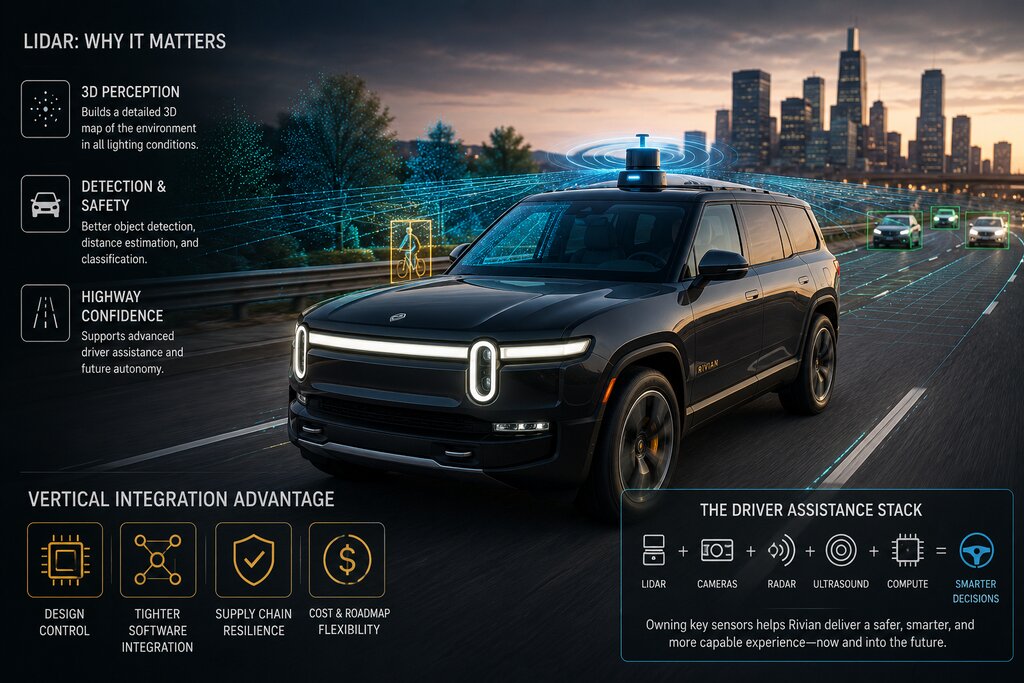
Rivian says it is looking at in house lidar, as sensor sourcing turns strategic
Rivian is exploring the idea of developing lidar internally, according to comments reported by Reuters on May 6, 2026. The key point was not a product launch or a new feature announcement. It was a signal about priorities. As advanced driver assistance systems become more central to how EVs are marketed and updated over time, the supply chain behind those systems is starting to look less like a commodity purchasing exercise and more like a competitive lever.
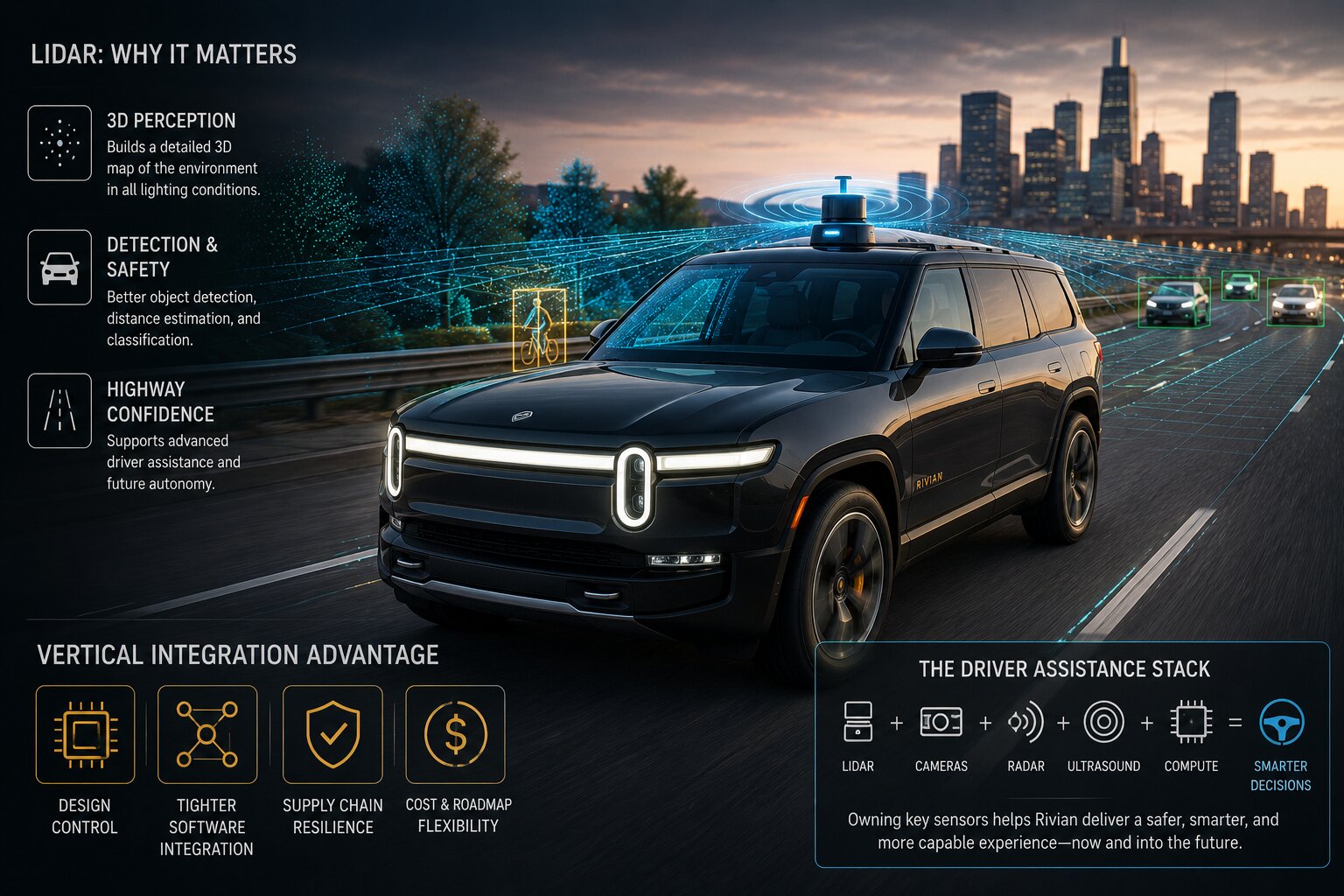
Lidar sits at the center of that shift. It is one of the costlier and more specialized sensors used in modern driver assistance stacks, and it relies on a narrower set of suppliers than cameras or basic radar. Rivian’s interest in bringing lidar work in house fits a broader industry pattern: automakers are trying to control critical parts of their software defined vehicle roadmap by controlling the components that feed the software.
What Reuters reported, and what Rivian did and did not claim
Reuters’ May 6 report framed Rivian’s thinking around the benefits of owning more of the sensor technology used for driver assistance. Rivian “eyes” in house lidar is an important phrasing. It implies evaluation and planning rather than a confirmed engineering program with timelines, costs, or supplier exits.
Rivian has not publicly provided, in that report, a detailed technical specification for any future lidar unit, nor did it confirm which models would receive it first, what performance targets it would meet, or whether an in house approach would fully replace external suppliers. Those missing details matter because lidar can vary widely in architecture (for example scanning versus solid state designs), integration complexity, thermal management needs, cleaning systems for real world use, and cost per vehicle.
Still, the strategic direction is clear enough to analyze: Rivian is positioning sensor supply as part of its long term differentiation plan, especially as it prepares for its next major product line.
Why lidar supply is becoming a differentiator in EVs
For many years, EV differentiation leaned heavily on battery range, charging speed, and performance figures. Those still matter. But as EV powertrains converge and as price competition intensifies in the United States, automakers are looking for other defensible advantages that are hard to copy quickly.
Driver assistance capability is one of those areas. It requires sensors, compute hardware, a robust software stack, and continuous validation. If any one piece becomes constrained by supply or cost volatility, product plans can slip or margins can erode. Lidar adds another complication: it tends to be expensive relative to cameras and it has historically been produced at lower volumes than mainstream automotive components.
From a business standpoint, lidar supply affects three practical levers:
Cost control. If a sensor remains pricey or subject to supplier pricing power, it can force difficult trim decisions. Automakers may push advanced features into higher trims only, limit take rates with expensive packages, or delay broad rollout.
Availability and build consistency. Shortages do not just slow production; they can create confusing build mixes where certain features appear sporadically depending on parts availability. That is frustrating for buyers and complicates resale valuation because two otherwise similar vehicles can have different hardware foundations.
Software roadmap stability. If the sensor set changes mid cycle due to sourcing constraints, software teams must support multiple hardware configurations. That increases engineering overhead and can slow updates.
This is why sensor strategy increasingly resembles battery strategy. In both cases, owning more of the stack can reduce dependency risk. It also raises execution risk because building sensors is not trivial and automakers must decide how much vertical integration is realistic.
How this ties to Rivian’s next act: R2
The Reuters report connected Rivian’s sensor thinking to its future R2 platform plans. Rivian has already said publicly that R2 will be its smaller, more affordable vehicle line positioned below today’s R1S SUV and R1T pickup in size and price. That context matters because R2’s success depends on hitting cost targets at scale while still delivering technology that feels modern in a crowded market.
In the United States, the sub 60,000 dollar EV space is where volume tends to be. Buyers cross shop mainstream brands aggressively; monthly payment sensitivity rises; incentives matter more; and resale expectations are shaped by what Tesla, Hyundai Kia, Ford, GM, and others are doing with pricing and lease support. A costly sensor bill of materials can quickly turn into either thinner margins or higher MSRPs that make conquest sales harder.
If Rivian wants R2 to compete effectively on value while still offering strong driver assistance capability over time through software updates, controlling key sensors becomes more consequential than it might be on higher priced vehicles where there is more room to absorb hardware costs.
The competitive landscape: who else controls sensors and who buys them
Most automakers source lidar from specialized suppliers rather than building it themselves. The supplier ecosystem includes established automotive electronics firms as well as lidar focused companies that have spent years chasing automotive grade reliability and cost targets. In practice today, many vehicles with hands free highway systems rely primarily on cameras and radar; lidar adoption has been selective because of cost and packaging considerations.
Tesla remains the notable outlier in approach because it has emphasized camera based perception rather than lidar for its consumer vehicles. That does not make lidar irrelevant; it underscores that sensor strategy itself is part of brand identity and cost structure. Other automakers have taken different paths depending on their software capabilities and risk tolerance.
Rivian’s reported interest in in house lidar should be read against that backdrop: it suggests Rivian sees enough long term value in owning part of the sensing stack to justify at least exploring internal development rather than remaining entirely dependent on external roadmaps.
What this means for U.S. pricing trends and trims
The U.S. EV market has been defined recently by price pressure and frequent adjustments across brands. Automakers have leaned heavily on leasing programs because leases can incorporate federal clean vehicle credits through commercial leasing structures even when retail purchase eligibility is limited by sourcing rules. That has helped move inventory but has also trained many shoppers to expect aggressive monthly payments rather than purely focusing on MSRP.
Rivian’s current lineup sits higher in price than many mass market EVs. The company has historically sold directly rather than through traditional franchise dealers, which changes how incentives show up for consumers. Discounts can exist but they tend to be structured differently from dealer cash programs seen at legacy brands.
A future R2 line is expected to operate closer to the heart of the market where buyers compare trims feature by feature: driver assistance capability versus price premium; standard equipment versus option packages; hardware readiness versus promised future updates. In that environment:
If lidar remains expensive, automakers often reserve it for top trims or pricey packages. That can create wide pricing spreads within one model line and push many buyers into lower trims without the full hardware suite.
If lidar costs come down or are better controlled, it becomes easier to make advanced sensing standard across more trims. That simplifies manufacturing and can help resale values because used buyers do not have to decode complex option histories to understand what hardware they are getting.
Reuters did not report any specific pricing impacts from Rivian’s exploration of in house lidar; any dollar figures would be guesswork without company guidance. But strategically, sensor control aligns with building a predictable trim walk for a high volume model where simplicity sells.
Resale considerations: hardware consistency matters more than many expect
Resale values in EVs have been volatile across the industry due to rapid product updates and shifting incentive landscapes. One underappreciated factor is hardware variance within a model year or across early production runs.
If advanced driver assistance features depend on specific sensors or compute modules that change due to supply constraints or mid cycle updates, used buyers can face uncertainty about which vehicles support which software features long term. That uncertainty tends to push values down because shoppers discount what they cannot verify easily.
An automaker that can keep its sensing suite consistent across large volumes improves clarity for second owners. It also helps subscription style feature strategies where buyers want confidence their vehicle has the necessary hardware before paying for optional software functions later.
Buyer demographics: why this matters beyond tech enthusiasts
Lidar discussions often sound like they belong only to early adopters who follow autonomy debates closely. In practice, mainstream buyers care about simpler outcomes: less fatigue on highway commutes; predictable lane keeping behavior; fewer false alarms; confidence that safety systems will keep improving through updates without needing new hardware.
Rivian’s customer base today skews toward higher income households shopping premium adventure themed vehicles such as the R1S SUV and R1T pickup against alternatives from Tesla and established luxury brands’ electric SUVs. R2 aims at broader demographics where families might be comparing an EV crossover against hybrids or gas models too.
For those buyers, advanced sensing becomes part of an overall value calculation alongside charging convenience, cabin usability (including storage), insurance costs, winter performance expectations depending on region, and whether local service capacity feels adequate. Sensor supply sounds abstract until it affects availability of certain trims or causes feature deletions during ordering windows.
The operational angle: vertical integration helps only if execution stays disciplined
Exploring in house lidar does not automatically translate into better products or lower costs. Lidar must meet automotive durability requirements across heat cycles, vibration loads, water intrusion risks, and long service lives. It also must be manufacturable at scale with tight quality control because small calibration drift can create large perception errors over time.
An internal program could allow tighter integration with Rivian’s software stack and packaging goals if executed well. It could also introduce new complexity if it distracts from core manufacturing ramp priorities or if validation timelines stretch longer than expected.
The Reuters framing kept this grounded: Rivian is “eyeing” an approach because supply has become strategically important. That reads as risk management as much as technology ambition.
Where this leaves shoppers watching R2
No buyer can order an R2 today based solely on this report; key details such as final pricing, trim structure, official range figures by configuration, charging performance specifications, towing ratings if applicable, safety ratings once tested by U.S. agencies or IIHS protocols (when available), and final driver assistance feature sets remain outside what Reuters reported here.
What shoppers can take away is narrower but useful: Rivian appears focused on controlling critical inputs for future driver assistance capability rather than treating sensors as interchangeable parts bought late in development. In a market where monthly payments often hinge on incentives and where competitors adjust pricing quickly, predictable hardware strategy becomes part of how an automaker protects both margins and customer trust.
A quiet signal about how EV competition is changing
The headline topic is lidar. The underlying story is about industrial strategy inside an EV company trying to broaden its lineup into higher volume segments while keeping technology competitive over time. Batteries still dominate EV headlines for good reason. But sensors increasingly decide whether advanced features ship broadly across trims or stay limited to expensive variants with uncertain availability.
If Rivian follows through on deeper sensor ownership for R2 era vehicles, it will be one more sign that the next phase of EV competition in America will be fought not only on range numbers and charging networks but also on who controls the building blocks of software driven driving features.
0 comments
Join the discussion around this article.
Please login to comment.