Tesla is recalling nearly 219,000 vehicles in the United States after a software-related issue can cause the rearview camera image to fail to display, according to a Reuters report dated May 6, 2026. Rear visibility has become one of those features drivers rely on without thinking about it, right up until the screen goes blank at the worst possible moment in a tight parking garage or a crowded school pickup lane.
The good news for owners is that this type of recall is typically addressed through a software update rather than a trip for parts replacement. The more important news is practical: if your display does not show a rearview image when you shift into Reverse, treat it as a safety issue and get the fix scheduled or downloaded as soon as Tesla makes it available for your vehicle.
What the recall is about
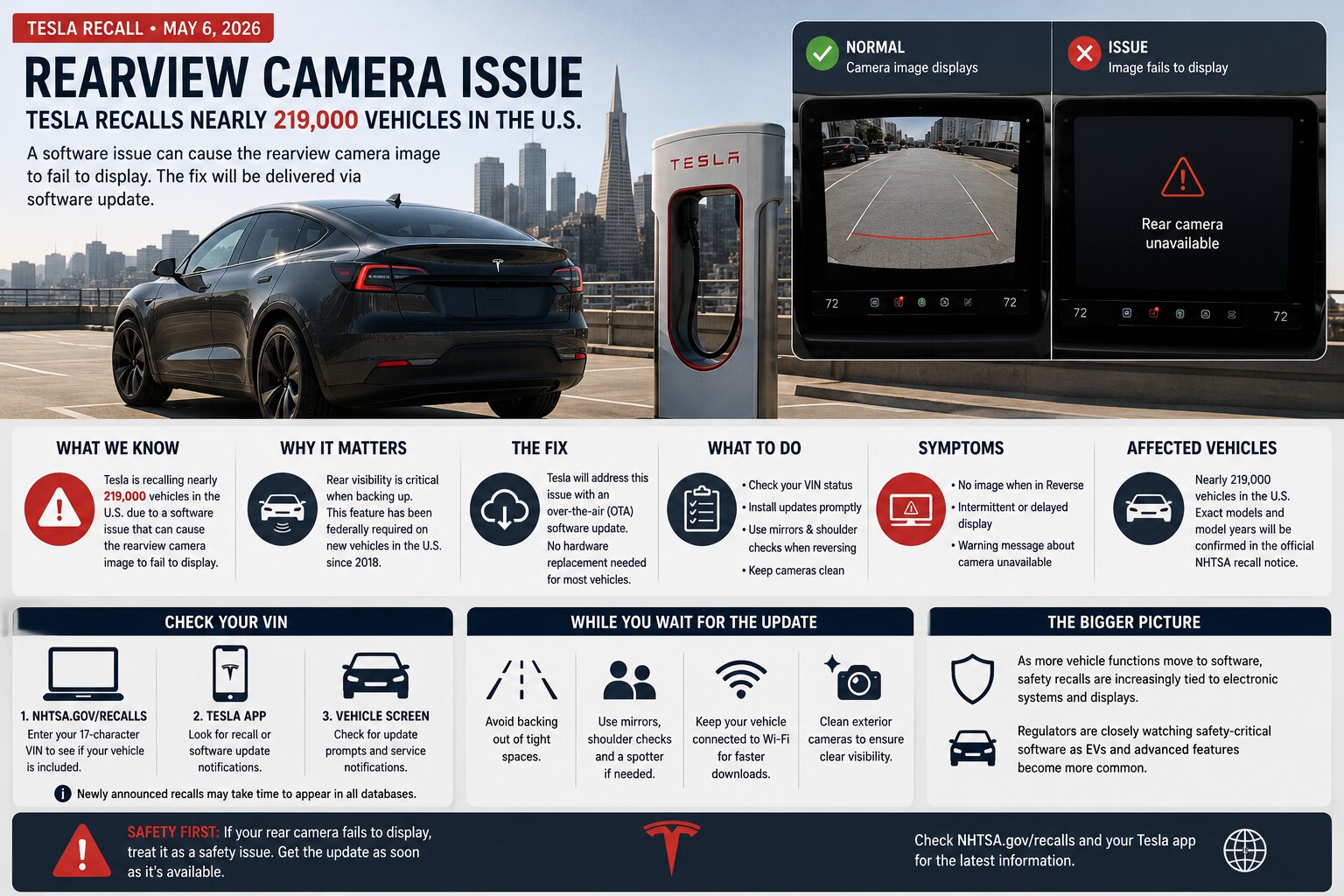
The recall centers on the rearview camera image not displaying. In modern vehicles, especially EVs with large central touchscreens, the camera feed is effectively part of the driver’s visibility toolkit. Federal safety standards in the U.S. have required rear visibility technology on new light vehicles since 2018, and that regulatory push has changed driver habits. Many people now reverse primarily by screen, with mirrors and shoulder checks as backup rather than the other way around.
Tesla’s recall described by Reuters is tied to a condition where the rearview image may not appear when needed. Reuters did not publish full technical detail in its summary, and Tesla’s formal National Highway Traffic Safety Administration (NHTSA) filing contains the definitive description, affected build dates, and remedy instructions. If you own one of the models involved, it is worth reading the NHTSA recall notice once posted or updated because it will spell out exactly what triggers the failure and how Tesla intends to correct it.
Which vehicles are affected (and what we can confirm)
Reuters reported the recall covers nearly 219,000 U.S. vehicles. The report characterizes it as a Tesla recall involving a rearview camera image issue, but it does not list every model and model year in the summary provided here.
What drivers should do with that uncertainty: do not assume your car is included or excluded based on social media lists. The only reliable confirmation comes from Tesla’s in-app notifications and NHTSA’s VIN-based lookup tool once the recall campaign is live in the database. Those sources will identify whether your specific vehicle is covered.
Why rear camera outages matter in daily driving
A missing rear camera image sounds minor until you map it onto real-world use. Many driveways have limited sightlines. Urban curbside parking often involves pedestrians stepping off between cars. Large SUVs and pickups have tall beltlines and thick rear pillars that make cameras more than just convenience equipment.
Tesla’s lineup adds another layer: visibility out the back can be compromised by design choices common to sleek EVs, including high trunk lines and glass shapes aimed at aerodynamics. That does not mean Teslas are uniquely unsafe, but it does mean drivers often lean heavily on camera feeds for precision when backing into a charger stall or threading into a narrow space.
Symptoms owners might notice
If your vehicle is affected, symptoms could include:
1) No rearview camera image when shifting into Reverse (blank screen, frozen frame, or delayed display).
2) Intermittent behavior where the image appears after a pause or only after rebooting the system.
3) Warning messages related to camera availability (the exact wording varies by software version).
If any of those occur, use old-school techniques immediately: mirrors, shoulder checks, and if needed, a spotter when backing out of tight spaces. Drivers should also consider parking in a way that reduces backing maneuvers until the issue is resolved. It is a small lifestyle adjustment, but it can lower risk during the period before an update arrives.
The fix (and why Tesla recalls often look different)
Many Tesla recalls are remedied through over-the-air software updates rather than hardware replacement. That approach has become one of Tesla’s defining operational advantages: fewer service visits for issues that are fundamentally software logic problems.
Reuters reported this campaign relates to an image-not-displaying condition; that points strongly toward a software remedy, although owners should wait for Tesla’s official recall remedy description to confirm whether any subset requires in-person service. If an update is required, Tesla typically pushes it in waves. Some owners receive it quickly; others may wait days or weeks depending on fleet rollout strategy.
No panic required: if your car drives normally and only the camera feed is impacted intermittently, you are not dealing with a propulsion or braking failure based on what has been reported so far. Still, reversing without a working camera increases risk in precisely those low-speed situations where accidents happen most often: bumping a pole in a garage, clipping another bumper, or failing to see a child or cyclist crossing behind you.
How to check your VIN and confirm recall status
Owners have three straightforward paths to confirmation:
1) NHTSA VIN lookup: Visit NHTSA.gov/recalls and enter your 17-character VIN. This is the most widely used public database for U.S. recall status. Keep in mind that newly announced recalls sometimes take time to populate fully across all records.
2) Tesla app notifications: Tesla commonly communicates recalls and software updates through its mobile app. If your vehicle is included, you may see an alert with instructions.
3) Vehicle touchscreen: Software update prompts often appear on the center display when an update is ready to download and install. The screen may also list open campaigns under service or notifications depending on software version.
If you cannot find your VIN quickly, it is typically visible at the base of the windshield on the driver’s side and inside registration documents.
What drivers should do while waiting for an update
If your rearview image fails even once, treat it as an actionable defect rather than an annoyance.
Practical steps:
• Schedule service through the Tesla app if prompted or if symptoms persist.
• Keep your vehicle connected to Wi-Fi when possible so software downloads arrive faster.
• Avoid backing out blind from tight spots; choose pull-through parking when available.
• Clean exterior cameras; grime can cause poor images but will not usually cause total loss of display. Still, cleaning removes one variable while you troubleshoot.
Tesla owners are used to living with frequent software changes that can improve features overnight but also occasionally introduce new quirks. A rear camera outage crosses into safety territory quickly because it affects situational awareness at exactly the moment you need clarity.
The broader context: recalls are rising across the industry
Tesla is not alone in issuing safety recalls tied to screens and cameras. As automakers shift more functions into centralized displays and software-defined architectures, defects increasingly look like bugs rather than broken parts.
This trend intersects with policy too. Regulators have been sharpening their focus on advanced driver assistance systems and electronic controls generally. NHTSA has pushed for clearer oversight of safety-critical software behavior across brands, not just EV startups. Recalls like this one sit right at that intersection: a basic federally required safety feature delivered through software running on an always-connected platform.
How this might land with shoppers comparing EVs
For many buyers cross-shopping EVs in 2026, Tesla remains a default option because of its charging ecosystem advantages and broad national availability compared with some newer entrants. But recalls affect perception even when fixes are quick.
A mainstream shopper weighing a Model Y against alternatives such as Ford’s Mustang Mach-E or Hyundai’s Ioniq 5 (both established competitors in the compact electric crossover space) tends to think less about firmware architecture and more about trust: will basic functions work every morning? A rearview camera glitch can create doubt disproportionate to its technical complexity because it touches something drivers use dozens of times per week.
Pricing pressure also matters here. EV transaction prices have been volatile over the past few years as automakers adjusted sticker prices and incentives amid changing demand and shifting federal tax credit eligibility rules (which depend on vehicle assembly location and battery sourcing requirements). In that environment, shoppers have become more value-sensitive and sometimes less forgiving of quality-of-life issues that feel avoidable.
If you experience the issue: document it
If your rear camera image fails to display, note when it happened and under what conditions (vehicle just started vs warm restart, after an update vs before). If safe to do so while parked, take a photo of any warning message on-screen. That information helps service teams replicate intermittent problems faster.
You can also file a complaint with NHTSA if you believe your vehicle has experienced a safety-related defect. This does not replace getting service from Tesla; it helps regulators track patterns across many owners.
What happens next
Tesla owners should watch for official recall communication through NHTSA postings and Tesla’s app. Once remedy details are published in full, they will clarify which models and model years are included and whether any vehicles require more than an over-the-air update.
A blank rearview camera screen is not something most drivers want to think about during their commute or grocery run. It is also one of those problems that has a clear path forward: confirm your VIN status, install updates promptly, and adjust habits temporarily if symptoms show up before the fix lands.

0 comments
Join the discussion around this article.
Please login to comment.