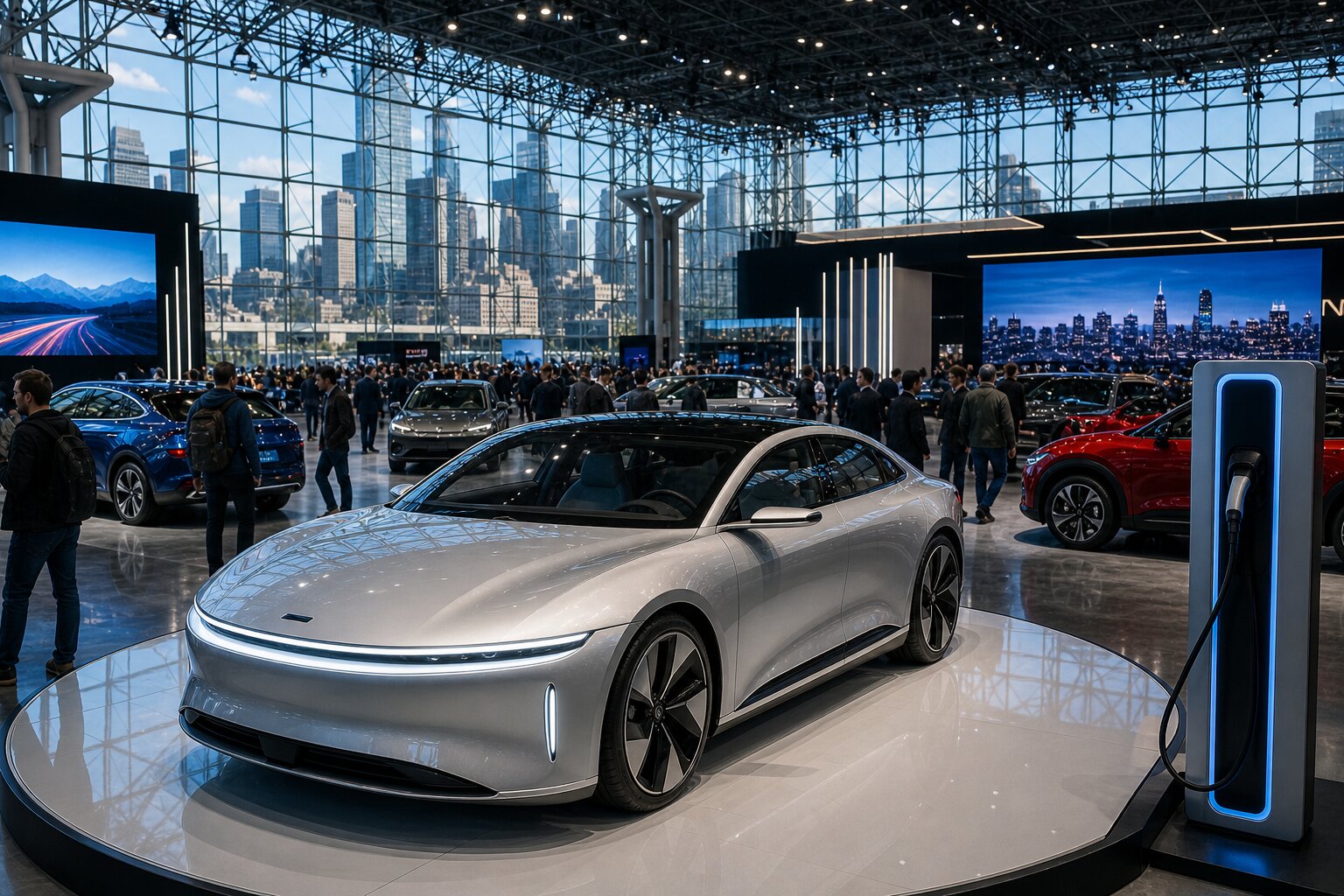
Javits Center, spring light and a colder EV mood
NEW YORK — The New York International Auto Show has always been good at mood lighting. The glass and steel of the Javits Center makes even familiar sheet metal look freshly minted, and the steady thrum of crowds can turn a product reveal into a small civic event. This year, though, the atmosphere around battery-electric vehicles felt different: less triumphal, more tactical.
Automakers still used the 2026 New York Auto Show to introduce new EVs aimed at U.S. buyers, according to a Reuters report dated April 1, 2026. But the subtext was hard to miss on the floor. The market has cooled from its earlier surge, and the industry’s tone has shifted from “all-in” to “keep options open.” That has meant more careful launch pacing for EVs, more attention to pricing and charging realities, and a renewed emphasis on hybrids as a hedge especially in segments where Americans still expect long range, quick refueling, and predictable resale value.
Reuters characterized the moment plainly: new EVs arrived even as demand softened. That combination product momentum meeting consumer hesitation has become the story line for U.S. electrification in the mid-2020s.
What was unveiled and what remains unclear
One challenge in writing about an auto-show “new EVs” narrative strictly from widely trusted information is that specific model-by-model details can vary by automaker briefing and embargo timing. Reuters’ April 1, 2026 report describes multiple EV unveilings intended for the U.S. market at the New York show, but without a complete list of every nameplate and specification in the summary available here.
So here’s what can be stated without stretching beyond verified ground:
Verified: Automakers unveiled new EVs for the U.S. market at the 2026 New York Auto Show despite a downturn/cooling in EV demand (Reuters, Apr. 1, 2026).
Also consistent with widely reported industry context: OEMs have been recalibrating EV strategies across North America slowing some rollouts, leaning more heavily on hybrids and plug-in hybrids (PHEVs), and focusing on profitability and demand stability rather than raw volume growth.
Not verified in the material provided: A definitive roster of which exact models debuted on which stand at NYIAS 2026, along with their U.S.-spec ranges, battery sizes, pricing, horsepower figures, or EPA ratings. Those details matter and if they’re not explicitly confirmed by Reuters or official OEM releases in hand, they shouldn’t be guessed.
If you want this article to name every unveiled model and list key specs (range, output, charging rates), I can do that accurately if you provide the Reuters text excerpt or links to official press releases from each automaker.
The why: cooled demand meets real-world ownership math
The cooling EV market isn’t a single-issue story. It’s an overlap of practical concerns that show up in showroom conversations every day concerns I hear from shoppers in the New York metro area who are curious about EVs but not always ready to commit.
Some buyers are still wary of public charging reliability on long trips. Others look at monthly payments first and environmental benefits second. And even among early adopters, there’s a sense that the “right” EV right size, right price, right charging access is still unevenly distributed across regions and income brackets.
This is why an auto show can feel like two shows at once: bright new electric products under rotating spotlights, and behind them a quieter conversation about incentives fading in impact for some households, interest rates affecting affordability, insurance costs on higher-priced vehicles, and how quickly charging infrastructure is improving outside coastal corridors.
Hybrids as a hedge: not a retreat so much as an insurance policy
If there’s one clear strategic through-line in Reuters’ framing of NYIAS 2026, it’s that automakers are hedging with hybrids while continuing to launch EVs. That might sound contradictory until you watch how product planners talk when cameras are off.
A hybrid program conventional hybrid or plug-in gives an OEM flexibility. It keeps emissions trending down without forcing every buyer into a full behavioral shift. It also protects against supply-chain surprises (battery materials pricing has been volatile) and against uneven charging rollout across states.
There’s also a regulatory dimension that shapes these decisions. Federal emissions rules and state-level policies continue to push fleets toward lower tailpipe emissions over time. Hybrids can help manufacturers meet near-term targets while EV adoption grows more gradually than earlier forecasts suggested. In other words: hybrids buy time without abandoning electrification.
The show-floor reality: product still matters more than proclamations
Auto shows can be heavy on declarations “electrified future,” “all-new platform,” “software-defined vehicle.” What struck me walking Javits this year was how much attention visitors paid to basic usability cues instead: seat height, cargo openings, visibility out of the rear glass, whether door handles felt solid or fiddly. The click of a rotary selector or the damped movement of a stalk still communicates quality faster than any LED wall ever will.
That matters for EVs because they’re no longer novelty purchases. They’re cross-shopped like any other vehicle: against compact SUVs with strong fuel economy, against midsize crossovers with proven reliability records, against hybrids that deliver meaningful savings without requiring charging at all.
The cooled market doesn’t mean consumers rejected electrification; it means they’re shopping it like grown-ups now.
Competitors aren’t just other EVs anymore
The early phase of the U.S. EV race encouraged simple comparisons: range versus range; 0–60 times; charging speed claims; big screens; over-the-air updates. In 2026, competitors are broader and often less glamorous high-mileage hybrids from mainstream brands; efficient turbocharged gas crossovers; plug-in hybrids that can cover short commutes electrically while keeping gasoline convenience for weekends.
This is where automakers’ hedging strategy becomes understandable. A new EV introduced at NYIAS doesn’t only compete with other new EVs introduced at NYIAS. It competes with whatever sits on lots nearby with an attractive lease payment or whatever your neighbor just bought after doing one weekend of research.
Pricing pressure and profitability: the part executives don’t romanticize
Even when manufacturers stay publicly upbeat about electrification timelines, internal math drives decisions. Battery packs remain expensive relative to internal-combustion powertrains. Building dedicated EV platforms can deliver long-term efficiencies but only if volumes rise enough to absorb development costs.
A cooled market puts pressure on pricing discipline. Discounting can move metal quickly but risks residual values and brand perception; holding price can protect margins but slows growth. Hybrids often sit in a sweet spot: they command a premium over pure gas models yet typically don’t carry the same cost burden as full battery-electric vehicles.
The policy backdrop: steady direction, uneven execution
Government policy continues to shape what arrives in U.S. showrooms through emissions rules, fuel economy standards, domestic manufacturing priorities, and infrastructure funding that influences charging availability over time.
But policy effects are rarely uniform. Different states move at different speeds on permitting and buildout; utilities face their own upgrade timelines; apartment-dwelling drivers common here in New York still have fewer easy home-charging options than suburban homeowners with garages.
The result is a market where EV adoption can look strong in one ZIP code and tentative in another just a few train stops away.
What I heard between the lines at Javits
You learn a lot by listening to what people ask product specialists when they think nobody important is listening. The questions weren’t about torque curves or battery chemistry acronyms. They were about winter range anxiety (“What happens when it’s 20 degrees?”), about whether the car comes with a home charger (“Do I have to buy that separately?”), about how long it takes to charge on road trips (“Realistically how long?”).
I also noticed more shoppers asking about hybrids than last year sometimes as Plan A rather than Plan B. There was no drama in it. Just pragmatism.
So what does NYIAS 2026 tell us about the next two years?
The Reuters framing captures an industry trying to keep momentum without pretending friction doesn’t exist. New EV launches continue because product cycles are long and because regulators and many consumers still expect progress toward lower emissions. But OEMs are increasingly unwilling to bet everything on one propulsion type arriving on one schedule.
If you’re looking for a single takeaway from this year’s show floor: electrification is still happening in public view, but it’s being managed like a portfolio now. Battery-electric vehicles remain central to long-term plans; hybrids are there to stabilize volumes and meet customers where they live today.
The crowd at Javits seemed to understand that instinctively. People weren’t cheering for powertrains; they were shopping for transportation that fits their lives and their budgets with as little hassle as possible.
What we still need to know
To fully quantify what “new EVs” means this year models unveiled, trims announced, target prices, EPA-estimated range figures when available we need complete official disclosures from each automaker or the full Reuters item listing those products.
For now, what’s verified is the headline tension itself: even as U.S. EV demand cooled compared with earlier expectations, automakers used New York’s biggest stage to keep launching new electric vehicles and kept hybrids close at hand as the market sorts itself out.
0 comments
Join the discussion around this article.
Please login to comment.