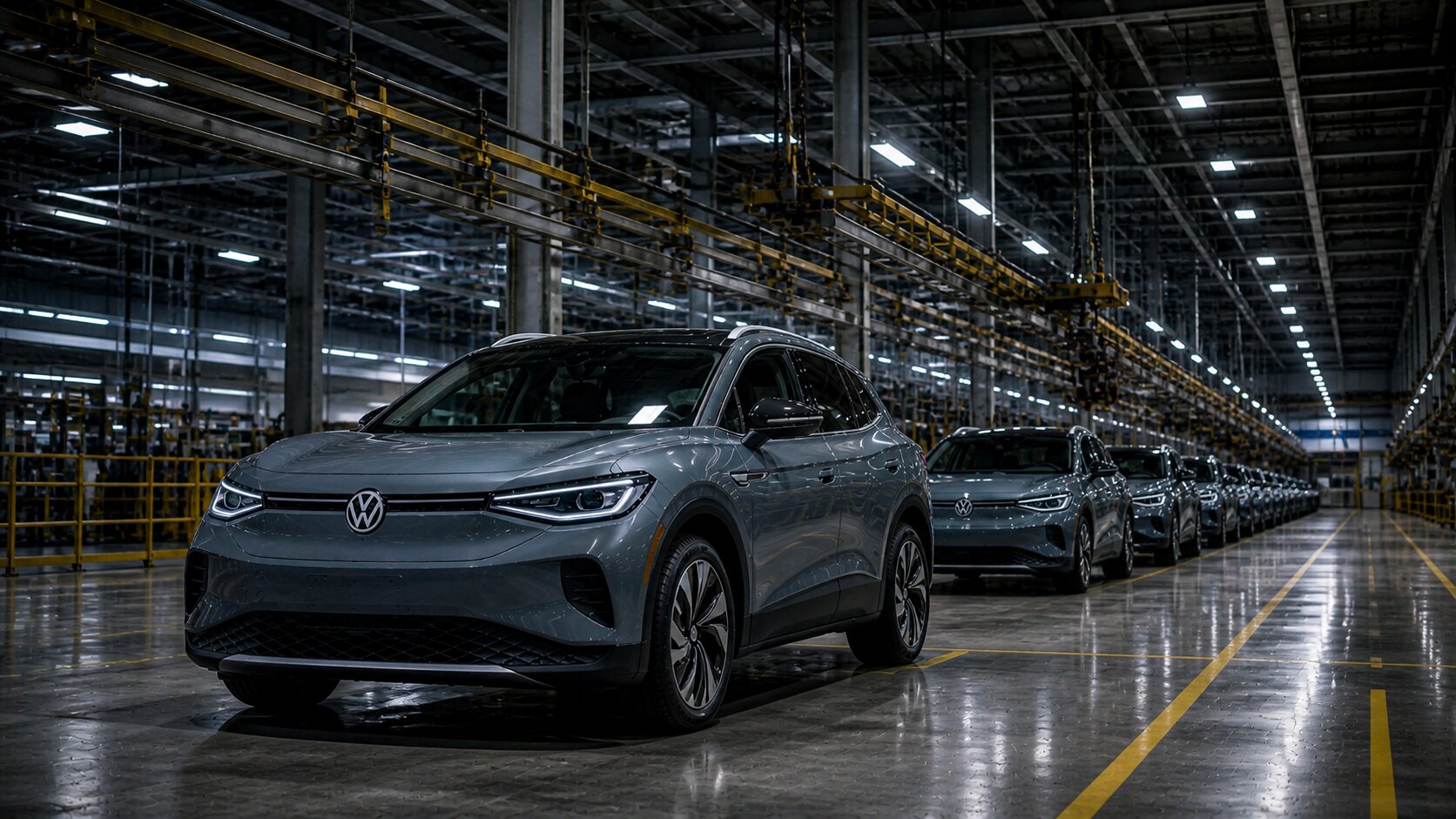
Volkswagen hits pause on U.S. ID.4 output
Volkswagen is halting production of the ID.4 electric SUV in the United States, a move the automaker attributed to challenging market conditions for EVs. The decision centers on Volkswagen’s assembly plant in Chattanooga, Tennessee, where the company has built U.S.-market ID.4s.
The headline is easy to misread as a retreat from electrification. It isn’t that simple. A production halt can be a tactical response to near-term demand and inventory realities, not necessarily a verdict on the long-term viability of the product or the broader EV transition. Still, it’s a notable signal from one of the world’s largest automakers and it lands at a moment when EV demand in the U.S. looks more uneven than many executives forecast a few years ago.
I’ve spent enough time around EV assembly plants and dealer lots to recognize the pattern: when demand softens, the first lever pulled is often production cadence. It’s less visible than a price cut, but it can be just as consequential for workers, suppliers, and the pace at which vehicles reach showrooms.
What VW said and what it didn’t
Volkswagen’s public message, as reported by Reuters, was straightforward: U.S. ID.4 production is being stopped, and the company pointed to a challenging EV market as the reason. That phrasing matters. Automakers typically choose words carefully here; “challenging market” is corporate shorthand for some combination of slower retail turn rates, higher incentives than planned, or dealer inventories rising faster than deliveries.
What Volkswagen did not do in that statement is equally important. It did not announce an end to the ID.4 nameplate in the U.S., and it did not say it was exiting EV manufacturing in Tennessee permanently. A halt is a pause sometimes short, sometimes extended used to align output with demand and manage costs.
Volkswagen also didn’t provide granular details in that brief framing: no restart date, no target production rate upon resumption, and no specific breakdown of whether the decision was driven more by consumer demand, pricing pressure, incentive changes, or competitive intensity. If Volkswagen releases additional specifics timing, staffing impact, inventory levels that will clarify whether this is a short-term adjustment or something closer to a strategic reset.
The ID.4’s place in VW’s U.S. lineup
The ID.4 has been Volkswagen’s core mass-market EV in America: a compact electric crossover aimed at the center of the U.S. market where families want five doors, decent cargo room, and an easy driving position. It’s also been VW’s most visible attempt to translate its global EV push into an American-built product.
The basics are well established: the ID.4 rides on Volkswagen Group’s MEB electric platform and competes in a crowded field of electric crossovers. Depending on model year and configuration, it has been offered with rear-wheel drive or all-wheel drive (dual-motor) layouts. Like most dedicated EVs, it delivers its performance with that familiar electric immediacy quiet propulsion and strong low-speed response that can make stop-and-go traffic feel less like punishment.
Some specifications vary by model year and trim (and VW has adjusted packaging over time), so it’s worth being careful about blanket claims on range or power without pinning them to a specific year/variant window. Widely reported configurations include battery packs around 82 kWh gross capacity for many versions (often discussed as about 77 kWh usable), with EPA-rated range varying by drivetrain and wheel/tire setup.
What this signals about EV demand
The simplest takeaway is that EV demand growth isn’t following a smooth curve. In the U.S., adoption has been real but lumpy by region, income band, charging access, and vehicle segment. The early adopters have largely had their moment; now the industry is fighting for mainstream buyers who cross-shop monthly payments, insurance premiums, home charging feasibility, and road-trip confidence with more skepticism.
Automakers are also operating in an interest-rate environment that punishes expensive purchases. Even if an EV’s operating costs pencil out over time, shoppers still feel the monthly payment first. When financing costs rise, inventory sits longer unless pricing adjusts.
Then there’s charging still the recurring friction point in owner surveys and casual conversations alike. Most EV owners who can charge at home are satisfied; those who rely on public infrastructure are more likely to report frustration. The gap between “EV-ready household” and “EV-curious household” remains one of the biggest determinants of demand elasticity.
A production halt at Chattanooga doesn’t automatically mean customers have stopped wanting EVs altogether; it suggests Volkswagen believes current demand for this specific model (at current pricing and incentives) doesn’t justify maintaining prior build rates right now.
What this does not necessarily mean
It does not automatically mean Volkswagen is abandoning U.S.-built EVs long-term. Automakers frequently modulate output especially in segments where incentives can swing quickly based on policy changes or competitive price moves.
It also doesn’t automatically mean there’s something fundamentally wrong with the ID.4 as a vehicle. In my experience driving mainstream EV crossovers including the ID.4 the differences often come down to software polish, charging experience consistency, packaging details you notice only after living with one (door pockets that actually hold bottles; a climate-control interface you don’t have to stare at), and how confident you feel taking it beyond your commuting radius.
A pause in production is more often an economics story than an engineering story.
The competitive pressure cooker: Model Y and a crowded middle
The ID.4 competes against some of the most aggressive players in today’s market. Tesla’s Model Y has been an obvious benchmark because it has combined scale with frequent pricing adjustments over time moves that ripple across competitors’ planning assumptions.
Mainstream rivals also include crossovers such as Ford’s Mustang Mach-E and Hyundai’s Ioniq 5/Kia EV6 family (exact competitive set varies by shopper). Many of these vehicles trade strengths: charging curves, interior space utilization, ride comfort, software ecosystems, dealer/service experience, and pricing discipline.
Volkswagen is fighting in what may be the hardest part of the EV market: not ultra-luxury where margins cushion mistakes, not entry-level where buyers accept compromises for price but right in the middle where buyers expect everything to work smoothly while still demanding value.
Policy crosswinds: incentives matter more than press releases
No discussion of U.S.-market EV demand is complete without acknowledging government policy and how confusing it can be for shoppers standing on a dealership floor trying to compare out-the-door numbers.
The federal clean vehicle tax credit structure has evolved under recent rules that tie eligibility to battery sourcing and assembly requirements. Those requirements have changed which vehicles qualify over time and whether they qualify at purchase via point-of-sale mechanisms depends on program implementation details and dealer participation.
I’m not going to claim ID.4 eligibility status here because it can vary by model year and timing; shoppers should verify current eligibility directly through official IRS guidance and Volkswagen/dealer documentation at time of purchase or lease signing.
But here’s what matters for production planning: when incentive eligibility shifts even temporarily it can change demand quickly enough that automakers respond with pricing actions or production adjustments rather than letting inventory pile up.
What owners should know: service and parts shouldn’t vanish
If you already own an ID.4 or you’re leasing one the practical question is simple: does a production halt change your day-to-day ownership experience?
In most cases, no immediate change should be expected regarding routine service support because automakers maintain parts distribution networks and service obligations regardless of short-term production decisions. Volkswagen has an established dealer network across the U.S., and warranty obligations don’t disappear because a factory pauses output.
That said, parts availability can fluctuate across any brand due to supplier constraints or logistics issues ICE or EV so it would be unrealistic to promise every component will always be available instantly everywhere. Owners who have lived through pandemic-era backorders don’t need reminding that modern supply chains can be fragile.
If you’re an owner worried about support continuity, focus on concrete steps rather than speculation:
• Keep documentation organized: service records, software update history if provided on repair orders, and warranty paperwork.
• Use official channels: schedule service through authorized Volkswagen dealers for warranty-related concerns.
• Ask direct questions: if you’re waiting on a part today (a body panel after a minor fender-bender, or an electronic module), ask your dealer for estimated lead times and whether alternatives exist through regional parts depots.
A quick reality check on what “production halt” feels like on the ground
The public hears “halt” and imagines lights off and silence a factory frozen mid-motion. In reality, these decisions often ripple outward: suppliers adjust shipments; logistics providers re-route; dealers reassess incoming allocations; workers face schedule uncertainty depending on how long the pause lasts.
For consumers walking into showrooms, effects can show up subtly first: fewer choices on color/trim combinations; fewer cars available with specific options; longer waits for exact builds if production restarts with different prioritization.
I’ve walked lots where you can hear your footsteps between rows because inventory thinned out after supply disruptions and I’ve also seen lots packed so tightly that sales staff weave between bumpers like they’re navigating Midtown foot traffic at rush hour. Production planning tries to avoid both extremes; neither is good for profitability or customer satisfaction.
The bigger trendline: EVs aren’t collapsing they’re normalizing
This moment looks less like an EV “bubble popping” than an industry entering its next phase: normalization. That means fewer hype-driven forecasts and more grinding work cost reduction, charging partnerships, software stability improvements, better residual value management for leases, smarter trim strategies.
It also means some uncomfortable adjustments as companies discover that mainstream buyers don’t tolerate friction well. If an interface requires too many taps just to adjust cabin temperature or if public fast charging feels like rolling dice those annoyances carry more weight than they did with early adopters who were willing to forgive rough edges for novelty or environmental motivation.
What to watch next from Volkswagen
The key questions now aren’t philosophical; they’re operational:
• How long does Chattanooga remain paused? A short pause suggests inventory balancing; a longer one could indicate deeper recalibration.
• Does VW adjust pricing or incentives? Automakers often use incentive spending as a pressure valve before making bigger product changes.
• Do dealers report tighter allocations or excess stock? Dealer inventory levels are often the clearest real-world indicator of demand relative to supply.
• Does VW shift focus within its EV portfolio? Product cadence matters: updates that improve software usability or charging experience can move needles more than cosmetic tweaks.
The bottom line for owners and for everyone else watching
Volkswagen halting U.S. production of the ID.4 is a clear acknowledgment that today’s EV market is tougher than many boardrooms expected when interest rates were low and early-adopter momentum was strong. It signals caution around near-term demand for this vehicle at this moment under current market conditions.
It doesn’t automatically signal abandonment of existing owners or an end to Volkswagen’s EV ambitions in America. For ID.4 drivers already accustomed to that calm electric glide through city traffic the soft whir at low speeds, the absence of engine vibration at stoplights the ownership fundamentals should remain anchored by warranty commitments and established service channels.
The industry will keep moving toward electrification but it won’t do so in a straight line. This production pause is one more reminder that momentum is real, yet conditional and increasingly shaped by affordability, charging confidence, and policy fine print rather than grand promises alone.
0 comments
Join the discussion around this article.
Please login to comment.