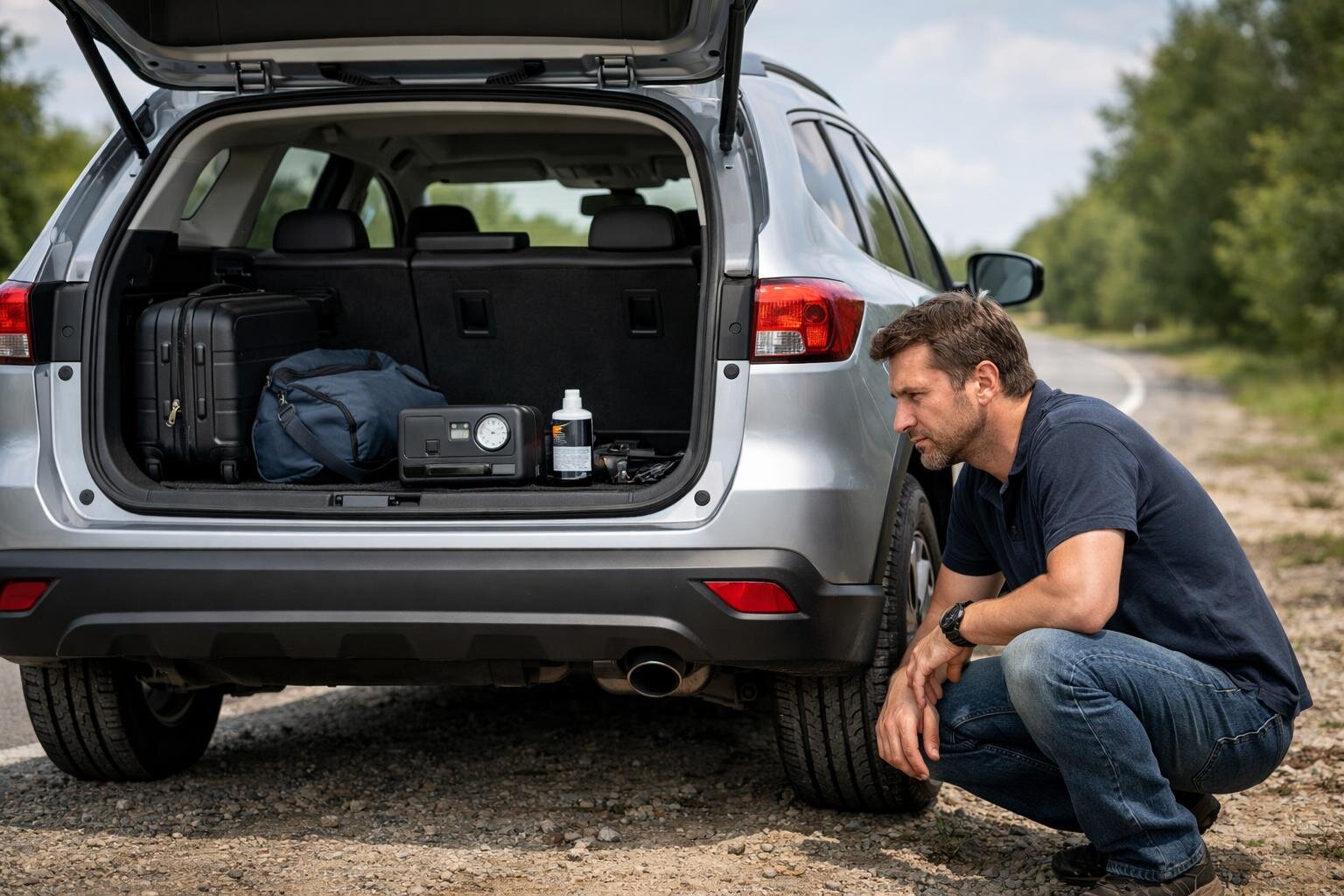
You pop the trunk after buying a used car, lift the floor panel, and… nothing. No donut spare. No jack. Maybe a little compressor in a foam block, maybe not even that. It’s more common than a lot of drivers expect, and it changes what “I’ll handle a flat” really means.
If your car has no spare tire, you can still be prepared. You just need to know what you actually have (sealant kit, run-flat tires, roadside assistance, or some mix), what it can’t do, and what your safest next step is when things go sideways.
First: find your real flat-tire plan (don’t guess)
Before you trust a sealant kit or your insurance app, do a quick inventory at home in daylight. Roadside surprises are where plans fall apart.
Check these four things:
1) Is there a spare tire? Look under the cargo floor, in a side compartment, or under the vehicle (more common on trucks and some SUVs). If there is a spare, confirm it’s actually usable: check its air pressure and condition. A neglected spare can be flat or cracked when you need it most.
2) Is there an inflator, sealant, or both? Many cars without spares include a 12-volt air compressor and sometimes a bottle of tire sealant. Some kits are “inflator only,” which helps if the tire is just low but does not plug a puncture.
3) Are your tires run-flats? Run-flat tires are designed to be driven for a limited distance after losing air, but only under certain conditions. Not every car without a spare has run-flats, and not every run-flat setup is obvious at a glance. The tire sidewall often indicates run-flat capability, and your owner’s manual usually spells out the limits.
4) Do you have roadside assistance? You might have it through the automaker (new-car coverage), an extended warranty plan, your insurance policy, or a motor club membership. These programs vary widely in tow distance limits, response times, and whether they’ll bring a spare or just tow you.
Do this small thing now: Put your roadside number in your phone contacts and write it on a card in the glovebox. In typical daily life you will not remember which app includes towing when you’re on the shoulder with traffic whipping by.
The basics that prevent most tire drama: pressure and tread
A lot of “sudden” tire problems aren’t sudden at all. They build slowly with low pressure or worn tread until one day the tire gives up at the worst possible moment.
The National Highway Traffic Safety Administration (NHTSA) emphasizes tire maintenance basics like keeping tires properly inflated and checking tread depth as part of overall tire safety guidance. It’s not glamorous advice, but it’s the cheapest way to reduce your odds of being stranded.
A simple monthly routine:
Check tire pressure monthly, and before long road trips or big temperature swings. Use the pressure listed on the driver’s door jamb sticker (not the maximum pressure molded into the tire). If your car has TPMS (tire pressure monitoring), treat it as a warning system, not a substitute for checking with an actual gauge.
Check tread depth monthly. In much of the U.S., wet-weather hydroplaning risk climbs as tread gets low. If you don’t have a tread gauge handy, use any common tread-depth method you trust, but don’t wait until cords show or handling feels sketchy.
Look for damage while you’re there: bulges on the sidewall, deep cracks, or nails and screws. Sidewall issues are especially important because many “quick fix” options can’t safely address them.
What a sealant kit can do (and what it cannot)
A sealant kit sounds like freedom: inject goo, reinflate, drive away. Sometimes that’s exactly how it goes. Other times it’s messy, ineffective, or outright unsafe to attempt on the roadside.
Sealant is usually meant for small punctures in the tread area. Think nail-in-the-tread type problems where the hole is relatively small and located in the part of the tire that meets the road.
Sealant usually cannot fix:
Sidewall damage. A cut or bulge on the sidewall is not a “seal it and go” situation. Sidewalls flex constantly; they’re also structurally critical. If you see damage there, plan on towing.
A blowout or shredded tire. If the tire has come apart or you’re driving on the rim, sealant won’t rebuild missing rubber.
A tire that’s come off the bead. If the tire has separated from the wheel edge (you may hear loud flapping or see the tire sitting oddly), many compressors cannot reseat it safely.
Multiple punctures, large holes, or damage from hitting debris or potholes hard enough to bend a wheel. Sealant is not magic; it’s an emergency bandage with limits.
Two practical realities people forget:
Your speed and distance will likely be limited after using sealant. The exact limit depends on the kit and vehicle guidance. Follow your owner’s manual and whatever is printed on your kit bottle. Don’t assume highway speeds are fine just because air pressure looks normal again.
The tire may still need replacement afterward. Even if sealant gets you rolling again, many shops will treat that repair differently than a standard plug-patch repair. Some repairs might be possible; others might not be recommended depending on where the puncture is and what condition the tire is in. The right answer is “let a professional inspect it,” not “I’m good forever.”
If you rely on sealant: build a smarter kit around it
If your car came with sealant, treat it like one tool in a bigger plan rather than your entire plan.
Add these items to your trunk:
A quality tire pressure gauge. Cheap gauges can be wildly inconsistent. A basic dial gauge from an auto parts store is usually fine.
A flashlight. Phone flashlights work until they don’t (dead battery, rain glare). A small LED light makes it easier to spot where air is escaping without putting yourself in danger.
Gloves and paper towels. Sealant is sticky stuff; cleanup matters if you have to handle valves or touch anything inside the wheel well area.
A valve core tool and spare valve cores, only if you know how to use them. Some slow leaks are valve-related rather than punctures. If that sentence sounds unfamiliar, skip this item and stick to safer basics.
Check expiration dates. Sealant bottles don’t last forever. If yours is expired or missing entirely (common on used cars), replace it with an OEM-approved option per your owner’s manual guidance rather than guessing compatibility.
Run-flat tires: convenient when they work, pricey when they don’t
Run-flats can feel like an elegant solution because they’re built to carry some load even after losing air pressure. For many drivers that means less time on the shoulder and more time getting somewhere safe before dealing with repairs.
But run-flats come with tradeoffs that matter for budgets and daily comfort:
You still need to know the limits. Run-flat capability typically comes with restrictions on speed and distance after air loss. Those specifics vary by tire design and vehicle guidance; follow what your owner’s manual says rather than assuming all run-flats behave the same way.
You may not feel an immediate “flat” sensation. That can be good for stability but bad for awareness. Pay attention to TPMS warnings and any change in steering feel or noise so you don’t unknowingly drive too far on a damaged tire.
Replacement costs can sting. Run-flats often cost more than comparable conventional tires in similar sizes (prices vary by size and brand). That matters if you’re trying to keep running costs predictable.
Ride quality can be firmer depending on vehicle setup. Many run-flats have stiffer sidewalls by design. Some cars tune suspension around them well; others feel sharper over broken pavement. This isn’t universal, but it’s common enough that shoppers notice when test-driving used luxury sedans or sportier trims that came factory-equipped with run-flats.
You might still end up towing. If there’s sidewall damage or severe impact damage, continuing to drive can risk wheel damage too. At that point it’s less about “can I limp home” and more about “should I.”
Your roadside assistance plan: read the fine print before you need it
A lot of drivers assume roadside assistance means someone shows up fast with everything needed to get you moving again. Sometimes that happens. Sometimes what you get is simply a tow to the nearest shop that’s open (and “open” at night or on holidays becomes its own problem).
A quick checklist to run through today:
Who provides it? Automaker coverage (if any), insurance add-on, credit card benefit, motor club membership, or an extended warranty plan all have different rules.
Tow distance limits: Some plans cap free towing at a certain mileage radius from where you break down; beyond that you pay per mile. Know your limit so you’re not stuck choosing between an expensive tow and an inconvenient shop just because it’s closer.
Tire service specifics: Ask whether they will mount your spare if you have one (many will), whether they carry temporary spares (often no), and whether they’ll bring fuel or jump-starts too (nice bonuses when plans overlap).
Your exact location matters: Coverage may change if you’re off paved roads or in restricted access areas. Also consider cell service gaps where calling help becomes harder than expected.
If you have no spare: consider whether adding one makes sense
This isn’t always possible because some vehicles simply don’t have space for a full-size spare or even a donut without giving up cargo room. Still, depending on how and where you drive, adding some form of spare can be worth exploring with realistic expectations about cost and packaging.
Questions to ask yourself:
Do I drive long distances regularly? Commuters who stay near town may be fine with roadside assistance plus good tires. Drivers who do rural routes, late-night shifts, or frequent road trips often value self-sufficiency more because tow times can stretch out fast away from cities.
Is my car set up for it? You need more than just a wheel: proper jack points matter; lug wrench fitment matters; wheel offset matters; brake clearance matters on some vehicles. This is where following OEM guidance helps keep things safe rather than improvising.
The moment of truth: what to do when you actually get a flat
If you get a flat while driving, safety comes first. NHTSA’s broader safety guidance includes staying alert to vehicle behavior changes; with tires specifically that means taking any sudden vibration, pulling sensation, thumping noise, or TPMS warning seriously.
If you suspect rapid air loss or a blowout:
Hold steady steering input. The car may tug toward the damaged tire side; keep both hands on the wheel if possible.
Eases off the accelerator gradually. Avoid sudden braking if you can; abrupt inputs can make control harder when traction is compromised.
Signal and move to a safe spot, ideally off the travel lane onto a wide shoulder or parking lot area away from traffic flow. If there’s no safe shoulder nearby, sometimes creeping slowly to an exit ramp area is safer than stopping immediately in an exposed spot (use judgment based on conditions).
If conditions are dangerous (tight shoulder, high-speed traffic), prioritize getting yourself out of harm’s way over saving the wheel or tire.
A practical decision tree: sealant vs run-flat vs tow
This is where people waste time debating while standing next to traffic. Keep it simple:
You might try inflator only if pressure is low but stable enough to reinflate and you don’t see obvious damage. Then drive slowly to air up properly and inspect at a shop soon.
You might try sealant + inflator if there’s likely a small tread puncture and your kit instructions allow it. Follow all limits in your owner’s manual and on the kit label about speed/distance afterward.
You should plan on towing if there’s sidewall damage, visible shredding, bent wheel signs after impact, repeated loss of pressure after inflation attempts, or any situation where working roadside feels unsafe (nighttime rain on narrow shoulders counts).
The ownership angle: avoid paying twice for one flat
No-spare setups can save weight and space for manufacturers, but for owners they sometimes shift costs around instead of eliminating them. A few ways to keep expenses predictable:
Avoid running tires too low for too long. Underinflation can accelerate wear and increase heat buildup inside the tire over time (another reason monthly checks matter). It also makes sidewall damage more likely when potholes show up unexpectedly.
If one tire needs replacement, ask about tread matching. On some drivetrains (especially all-wheel drive setups), big differences in tread depth across tires can be undesirable depending on manufacturer guidance. Don’t assume “one new tire is always fine.” Let your shop advise based on your vehicle requirements without guessing online forums are right for your case.
If buying used: negotiate based on preparedness gaps. Missing inflator kits happen; expired sealant happens; mismatched tires happen too. You don’t need drama at delivery day; just price those fixes into what you’re willing to pay so reliability stays affordable from month one.
A quick pre-trip checklist (takes five minutes)
If you’re heading out for a weekend drive or long commute week:
- Confirm all four tires are at door-sticker pressure when cold (or as close as practical).
- Check tread quickly for uneven wear and obvious objects embedded in grooves.
- Verify your inflator powers on from the 12-volt outlet if that’s all you’ve got.
- If using sealant kits: confirm bottle isn’t expired per its labeling guidelines; replace if needed following owner-manual recommendations for compatible products.
- Confirm roadside assistance contact info is accessible without logging into three different apps while stressed out roadside.
The bottom line: know what you’re betting on
No spare tire isn’t automatically bad news; plenty of drivers go years without needing one. The problem is assuming every flat looks like a nail-in-the-tread puncture at noon in perfect weather near an open shop. pick your plan while calm: verify what came with your vehicle, keep tires properly inflated with regular tread checks as NHTSA recommends as part of basic tire safety awareness, learn safe response basics for rapid air loss events, then decide whether sealant plus roadside coverage fits your driving life or whether adding some form of spare makes sense for peace of mind.
0 comments
Join the discussion around this article.
Please login to comment.