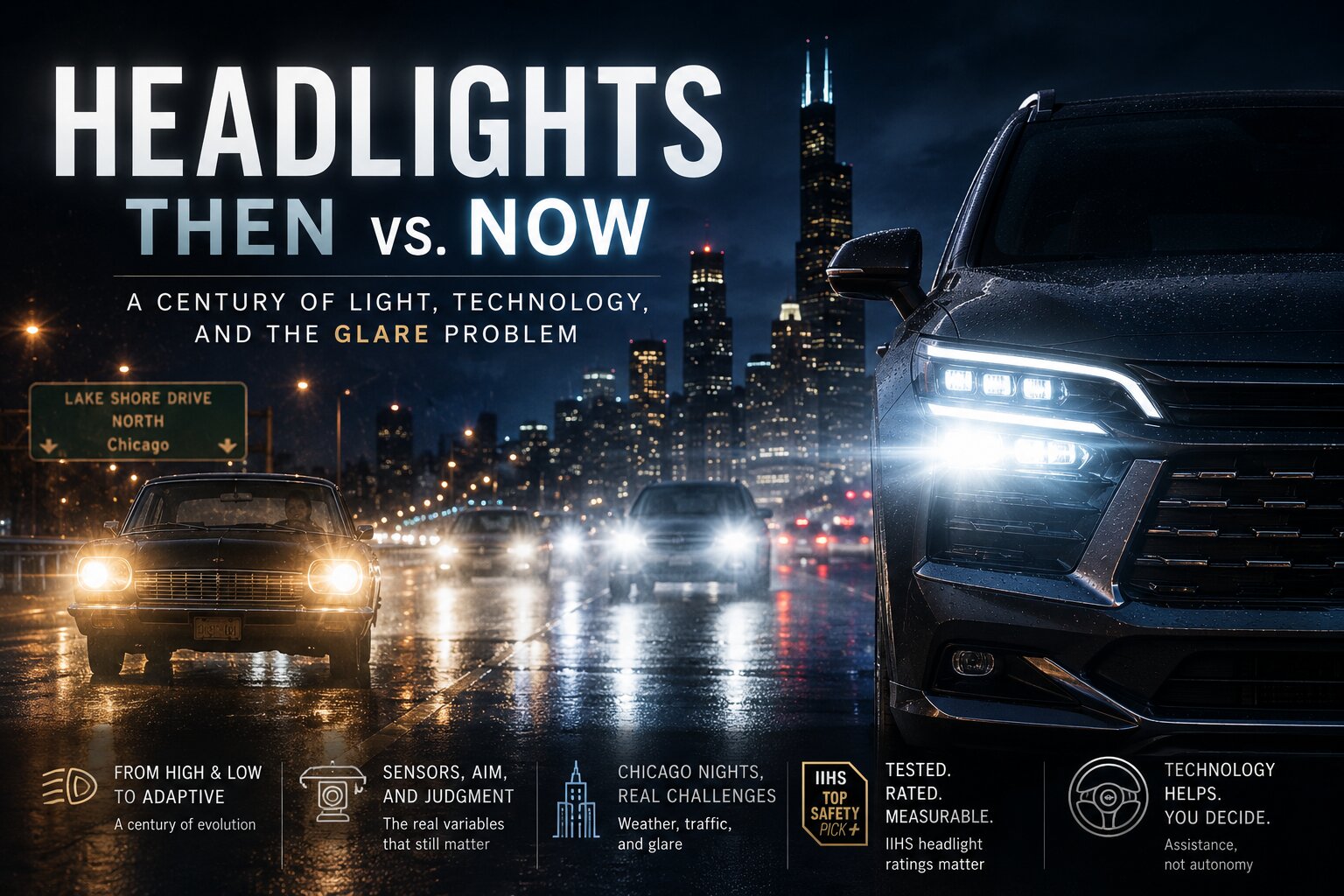
A Chicago night, a familiar complaint
In Chicago, winter darkness shows up early and stays late. You can feel it in the way traffic tightens up on Lake Shore Drive, in the wet shine of pavement after a slushy day, and in the little social contract we all try to keep when we’re sharing two lanes at 65 mph: don’t blind the person coming the other way.
And yet, talk to drivers lately and you hear the same thing. Headlights are brighter than ever, but night driving still feels like a glare contest. Some people swear modern LEDs are out of control. Others blame lifted trucks. A few blame “those automatic high beams.” The truth is less satisfying and more engineering-shaped: lighting tech has improved dramatically, but the system still depends on three old variables that never went away. Aim, sensors, and driver judgment.
That’s the thread running through a century of headlight evolution. We’ve gone from simple high and low beams to systems that can decide when to dim for you. We’re creeping toward headlights that can shape their beam patterns around other traffic. But if the lamps are aimed wrong, if the lenses are cloudy, if the camera is confused by rain or grime, or if the driver assumes “auto” means “handled,” you get the same result as 1978 with your brights stuck on: glare, reduced visibility, and irritation on both sides of the centerline.
Old beam logic: two filaments and a promise
For decades, headlight control was about as binary as it gets. Low beams for traffic, high beams for empty roads. The driver made the call with a floor switch or a stalk, and that was that.
The cultural context matters here. Mid-century America built its driving identity on long stretches of rural highway and postwar suburban sprawl. Night driving was part of the deal, and high beams were treated like a tool you were expected to use correctly. The “correctly” part was always the problem. Human beings forget. They get distracted. They overestimate how far their low beams reach. They leave their brights on because they’re tired or because they’re alone in their own little bubble of light.
Even with perfect etiquette, basic physics never cooperated. Headlights have to illuminate far enough ahead to give you stopping distance at speed while also keeping light out of other drivers’ eyes. That balancing act depends heavily on aim. A lamp pointed slightly high throws more light downrange but creates glare for oncoming traffic. A lamp pointed slightly low is polite but short-sighted.
As an engineer by training, I love how unglamorous this is. We can talk about LEDs and adaptive systems all day, but aim is still a mechanical adjustment interacting with suspension height, load in the trunk, tire pressure, and even minor crash damage you might not notice after a parking-lot bump.
Sealed beams to halogen: brighter light, same human inputs
Lighting got better in obvious ways before it got smarter. Sealed-beam headlights standardized performance for years in the U.S., then replaceable-bulb housings and halogen technology brought more usable light for many drivers. The output improved; so did beam control through better optics.
But that improvement also raised expectations. When you can see farther down a dark road, you drive like you can see farther down a dark road. That’s not inherently reckless; it’s just how humans work. Better lighting tends to pull your comfort zone outward.
This is also where maintenance started quietly becoming part of headlight performance. Lenses haze over time from UV exposure and abrasion; internal reflectors can degrade; bulbs age; wiring voltage drops can dim output. None of this is glamorous either, but it’s real-world night driving.
Automation arrives: automatic high beams are assistance, not autonomy
The big shift in recent years has been automation that tries to solve an old etiquette problem: forgetting to dip your brights for other traffic.
The National Highway Traffic Safety Administration (NHTSA) groups automatic high beams under driver assistance technologies and describes them as systems that automatically switch between high and low beams based on detected traffic conditions (NHTSA’s broader driver-assistance overview lives on its Driver Assistance Technologies page). That framing is important because it sets expectations where they belong: this is assistance. It’s not an autonomous lighting chauffeur.
In typical implementations, automatic high-beam systems rely on forward-facing cameras (and sometimes additional sensors) to detect headlamps from oncoming vehicles and taillamps ahead of you, then decide when to dim. When it works well, it’s one less task at night and one less opportunity to be “that person” blasting brights at everyone else.
When it works poorly, you get delayed dimming, unnecessary dimming (on reflective signs or bright storefronts), or no dimming when there should be some. None of those outcomes are shocking if you think about what the system actually sees: a camera view through your windshield in weather, dirt, salt spray, fogging, glare, and sometimes a wiper-swept pattern that leaves parts of the glass less clear than others.
The promise and limits of adaptive lighting
“Adaptive headlights” gets used as an umbrella term in casual conversation, but not every adaptive system does the same thing.
Some systems swivel the beam with steering input so you can see into corners better on dark roads. Others adjust vertical aim based on vehicle pitch changes under acceleration or braking (or based on load). Still others use multiple light segments to shape where light goes within a broader field.
The key point for shoppers is simple: adaptive behavior depends on sensors reading vehicle motion correctly and actuators moving optics accurately over time. If calibration drifts or if a sensor gets confused by road conditions or modifications (lift kits are an obvious example), performance can suffer even if nothing looks “broken.”
This isn’t unique to headlights; it’s a theme across modern driver assistance tech. Sensors and software do impressive work within their design envelope. Outside that envelope, they become fallible in very normal ways.
Why glare still happens in 2026
If modern headlights frustrate drivers even as lighting technology improves, it’s usually because one of these fundamentals got compromised.
Aim: small angles, big consequences
Aim is still king. A slight upward mis-aim can turn low beams into something that feels like high beams to oncoming traffic, especially with brighter sources like LEDs where intensity can be higher within a sharp cutoff pattern.
Aim changes for boring reasons: heavier cargo in back squats the rear suspension and points the nose up; worn shocks let the body pitch more; non-stock ride height changes geometry; even tire size differences can alter stance enough to matter.
The frustrating part is that many drivers never check headlight aim unless something looks obviously wrong from behind the wheel. Meanwhile everyone else notices immediately because they’re getting lit up.
Lenses and optics: clarity matters more than people think
Cloudy plastic lenses scatter light instead of shaping it cleanly onto the road surface where it belongs. Scattered light increases perceived glare without necessarily improving your own forward visibility much.
If you’ve ever watched an older car approach at night with a fuzzy halo around each lamp rather than a crisp beam pattern on the pavement ahead of it, you’ve seen optical degradation in action. Restoration kits can help some lenses; badly pitted or internally damaged housings may need replacement depending on vehicle design and parts availability.
Sensors: cameras only know what they can see
Automatic high beams depend heavily on camera vision through glass that lives in the real world: rain droplets turning into little lenses of their own; salt streaks in winter; fogging; glare from wet pavement; snowbanks reflecting light back toward you; construction zones full of temporary reflectors.
This is why NHTSA’s framing matters again: driver assistance technologies support the driver rather than replace them. If your automatic high beams keep making questionable decisions in certain conditions, treating them as optional rather than mandatory is often the safest move.
Road context: hills, curves, dividers, and city lighting
Even perfectly aimed headlights can cause discomfort depending on terrain and geometry.
Cresting hills is a classic example: your low beams may be aimed correctly relative to your car’s body angle on level ground, but as you climb toward a crest your beam points higher relative to an oncoming driver down the slope. On tight undulating roads this becomes a strobe-like sequence of glare events that no amount of automation fully erases.
Add modern road environments and it gets messier. Urban lighting creates competing brightness levels that affect how drivers perceive glare and how cameras interpret scenes. Concrete barriers can reflect light back into adjacent lanes. Wet roads amplify everything by reflecting headlamp output like a mirror with texture.
IIHS ratings: proof that headlights are measurable
If all this sounds subjective (“these lights feel too bright”), there’s an objective side too. The Insurance Institute for Highway Safety (IIHS) publishes vehicle safety ratings and includes headlight evaluations as part of its testing regime (its ratings live at iihs.org/ratings). The existence of those ratings is a reminder that headlight performance varies widely between vehicles based on design choices such as beam pattern control and how well systems handle different speeds and curves under test conditions.
I’m not going to pretend every buyer cross-shops IIHS headlight scores while standing on a dealer lot under fluorescent lights at 7 p.m., but if night driving matters to you it’s one of the few places where lighting quality gets treated like data rather than vibes.
The uncomfortable truth: brighter isn’t always better
LEDs brought real benefits: efficiency, longevity potential compared with some traditional bulbs depending on design, quick response time for brake lights (a different safety conversation), and packaging freedom for designers who want thin lamp shapes.
The tradeoff is that bright sources combined with sharp optics create higher contrast edges between lit and unlit areas. Done well, that improves seeing distance without spraying light upward. Done poorly or aimed poorly, it feels harsh even when total output isn’t wildly higher than older tech because more intensity ends up right at eye level for other drivers.
This is why arguments about “LEDs are too bright” never fully resolve online. Some LED setups are genuinely well controlled; others are mis-aimed or compromised by optics; others may simply be interacting with your seating height (a low car meeting tall trucks) or with your own aging eyes’ sensitivity to glare.
What shoppers can actually check before signing papers
If you’re buying used or new and you care about night driving comfort (yours and everyone else’s), there are practical checks you can do without special equipment.
Look at lens condition in daylight
Don’t just check whether headlights turn on; look at clarity up close during the day. Haze or yellowing suggests scattered light at night. If lenses look cloudy now, they won’t magically improve later.
Find a flat wall after dark
A quick parking-lot check goes a long way: park facing a wall on level ground at a reasonable distance and look for symmetry between left and right patterns on low beam (the exact procedure varies by vehicle). If one side looks noticeably higher or fuzzier than the other, something may be off with aim or housing condition.
Understand what “auto” does in practice
If the car has automatic high beams, ask how they’re enabled (often via a menu setting plus stalk position). Then remember what NHTSA’s description implies: it’s assistive logic responding to detected traffic conditions through sensors. It will not anticipate every situation your brain handles instinctively such as pedestrians near unlit shoulders or weird reflections off construction signage.
Be honest about ride height changes
If you plan to lift a truck or change tire sizes significantly, budget time for proper headlight aiming afterward. This isn’t just courtesy; mis-aimed lamps reduce your own seeing performance by putting light where it doesn’t help while increasing glare risk for everyone else.
A quick word about driver judgment (yes, still)
I wish there were a purely technical fix for night-driving frustration because engineering likes closed-form solutions. Lighting refuses to cooperate because roads aren’t controlled environments.
The most effective night-driving tech still asks something of us: keep lenses clean; don’t ignore aim after suspension changes; understand what automatic features do; override them when conditions call for it; use high beams responsibly when no one else is around because they genuinely extend seeing distance when used correctly.
The irony is that we’re closer than ever to headlights behaving like intelligent tools instead of simple bulbs. But even now, good lighting remains less about raw brightness than about disciplined control of where photons go and when they should back off.
The story keeps looping back to fundamentals
If you take one thing from this whole history arc from old-school high beams to adaptive lighting wizardry, make it this: progress didn’t delete responsibility; it redistributed it between hardware alignment, sensor interpretation, software decisions, and human oversight.
On paper that sounds complicated. On an actual Chicago night with wet pavement reflecting every streetlamp like chrome trim, it feels simpler: keep your lights aimed right, keep your sensors seeing clearly when they’re doing work for you, and don’t let automation convince you nobody needs manners anymore.
0 comments
Join the discussion around this article.
Please login to comment.