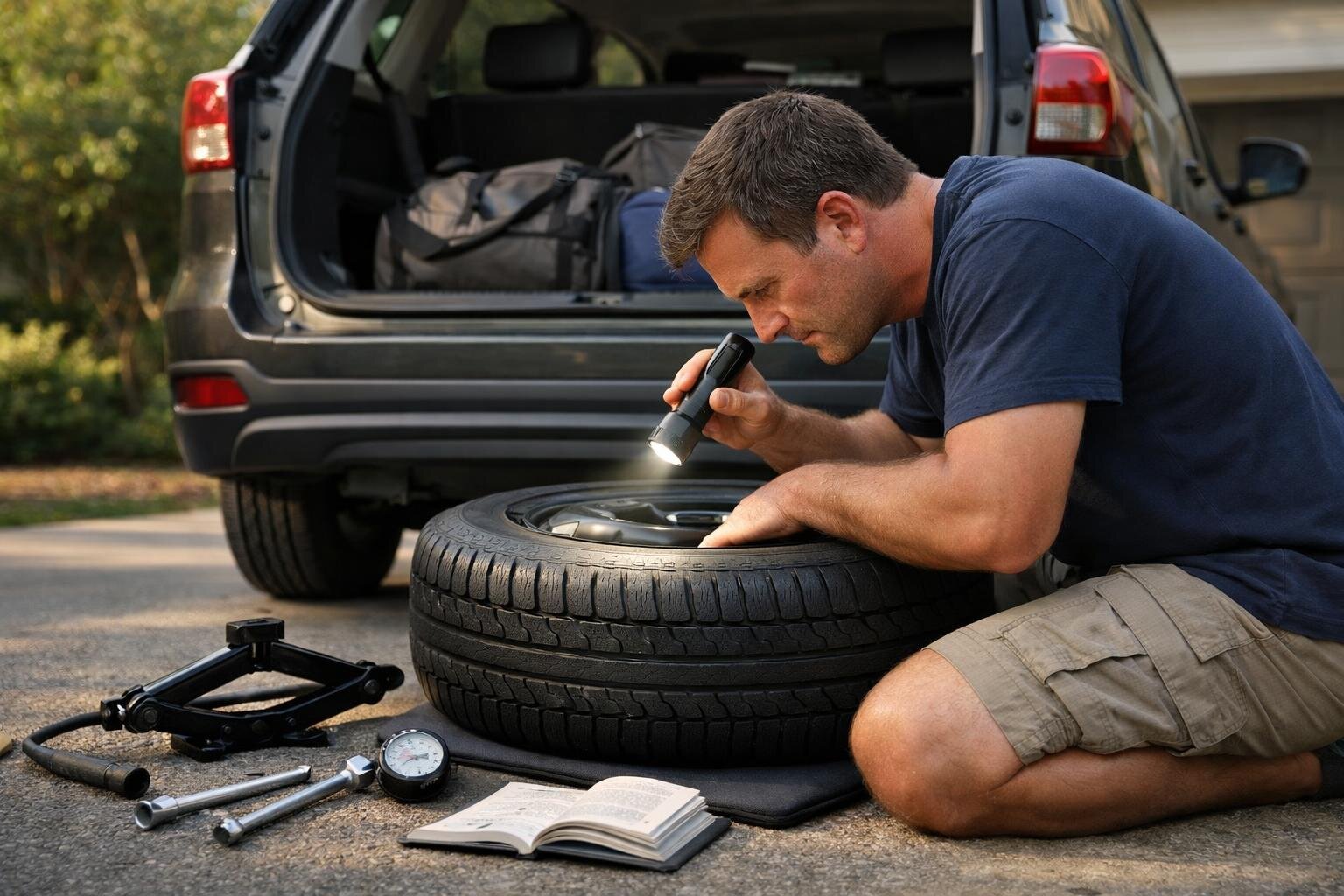
Why spares get ignored (until the worst moment)
Most of us treat the spare tire like a smoke alarm. We assume it is “there,” and we only think about it when something goes wrong. The spare lives under the cargo floor, on a rear door, or slung under the vehicle where you never see it. It never gets rotated. It never gets washed. On many cars, it is a compact “donut” that looks more like a placeholder than a real tire.
That’s exactly why spare-tire checks matter before a summer road trip. Heat, highway speeds, and extra load from luggage can expose weak points fast. And if your main tire fails in the middle of nowhere, the spare is not a nice-to-have. It is your plan A.
One more twist: your spare might be older than you think. Even if the tread looks new (because it basically is), rubber ages. NHTSA’s tire-safety guidance emphasizes basics like keeping tires properly inflated, checking tread and condition, and paying attention to aging and damage. A spare that has been sitting for years can be underinflated, cracked, or simply not something you want to trust at speed.
The quick facts: what you can verify on almost any spare
Here’s what’s widely known and easy to confirm without guessing:
1) Tire age is printed on the tire. In the U.S., tires carry a Department of Transportation identification code (the “DOT” code). The last four digits tell you the week and year the tire was made.
2) Pressure matters, and spares lose air too. Tires naturally leak small amounts of air over time. NHTSA’s tire-safety materials stress maintaining proper inflation and checking tires regularly. Your spare is still a tire, even if it never touches the road.
3) Compact spares have limits. Many temporary spares are designed for short distances and lower speeds. The exact limits vary by vehicle and tire, so you should verify in your owner’s manual and on the spare’s sidewall labeling rather than relying on a one-size-fits-all rule.
4) Tools are part of the system. A perfect spare does not help much if your jack is missing, your lug wrench does not fit, or your wheel-lock key is lost.
How to read tire age (DOT code) in plain English
The DOT code is molded into the sidewall. On some tires it is easy to spot; on others you may need to roll the spare a bit or use a flashlight because part of the code can be on the inward-facing sidewall.
Look for “DOT” followed by a string of letters and numbers. The part you care about most is the last four digits.
Example: If the last four digits are 2621, that means the tire was made in the 26th week of 2021. If it reads 0518, that’s the 5th week of 2018.
If you find only three digits at the end, that usually indicates an older format used decades ago, which is uncommon on vehicles still in normal service. If you run into anything confusing or partially missing, treat it as a reason to get a professional opinion rather than guessing.
No universal “expiration date.” You will hear people throw out a single number of years as an absolute cutoff. Real-world guidance varies by manufacturer, usage, storage conditions, and inspection results. The safe move is to use age as a trigger for closer inspection and for a conversation with a tire shop if your spare is getting up there in years or shows any deterioration.
Aging signs: what matters even if tread looks brand-new
The weird thing about spares is that they often have plenty of tread because they have barely been used. That can lull you into trusting them. Condition matters just as much as tread depth.
Do this with good light and a slow walk around the tire:
Check for cracking (dry rot). Look closely at the sidewall and between tread blocks for small cracks or a webbed pattern. A few tiny surface lines can appear with age; deeper cracks are more concerning.
Look for bulges or bubbles. Any swelling on the sidewall can suggest internal damage. That’s not something you want to discover after mounting it on the shoulder of I-80.
Inspect for cuts, punctures, or exposed cords. Spares can get damaged in storage by sharp edges, road debris if they are mounted underbody, or even improper handling during previous use.
Check bead area wear. If someone mounted and dismounted it before (or drove it flat), look around the bead area for scuffs or tearing.
If any of these issues show up, don’t talk yourself into “it’ll probably be fine.” A spare is supposed to reduce risk when things go sideways, not add another variable.
Pressure: check it cold (and don’t trust your TPMS)
Your Tire Pressure Monitoring System (TPMS) may not reliably warn you about an underinflated spare because many vehicles do not monitor pressure in the spare at all. Even when TPMS covers all four road tires, that does not automatically mean it covers the fifth one.
The practical habit: check pressure when the tire is cold, meaning before driving or after the car has been parked for several hours. Use an inexpensive gauge you trust and compare your reading to what your vehicle specifies.
Where to find correct pressure:
The driver’s door jamb placard lists recommended pressures for normal tires (and sometimes for spares). Your owner’s manual may have additional notes for temporary spares.
The spare tire sidewall may list its own inflation pressure requirement if it’s a compact spare or has special construction. Follow vehicle guidance first when there’s any confusion; if you cannot reconcile them quickly, call a dealer parts department or tire shop with your VIN before you leave town.
A small but real summer-road-trip detail: if you pack heavy (coolers, luggage, extra passengers), correct inflation becomes more important across all tires. Underinflation builds heat at highway speed. Heat is not your friend here.
Tread: yes, check it anyway
If your spare is full-size and meant to be driven like a normal tire (again, verify via owner’s manual), tread depth matters just like any other tire because you might be on it longer than planned while waiting for a replacement.
If your spare is temporary, tread depth still matters because it affects traction in rain and stability while you limp to safety or a repair shop.
You do not need fancy tools to get value out of this check:
Scan for uneven wear, which could hint at prior use with improper inflation or misalignment issues from its last stint on the car.
Confirm there’s no embedded debris, especially if it has ever been used and then stored without inspection afterward.
Storage location matters more than people think
A spare stored inside the trunk well lives an easier life than one hanging under an SUV where it gets blasted with water, salt, grit, and temperature swings. That doesn’t automatically make an underbody spare unsafe; it just means you should expect more grime and potentially more corrosion on hardware that holds it in place.
If your spare mounts underneath:
Make sure you can actually lower it. Crank mechanisms can seize over time. Try lowering it at home first so you are not fighting rusted hardware while cars whip past on a narrow shoulder.
Check for sidewall scuffing from contact with brackets or shields.
The tool check: jack, lug wrench, wheel-lock key, and instructions
This part feels boring right up until it saves your trip.
Confirm these items are present:
The jack, plus any handle extensions needed to operate it.
The lug wrench, including any adapters specific to your vehicle.
Your wheel-lock key, if your wheels use locking lug nuts. People lose these constantly because they get tossed in gloveboxes during tire rotations and never returned to their spot.
The tow hook, if your vehicle stores one with roadside tools (varies by car). This matters if you end up needing a tow out of sand or snow rather than just changing a flat.
Your owner’s manual instructions. Many cars have specific jack points that are easy to miss when you’re stressed or working at night with a phone flashlight clenched in your teeth. A quick skim now beats guessing later and damaging rocker panels or underbody covers.
If you want one low-cost upgrade that pays off: toss in work gloves and a small kneeling pad (or even an old towel). Changing a tire on hot asphalt in July is uncomfortable fast, and comfort affects how carefully you work around traffic.
If your car didn’t come with a spare (it happens)
A growing number of vehicles ship without a traditional spare tire; some come with sealant kits instead. If that’s your situation, read what came with your car and decide whether it matches how you travel.
A sealant kit can be useful for certain punctures in the tread area; it may not help with sidewall damage or larger tears. I’m not going to pretend every driver needs to buy an aftermarket spare setup because costs and packaging vary wildly by vehicle. But if your summer travel includes long rural stretches or late-night driving where help takes time, having some kind of realistic plan matters. That might be roadside assistance coverage plus verifying your kit is unexpired and complete. Or it might mean sourcing an OEM-style spare kit if one exists for your model (a dealer parts counter can tell you what fits).
A note on driving on a temporary spare (donut)
This is where people get into trouble by treating the donut like “a normal tire.” Many temporary spares are clearly labeled with speed and distance limits. Those limits vary; don’t assume they’re identical across brands or vehicles.
Your safest play before leaving town:
Read what’s printed on your spare’s sidewall.
Check your owner’s manual for restrictions such as maximum speed, maximum distance, whether it can be used on certain axles only, and whether traction-control or AWD systems require special handling when running mismatched tires.
If anything conflicts or seems unclear, verify with a dealer service advisor or reputable tire shop before your trip. It costs nothing but time compared with shredding a temporary spare on an interstate because you assumed it could do more than it was designed for.
The simple pre-trip checklist (5 minutes that actually changes outcomes)
If you only do one thing this week, do this in daylight in your driveway:
1) Find the DOT date code on the spare, write down the last four digits (week/year), and take one clear photo of each sidewall condition issue you see (if any).
2) Check cold pressure on all four tires plus the spare. Inflate to vehicle-recommended specs using an air compressor at home or at a gas station pump that reads accurately (many don’t). Recheck after filling because gauges vary.
3) Inspect condition: cracks, bulges, cuts, punctures, missing valve cap (small part, big annoyance).
4) Confirm tread isn’t compromised, especially if that spare has been used before.
5) Verify tools are present and usable: jack works smoothly; lug wrench fits; wheel-lock key present; underbody-spare lowering mechanism moves freely if equipped; owner’s manual instructions are accessible offline (paper manual or downloaded PDF).
If something looks off: what most drivers should do next
If your spare shows cracking, bulging, obvious damage, won’t hold air properly, or appears very old based on its DOT code and storage history, treat that as actionable information rather than trivia.
A sensible next step for many budget-minded owners is to stop by an independent tire shop and ask them to inspect the spare specifically. It’s usually quick compared with diagnosing intermittent car problems. If replacement makes sense financially, ask about value-focused options that match what your vehicle actually needs: full-size versus temporary compatibility depends on wheel size, brake clearance, and storage space available in your car. Those details are vehicle-specific; guessing can waste money fast.
The bottom line: don’t let “unused” fool you
A spare can look perfect because it has never touched pavement. That doesn’t mean it’s ready for August heat on I-95 with a trunk full of gear. Reading the DOT date code takes seconds once you know where to look; checking cold pressure takes another minute; confirming tools are present saves real frustration later.
If you’re trying to keep running costs predictable (and who isn’t), this is one of those rare car chores that costs almost nothing but can prevent towing bills, missed hotel check-ins, and that sinking feeling when you realize your backup plan was never really there at all.
0 comments
Join the discussion around this article.
Please login to comment.