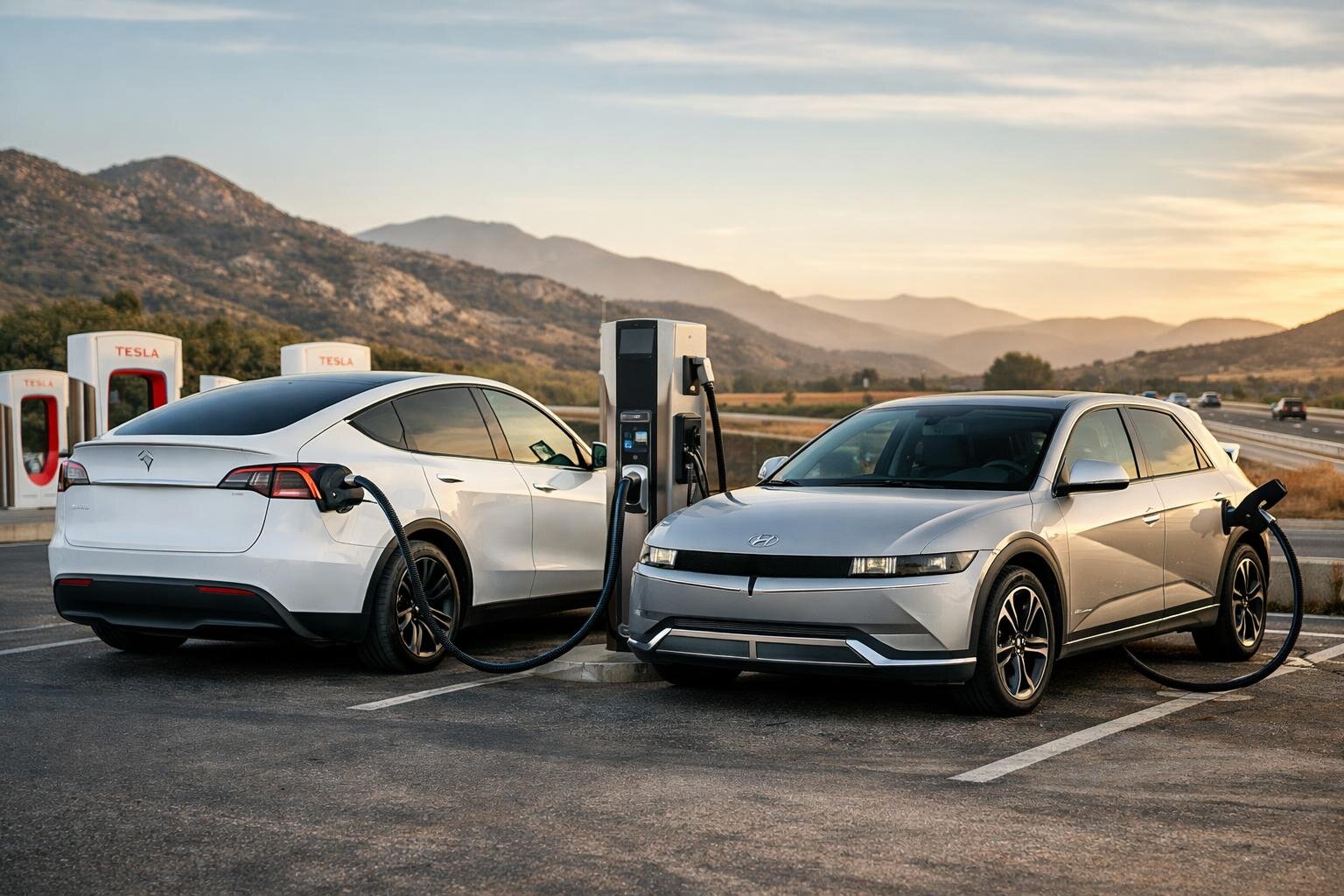
The one sentence verdict, depending on your life
If you road trip a lot or you do not want to think about charging apps and stall availability, the Tesla Model Y is still the easiest family EV to live with because of Tesla’s Supercharger ecosystem. If your day-to-day is school runs, errands, and sitting in traffic and you care more about ride comfort and a lounge-like cabin, the Hyundai Ioniq 5 tends to feel more relaxed and human. If you are truly split, pick based on charging access where you actually drive, then let seating and controls break the tie.
Reality check first: 2026 details are still moving
You asked this through a 2026 lens, and that matters because EV charging standards are in transition. Tesla uses the North American Charging Standard (NACS) connector on its vehicles in the US. Hyundai’s Ioniq 5 has been sold with a CCS port in the US, but Hyundai has publicly committed to adopting NACS for future EVs and providing NACS adapters for many existing owners. Exactly how that plays out for the 2026 model year Ioniq 5 depends on build date and trim, and it can vary by market. Before you sign anything, confirm what port is physically on the car and what fast charging networks it can access without workarounds.
EPA range and efficiency numbers also vary significantly by trim, drivetrain, and wheel size on both vehicles. The Model Y lineup has included Long Range and Performance variants in recent years. The Ioniq 5 lineup has included single-motor rear-wheel drive (RWD) and dual-motor all-wheel drive (AWD) versions with different battery sizes depending on model year. Because 2026 EPA listings can change and not every trim’s figures may be published when you shop, treat any range claim as trim-specific and verify it on the EPA window sticker or the official EPA site for that exact configuration.
Charging ecosystem: where the Model Y makes your life simpler
Here’s the plain truth I hear from families who buy EVs in Los Angeles: most people love driving electric, but they hate uncertainty. That is where Tesla has built its advantage.
Tesla Model Y: You get a NACS port and native access to Tesla’s Supercharger network. The practical benefit is not just speed. It is consistency: plug in, payment is tied to your Tesla account, and the car’s navigation is built around Supercharger routing. In typical ownership, that reduces friction on road trips because you are less likely to juggle multiple apps or wonder whether a station is online.
Hyundai Ioniq 5: With a CCS-equipped vehicle, public fast charging typically means using third-party networks (Electrify America, EVgo, ChargePoint fast chargers where available, and others). Those networks can work well, but the experience depends heavily on location, maintenance, and how seamless payment is at that specific station. Hyundai’s move toward NACS compatibility is a big deal because it can open up more charging options, including access to many Tesla Superchargers via adapter or native NACS ports on newer builds. The catch is that access rules can be network-specific, station-specific, and time-specific. Verify whether the exact Ioniq 5 you are buying includes a NACS port or requires an adapter for NACS fast chargers, and confirm which networks are supported.
Your week lens: If you live in an apartment or rely on public charging several times a week, Tesla’s integrated ecosystem often feels like less mental load. If you charge at home most of the time and only fast charge on occasional trips, the gap narrows because both cars can start every morning “full” if your home setup supports it.
Home charging: both are easy if your parking situation is real
For many families, home charging is the make-or-break factor. Both vehicles support Level 2 charging at home with a 240-volt circuit when paired with appropriate equipment. The install details depend on your electrical panel capacity, distance to the parking spot, whether you need permits, and whether your HOA or landlord will cooperate. Those variables matter more than brand.
The difference comes down to connector standard and what you want hanging on your garage wall. A Tesla wall connector uses NACS by default. Many non-Tesla home chargers use J1772 (common for Level 2), which works great for an Ioniq 5 with no adapter if it has CCS (CCS cars use J1772 for Level 2). A Tesla can also charge from J1772 with an adapter (Tesla has long offered one). As NACS becomes more common across brands, you will see more home equipment options that match either approach.
If your household has mixed EV brands now or you think it might later, it is worth choosing a home charger strategy that will not annoy Future You. Sometimes that means picking a charger with swappable cables or planning for adapters rather than locking yourself into one connector forever.
Cabin comfort: this is where the Ioniq 5 earns its keep
The Ioniq 5’s design has always leaned into airy space and clean lines. Even without quoting interior dimensions here (they vary by year and spec sheet source), the visual impression is consistent: a low dash, open sightlines, and a sense of width up front that feels more living room than cockpit. Physical controls also tend to be more present in Hyundais than in Teslas, which matters when you are juggling coffee cups and kid questions at a stoplight.
The Model Y goes in the opposite direction: minimalist to the point of being stark. Almost everything routes through the center touchscreen. Some drivers love that because it feels modern and uncluttered; others find it annoying because basic tasks like adjusting vents live inside menus instead of under your fingertips. For family duty, that can be either calming or distracting depending on your tolerance for screen-first interaction.
Seats and comfort: Comfort is subjective, but there’s a pattern: buyers who prioritize cushy ride quality often gravitate toward the Ioniq 5’s vibe; buyers who prioritize efficiency-focused design and tech integration often accept the Model Y’s firmer edge. Wheel size also matters on both cars since larger wheels generally bring sharper impacts over broken pavement.
Kid logistics: Both offer two-row seating with room for child seats; both have LATCH anchors as required. The difference tends to be ergonomics rather than raw space: door openings, seat height relative to curbside loading, rear floor shape, and how easy it is to reach buckles without contorting your wrist. These are “bring your car seat to the dealer” moments.
Cargo space: useful shapes beat big numbers
Tesla loves packaging efficiency, and the Model Y benefits from it. You typically get a rear cargo area plus a front trunk (frunk), which is genuinely handy for separating messy items from groceries or keeping charging gear out of your main load bay.
The Ioniq 5 does offer front storage too (often smaller), but its real trick is cabin openness and flexible storage throughout the interior depending on trim features. What matters in daily life is how easy it is to slide in a stroller without playing Tetris around an aggressively sloped hatch line or high load floor.
If cargo volume numbers are important to you (and they should be if you pack like a family), check the manufacturer spec sheet for the exact model year because measurement standards differ between brands and publications. The “bigger” car on paper does not always feel easier at Costco.
Driving feel: calm confidence versus quick reactions
Both vehicles deliver what EVs do best: instant response around town. No waiting for downshifts; just press and go.
Power: Output varies widely by trim. The dual-motor versions of both vehicles are quick enough that merging onto a freeway feels effortless. Tesla publishes performance claims prominently; Hyundai’s published specs depend on trim level (RWD versus AWD). Rather than chase one number here without locking to an exact trim, treat this as practical guidance: if you care about straight-line punch for short freeway gaps or passing uphill with a full load of people, choose an AWD variant of either vehicle and verify horsepower output on that window sticker.
Steering and road behavior: The Model Y tends to feel more immediate off-center with quick responses that read as sporty to some drivers and busy to others over rough pavement. The Ioniq 5 often comes across as more relaxed in its primary controls with an emphasis on calm cruising rather than constant feedback through your hands. Neither approach is “right,” but if your daily route includes cratered city streets or long stretches of freeway expansion joints, ride tuning becomes part of your mental health plan.
Noise: EVs make wind noise and tire noise more noticeable because there’s no engine soundtrack masking everything else. Tire choice matters a lot here; so does wheel size; so does how much sound insulation each manufacturer chose to add at a given price point.
Towing: check trims carefully before you assume anything
This one catches people off guard because crossovers look capable even when they are not configured for towing.
Tesla Model Y: In the US market, Tesla has offered towing capability via an available tow package on certain Model Y variants; widely cited capacity is up to 3,500 pounds when properly equipped (always confirm current-year specs). If towing matters even occasionally (small trailer, lightweight camper), make sure the car actually has the hitch hardware and software settings enabled as delivered.
Hyundai Ioniq 5: Towing capability exists but varies by configuration and market rules; published ratings differ by drivetrain and model year in official documentation. Because this changes over time and can be sensitive to equipment requirements like trailer brakes or hitch type, verify towing rating directly from Hyundai’s owner documentation or spec sheet for your exact trim before buying based on towing alone.
Efficiency and range: why wheel size quietly decides your road trip mood
Both vehicles have EPA-rated range figures that shift with drivetrain choice (RWD usually goes farther than AWD) and wheel size (smaller wheels usually help range). That sounds obvious until you see how many cars sit on dealer lots wearing bigger wheels because they look better under showroom lights.
The Model Y has built a reputation for strong efficiency relative to its size in EPA testing across recent model years; it often translates into fewer stops per mile traveled when compared with similarly sized EV crossovers depending on configuration. The Ioniq 5 can be very competitive too, especially in RWD form with smaller wheels where available.
If you are shopping in 2026 specifically, pull up EPA figures for each exact configuration you are considering rather than comparing “Model Y” versus “Ioniq 5” as if they were single vehicles. If EPA figures for a newly updated trim are not yet released at purchase time, treat any estimate as provisional until official numbers land.
Tech experience: Tesla wins simplicity; Hyundai wins normal-human controls
Tesla: The software experience is cohesive because Tesla controls most of the stack: navigation tied closely to charging planning; frequent over-the-air updates; phone-as-key convenience; app-based climate preconditioning that feels made for real life when it’s hot out or when you want to cool the cabin before school pickup. The tradeoff is dependence on your account ecosystem plus doing many tasks through one screen interface.
Hyundai: Hyundai’s infotainment approach feels more traditional with familiar menus plus physical buttons where many drivers want them most (volume, climate adjustments). Over-the-air update capability exists in modern Hyundais but feature scope varies by model year and system; verify what updates apply to infotainment versus broader vehicle functions for your specific build.
Driver assistance: Both brands offer driver assistance features such as adaptive cruise control and lane-keeping support depending on trim packages. Tesla markets Autopilot features heavily; availability includes standard Autopilot with optional upgrades depending on purchase choices at time of sale (and those offerings have evolved). Hyundai offers its own suite under names like Highway Driving Assist depending on trim level. Because feature names do not guarantee identical behavior across years or software versions, test them yourself on a familiar route before committing if this is high priority.
Ownership factors: price swings, maintenance basics, resale reality
Price: MSRPs move around year-to-year and incentives can reshape monthly payments overnight. Tesla pricing also changes more dynamically than traditional automakers at times. Hyundai pricing depends on trim strategy plus dealer practices in your area. For factual accuracy here without locking into numbers that may shift by week in 2026: compare official MSRP from each automaker plus destination fees as listed at time of purchase; then compare actual out-the-door quotes from multiple sellers if possible.
Maintenance: Both are EVs so routine maintenance usually centers around tires, brake fluid checks at specified intervals per owner’s manual, cabin air filters, windshield washer fluid, alignment if roads punish you (hello LA), plus occasional brake service even though regenerative braking reduces wear for many drivers. There is no engine oil service schedule because there is no engine oil.
Warranty: Hyundai has been known in the US market for long warranty coverage including powertrain terms (confirm current-year details directly from Hyundai since terms can change). Tesla’s vehicle warranty structure differs; confirm current coverage from Tesla documentation for model year 2026 specifics including battery and drive unit coverage periods.
Resale: Resale value depends heavily on broader EV market conditions including incentives for new cars plus interest rates plus how quickly new battery tech arrives. Historically Teslas have had strong demand in many regions due partly to brand recognition and Supercharger access; however resale values across EVs have seen volatility as pricing adjusts industry-wide. Treat any blanket resale promise skeptically; look at current used listings locally when you buy new because they tell you what depreciation pressure looks like right now.
A quick “window sticker watch list” before you choose
If you only remember one shopping tip: do not buy either vehicle based solely on nameplate. Verify these items line-by-line for the exact car sitting in front of you.
On any Model Y: battery/range figure shown on Monroney label if applicable; wheel size; whether it includes tow package if needed; which driver assistance features are included versus optional purchases; tire type (range-focused tires can change feel).
On any Ioniq 5: whether it has CCS or NACS port; whether any NACS adapter is included; which driver assistance suite level it has; wheel size; AWD versus RWD; any feature deletions or additions tied to mid-cycle updates.
If your priority isn’t these two cars
(a) Cheapest miles: Look beyond brand loyalty toward whichever configuration offers higher EPA efficiency for your needs plus access to reliable low-cost home charging where you park every night. In practice that often points toward efficient trims with smaller wheels rather than performance variants.
(b) Most space: If third-row flexibility matters sometimes but not always, compare other compact-to-midsize EV crossovers carefully because two-row cargo shapes vary wildly even when exterior sizes look similar. Also consider three-row EVs if budget allows since neither of these is fundamentally built around adult third-row comfort.
(c) Best driver assist: Cross-shop based on how systems behave in real traffic rather than marketing names alone. Many shoppers also compare alternatives like Ford Mustang Mach-E or Kia EV6 depending on priorities (and yes, some buyers still land on plug-in hybrids if their charging situation isn’t stable yet).
The bottom line: ecosystem versus atmosphere
If charging reliability across long distances feels like the stress point in your family calendar, the Model Y remains hard to argue against simply because Tesla built an end-to-end system around making fast charging feel normal.
If what wears you down is daily friction inside the car itself, stiff ride edges over scarred pavement or screen-heavy controls when you just want to change fan speed without thinking about it then the Ioniq 5 makes a persuasive case as the comfier place to spend real hours.
The best answer in 2026 might be less philosophical than people want it to be: choose based on which plug standard shows up at your favorite stations along your most common routes, then pick whichever cabin makes you exhale when you sit down.
0 comments
Join the discussion around this article.
Please login to comment.