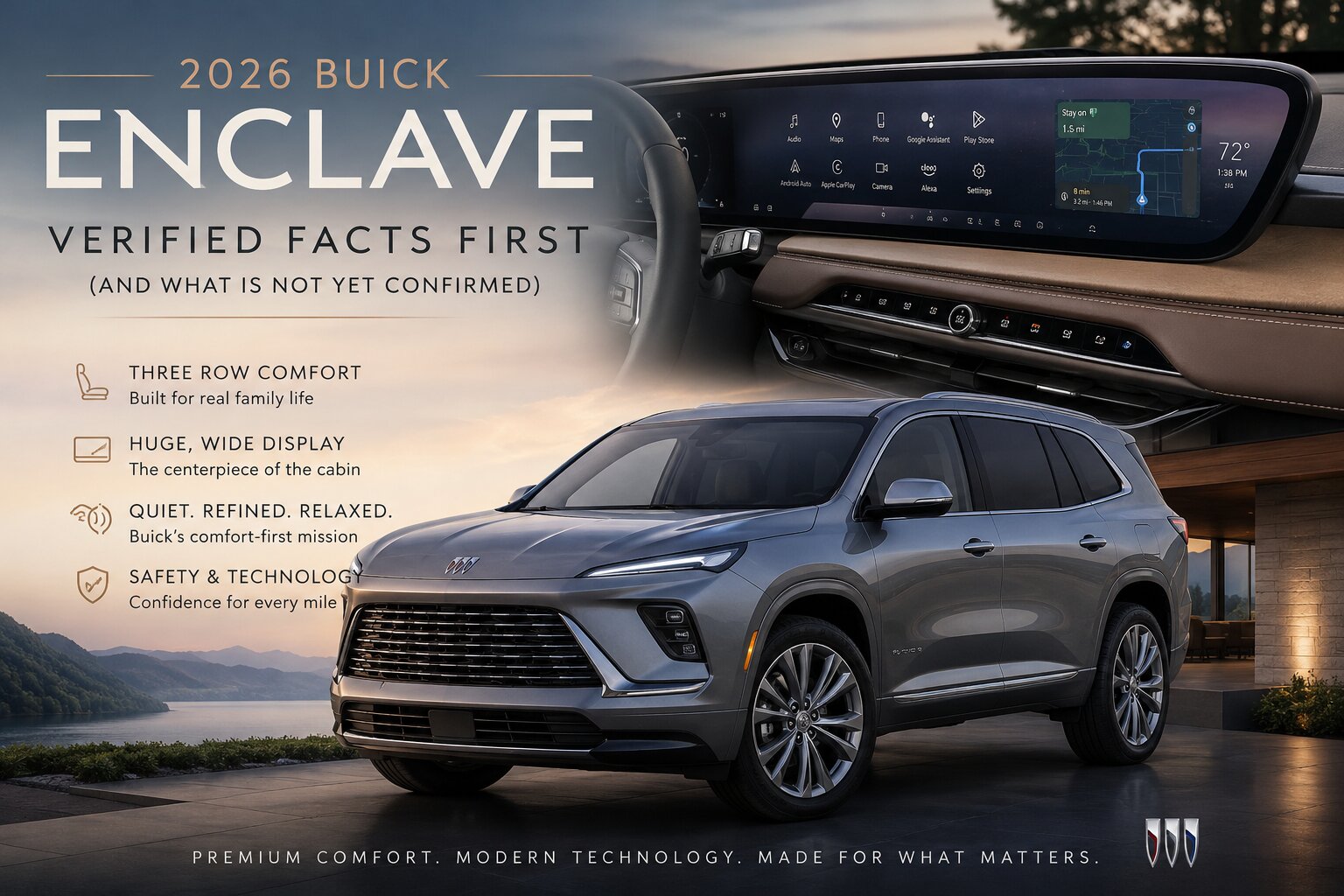
Verified facts first (and what is not yet confirmed)
Buick’s Enclave is a three row, midsize crossover SUV aimed at families who want a quieter, more comfort focused alternative to mainstream nameplates. For the 2026 model year, Buick has publicly emphasized a cabin dominated by a very large, wide format infotainment display. Buick has also positioned the Enclave as a premium leaning sibling to more mainstream GM crossovers, with an emphasis on isolation, a calm ride, and upscale design cues rather than overt sportiness.
That said, some of the details shoppers often want most are not consistently available in a single, universally accessible place at the time of writing. Depending on when you read this and which official Buick page you land on (overview pages, trim pages, or downloadable PDFs), you may find certain specifications clearly stated and others not. I am not going to guess. Where key numbers like horsepower, torque, towing capacity, cargo volume, wheelbase, or EPA fuel economy are not explicitly confirmed on Buick’s official 2026 Enclave pages, I will call that out directly.
What can be stated confidently from widely known context is the Enclave’s competitive set and mission. It sits in the heart of the U.S. three row crossover market alongside vehicles like the Acura MDX, Audi Q7 (more expensive), Genesis GV80 (also more expensive in many configurations), Infiniti QX60, Lexus TX (newer entrant), Lincoln Aviator (different character and often higher price), Mazda CX 90, Hyundai Palisade, Kia Telluride, Toyota Grand Highlander, Honda Pilot, and Ford Explorer. Some of those lean sporty, some lean value packed; Buick’s lane has traditionally been quiet comfort with a near luxury vibe.
The headline: three rows plus one huge screen
The title feature for 2026 is the screen. Buick’s recent design direction has moved toward large, integrated displays that sit high on the dash and stretch across the driver’s field of view in a way that feels more like a modern EV cockpit than an old school SUV stack. In family use, that matters less for wow factor and more for ergonomics: how quickly you can change audio sources while negotiating a school pickup line, how clearly navigation is presented when you have a full cabin and a noisy conversation behind you, and whether climate controls are easy to find without taking your eyes off the road.
A very large display can be a blessing or an annoyance depending on execution. The blessing is obvious: larger map tiles, clearer camera views when parking, and less squinting at small icons. The annoyance tends to show up when basic functions are buried in menus or when glossy surfaces catch sunlight at exactly the wrong angle. Buick’s official materials emphasize the screen’s size and presence; they do not always spell out how many physical controls remain for climate or audio across every trim level. If you are shopping trims in person, pay attention to how much of your daily interaction still happens through hard keys and knobs versus touch menus.
Design and presence: premium without trying too hard
Enclave shoppers are often people who have done the minivan debate already and decided they want an SUV shape for image or driving position reasons. For those buyers, exterior design matters more than it does on paper. Buick’s recent styling language favors clean surfacing and crisp lighting signatures rather than busy grilles or exaggerated vents. It reads upscale in traffic without looking like it is chasing performance credibility.
This approach also tends to age well. A three row family vehicle lives outside in driveways and school lots for years; restrained shapes usually look less dated after five winters than trend chasing bodywork. The flip side is that if you want your premium SUV to broadcast status loudly, rivals from Lexus or some German brands can feel more overtly prestigious.
Cabin layout for actual families
Three row crossovers succeed or fail on small daily interactions: where you drop your phone when your hands are full of snacks, whether cupholders fit real American water bottles, and how easily adults can climb into the third row without performing yoga.
Second row access: Most vehicles in this class offer either second row captain’s chairs or a second row bench depending on trim and option packages. Buick typically follows that playbook. The key family question is whether you can access the third row with a child seat installed in the second row. Many competitors struggle here because tilting mechanisms get blocked by child seat anchors or seatbelt routing. Buick’s official trim pages should spell out seating configurations by trim; verify in person by physically trying the slide or tilt mechanism with your own child seat if possible.
Third row comfort: In this segment, “adult friendly third row” often means “adult tolerable for short trips.” Vehicles like the Honda Pilot and Toyota Grand Highlander have earned reputations for making better use of space back there than many rivals; others feel tighter at knees and feet even if they technically seat seven or eight. Without verified third row legroom numbers from official 2026 Enclave documentation in front of us here, it would be irresponsible to claim class leading space. What can be said is that Enclave’s mission has historically been family comfort first; if Buick prioritized packaging well, the third row should be usable for kids day to day and occasional adults depending on seating position and how far forward the second row is set.
Cargo loading: For many owners, cargo height matters as much as cargo volume. A low load floor makes strollers easier; a wide opening reduces frustration when loading bulky sports gear. This is also where three row SUVs differ from minivans: you usually lift higher and reach farther into an SUV shaped opening. If you routinely carry heavy items like folding wagons or big coolers, check whether the Enclave offers convenient underfloor storage and how flat the folded seats lie.
Screen ergonomics: big glass is only half the story
A huge display changes how you interact with everything else. It can improve camera visibility in tight parking lots and make lane guidance easier to parse at highway speeds. It can also tempt manufacturers into moving too many controls into software.
In typical family use there are four recurring tasks: changing temperature quickly when kids complain from the back; muting audio for drive through orders; switching between navigation and audio without losing your place; and engaging camera views while creeping into tight school parking spaces.
If Buick retains physical climate toggles or shortcut buttons around that screen (this varies widely by brand), that helps reduce distraction. If it goes heavy on touch sliders or nested menus instead, expect a learning curve during the first few weeks of ownership. Before committing to any trim level, spend ten minutes in the driver’s seat with the vehicle stationary and run through those tasks as if you were in traffic.
Powertrain and performance: what we can say without guessing
For 2026 specifically, confirm engine output figures directly on Buick’s official Enclave specifications page or its downloadable spec sheet because those numbers matter for towing confidence and merging behavior. Historically in this segment there are two common approaches: naturally aspirated V6 engines tuned for smoothness (as seen in several Japanese rivals) and turbocharged four cylinders tuned for torque (common among newer designs). GM has used both strategies across its lineup over time depending on platform generation.
If your shopping list includes regular mountain driving with a full cabin or frequent towing of small campers or boats, do not accept vague assurances from marketing copy alone. Look up official horsepower and torque figures for your chosen trim level, then compare them against direct competitors like the Honda Pilot V6 (known quantity), Mazda CX 90 (torque rich turbo options), Toyota Grand Highlander (including hybrid options), Hyundai Palisade V6 (smooth but not sporty), and Acura MDX (more performance oriented tuning).
Ride comfort and isolation: where Buick usually earns its keep
Buick’s modern brand promise leans heavily on quietness and ride composure rather than sharp handling. That fits family reality: most three row SUVs spend their lives commuting at suburban speeds with occasional highway trips where wind noise becomes fatiguing after two hours.
A calm ride comes from several ingredients: suspension tuning that filters broken pavement without bobbing over highway undulations; tires chosen for low noise rather than maximum grip; body structure stiffness; extensive sound deadening; and careful sealing around doors and glass.
If Buick delivers on that brief for 2026, it will feel different from some rivals immediately. A Mazda CX 90 tends to communicate more road texture because it chases driver engagement. A Kia Telluride or Hyundai Palisade often strikes an excellent balance but can vary by wheel size; larger wheels tend to add impact harshness over potholes. An Acura MDX feels more athletic but may transmit more tire noise depending on tire choice.
The Enclave should appeal to buyers who want their family vehicle to feel like a quiet room rolling down the interstate. If you test drive one back to back with sportier alternatives you may notice less steering chatter and fewer sharp impacts over patched pavement. That is usually what Buick buyers want.
Handling: stability first
No three row crossover hides its mass completely; physics wins eventually when you hustle through an off ramp with seven people aboard. What matters is predictability: stable braking feel with a loaded cabin, consistent steering response at highway speeds, and body control that does not make passengers carsick on winding roads.
Without verified details about suspension hardware by trim (for example whether adaptive dampers are available on certain trims), it is safest to frame expectations this way: expect competent composure rather than sports sedan reflexes. If Buick offers different wheel sizes across trims, remember that larger wheels often look better but can reduce ride plushness over rough city pavement.
Visibility and parking lot reality
The modern three row SUV suffers from two conflicting trends: higher beltlines and thicker pillars for crash standards on one hand, larger vehicles navigating tighter parking lots on the other. That makes camera systems less of a luxury feature and more of a daily tool.
The good news about a massive screen is that it can make backup camera views easier to interpret quickly. The question becomes camera quality rather than screen size alone: resolution at night under parking lot lights, lens distortion near curbs, how quickly the image appears after shifting into reverse, and whether guidelines are intuitive.
Also pay attention to front corner visibility when pulling into angled spaces between large pickups. Some rivals provide excellent surround view systems depending on trim; others reserve them for top trims only. Confirm availability directly against Buick’s official 2026 trim equipment listings because this feature often shifts year to year.
Second row living: captain’s chairs versus bench
This choice shapes daily life more than most buyers expect.
Captain’s chairs: Usually easier walk through access to the third row if there is an open aisle between seats; often more comfortable for older kids because each gets their own space; sometimes fewer total seats depending on configuration.
Bench: Better if you need maximum seating capacity; sometimes better cargo flexibility if you fold sections independently; often trickier third row access when child seats are installed outboard.
The right answer depends on your household routine: carpools favor maximum seats; families with two kids often prefer captain’s chairs because it reduces arguments about personal space.
Third row realities: heat management matters
The third row experience is not only about legroom. It is also about airflow and temperature control during summer road trips when sun loads hit rear glass areas hard.
If Buick equips rear passengers with dedicated vents (typical in this class) that helps keep peace on long drives. If rear climate controls are available only on certain trims or packages (common practice), confirm before buying because retrofitting comfort later is not realistic.
Materials quality: where near luxury earns its price premium
A Buick has to justify itself against well equipped mainstream alternatives that offer plenty of features for less money (without discussing pricing specifics here). That justification usually comes down to tactile quality: softer touch points where elbows rest; quieter door closures; less cheap gloss plastic in high traffic areas; stitching that looks consistent rather than decorative.
This is also where some competitors excel unexpectedly. A top trim Kia Telluride can feel convincingly upscale inside even if its badge says mainstream brand. A Lexus TX leans heavily into soft materials but trades some sporty feel for comfort calmness similar to Buick’s likely approach.
Technology beyond the big screen
The big display will dominate showroom impressions but daily satisfaction depends on smaller details:
Phone integration: Confirm Apple CarPlay and Android Auto support as listed on official 2026 Enclave pages because this is still non negotiable for many U.S. buyers who live inside Google Maps or Waze.
Wireless charging: Useful but only if it fits larger phones securely without overheating them during long navigation sessions.
User profiles: Helpful if multiple drivers share the vehicle because seat position memory plus infotainment preferences reduce friction during morning handoffs.
Safety systems: confirm what is standard versus optional
This segment has largely standardized core driver assistance features such as automatic emergency braking and lane keeping support across many brands, but availability still varies by trim level and package selection.
The correct way to shop here is boring but effective: open Buick’s official 2026 Enclave trim comparison tool (or PDF) and verify which safety features are standard across all trims versus bundled into options packages. Then compare that list against rivals like Honda Pilot (often generous standard safety content), Toyota Grand Highlander (Toyota Safety Sense suite), Hyundai Palisade (feature rich but package dependent), Mazda CX 90 (varies by trim), Acura MDX (premium safety tech but sometimes tied to higher trims).
If crash test ratings from NHTSA or IIHS are available for 2026 Enclave specifically at time of purchase, use those sources directly rather than relying on older model years or related vehicles as proxies. If ratings are not yet published early in a model year cycle, treat any claims about “top safety” as unverified until ratings appear.
Towing and hauling: do not buy blind
A three row SUV often ends up towing something eventually even if it was not part of the original plan: a small utility trailer during a move, jet skis borrowed from relatives, or rental trailers for home improvement runs.
Towing capacity varies dramatically within this class depending on engine choice, cooling hardware, drivetrain configuration (front wheel drive versus all wheel drive), axle ratios where applicable, and whether a factory tow package is installed.
I cannot responsibly quote an official tow rating here without referencing Buick’s published 2026 specifications directly because tow ratings are easy to misstate by model year or configuration. If towing matters at all in your household plan, verify these items before signing paperwork:
1) Maximum tow rating for your exact configuration.
2) Whether that rating requires an optional tow package.
3) Payload rating on the door jamb sticker once you find an actual vehicle on a dealer lot.
4) Hitch availability (factory installed versus accessory) because factory wiring integration matters for reliability.
Fuel economy expectations: likely competitive but check EPA labels
Midsize three row crossovers rarely deliver miracles at the pump unless they offer hybrid powertrains like some Toyota variants do today. Turbocharged engines can look efficient on paper but may consume fuel quickly under load because they rely on boost pressure during acceleration with passengers aboard.
The only numbers worth treating as authoritative are EPA estimates posted for 2026 Enclave configurations once published. If EPA figures are not yet posted when you shop early builds, treat any preliminary claims cautiously and ask dealers to show official window stickers once vehicles arrive.
How it stacks up against key rivals
Versus Honda Pilot: Pilot remains one of the most rational choices for space efficiency and family usability with straightforward controls in many trims. The Enclave should counter with a more premium cabin vibe and potentially quieter isolation depending on final execution.
Versus Toyota Grand Highlander: Toyota emphasizes packaging efficiency plus available hybrid efficiency advantages depending on version. The Enclave will appeal more if you prioritize serene road manners over maximizing mpg potential or third row packaging reputation.
Versus Kia Telluride / Hyundai Palisade: These siblings set a high bar for features per dollar (again without discussing pricing specifics) plus strong everyday usability. Buick needs its quiet luxury angle plus screen execution to feel meaningfully nicer rather than simply different.
Versus Mazda CX 90: Mazda aims at drivers who still care about steering feel even after buying three rows. If your household includes someone who dislikes numb SUVs, Mazda may satisfy more emotionally; if your goal is relaxed comfort above all else, Enclave should be closer to your taste profile assuming suspension tuning aligns with Buick tradition.
Versus Acura MDX / Lexus TX / Infiniti QX60: These live closer to premium territory by badge perception alone. The Enclave’s job is to deliver enough refinement that you do not miss those badges in daily use while keeping operation simple enough for family life rather than feeling overly complex.
The ownership implications people do not talk about much
A large screen heavy interior changes long term satisfaction in subtle ways:
Smudges and glare: Big glossy displays show fingerprints quickly when kids reach forward from the second row asking to change music or when drivers tap icons repeatedly at stoplights (not recommended). Keep microfiber cloths handy; it becomes part of routine maintenance like cleaning piano black trim pieces did five years ago.
User interface updates: Modern infotainment systems evolve via software updates over time depending on manufacturer support policies. Check what Buick states officially about update capability for 2026 models if that information is published because it affects whether today’s interface improves tomorrow or stays frozen forever.
Tires matter: Even luxury leaning SUVs can become noisy if fitted with aggressive tread patterns when replacement time comes around years later. Owners chasing low cost tires sometimes accidentally ruin cabin serenity; choosing quieter touring tires helps preserve what you bought the vehicle for in the first place.
Pros
A clear luxury comfort mission: In a crowded segment full of “do everything” entries, an SUV tuned around quietness and ease has real appeal.
The huge display should improve day to day usability: Especially for camera views and navigation readability if software design supports quick access.
A compelling alternative to mainstream three rows: For buyers who want something nicer than mass market staples without stepping fully into premium brand pricing structures.
This format fits American life well: Three rows plus SUV ride height remains one of the most versatile household tools available today.
Cons
A big screen can create new annoyances: Glare potential plus menu dependence if physical controls are reduced.
You must verify specs carefully by trim: Items like surround view cameras, rear climate controls functionality level, seating configuration availability, towing equipment requirements, wheel sizes, and safety tech packaging often vary.
The segment has excellent alternatives: Telluride/Palisade value content strength plus Pilot/Grand Highlander practicality mean Buick cannot win solely by being “nice.” It needs execution excellence.
If efficiency matters most: Hybrid options offered by some competitors may be difficult to ignore depending on your commute pattern once EPA numbers are compared honestly.
Verdict: quiet family luxury still makes sense if Buick nails execution
The 2026 Buick Enclave aims at a specific kind of American buyer: someone who needs real three row flexibility but wants their daily driving environment calmer than what most mainstream SUVs deliver. The enormous screen gives it immediate showroom drama; whether it becomes an everyday delight depends on ergonomics choices like shortcut buttons, menu structure speed, camera clarity in dim parking lots, and how well basic functions stay intuitive after two months of routine use.
If your household values serenity over sportiness and appreciates understated design over flashier prestige cues, the Enclave’s positioning makes sense against both mainstream leaders like Pilot and Grand Highlander and near luxury alternatives like QX60 or TX. Just do your homework carefully using Buick’s official 2026 trim pages before choosing a configuration because family satisfaction hinges on details such as second row access with car seats installed, third row ventilation effectiveness in summer heat, camera system availability by trim level, and whether towing capability matches your weekend plans without requiring hard to find packages.
The promise here is simple: three rows built around quiet comfort plus modern tech presentation done right. If those fundamentals line up during an extended test drive with real family members aboard rather than just a quick solo loop around the dealer block then the 2026 Enclave deserves serious consideration among America’s best selling family crossovers.
0 comments
Join the discussion around this article.
Please login to comment.