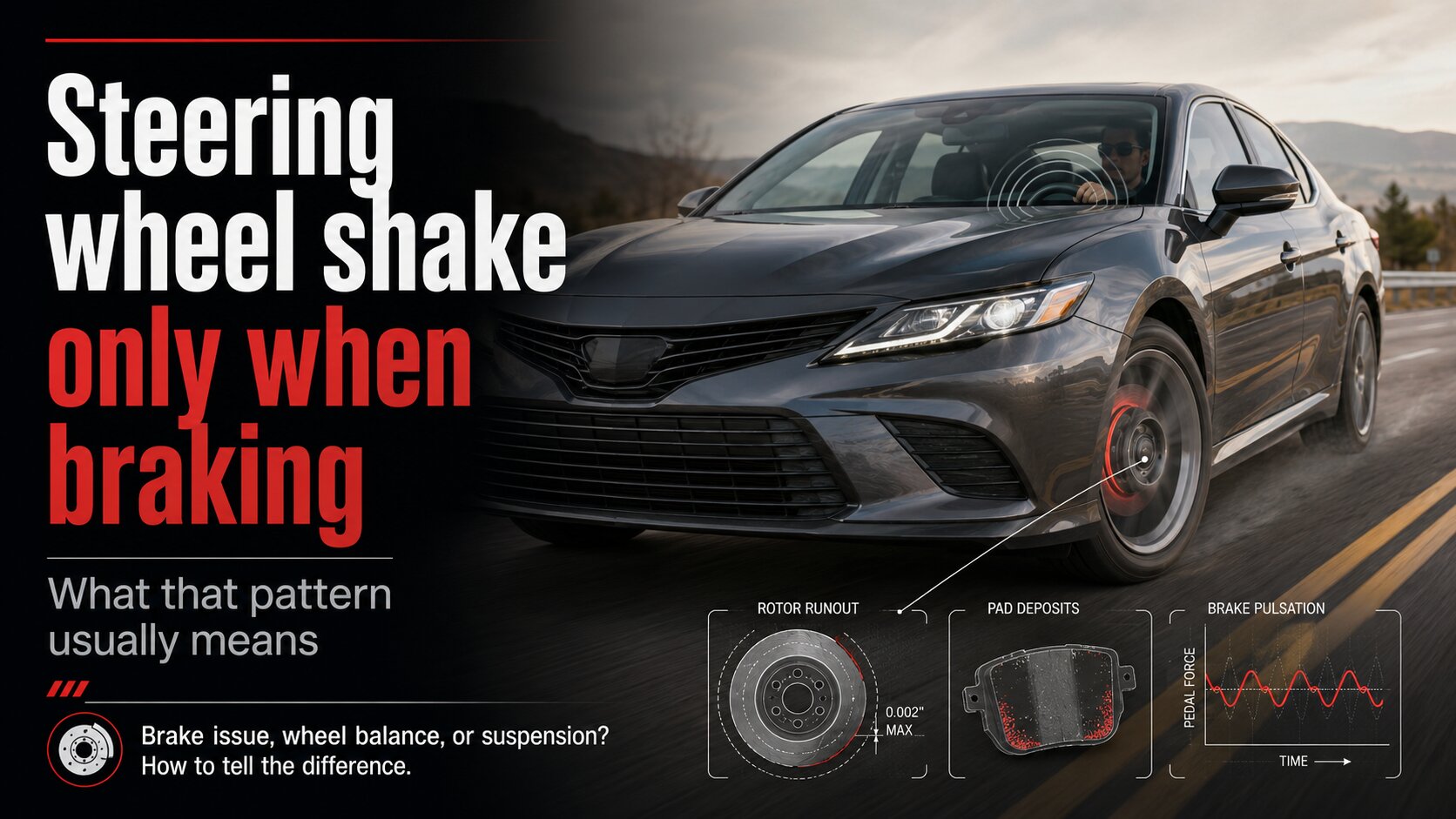
Steering wheel shake only when braking: what that pattern usually means
A steering wheel that shimmies when you press the brake pedal is a classic complaint, and it is also one of the more misunderstood ones. Many drivers call it “warped rotors,” but the underlying causes are often more specific and more fixable than that phrase suggests.
The first step is to map the symptom. When the vibration shows up, where you feel it, and how it changes with speed tells you whether you are chasing a brake issue, a tire and wheel issue, or a suspension problem that braking simply makes more obvious.
A quick symptom map (use this before you book service)
1) Shake mainly under braking, felt in the steering wheel: This commonly points to the front brakes because the front axle does most of the braking work in typical passenger vehicles. Likely contributors include rotor runout, uneven pad material transfer (sometimes called pad deposits), or a rotor thickness variation that creates a repeating torque pulse as the wheel rotates. Hub face corrosion or debris can be an upstream cause because it can keep the rotor from sitting perfectly flat.
2) Vibration at highway speed even when you are not braking: Wheel and tire balance rises to the top of the list. A bent wheel, tire uniformity issue, or uneven tire wear can also do it. Braking may make this feel worse because weight transfers forward and loads the front tires more heavily, but the root cause is often not the brake system.
3) Pulsation you feel mostly through the brake pedal (not much in the wheel): That can still be rotor related, but it can also reflect rear brake issues depending on vehicle design. Modern ABS can also create a pulsing sensation during low traction stops, but that typically happens only when ABS is actively intervening and often comes with an audible buzz or rapid clicking.
4) Shake under braking plus clunks, wandering, or instability: Worn suspension or steering components can amplify any small brake irregularity. Think tie rod ends, ball joints, control arm bushings, and sometimes wheel bearings. This category matters for safety because loose parts can change alignment under load.
Rotor runout in plain English (and why it matters)
Rotor runout is a measure of how much the brake rotor wobbles side to side as it rotates. Picture a dinner plate that is not sitting perfectly flat on the table. Even if it looks fine at a glance, one edge lifts slightly as you spin it.
In a brake system, that tiny wobble can push the pads back and forth once per rotation. Over time it can also encourage uneven pad contact, which can lead to thickness variation or uneven friction behavior. The driver experiences this as a repeating shake or judder during braking, often most noticeable from moderate speeds down to near stop.
What causes runout? The rotor itself can be manufactured out of spec or damaged by heat, but very often the issue starts at the mounting surface. Rust scale on the hub face, trapped debris between rotor and hub, or uneven lug nut torque can prevent proper seating. That is why “new rotors” do not always cure a shake if the root cause is still there.
The “warped rotor” myth and what is usually happening instead
Drivers feel vibration and assume the rotor has physically warped like a bent record. Severe overheating can distort components, but in typical daily use many complaints trace back to disc thickness variation or uneven friction film on the rotor face rather than a rotor that has dramatically changed shape.
This distinction matters because it affects what fixes will last. If uneven pad material transfer is creating high spots of friction around the rotor, replacing parts without addressing why that transfer happened can bring the vibration back.
Uneven pad transfer (pad deposits): why smooth brakes start to feel rough
Brake pads are designed to leave a thin, even layer of material on the rotor surface during normal operation. That stable transfer layer helps braking feel consistent and predictable. Problems begin when that layer becomes uneven.
How does it become uneven? A few common scenarios show up in real life:
Repeated hard stops followed by holding still with hot brakes: For example, exiting a highway ramp briskly and then sitting at a long light with your foot firmly on the pedal. Heat is high and pressure is concentrated at one spot on each rotor where the pads clamp down. That can encourage localized transfer.
Towing or mountain driving beyond what your setup comfortably handles: Even vehicles rated to tow can overheat brakes if speed management is poor or if trailer brakes are not properly adjusted. Many crossovers and half ton pickups have plenty of powertrain capability but still rely on correct driving technique for thermal control on long grades.
Mismatched pad and rotor condition: Installing new pads on rotors with existing hot spots or glazing can lead to uneven bedding behavior. A shop will typically evaluate whether rotors should be resurfaced or replaced based on condition and manufacturer guidance.
The telltale sign is often a judder that feels speed related during braking rather than a constant pull or noise. It may come and go depending on temperature; some drivers notice it more after city driving than after a cold start.
Hub corrosion and mounting issues: small rust, big consequences
If you live in areas that use road salt or if your vehicle sees wet winters, hub corrosion is not just cosmetic. Rust on the hub face can create an uneven mounting surface for the rotor hat (the center section of the rotor). That can introduce runout even if the rotor itself is new.
This is one reason brake work quality varies from shop to shop. A careful technician will pay attention to hub cleanliness, mating surfaces, and lug nut torque procedure because those details determine whether parts sit true when spinning at highway speeds.
A practical observation: If your shake started shortly after tire rotation, wheel removal for seasonal tires, or recent brake service, mention that timing. It does not prove fault, but it helps a shop focus on mounting surfaces and torque patterns early in diagnosis.
Wheel balance: why it usually shows up without braking (but not always)
An out of balance wheel creates vibration because mass is not evenly distributed around the axis of rotation. At certain speeds, typically highway speeds for many vehicles, that imbalance produces a steady shake that does not require braking to trigger it.
If you only feel shake when braking, wheel balance is less likely to be the primary cause. Still, there are edge cases worth knowing:
Brake application shifts load forward: That increases vertical load on front tires and can make an existing imbalance feel more pronounced right as you get on the brakes.
Bent wheels or tire uniformity issues: These can create vibrations that vary with speed and load rather than appearing as a constant buzz. A good shop may recommend road force balancing if standard balancing does not resolve it.
Tire wear patterns: Cupping or scalloping from worn shocks or alignment issues can mimic other problems. If your tires sound louder than usual on certain pavement textures or you see irregular tread wear blocks, bring that up during your visit.
What you can safely check at home (no disassembly required)
You do not need to pull wheels off to collect useful clues for your service appointment. A few low risk observations help narrow down causes while keeping you out of trouble.
Note when it happens: Write down speed range (for example 60 to 40 mph), whether it worsens with harder pedal pressure, and whether it changes after several stops when brakes are warm.
Find an empty straight road for a gentle comparison test: At a safe speed well within limits and with no traffic close behind you, apply light then moderate braking in a straight line. If light braking feels smooth but moderate braking triggers shake consistently, that leans toward brake torque variation rather than tire balance.
Check steering behavior without braking: On a smooth road at highway speed, does the steering wheel remain steady? If there is already vibration before touching the brakes, tell your shop because they may start with tire balance or wheel inspection before focusing solely on rotors.
Look for obvious tire problems: Check pressures when cold using an accurate gauge; large pressure differences side to side affect stability under braking. Visually inspect tread for bulges, cords showing, or severe scalloping. If anything looks unsafe, do not drive at speed.
Pay attention to warning lights: An ABS or stability control warning light changes how you should approach diagnosis because electronic brake force distribution and traction systems may be limited until repaired.
What to ask for at the shop (and what good diagnosis looks like)
A professional diagnosis should separate brake related vibration from chassis vibration rather than guessing based on internet shorthand.
Mention these terms plainly:
“Steering wheel shake only when braking”, plus your speed range and whether it feels like pulsing through pedal as well.
Ask whether they will measure lateral runout. Shops typically use a dial indicator for this type of check; you are not asking them to follow any one procedure so much as confirming they plan to measure rather than assume.
Ask about hub face condition, especially if you live in rust belt states. It is reasonable to ask whether corrosion could be contributing to runout even with good rotors.
If new pads were installed recently, ask whether they suspect uneven transfer film and what they recommend based on pad condition and rotor surface appearance. There are multiple valid repair paths depending on thickness remaining and manufacturer limits; your shop should explain options without pushing unnecessary parts.
If you also have vibration at speed, ask for tire balance verification and inspection for bent wheels or abnormal wear before spending money on brake parts alone.
A few ownership context notes: why this shows up across many vehicles
This issue is not tied to one model year or brand in any exclusive way. Most modern cars sold in the U.S., from compact sedans to three row SUVs and half ton pickups, use disc brakes up front with ventilated rotors designed for everyday duty cycles. They work extremely well in typical commuting use; they are also sensitive to heat management and correct installation practices because tolerances are tight across hubs, rotors, wheels, and lug hardware.
The frustration comes from how normal life loads brakes: stop and go traffic, short trips where corrosion builds faster than parts heat cycle evenly, occasional panic stops followed by sitting still at intersections, then long highway stretches where vibration becomes obvious through an electrically assisted steering rack tuned for precision rather than isolation.
When it is smart to stop driving and get help quickly
A mild shimmy under braking is often manageable long enough to schedule service soon, but some signs justify immediate caution:
Pulling hard to one side under braking, which could indicate caliper issues or uneven friction side to side.
Loud grinding noises, which may indicate pad material is gone and metal backing plates are contacting rotors.
A soft pedal or sinking pedal, which raises concerns about hydraulic integrity; do not ignore this.
A steering wheel that shakes violently, especially if paired with clunks; loose suspension parts can be dangerous under braking loads.
The practical takeaway
If your steering wheel shakes only when braking, start by treating it as a brake torque variation problem until proven otherwise. Rotor runout from hub mounting issues and uneven pad transfer are common real world causes; wheel balance becomes more likely when vibration exists even off throttle with no brake input. Bring clear notes about speed range, temperature sensitivity, recent service history, and whether you feel pulsation in the pedal as well as in your hands. A careful shop can then measure runout, inspect mating surfaces and tire condition, and recommend repairs that actually last instead of swapping parts by habit.
0 comments
Join the discussion around this article.
Please login to comment.