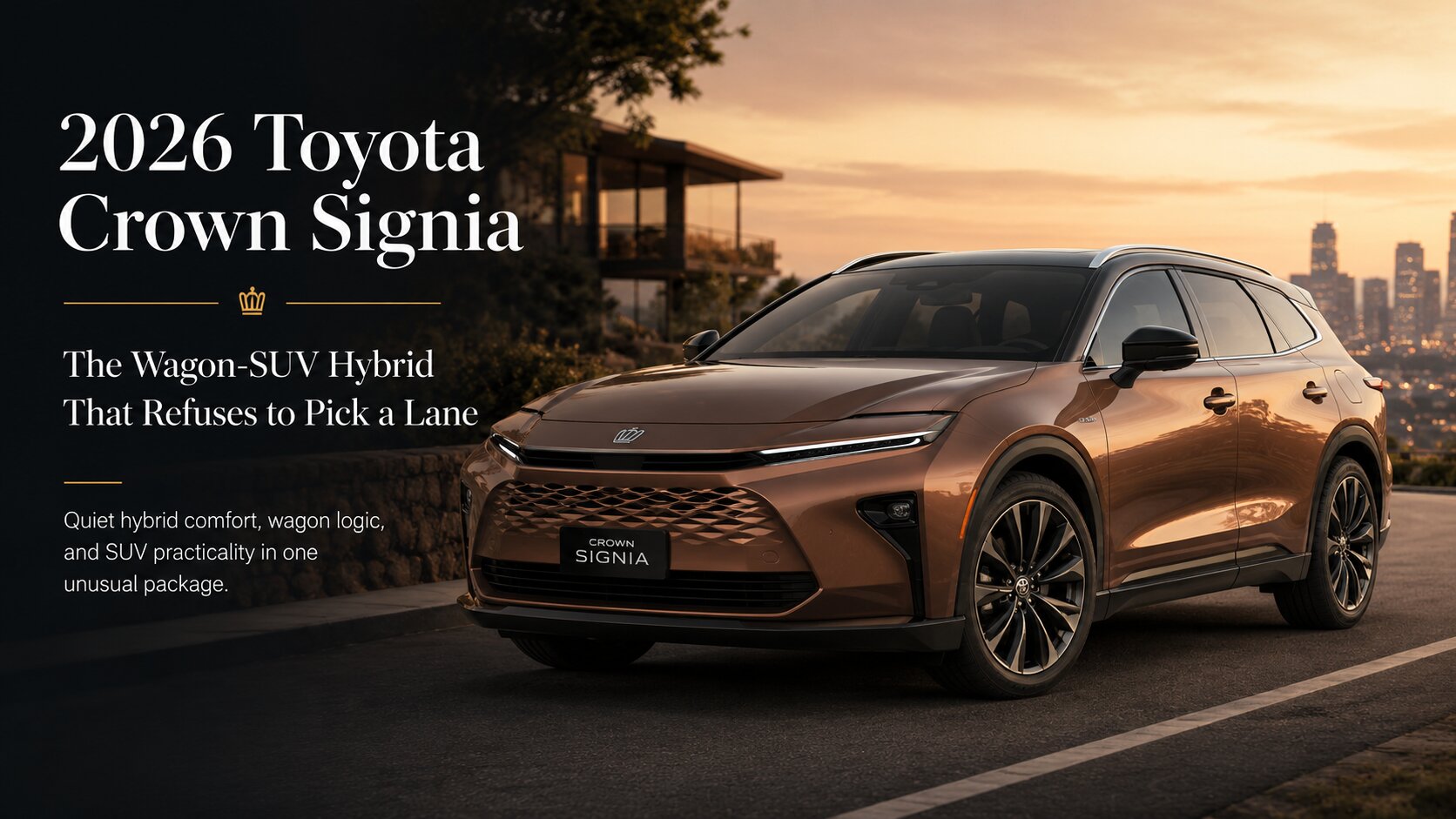
2026 Toyota Crown Signia Review: The Wagon-SUV Hybrid That Refuses to Pick a Lane
Toyota has been quietly expanding the Crown name in the U.S., and the Crown Signia is the most interesting of the bunch because it does not behave like a traditional segment player. It is not a three-row family hauler. It is not a tall, squared-off compact SUV. It is also not a low wagon in the European sense, even if its long roof and rear overhang invite that comparison. Instead, the Crown Signia lands in that increasingly rare middle ground: a two-row, mid-size, hybrid-only vehicle with wagon-like proportions, SUV-like seating height, and a calm demeanor that feels intentionally unflashy.
For 2026, Toyota has not announced major changes to the Crown Signia as of this writing. That matters because any “2026 review” needs to be honest about what is confirmed and what is simply likely. The Crown Signia debuted for the 2025 model year in the U.S., and Toyota’s early messaging focused on its hybrid powertrain, standard all-wheel drive, and premium-leaning positioning. Unless Toyota publishes updates for 2026 (equipment shuffles, pricing changes, or new trims), the smartest way to shop it is to treat it as a continuation of the same concept: a comfortable, efficient alternative to boxier SUVs that prioritizes quiet competence over image.
Verified facts first: what we know (and what Toyota has not confirmed for 2026)
Based on Toyota’s published U.S. specifications for the Crown Signia lineup at launch, several core points are clear and widely reported:
Powertrain: Hybrid-only. Toyota pairs a 2.5-liter four-cylinder engine with Toyota’s hybrid system and standard electronic all-wheel drive (AWD). The system uses an electric motor at the rear axle for AWD rather than a mechanical driveshaft in typical operation.
Output: Toyota quotes a net system output of 243 horsepower for the Crown Signia.
Fuel economy: Toyota has stated an EPA-estimated 38 mpg combined for the Crown Signia (final EPA figures can vary by trim and wheel size; shoppers should verify the exact window sticker).
Layout and seating: Two-row cabin with seating for five.
Positioning: Mid-size footprint, premium-adjacent pricing and materials relative to mainstream Toyota crossovers.
Competitors (realistic shopping set): In practice, buyers cross-shop vehicles like the Toyota Venza (when available on lots), Toyota Highlander Hybrid, Lexus RX Hybrid, Lexus NX Hybrid, , , , , and wagon-like alternatives such as the . Not all are direct matches in size or price, but they overlap in buyer intent: efficient comfort with practical cargo space.
What is not confirmed here: Any specific 2026 changes in features, MSRP, option packaging, or new trims. Also not included are unverified performance numbers (0 to 60 mph times), exact curb weights by trim, or trim-by-trim cargo volume figures unless you are looking at official Toyota specs or EPA documents for your exact vehicle. If those details matter to your decision, treat them as must-check items at purchase time rather than assumptions.
The design story: wagon silhouette, SUV stance
The Crown Signia’s shape is its entire argument. From some angles it reads like a lifted wagon with an elongated roofline and a tidy rear end. From others it looks like an SUV that has been stretched and lowered slightly to prioritize aerodynamics and on-road stability over trail-posturing ground clearance.
This body-style ambiguity is not just aesthetic. It changes how you use the vehicle day to day. A lower roof than many mid-size SUVs can make loading roof boxes or bikes less of a hassle. A tailgate opening that feels more wagon-like can make it easier to slide in bulky items without heaving them up to chest height. At the same time, you sit higher than in a traditional car-based wagon, which tends to improve outward sightlines in traffic and makes entry and exit easier for many drivers.
If you are tired of squared-off “adventure” styling cues but still want something that looks substantial in a suburban driveway, the Crown Signia splits that difference better than most. It does not pretend to be rugged in the way a body-on-frame SUV does. It also does not apologize for being practical.
Cabin first impressions: quiet intent over flashy gimmicks
Toyota pitched the Crown Signia as more premium than a typical mainstream crossover, and that generally tracks with how buyers should interpret it: not luxury-brand indulgence, but an intentional step up in ambiance compared with something like a RAV4 Hybrid.
The best compliment you can pay this kind of cabin is that it seems designed for long stretches of normal life: commuting, errands, airport runs, weekend highway miles. The hybrid system’s ability to glide at low speeds without constant engine presence helps reinforce that calm mood. In typical use, hybrids like this spend meaningful time with the gasoline engine cycling on and off as needed; when calibration is good, it reads as smooth rather than fussy.
Toyota’s current infotainment approach across many models centers on a large central touchscreen with smartphone integration (Apple CarPlay and Android Auto are common expectations in this class). Exact screen size and feature availability can vary by model year and trim; shoppers should confirm on the Monroney label or Toyota’s build tool for their specific vehicle.
A practical note: premium-leaning vehicles sometimes chase minimalism at the expense of usability. In this segment, physical controls for climate functions remain valuable because they reduce distraction when you are adjusting temperature or fan speed while moving. If your tolerance for touch-heavy interfaces is low, verify how your preferred trim handles those basics before you commit.
Seating comfort and visibility: where the Signia earns its keep
The Crown Signia’s whole premise depends on being easy to live with from behind the wheel. A slightly elevated seating position compared with sedans helps visibility over traffic without forcing you into an upright truck posture. For many drivers moving out of sedans or wagons, this “in-between” height feels immediately natural.
Visibility is never just about seating height; it is also about pillar thickness, mirror placement, rear glass shape, and how much style you sacrifice for sightlines. Many modern crossovers trade rearward visibility for design drama with rising beltlines and narrow back windows. The Signia’s wagon-influenced rear profile can help here because it typically preserves more usable glass area than aggressively tapered coupe-like SUVs. Still, buyers should do their own check: adjust mirrors properly, look over both shoulders, and confirm whether rear-quarter blind spots feel manageable in your daily driving environment.
Rear-seat comfort matters because this is likely to be used as an everyday family vehicle even without a third row. Legroom expectations should be aligned with mid-size two-row crossovers rather than compact entries like a CR-V Hybrid or RAV4 Hybrid. If your household regularly carries adults in back seats for longer drives, bring them along for your test drive instead of assuming any mid-size badge guarantees generosity.
Cargo usability: wagon logic in an SUV market
This is where body style stops being an abstract debate and becomes something you feel at Home Depot or at an airport curb. A long roofline tends to translate into more consistent cargo height behind the rear seats compared with sharply sloped designs. Even if ultimate cargo volume numbers are similar across rivals on paper (and those numbers vary depending on measurement standards), usable space often comes down to shape more than raw liters or cubic feet.
The Crown Signia’s appeal is that it should swallow everyday bulky items without demanding that you buy something taller and boxier just to get there. Strollers, medium-size coolers, grocery runs that turn into Costco runs by accident; these are normal use cases where a wagon-like rear end makes sense.
If you are comparing it with something like a Subaru Outback (a vehicle that has owned this “not quite SUV” niche for years), pay attention to load-floor height and tailgate opening geometry rather than just spec-sheet volume. The Outback also offers strong roof utility culture among owners; Toyota’s advantage tends to be hybrid efficiency and smoothness rather than outdoorsy brand identity.
The hybrid powertrain: calm competence instead of drama
Toyota’s hybrid systems have become familiar because they work well in typical American driving: stop-and-go traffic punctuated by brief highway sprints and constant speed changes around town. With 243 horsepower quoted for net system output, the Crown Signia should have enough muscle to feel appropriately responsive when merging or passing without chasing performance credentials.
The key characteristic many buyers notice first in hybrids is not peak power but how power arrives. Electric assist can make initial acceleration feel immediate at city speeds even when overall output is modest compared with turbocharged rivals on paper. When you ask for more sustained acceleration at highway speeds, hybrids often bring the gasoline engine into play more audibly; whether that sound quality bothers you depends on calibration and your sensitivity to engine note under load.
A subtle advantage here is psychological as much as technical: hybrid drivetrains encourage smoother driving without demanding behavioral change from the driver. There is no plug-in routine unless you choose a plug-in hybrid elsewhere; there is no charging plan; there is no range anxiety conversation before every road trip. You just fuel up normally while enjoying better efficiency than many non-hybrid competitors.
Ride quality and road manners: tuned for composure
The Crown Signia’s mission points toward ride comfort and quiet stability rather than sporty sharpness. In this price neighborhood, buyers often want a vehicle that feels settled at 75 mph on imperfect interstate pavement while remaining easy around town when streets are patched and uneven.
A longer roofline often correlates with good high-speed stability because proportions can support calmer pitch motions over rolling pavement dips. Wheel-and-tire choices matter too; larger wheels tend to look better on dealer lots but can chip away at ride compliance on broken surfaces depending on sidewall height.
If you are coming from something like a Highlander Hybrid or even a three-row competitor such as a Kia Sorento Hybrid or Hyundai Santa Fe Hybrid (both typically tuned toward family comfort), expect the Signia’s two-row layout to feel slightly more cohesive dynamically simply because engineers do not have to accommodate third-row packaging compromises in quite the same way. That said, those rivals offer something important: occasional third-row flexibility (in some configurations) or different packaging priorities that may matter more than subtle ride differences depending on your household needs.
Cabin noise: hybrids shine when everything else stays out
A quiet vehicle is rarely about one heroic engineering trick; it is usually about dozens of small decisions adding up: sound insulation placement, door sealing strategy, glass thickness choices (where applicable), tire selection, suspension bushing tuning, even how mirrors channel airflow around A-pillars.
The Crown Signia benefits from its hybrid nature because low-speed electric operation reduces engine noise during parking-lot crawling or neighborhood speeds where you might otherwise hear an engine droning lightly all the time. On highways, wind noise becomes more dominant; vehicles with smoother shapes sometimes do better here than tall brick-like SUVs simply because there is less turbulent air hitting flat surfaces.
If quietness is one of your top reasons for shopping this car rather than another mainstream crossover, test drive it on your actual roads if possible. A short loop near a dealership rarely reveals tire roar on coarse asphalt or wind noise around common highway speeds.
How it stacks up against rivals (subtle comparisons that matter)
Versus Subaru Outback: The Outback remains the obvious “wagon alternative” in America because people recognize what it is immediately. The Crown Signia counters with hybrid efficiency (Toyota quotes 38 mpg combined) and likely a more premium-leaning cabin presentation depending on trim comparisons. The Subaru’s strengths tend to include brand-specific AWD reputation and outdoorsy utility culture; Toyota’s strengths tend to be smoothness and everyday refinement.
Versus Honda CR-V Hybrid: The CR-V Hybrid plays in a slightly smaller class but overlaps heavily as an efficient family runabout with excellent day-to-day packaging. Honda typically wins buyers who want straightforward ergonomics and airy interior space per exterior footprint; Toyota draws buyers who want something less common-looking than yet another compact crossover shape.
Versus Hyundai Santa Fe Hybrid and Kia Sorento Hybrid: These Korean rivals lean hard into bold styling and family-focused packaging advantages (including available three-row seating on Sorento). They can be compelling value plays depending on incentives and equipment levels available locally. The Crown Signia’s counterargument is simpler: hybrid smoothness wrapped in quieter design restraint plus Toyota’s broad dealer network familiarity among U.S. shoppers.
Versus Lexus RX Hybrid: If your budget stretches into luxury territory, the RX Hybrid becomes an obvious alternative because it offers brand cachet plus similar themes of quiet comfort and efficiency depending on configuration. The Crown Signia tries to capture some of that vibe without committing fully to luxury pricing or image; whether it succeeds depends largely on transaction prices in your market.
Ownership implications: why this kind of Toyota appeals long-term
Toyota hybrids have earned their popularity by being easy to integrate into normal ownership routines. You do not need special home equipment or charging access; maintenance schedules generally resemble other modern gasoline vehicles with additional hybrid components designed for longevity under typical use patterns.
This review cannot promise reliability outcomes for any specific model year because long-term data takes time and varies by usage conditions. What can be said fairly is that Toyota’s hybrid technology has been deployed across millions of vehicles over multiple generations in the U.S., which tends to reassure buyers who keep cars beyond warranty periods.
A real-world shopping consideration: because this model sits outside traditional categories, some buyers may struggle to justify its price versus more conventional crossovers if incentives favor those vehicles locally. On dealer lots where supply varies wildly by region, you may find yourself choosing between “the car I actually want” and “the car I can get easily.” The Crown Signia will appeal most strongly when it is available in sensible colors and trims without heavy markups or forced accessory bundles.
The body-style ambiguity cuts both ways
A vehicle that refuses to pick a lane also refuses some buyers’ expectations along with it.
If you want maximum cargo height for tall boxes or dog crates stacked high behind the second row, taller SUVs still win by simple geometry even if their shapes are less elegant aerodynamically.
If you want sedan-like handling purity or low-slung road feel, this still sits higher than traditional wagons and will feel like it carries more mass up top compared with true cars.
If you want off-road credibility beyond gravel roads or winter weather confidence on good tires, remember what AWD means here: excellent traction support for normal conditions but not necessarily built around low-range gearing or heavy-duty underbody protection like purpose-built off-roaders.
Pros and cons (based on available specifications)
Pros:
- Distinctive wagon-SUV packaging that prioritizes usable cargo shape without going full boxy SUV
- Hybrid-only lineup simplifies decisions; strong efficiency target with Toyota-quoted 38 mpg combined
- Standard AWD adds all-weather confidence without requiring a separate upgrade path
- Net system output of 243 horsepower suggests adequate real-world passing power for most drivers
- Likely appealing ride-and-quiet focus relative to more rugged-styled alternatives
Cons:
- Not everyone will understand what it is; resale desirability can hinge on public perception (hard to predict)
- Two-row layout limits flexibility versus three-row hybrids if you occasionally need extra seats
- Buyers seeking maximum cargo height will still prefer taller mid-size SUVs
- Exact feature content can vary by trim; shoppers must verify equipment rather than assume “Crown” equals luxury standards across all builds
The verdict: who should buy the 2026 Crown Signia?
The Crown Signia makes sense for American buyers who want mid-size comfort without committing to a tall SUV silhouette they never loved in the first place. It fits households that value quietness during daily driving, appreciate hybrid efficiency without plugging in, and regularly use cargo space but do not need three rows of seats.
If your ideal vehicle would be described as “a nice wagon,” but you also want modern ride height and all-weather traction without stepping into luxury-brand pricing immediately, this Toyota occupies rare territory. It will not satisfy drivers chasing sporty feedback or families needing occasional third-row duty; plenty of competitors exist for those missions. What it offers instead is calm competence wrapped in an unusual shape that feels deliberately grown-up.
The smartest way to shop one as a 2026 model is simple: confirm whether Toyota has made any year-to-year changes where it matters most to you (price, wheels/tires affecting ride quality, driver-assistance feature content), then choose based on how well its quiet hybrid personality matches your routine. For many buyers tired of boxy SUVs but unwilling to give up practicality, that routine match will be exactly the point.
0 comments
Join the discussion around this article.
Please login to comment.