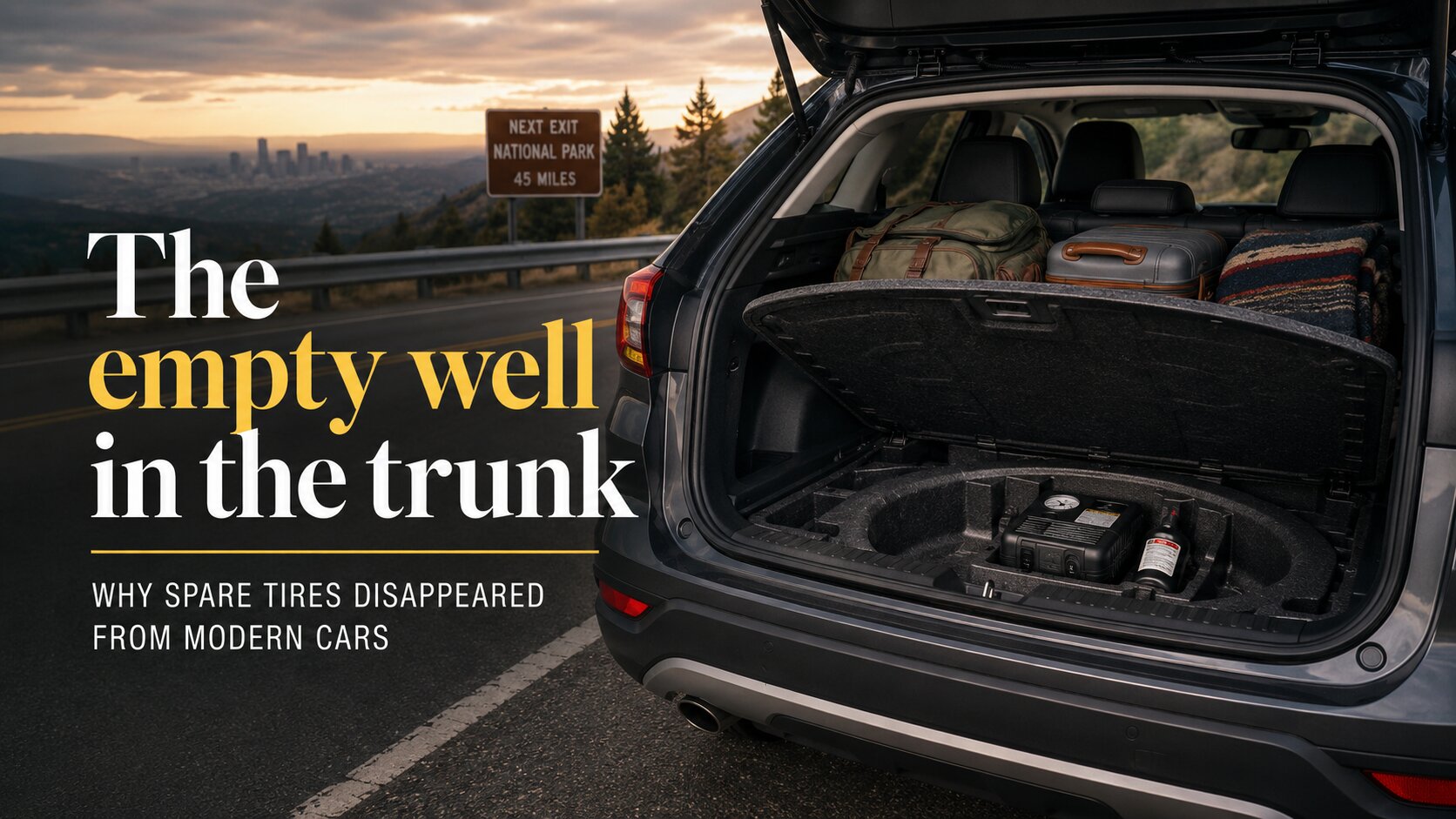
The empty well in the trunk
Open the hatch on a lot of new cars and you can feel the moment where old expectations meet modern packaging. The cargo floor lifts up, you’re ready to see a steel wheel and a real tire, and instead you find a molded foam tray holding a small air compressor and a bottle of sealant. Sometimes there’s nothing at all. Just an empty well, or no well because the floor is flat and the battery is underneath.
For American drivers raised on road trips, spare tires were part of the mental checklist. Cooler, charger, jumper cables, spare. The spare was reassurance you could limp to the next exit even if the nearest town was forty miles away and your phone had one bar. So when it started disappearing, it felt personal. Not because most people change tires for fun, but because it rewired what “being prepared” looked like.
The spare tire didn’t vanish overnight, and it didn’t happen for one single reason. It was a slow squeeze from every direction: tighter crash standards, bigger brakes, more safety tech, rising fuel economy pressure, styling that pushed wheels outward and floors downward, and then electrification, which brought big battery packs that want the space a spare used to occupy. In the middle of all that came a compromise product that sounded like progress in a press release: the temporary mobility kit.
When every car had one (and why it mattered)
For decades, a full size spare was normal on American cars and trucks. You’d often get a fifth matching wheel on pickup trucks and body on frame SUVs because there was room underneath or on the rear door. Many sedans carried a smaller spare but still a real wheel with a tire mounted. Even if it was “compact,” it was predictable: jack, lug wrench, wheel. A puncture was annoying but legible.
That predictability mattered because American driving patterns tend to be long distance by default. Interstates encourage speed and distance. Suburbs stretch errands into mini road trips. And plenty of families still do the classic summer run across state lines where services get sparse at exactly the wrong time.
There’s also culture here. The spare tire was one of those quiet symbols of self reliance that fit neatly with roadside independence: fix it yourself, keep moving. Even drivers who never used their spare liked knowing it was there.
The donut era: smaller spares as the first retreat
The first major shift wasn’t from spare to no spare. It was from full size spares to compact temporary spares, commonly called donuts. They saved space and weight and they let automakers design lower trunks and more usable cargo floors without giving up the safety net entirely.
These temporary spares also came with rules that trained drivers to accept limitations: reduced speed warnings (often 50 mph), shorter distances, careful handling in rain or snow. Even without quoting a specific number that varies by manufacturer, the point is consistent: donuts were never meant to be driven like a regular tire.
Once buyers accepted that their “spare” might be an emergency tool rather than a true replacement, it became easier for automakers to ask for another step in the same direction.
Packaging pressure: where did the space go?
If you want to understand why spares disappeared, look at what grew.
Wheels got bigger across the market. Larger diameter wheels can mean less sidewall height depending on tire sizing, which can change how punctures happen and how quickly air loss becomes obvious. Brakes grew too; performance trims and even mainstream crossovers increasingly use larger brake rotors and calipers than their predecessors. Those changes don’t directly delete the spare, but they tighten packaging everywhere around suspension geometry and underbody space.
Then came modern crash structures and more complicated rear suspensions in some vehicles. Underfloor storage areas became carefully engineered zones for impact management and stiffness. That deep spare tire well in an older sedan is not always compatible with how newer platforms distribute loads in a crash or where exhaust systems and emissions hardware need to run.
Crossovers added another twist. Many compact SUVs are front wheel drive based platforms with all wheel drive as an option. Their rear floors are higher than old sedans because you’re packaging different suspension layouts and sometimes driveline components under there. Buyers want maximum cargo volume and flat load floors for strollers, dogs, home improvement runs, or airport luggage. A full size spare eats into that clean rectangle of space.
And then electrification arrived with its own reality: batteries are heavy, expensive, and usually packaged low in the vehicle for center of gravity benefits. That often means underfloor space is no longer “available” in the way it used to be.
Weight matters more than you think (even if you barely notice it)
A spare tire assembly is not light. It’s not just rubber; it’s a wheel plus tire plus jack plus tools plus mounting hardware. Exact weights vary widely by vehicle and wheel size, so it’s hard to cite one universal number without overpromising precision. But in typical passenger vehicles it can easily be dozens of pounds of mass that is carried every mile whether you ever use it or not.
In an era where automakers chase fuel economy targets and emissions compliance across entire fleets, shaving weight is tempting because it touches everything: acceleration feel, braking distances in certain conditions, ride tuning choices, even how big you need to make other components to meet performance targets.
This is where some owners feel whiplash. The same vehicle might have big wheels, thick glass for noise reduction on some trims, power seats everywhere, panoramic roofs depending on options, yet it deletes the one thing meant for emergencies because of weight or space savings. From an engineering standpoint those decisions come from different teams optimizing different targets; from an ownership standpoint it can feel like priorities got scrambled.
The rise of run flat tires
If there was one technology that made deleting spares feel defensible to mainstream buyers, it was run flat tires.
A run flat tire is designed with reinforced sidewalls (and sometimes other internal features) so that after losing air pressure it can still support the vehicle for a limited distance at reduced speed. The exact distance depends on the tire specification and conditions; manufacturers commonly cite ranges around several dozen miles in ideal scenarios, but owners should follow their vehicle manual because limits vary by tire model.
Run flats became especially associated with premium brands in the U.S., notably BMW for many years across various models as part of its factory strategy to reduce reliance on spares. Some Corvettes have also used run flats from the factory in certain generations as part of performance packaging decisions (exact fitments depend on year and trim). Other automakers adopted them selectively.
The pitch made sense: no roadside wheel changes in bad weather or dangerous traffic; keep driving to a safe place; preserve trunk space; reduce vehicle weight versus carrying an extra wheel (though run flats themselves can be heavier than comparable conventional tires).
The tradeoff is cost and sometimes ride quality depending on tire design and vehicle tuning. Run flats tend to be more expensive than conventional tires in many sizes, and replacement availability can matter if you are far from major metro areas. Some drivers also report harsher impacts over sharp bumps compared with non run flat tires; results vary by vehicle tuning and tire generation.
The mobility kit: sealant replaces steel
Mobility kits took the concept even further by replacing both full size spares and donuts with two things: an inflator (usually a 12V compressor) and sealant designed to plug small punctures in the tread area.
This isn’t new chemistry invented yesterday; tire sealants have been around for ages in various forms. What changed is how confidently they were positioned as standard equipment for mainstream vehicles.
The kit strategy works best for common puncture scenarios like a nail or screw through the tread that causes slow air loss. It does not work reliably for sidewall damage or large cuts. It also cannot help if the tire comes off the bead after driving flat or if you bend a wheel badly on a pothole. Those limitations are usually spelled out in owner’s manuals because they’re real constraints of physics rather than corporate fine print.
There are practical annoyances too: sealant can make later repairs more complicated depending on what product is used and what repair shop policy allows; some shops may prefer replacing rather than patching after sealant use due to cleanup concerns or warranty policies (this varies). And if your puncture happens at night on a rural highway shoulder during winter rain, “just use the kit” can sound like advice from someone who has never tried finding a valve stem while trucks blast by.
Competitors in this story: who kept spares longer?
This shift didn’t hit every segment at once.
Many pickup trucks held onto full size spares longer because they had room under the bed or behind the rear axle on body on frame designs. Traditional SUVs based on truck platforms also often kept them because customers expect off road readiness or towing support where roadside fixes matter more.
Mainstream sedans moved earlier toward compact spares or kits as trunks shrank relative to exterior length goals and as manufacturers prioritized cargo usability metrics that show well on spec sheets.
Crossover competitors pushed each other too. If one compact SUV offers more cargo volume behind the second row thanks partly to deleting underfloor hardware, rivals notice because shoppers compare those numbers even if they rarely carry huge loads day to day.
Electric vehicles added another nudge: many EVs ship without spares due to battery packaging constraints and weight goals tied directly to range ratings under EPA test cycles (range varies by model; I’m not citing specific EV range figures here because they differ widely). Some EVs offer optional spare kits or aftermarket solutions; others rely on roadside assistance plans bundled into ownership periods depending on brand policy (policies vary by manufacturer and model year).
The ownership reality: what happens when you actually get a flat?
This is where emotion shows up fast.
A flat tire used to be an interruption you could solve with your own hands if you had basic tools and enough shoulder space. Now it often becomes a logistics problem involving cell coverage, towing availability, tire inventory at local shops, and whether your car has locking lug nuts you can actually find the key for.
If you have run flats and your damage is compatible with them, you might drive home calmly while your dashboard warns you about low pressure monitoring systems (TPMS has been federally required on new light vehicles since model year 2008). That’s genuinely convenient when it works as intended.
If you have only sealant and your puncture is too large or in the sidewall, you’re calling roadside assistance anyway. For many people that’s acceptable because they already rely on AAA or manufacturer assistance programs; for others it feels like paying twice for something older cars handled mechanically.
There’s also an uneasy mismatch between modern wheel sizes and real world roads. Bigger wheels with lower profile tires can be more vulnerable to pothole damage depending on sidewall height; potholes are not theoretical in many U.S. cities after winter freeze thaw cycles. A bent rim is outside what sealant fixes best.
Why drivers still feel strongly about it
This debate sticks around because both sides have valid points that show up differently depending on lifestyle.
If your driving life is mostly commuting within metro areas where towing is fast and tire shops are everywhere, deleting the spare might never hurt you once over years of ownership. You gain cargo floor space you use every weekend at Costco or loading sports gear into a compact SUV that already feels tight behind the second row.
If your life includes long rural drives, job sites far from services, late night airport runs across multiple counties, or family road trips where time matters more than convenience store snacks at mile marker 212, not having a real spare feels like giving up agency.
The emotional reaction also comes from trust. A spare is visible proof of preparedness; an inflator kit feels like hoping your problem matches what engineers planned for in their most common puncture scenario statistics (those statistics exist internally but aren’t usually published in detail). When something goes wrong at 11 p.m., nobody wants probabilities; they want certainty.
What to do if your next car has no spare
If you’re shopping today in the U.S., assume nothing about spares until you check that exact trim level’s equipment list or physically lift the cargo floor on the dealer lot. Automakers sometimes make spares optional packages even within one model line depending on drivetrain or wheel size options.
A few practical moves help:
First, learn what your car actually has: run flats, conventional tires with sealant kit, or nothing beyond roadside assistance coverage.
Second, understand limitations before you need them. Sealant typically only helps tread punctures; sidewall damage usually means tow time regardless of brand claims.
Third, consider your routes. If you do long interstate trips through sparse areas or regularly tow trailers where blowouts matter more (towing needs vary widely by vehicle), having some form of real spare solution can reduce stress even if it costs cargo space.
The spare didn’t disappear so much as get outsourced
The truth hiding under those foam trays is that automakers didn’t eliminate flats; they changed who solves them and how quickly solutions arrive.
A full size spare put responsibility inside the vehicle along with tools designed for self rescue at any hour on any shoulder wide enough to stand safely. Run flats shifted responsibility toward engineering margins built into tires plus driver compliance with speed limits after air loss. Mobility kits shifted responsibility toward chemical fixes for common punctures plus service networks when things get messy.
If that feels like progress depends on how you drive America: short hops between well lit exits or long stretches where “next services” signs start looking like promises instead of information.
0 comments
Join the discussion around this article.
Please login to comment.