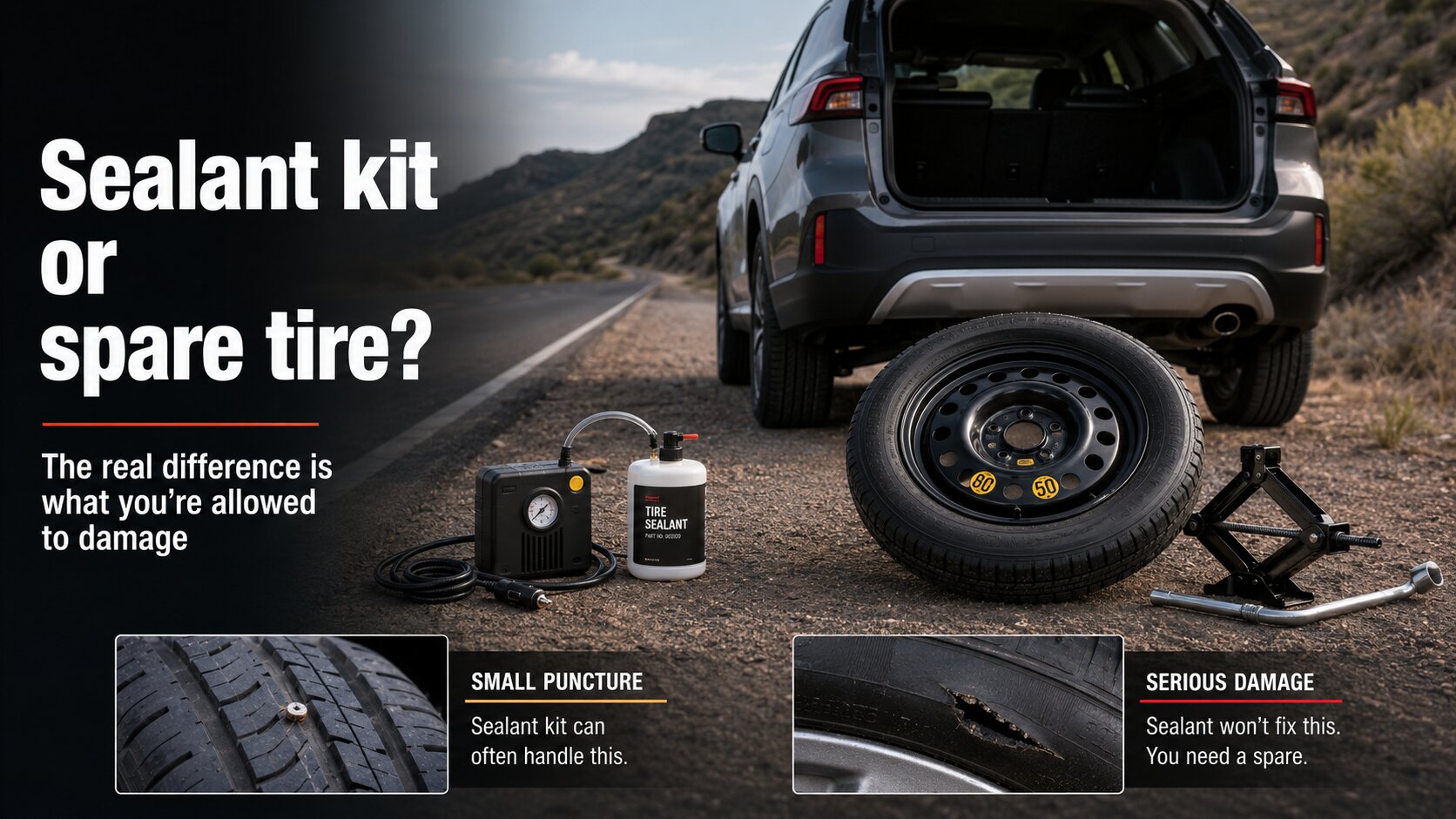
Sealant kit or spare tire? The real difference is what you’re allowed to damage
I’m Brian O’Connor, based in Chicago, with an engineering background in automotive design. I like clever packaging as much as the next car nerd, but I also like getting home on time. That’s why the modern trend of deleting spare tires in favor of a tire sealant kit still bugs me a little. It’s not that sealant kits are useless. It’s that they’re narrow tools, and a lot of drivers don’t learn the limits until they’re sitting on the shoulder with semis thumping past.
Here’s the grounded version: a spare tire is a physical replacement for a damaged tire (temporary or full size). A sealant kit is an attempt to patch one specific kind of problem from the inside long enough to reach a shop. It is not a real repair, and it cannot save every flat.
Verified basics: what these kits usually include, and why automakers ship them
Most factory tire mobility kits are a bottle of liquid sealant plus a small 12-volt air compressor that plugs into your car’s power outlet. Some kits inject sealant through the valve stem, then use the compressor to inflate the tire. Others combine steps through a single hose setup. This layout is common across many mainstream brands because it saves weight, cost, and space versus carrying a spare wheel and jack.
Verified general reality: deleting the spare can free up underfloor storage, help packaging for hybrid batteries or EV components, and shave mass. Mass matters for fuel economy and EV range, so you see this on everything from compact crossovers to performance sedans. The tradeoff is simple: you gain space and sometimes efficiency, but you lose capability when the puncture is not “sealant friendly.”
What sealant kits can fix (the best case)
Sealant kits are mainly intended for small tread-area punctures, think a nail or screw in the part of the tire that actually contacts the road. That’s the center-ish zone of the tread, not the shoulder and definitely not the sidewall.
In that scenario, sealant can work surprisingly well. The liquid gets pushed around inside the tire as it rotates, then plugs the hole from the inside while air pressure helps force it into place. If you catch it early enough and the hole is small, you can often get back up to usable pressure and limp to a tire shop without calling for a tow.
A practical note from living with Midwest roads: when temperatures drop, rubber stiffens and leaks can feel more dramatic. Sealant does not magically reverse a torn tire, but for a clean puncture it can be the difference between waiting an hour for roadside assistance and being back on Lake Shore Drive in 15 minutes.
What sealant kits cannot fix (and why)
The hard line is sidewall damage. If you have a cut, bulge, tear, or puncture in the sidewall, stop thinking about sealant. Sidewalls flex constantly. They are thin compared with tread blocks, and they carry huge structural loads as the tire deforms under cornering and bumps. A sidewall injury is typically considered non-repairable by industry practice because even if you could “plug” it temporarily, the casing strength is compromised.
Sealant also struggles with:
1) Large punctures or multiple holes. A screw might be fine; a chunk of metal or road debris that leaves an oversized opening often is not.
2) Tread shoulder damage (near where tread meets sidewall). That area flexes more than center tread and tends to leak again.
3) A bead leak or wheel damage. If you hit a pothole hard enough to bend a wheel or unseat the bead (the sealing edge where tire meets rim), sealant cannot restore proper seating force. You may inflate it briefly and then watch pressure drop again.
4) Blowouts and shredded tires. If there’s visible cord, flapping rubber, or a loud bang followed by instant loss of control feel, you’re beyond “kit” territory.
The compressor reality check: airflow limits matter
The little compressors in these kits are built for convenience, not speed. Many are low-volume pumps designed to top up pressure gradually. That’s fine if your tire is mostly intact and you just need to go from near-flat back to something drivable.
If air is escaping quickly through a big puncture or an unseated bead, you can sit there listening to that tiny motor whine while nothing meaningful happens at the gauge. Another limitation: these compressors can overheat if run too long continuously. Manufacturers often advise running them in short intervals if needed (your owner’s manual usually spells out duty cycle guidance). If your compressor shuts off or smells hot, that’s your cue to stop pushing it.
Speed and distance limits: read your manual because they vary
This is where people get burned because they assume all sealant kits are identical. They’re not. Automakers typically include specific speed and distance limits after using sealant so you don’t over-stress a compromised tire.
I’m not going to invent numbers here because they vary by vehicle brand and kit supplier. What is widely consistent is the concept: after sealant use, you’re expected to drive slowly and only far enough to reach service. Many manuals also instruct you to stop after a short initial drive to recheck pressure because sealant needs rotation time to distribute evenly.
If your manual says “X miles at no more than Y mph,” treat that like an engineering constraint, not friendly advice. Heat buildup in an underinflated or damaged tire escalates quickly at highway speeds.
Tread puncture versus sidewall damage: quick roadside triage
If you want one simple decision tree on the shoulder:
Look at where the damage is. If it’s in the tread area and looks like a small puncture (nail or screw), a sealant kit has a decent chance.
If it’s in the sidewall, or there’s any bulge (a bubble), skip sealant. A bulge can indicate internal cord damage from an impact, common after potholes in cities like Chicago. That tire may fail even if it holds air for now.
If you can hear hissing loudly, see a slit instead of a round hole, or find multiple punctures (construction debris happens), plan on towing or installing a spare if you have one.
Why a kit isn’t a real repair (even when it “works”)
A proper tire repair for many passenger vehicles typically means removing the tire from the wheel, inspecting inside and out, then using an internal patch or patch-plug combination in an approved repairable area of the tread. That inspection step matters because what looks like “just a nail” can hide internal damage from driving on low pressure.
Sealant skips all of that. It’s an emergency measure meant to restore air retention temporarily. It does not restore structure; it does not guarantee long-term sealing; and it complicates later service because now there’s liquid sloshing inside the carcass.
Also worth saying plainly: if you drove any meaningful distance while very low on pressure before using the kit, you may have damaged the tire internally with heat and sidewall flexing. In that case even an apparently successful inflation does not mean you should keep driving normally.
TPMS after sealant: expect warnings and extra steps
Tire Pressure Monitoring Systems (TPMS) are great when they’re accurate and annoying when they’re confused by circumstances they weren’t designed for. Sealant can create those circumstances.
Many vehicles use valve-stem mounted TPMS sensors inside each wheel (common direct TPMS setup). Sealant is injected through that same valve path on many kits. Some manufacturers warn that sealant can contaminate or clog TPMS components or make sensors harder to service later. Not every kit causes problems every time; some sealants are marketed as TPMS compatible; but sensor issues are common enough that tire shops will ask whether you used fix-a-flat style products before they touch anything.
Practical tip: after using sealant, do not ignore repeated TPMS warnings just because “I already filled it.” Recheck pressure with an actual gauge when safe. If TPMS reads strange values or doesn’t update normally after driving, treat it as another reason to get professional help sooner rather than later.
When to stop trying and call for help
This part feels obvious until you’re cold, late, and tempted to gamble.
Stop using the kit and call roadside assistance (or install your spare) if:
1) The puncture is in the sidewall or shoulder area.
2) The tire won’t take air or won’t hold pressure after inflation.
3) You see wheel damage (bent rim lip) or suspect bead unseating after an impact.
4) You smell burning rubber after driving on it low, or you notice vibration that wasn’t there before.
5) The compressor overheats or cannot reach usable pressure within a reasonable time (your manual may define this).
Your safety margin shrinks fast when a compromised tire heats up at speed. If you have any doubt about structural integrity, do not merge back onto traffic at 70 mph hoping chemistry will save you.
Spare tires: still old-school effective (with their own caveats)
A spare tire gives you something sealant never does: known structure. Even if your original tire has a sidewall gash or your wheel took a hit, swapping to a spare can get you rolling without relying on plugging goo into unknown damage.
The catch is that many spares today are temporary “donut” spares with their own speed limits printed right on the sidewall. They also reduce grip compared with your full-size tires and can upset handling balance on performance cars or trucks carrying loads. Some vehicles come with full-size spares (more common on certain trucks and body-on-frame SUVs), which is ideal for capability but costs space and weight.
If you do have a donut spare, treat it as exactly what it is: an emergency wheel-tire assembly designed for short trips at reduced speed so you can get proper tires back on ASAP.
A few real-world ownership tips I wish everyone followed
1) Check what your vehicle actually has before you need it. Open the cargo floor at home. Confirm whether you have a spare, jack, lug wrench, locking lug key (if equipped), tow hook cover tool (on some cars), or only a mobility kit.
2) Know your lug nut situation. If your wheels use locking lugs and you don’t have the key handy, your “spare” plan collapses fast at night on I-94.
3) Keep pressures correct year-round. Underinflation increases heat buildup risk during any puncture event because there’s less reserve capacity before sidewalls start flexing excessively.
4) After any sealant use, go straight to service. Tell them exactly what product was used if possible (factory kit brand varies). Many shops will want to clean out sealant before doing any internal repair assessment; some may recommend replacement depending on damage location and how far it was driven flat.
If you’re shopping for a car: ask about this like it matters (because it does)
This is one of those dealership-lot details that gets overlooked next to screens and horsepower numbers. Plenty of sporty sedans and crossovers ship without spares now; some offer spares only as accessories; others rely on run-flat tires instead of sealant kits; some give you neither spare nor run-flats beyond roadside assistance coverage terms (which vary).
I’m not going to name specific model years or trims here because packaging changes frequently across updates and option packages; even within one model line it can differ depending on drivetrain layout or battery placement based on available specifications at purchase time. The actionable move is simple: look up your exact trim’s equipment list or physically check underfloor storage before signing paperwork if having a spare matters to how you travel.
The bottom line from an engineering perspective
A sealant kit is optimized for one problem: small tread punctures that leak slowly enough for the compressor to catch up once sealed. When that’s what happened, it can feel like magic in an annoyingly practical way.
A spare tire covers far more failure modes because it replaces hardware instead of trying to chemically bandage it. The downside is weight and space; those are real constraints engineers fight every day when balancing efficiency targets against real-world usability.
If your car only has a mobility kit, treat it like emergency equipment with clear limits. Learn those limits now while you’re warm in your driveway instead of later when you’re crouched next to traffic watching your pressure drop faster than your patience.
0 comments
Join the discussion around this article.
Please login to comment.