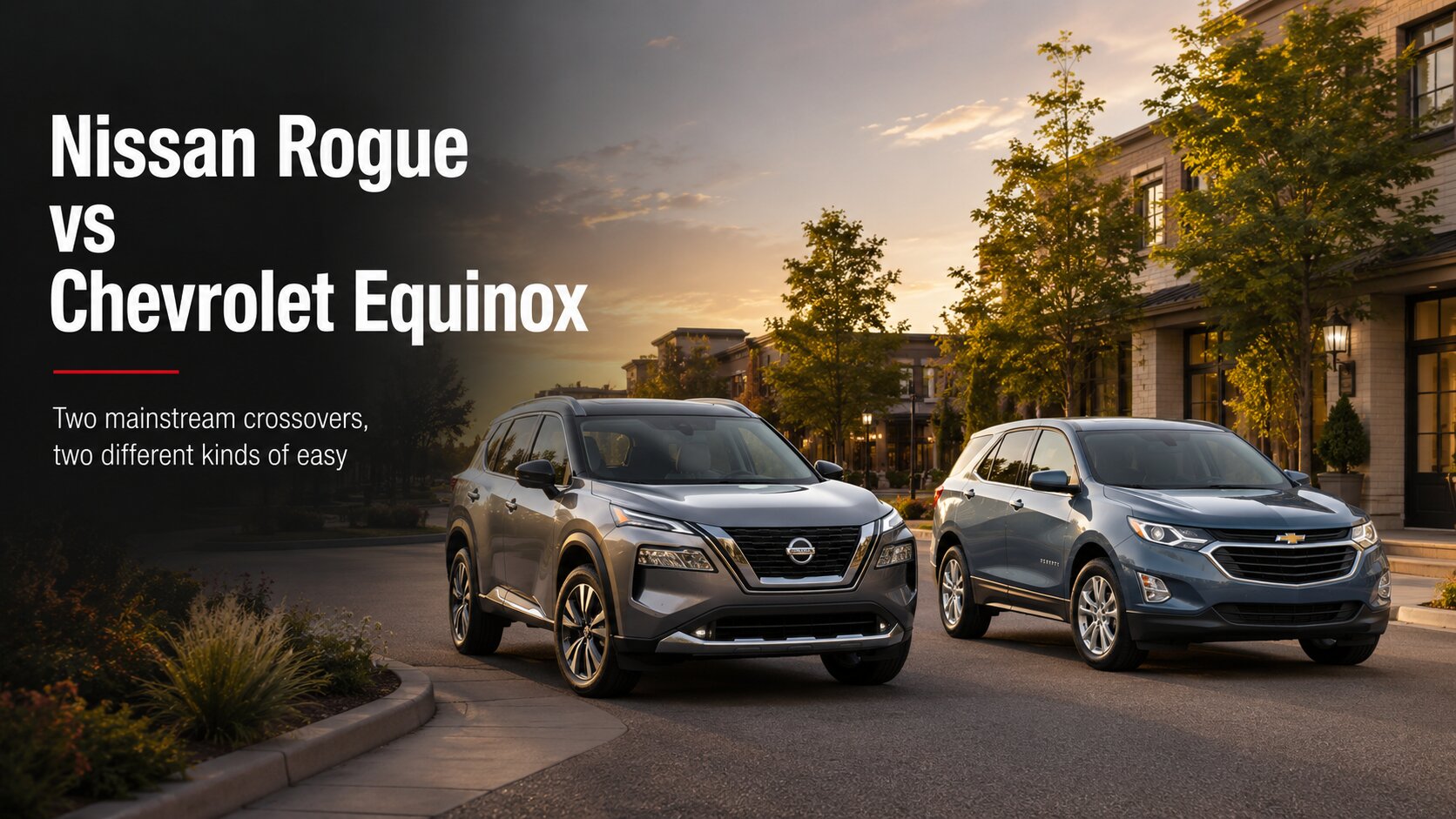
Nissan Rogue vs Chevrolet Equinox: Two Mainstream Crossovers, Two Different Kinds of Easy
I live in Detroit, which means I spend a lot of time watching the American crossover market from the inside. It is the segment where normal life happens. School drop offs. Costco runs. A slushy Tuesday commute that turns into a wet night drive home with glare bouncing off every lane marker. In that world, “easy” matters more than bragging rights.
The Nissan Rogue and Chevrolet Equinox are two of the most familiar faces in this class. They chase the same buyer, but they get there with different personalities and, right now, different points in their product cycles. The Rogue is Nissan’s newer-feeling entry (current generation launched for 2021, with a notable refresh for 2024). The Equinox you see on lots most commonly is the prior-generation model that ran through 2024 with only incremental changes over the years. Chevrolet has an all-new Equinox for 2025, including an EV variant called Equinox EV, but this comparison is about the mainstream gasoline crossovers most people cross-shop in the real world.
To keep this clean and factual: specs vary by model year and trim. I’m using widely published U.S. specifications for recent model years that shoppers are likely to encounter on dealer lots and used listings. Where a figure depends heavily on configuration or isn’t consistently reported across sources, I’ll say so.
The quick reality check: where each one sits in the segment
In size and mission, both are compact crossovers competing with heavy hitters like the Toyota RAV4, Honda CR-V, Mazda CX-5, Hyundai Tucson, Kia Sportage, Ford Escape, Volkswagen Tiguan, and Subaru Forester. The Rogue and Equinox aim for comfort and everyday usability rather than sporty edge.
The big difference is timing. The current Rogue is a newer design with newer powertrain strategy (a small turbo three-cylinder paired to a continuously variable transmission in most recent models). The gas Equinox most shoppers know is older in architecture and uses a conventional turbo four-cylinder with a traditional automatic transmission. That split affects how they feel around town more than you might expect.
Weekday commute: power delivery you notice at 25 mph
Commutes are where you learn whether an engine and transmission combo feels like a helpful assistant or a slightly confused roommate.
Recent Nissan Rogue models use a 1.5-liter turbocharged three-cylinder making 201 horsepower and 225 lb-ft of torque (a widely reported spec for 2023-2025 Rogue). It’s paired with Nissan’s Xtronic CVT and available with front-wheel drive or all-wheel drive.
The Chevrolet Equinox (gas model through 2024) uses a 1.5-liter turbocharged four-cylinder. Output varies by year; in its later years it is commonly listed at 175 horsepower and 203 lb-ft of torque. It pairs with a six-speed automatic on front-wheel-drive versions and a nine-speed automatic on all-wheel-drive versions (again depending on year and drivetrain).
On paper, the Rogue has the advantage you can actually feel in typical city driving: more torque, and it tends to deliver it earlier in the rev range thanks to turbo tuning aimed at low-speed response. The CVT keeps the engine in its sweet spot when you roll into the throttle from a stoplight or merge into a short on-ramp.
The flip side is also familiar if you’ve driven modern CVTs. Under harder acceleration, engine sound can rise without the satisfying step changes you get from a geared automatic. Some drivers do not care at all; others find it mildly irritating when they’re trying to hustle into a gap.
The Equinox’s turbo four with an automatic transmission feels more traditional in how it builds speed. It does not have the Rogue’s headline torque figure, so it can feel less eager if you’re carrying passengers or climbing a grade. But the shifting behavior is conventional, which some people read as “normal” even when it’s not necessarily quicker.
No verified 0 to 60 mph numbers are needed to make this call because most buyers live between 0 and 45 mph. In that range, the Rogue’s torque advantage tends to translate into easier, lighter effort driving.
Grocery run math: cargo space, rear seats, and why inches matter
This is where compact crossovers earn their keep: rear doors opening wide enough for car seats, cargo floors that don’t fight you, and cabin storage that makes daily clutter feel organized instead of shameful.
Cargo volume depends on measurement method (behind second row vs maximum with seats folded), but widely cited EPA cargo figures put the Nissan Rogue around 31.6 cubic feet behind the rear seats and about 74.1 cubic feet with seats folded (recent model years). The Chevrolet Equinox is commonly listed around 29.9 cubic feet behind the rear seats and about 63.9 cubic feet maximum.
In practice that difference shows up quickly if your grocery run includes bulky items like paper towels, dog food bags, or a stroller that refuses to fold flat unless you negotiate with it. The Rogue simply gives you more usable room when you keep the second row up.
Passenger space is closer than cargo numbers suggest; both are legitimate five-seaters for many families. But there’s nuance here too: packaging matters as much as raw volume. The Rogue’s cabin design in this generation has been praised for smart storage spots and an overall airy feel depending on trim (and especially if equipped with a panoramic roof). The Equinox’s interior packaging works fine day to day but reflects an older design era in materials and screen integration.
Kid pickup duty: car seats, door openings, and back-seat peace
If you’ve ever tried to buckle a kid while holding a backpack in one hand and your phone in your teeth because it started raining mid-parking-lot sprint, you know what matters back there: access and comfort.
Both vehicles offer rear LATCH anchors as required; both have rear doors sized for family duty; both can be optioned with heated front seats depending on trim (and sometimes heated rears depending on package). The differences tend to be in seat shape and ride quality rather than headline features.
The Rogue’s ride tuning generally leans toward soft compliance over sharp control. That usually plays well with kid comfort because it rounds off pothole edges instead of sending them straight into little spines. Steering feel is typically light in Nissans of this class; it makes parking lots easy but doesn’t give much feedback through your palms.
The Equinox also prioritizes comfort over sportiness; historically it has had an easygoing ride in this segment too. With its older platform tuning, some trims can feel slightly busier over broken pavement compared with newer rivals depending on wheel size. I’m not going to pretend every Equinox rides worse than every Rogue because tire choice matters a lot here; just know that both are aimed at calmness rather than corner carving.
Wet-night visibility: headlights, driver aids, and stress levels
This is one of those categories where “easy” becomes literal safety margin: how much mental bandwidth does the car demand when conditions are ugly?
Both models offer modern driver-assistance features depending on trim and year: automatic emergency braking, lane departure warning or lane keeping assistance, blind-spot monitoring, rear cross-traffic alert, and adaptive cruise control on higher trims or packages.
Nissan’s ProPILOT Assist system (availability varies by trim) has been part of Rogue’s story for years now as an accessible highway helper combining adaptive cruise control with lane centering assistance under certain conditions. Chevrolet offers Super Cruise on some vehicles in its lineup; however Super Cruise has not been a mainstream feature on the gas Equinox during its prior generation run as commonly configured by buyers (and availability depends heavily on year and trim strategy). For most shoppers comparing typical Rogues and Equinoxes on lots today, you’re looking at conventional adaptive cruise plus lane assist rather than hands-free driving.
Headlight performance is tricky to state as fact without instrumented testing per trim because beam pattern varies by headlamp type (halogen vs LED) and option packages. What I can say without overreaching: both can be equipped with LED lighting in many trims across recent years; both have adequate outward visibility by compact crossover standards; neither has a reputation for class-leading headlight performance across all trims like some premium brands push as a calling card.
Highway trip: noise, stability, and who feels less tiring after two hours
A good road trip car doesn’t have to be exciting; it has to be relaxing at 75 mph while loaded up with humans and their stuff.
The Rogue’s small turbo three-cylinder plus CVT combination tends to keep revs low at steady highway speeds because there aren’t fixed gear steps forcing engine speed changes. That can help cabin calmness when you’re just cruising. When you need to pass quickly or climb hills, the CVT may raise revs more abruptly than an automatic would; some drivers perceive that as noise even if actual acceleration is acceptable.
The Equinox’s automatic transmission behavior tends to feel more familiar during passing maneuvers because it will downshift rather than simply change ratio continuously. Depending on calibration year to year, that can either feel reassuringly direct or slightly indecisive if it hunts gears on rolling terrain.
Both vehicles are available with all-wheel drive (AWD), which helps stability in snowbelt states like mine when roads go greasy. AWD does not shorten braking distances on ice; it mostly helps you get moving without drama and maintain traction under acceleration.
Towing: small numbers still matter when you rent a trailer
Towing capacity isn’t why most people buy these crossovers until suddenly it is because your buddy bought a couch off Facebook Marketplace and now you’re involved.
For recent Nissan Rogue models equipped properly (and depending on year), towing capacity is commonly listed at up to 1,500 pounds.
The Chevrolet Equinox gasoline model is also commonly rated up to 1,500 pounds when properly equipped (again depending on year).
That means neither is your weekend boat hauler; both can handle light utility trailers or small campers within limits if you pay attention to payload ratings, tongue weight guidelines, passenger load, and cooling requirements stated by the manufacturer.
Fuel economy: what EPA numbers suggest about your monthly rhythm
Fuel economy is where small differences add up quietly over years of commuting.
For recent Nissan Rogue models with the 1.5-liter turbo three-cylinder, EPA ratings are widely published around 30 mpg combined for AWD versions (often cited as 28 city/35 highway/31 combined for FWD; AWD ratings typically dip slightly). Exact figures vary by drivetrain and year; check the window sticker or fueleconomy.gov listing for your specific configuration.
For recent Chevrolet Equinox gasoline models with the 1.5-liter turbo four-cylinder, EPA combined ratings are commonly around the mid-20s mpg range depending on FWD vs AWD (often roughly 26 mpg combined for FWD in later years). Again configuration matters; verify per VIN if fuel costs are central to your decision.
Interpreting that like an adult who buys gas weekly: if your driving mix includes lots of highway miles, the Rogue often looks better on paper than an equivalent Equinox gas model from the prior generation era. If your commute is short trips in cold weather where engines rarely warm fully (hello Michigan), real-world mileage will drop for both regardless of EPA ratings.
Tech usability: screens are easy until they aren’t
This class lives or dies by how quickly you can pair your phone while sitting in a parking lot with someone honking behind you because they think every stop sign is optional.
The current-generation Nissan Rogue moved toward larger center screens over time (availability varies by trim), plus modern smartphone integration via Apple CarPlay and Android Auto across many trims in recent years. Wireless phone integration appears on certain trims depending on year; do not assume it without checking equipment lists because manufacturers love making “wireless” part of higher packages.
The prior-generation Chevrolet Equinox also offers Apple CarPlay and Android Auto broadly across trims in recent years via Chevrolet Infotainment systems (screen sizes vary). GM’s interfaces have generally been straightforward for basic tasks like audio selection and navigation mirroring through phone apps.
The more meaningful difference isn’t whether they have CarPlay; it’s how integrated everything feels around it. The Rogue’s newer cabin design tends to present information more cleanly with updated graphics depending on trim level (including available digital gauge clusters on some versions). The Equinox works fine but looks older next to newer rivals because it is older next to newer rivals.
Comfort details that show up after week two
You can learn more about these cars from cupholders than from horsepower charts.
Nissan has made seat comfort something of a brand talking point over the years with its “Zero Gravity” seat marketing across several models including Rogue; many owners do find Nissan seats comfortable for long stints even if that phrase itself belongs in a sci-fi movie poster rather than an owner’s manual. Comfort is subjective though; body types vary wildly.
The Equinox offers comfortable seating too depending on trim upholstery choices; what tends to date it isn’t necessarily cushion shape so much as interior materials choices versus newer designs at similar price points when new.
Cabin storage matters daily: door pockets that hold real bottles, center consoles deep enough for actual stuff, places to toss keys without them sliding into oblivion during turns. Both do this reasonably well because compact crossovers have learned these lessons over decades of family duty. The Rogue’s packaging advantage shows up again when you start stacking strollers plus groceries plus backpacks plus whatever mystery item your kid insists must come along today.
Driving character: light steering vs familiar shifting
I’m careful about claiming firsthand impressions here because I’m not writing this off an instrumented back-to-back test day at Milford Proving Ground or Chelsea right now; I’m leaning on widely reported characteristics of these models across multiple reviews over their lifecycles plus what their mechanical layouts tend to produce.
The Nissan Rogue generally drives like what it is: a modern compact crossover tuned for ease. Steering effort is typically light at parking speeds; body motions are controlled enough for normal use; road isolation is prioritized over communication through the wheel rim.
The Chevrolet Equinox gas model from its outgoing generation generally feels competent but less fresh dynamically compared with newer entries introduced later in the cycle. Its conventional automatic transmission gives it that familiar stepped acceleration sensation many drivers prefer even when objective performance isn’t better.
If your idea of “easy” means seamless low-speed torque delivery without thinking about gears at all, Rogue tends to align better based on specs alone (201 hp/225 lb-ft versus roughly 175 hp/203 lb-ft). If “easy” means predictable shifting feel that matches what you’ve driven for years, Equinox has an argument even if it gives up some punchiness on paper.
Pricing reality (without telling you what to buy)
You asked for ownership factors including price without giving price or value advice, so here’s what can be said cleanly:
MSRP changes every model year and varies sharply by trim level (S/ SV/ SL style ladders at Nissan; LS/ LT/ Premier style ladders at Chevrolet historically). Incentives also fluctuate monthly and regionally and cannot be responsibly stated without real-time data from manufacturers or dealers.
If you’re shopping used or leftover new inventory of the outgoing gas Equinox generation alongside newer Rogues, expect wide spread based purely on age differences alone rather than brand positioning magic. In many markets there are simply more Rogues moving through rental fleets and used listings than people realize; similarly Equinox has been common as fleet inventory too depending on region and year. That affects availability more than brochure promises do.
Maintenance and resale: what we can say without guessing
This category tempts writers into making claims they cannot back up responsibly without comprehensive data sets from sources like Consumer Reports surveys or long-term fleet studies tied to specific model years and powertrains. I’m not going to invent reliability rankings or cost curves here.
What we can state factually:
The Nissan Rogue uses a turbocharged engine paired with a CVT in recent model years. CVTs have historically carried mixed reputations across brands due to early designs from various manufacturers; modern units can be improved but maintenance history matters greatly when shopping used (fluid service intervals vary by manufacturer guidance).
The Chevrolet Equinox uses a turbocharged four-cylinder paired with conventional automatics (six-speed or nine-speed depending on drivetrain/year). Traditional automatics also have their own service needs; again history matters more than internet lore when buying used.
Resale value varies strongly by market demand and competition within each segment year by year. Generally speaking across compact crossovers as a class, Toyota RAV4s and Honda CR-Vs tend to set strong resale benchmarks industry-wide (widely observed), which indirectly pressures everyone else including Rogue and Equinox when shoppers compare used prices later on. Exact residual values require current market data I’m not citing here because they change constantly.
0 comments
Join the discussion around this article.
Please login to comment.