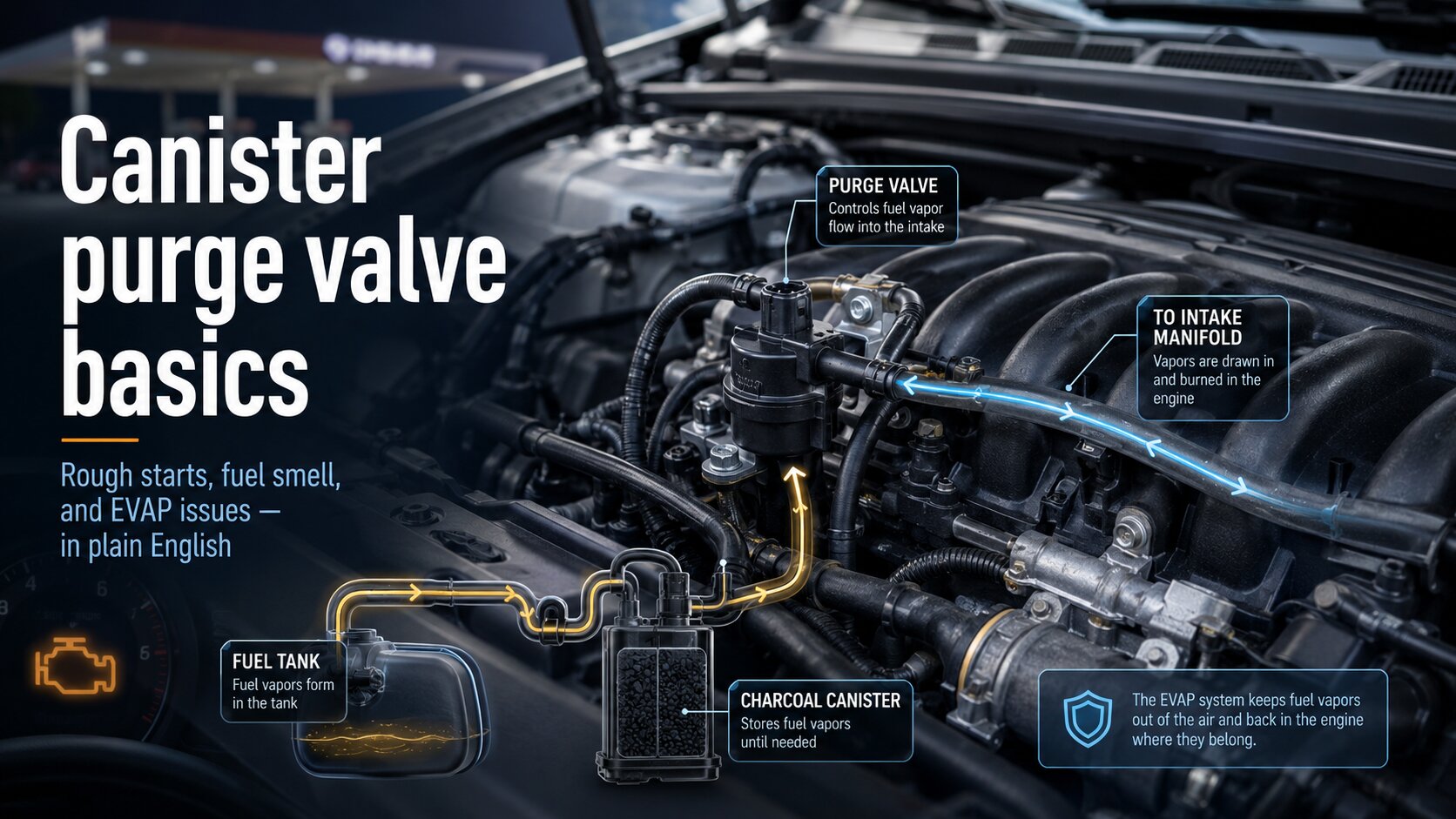
Canister purge valve basics, in plain English
Modern gasoline vehicles are designed so raw fuel vapor does not simply vent to the atmosphere. Instead, vapors from the fuel tank are routed into an EVAP (evaporative emissions) system and stored in a charcoal canister. When operating conditions are right, the engine pulls those stored vapors in and burns them as part of normal combustion. That is where the canister purge valve comes in.
The purge valve (often called a purge solenoid) is an electronically controlled valve that meters fuel vapor from the charcoal canister into the intake manifold. The engine computer opens it in pulses based on temperature, load, and other inputs so the mixture stays stable. When it is closed, it should seal well enough that the intake does not get a steady stream of vapor at the wrong time.
This part is small and usually not expensive compared with major powertrain components, but it can create outsized drivability complaints. Rough starts, a fuel smell, and occasional stalls are all plausible outcomes when purge flow is happening when it should not, or when it cannot happen when it should.
Verified facts: what the purge valve does, how EVAP is monitored, and why this shows up as a “recall type” issue
Here are widely accepted, broadly applicable facts about EVAP systems on U.S. market vehicles:
EVAP purpose: EVAP systems reduce hydrocarbon emissions by capturing gasoline vapors from the tank and storing them in activated charcoal. Those vapors are later purged into the engine to be burned.
Core components: Most systems include a charcoal canister, a purge control valve (underhood), vent control hardware (often near the canister), pressure and temperature sensing (varies by manufacturer), and a network of hoses and lines connecting the tank, canister, and intake.
OBD-II monitoring: Since 1996 model year vehicles sold in the U.S. have OBD-II diagnostics. EVAP is one of the monitored systems. Depending on design, the vehicle may run self-tests that look for leaks (small or large) and verify that commanded purge flow actually changes tank pressure as expected.
Common diagnostic outcomes: A malfunction may illuminate the check engine light and store an EVAP-related diagnostic trouble code (DTC). Widely recognized examples include P0440 (general EVAP fault), P0441 (incorrect purge flow), P0442 (small leak), P0455 (large leak), and P0456 (very small leak). Not every vehicle uses every code in the same way, but these are common OBD-II definitions.
Why this can become recall-related: Some manufacturers have issued recalls or service campaigns over the years for EVAP components including purge valves on certain models and model years. The underlying reason varies by design and supplier. The consistent theme is that an emissions component failure can also create drivability issues or increase evaporative emissions beyond regulatory limits. Because recall coverage is model and VIN specific, owners should verify status through NHTSA.gov or their manufacturer’s VIN lookup tool rather than relying on forum lists.
If you are looking for exact model years or competitors affected, that information is not universal to “purge valve problems.” It depends on brand, engine family, and production run. The reliable approach is VIN-based verification through official sources.
How a failing purge valve creates rough starts, fuel smell, and stalls
The symptoms make more sense once you picture what happens when vapor is introduced at the wrong time.
Rough start after refueling: This is a classic complaint. If a purge valve sticks open or leaks when it should be closed, fuel vapor can be drawn into the intake during cranking or right after startup. That can effectively enrich the mixture beyond what the engine expects during its carefully calibrated cold start routine. Some engines stumble for a few seconds; others may crank longer than normal before catching.
Stalling at idle or low speed: At idle, airflow is low and mixture control is sensitive. An unintended vapor path into the intake acts like an unmetered “fuel source.” The engine may surge, idle roughly, or stall when coming to a stop. Drivers often describe this as intermittent and frustrating because it can disappear once you are back on throttle.
Fuel smell: A purge problem can contribute to fuel odor in a few ways. If vapor handling is compromised elsewhere in EVAP (a stuck vent valve, saturated charcoal canister, cracked hose), vapors may escape near the rear of the vehicle or underhood depending on where the leak occurs. A stuck-open purge valve itself does not automatically mean you will smell fuel in the cabin, but it can be part of an overall system problem that increases vapor release.
Check engine light with “EVAP” codes: Many owners first learn about EVAP because of an illuminated MIL (malfunction indicator lamp). The car may drive normally aside from occasional odd starts or idle behavior. That mismatch between “it seems fine” and “the light is on” is typical of EVAP issues.
The EVAP system’s normal rhythm: when purging should happen
Purge strategy varies by manufacturer, but general patterns hold across many gasoline vehicles:
The engine computer usually avoids purging immediately after a cold start because fuel control is already busy stabilizing combustion as sensors warm up and catalytic converter light-off begins. After warm-up, during steady cruising or light acceleration, purging often ramps up because airflow is predictable and there is enough vacuum to draw vapors through a controlled opening of the purge valve.
If purging occurs at idle or during crank when it should not, you get drivability complaints. If purging does not occur when commanded, vapors remain stored until they overwhelm capacity or trigger diagnostic tests that notice “incorrect flow.” Either way, your daily driving pattern matters. Short trips in cold weather can delay monitors from running, which sometimes means you see symptoms before you see a clear diagnostic pattern.
Overfilling the tank: why it complicates diagnosis (and sometimes causes damage)
Topping off after the pump clicks off seems harmless. In practice it can create messy EVAP side effects.
Your fuel tank needs headspace for vapor expansion. When you repeatedly overfill past automatic shutoff, liquid fuel can enter areas designed for vapor only. That matters because activated charcoal in the canister is meant to store vapor; liquid gasoline can saturate it. A saturated canister may release strong odors and may shed charcoal dust into lines on some designs. It also makes purge behavior harder to interpret because now you have both a possible control issue (valve operation) and a storage issue (canister capacity).
Even if nothing breaks outright, overfilling muddies troubleshooting: a technician may see an EVAP code or hard-start-after-refuel complaint that looks like a faulty purge valve when the real trigger was liquid fuel ingestion into EVAP plumbing. The cleanest advice is also the simplest: stop fueling at first click. If your vehicle routinely needs more range between stops, plan for one extra fill-up rather than forcing extra ounces into the neck.
Common symptoms checklist: what to notice before you book service
A good service visit starts with good observations. These details help separate purge-valve behavior from other common issues such as weak batteries, ignition misfires, vacuum leaks unrelated to EVAP, or low fuel pressure.
Pay attention to timing:
Does it stumble only after refueling? Only on cold mornings? Only after short trips? Does it happen with a full tank but not at half tank? Patterns matter.
Note how long symptoms last:
A rough idle for five seconds after start suggests something different than a persistent misfire under load.
Smell location:
If you smell raw fuel outside near the rear wheel area after parking in a garage, mention that specifically. If odor appears only underhood with windows down at stoplights, say so too.
Driveability context:
If stalling happens when coming off highway speeds onto an exit ramp or when shifting into gear on an automatic transmission vehicle, that detail helps narrow down whether airflow transitions are triggering an issue.
What codes mean and what they do not
An EVAP code points you toward a system but rarely identifies one part with certainty without testing.
P0441 (incorrect purge flow) often puts suspicion on purge control because it indicates commanded flow does not match expected results. Still, restricted lines, vent faults, sensor interpretation problems (where equipped), wiring issues to the solenoid, or even unusual fueling habits can contribute.
P0455 (large leak) frequently turns out to be something simple like a loose gas cap on cap-equipped vehicles or damage around filler neck sealing surfaces. On capless systems it can be debris in the sealing door or filler neck issues. A purge valve stuck partially open can also mimic certain leak-test failures on some designs because it creates an unintended path between intake vacuum and tank vapor space during self-tests.
If your vehicle has no check engine light but has strong symptoms after refueling, do not assume there will always be stored codes waiting. Some faults are intermittent; some monitors only run under specific conditions; some vehicles store pending codes that do not mature into a MIL until they repeat.
Purge valve failure modes technicians actually see
The typical real-world problems fall into three buckets:
Stuck open or leaking when closed: This aligns with hard starts after refuel and rough idle complaints because vapors enter at inappropriate times.
Stuck closed or restricted: Vapors cannot be purged effectively; this tends to produce EVAP codes without dramatic drivability symptoms for many drivers until storage capacity becomes an issue.
Electrical control problems: The solenoid may be mechanically fine but electrically open-circuit or shorted; wiring harness damage and connector corrosion happen too depending on location and heat exposure.
No DIY bypassing: safe owner checks that stay within emissions rules
This topic attracts questionable advice online because people want quick fixes for check engine lights. Avoid bypassing emissions equipment or modifying hoses to “make codes go away.” That can be illegal in many jurisdictions and often creates new drivability problems.
You still have practical steps you can take before service:
Tighten fueling habits: Stop at first click for several tanks and note whether post-refuel rough starts improve.
Inspect obvious items without disassembly: Look for cracked or disconnected hoses you can see near the intake manifold area if accessible without removing covers. Do not force brittle plastic fittings.
Check your gas cap situation: If your vehicle uses a removable gas cap, inspect its seal for cracks and ensure it clicks tight as designed. If your vehicle uses capless refueling hardware, keep dirt out of the filler area and make sure any provided funnel is used correctly only when needed.
Use an OBD-II scan tool responsibly: Reading codes is fair game for owners in most contexts; clearing codes repeatedly without fixing anything is where people get stuck in circles because monitors reset and symptoms return later with less useful data captured.
What to document for your technician (this saves time and money)
If you want results without paying for unnecessary parts swaps, bring organized information:
DTCs and freeze-frame data: If you have access to code readouts including freeze-frame snapshots (engine temp, RPM, load), capture them before clearing anything. Many shops will pull this anyway; having your own record helps if symptoms are intermittent.
A symptom log tied to fuel level: Write down date/time; ambient temperature; whether you just refueled; how much fuel you added; whether you topped off; how long cranking lasted; whether it stalled; whether smell was present.
Your fueling station context: It sounds minor but note if issues began after switching stations or if pump shutoff seems inconsistent. This does not prove bad fuel; it just gives context if liquid carryover into EVAP is suspected from repeated overfill behavior or unusual nozzle shutoff behavior.
A short video helps: A 20-second clip of extended cranking right after refuel or an unstable idle gives a technician something concrete to match against scan data.
If there is an open recall: how to handle it cleanly
If you suspect your vehicle might be covered by an emissions-related recall involving EVAP components such as a purge valve, verify with your VIN using NHTSA’s recall lookup tool or your manufacturer’s official site. Recall scope depends on model year ranges and build dates; internet lists are often incomplete or overbroad.
If coverage exists, schedule with a dealer service department first rather than paying out of pocket elsewhere. Bring your documentation anyway because recalls address specific failure modes but do not automatically cover every related symptom if additional parts were affected by fueling habits or unrelated wear items.
The ownership angle: what this feels like day to day
Purge valve problems sit in an annoying middle ground for many owners. The car might cruise quietly on the highway with no drama yet act up at exactly the wrong time: pulling away from a gas station with traffic behind you or idling in a drive-through line where stalls feel more embarrassing than dangerous.
The upside is that EVAP repairs are typically straightforward once diagnosed correctly because access is often underhood for the purge valve itself (though some layouts bury components under covers). The bigger time sink tends to be diagnosis when multiple small issues overlap: overfilled tanks saturating charcoal media, aging hoses that seep vapor only under certain temperatures, or intermittent electrical faults that only appear after heat soak.
A practical closing checklist
If you suspect your canister purge valve or EVAP system is behind rough starts, fuel smell, or stalling:
1) Stop topping off after first click for several fill-ups.
2) Record when symptoms occur relative to refueling and temperature.
3) Pull codes once if possible; save freeze-frame data.
4) Avoid clearing codes repeatedly before diagnosis.
5) Verify recalls by VIN through official sources.
6) Book service with clear notes so testing targets likely causes instead of guesswork.
Treated methodically, this is usually a solvable problem rather than an ongoing mystery light on your dash.
0 comments
Join the discussion around this article.
Please login to comment.