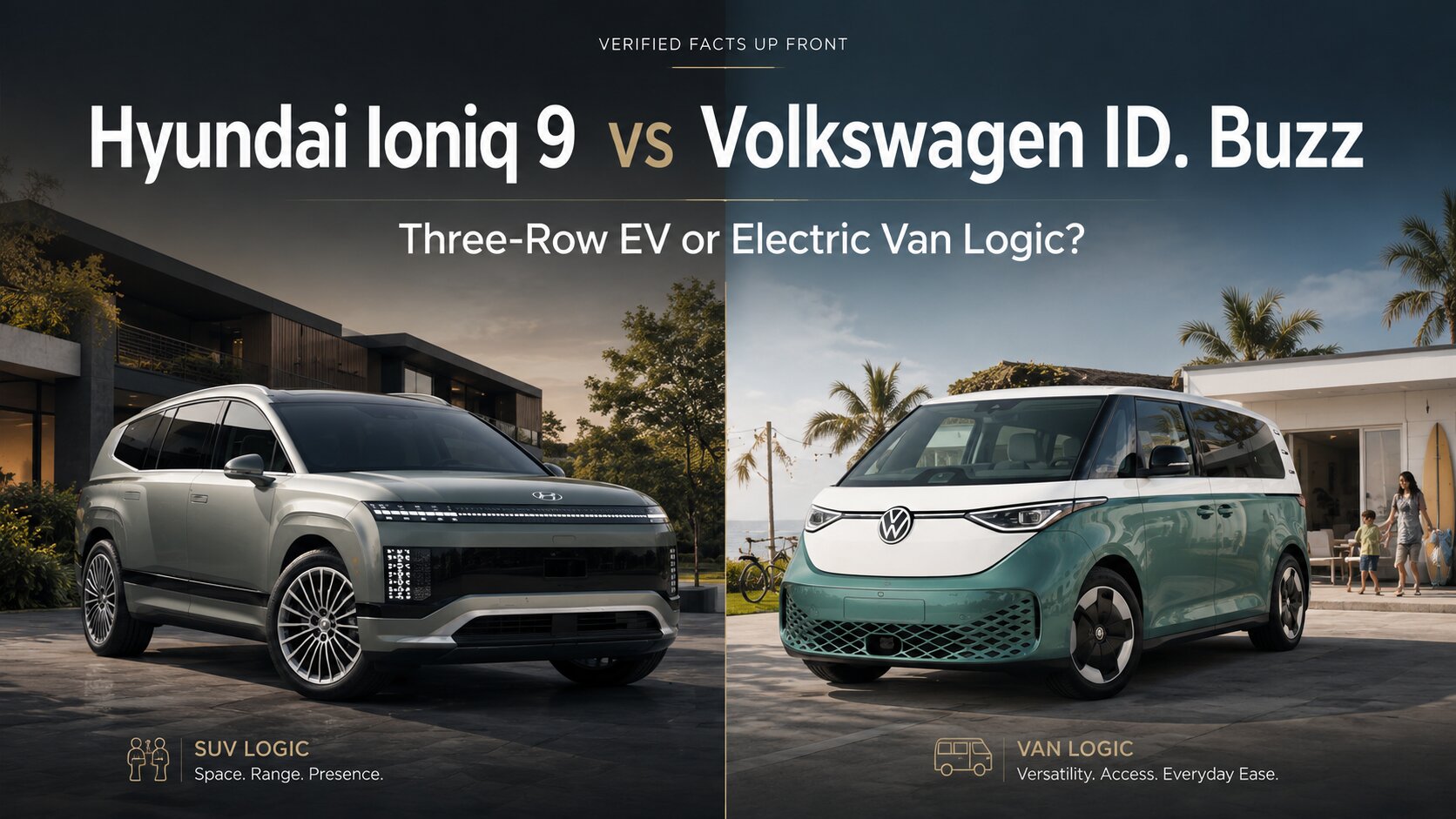
Hyundai Ioniq 9 vs Volkswagen ID. Buzz: Three-Row EV or Electric Van Logic?
There are two very different ways to electrify a family hauler. One is the familiar three-row SUV: tall, wide, and styled to look “premium” in the school pickup line. The other is the van, unapologetically shaped around people and stuff, with a cabin you move through instead of climbing into.
Hyundai’s Ioniq 9 and Volkswagen’s ID. Buzz land on opposite sides of that divide. Both are battery-electric. Both aim at American families who want space without gas stops. But their priorities are not the same, and that shows up everywhere: how you sit, how you load cargo, how you road-trip, and even how you think about range.
A quick honesty note before we get deep: the Hyundai Ioniq 9 is a new model for the U.S., and not every U.S.-spec number has been finalized in public sources at the time of writing (especially final EPA range and some trim-specific details). The Volkswagen ID. Buzz is on sale in the U.S. for the 2025 model year, with many key specs already published by VW, but EPA range also depends on final certification and configuration. Where data is not yet officially released or widely confirmed, I’ll say so plainly.
What these two EVs are really trying to be
Hyundai Ioniq 9: A full-size, three-row electric SUV positioned as a bigger sibling to the Ioniq 5 and Ioniq 6. It rides on Hyundai Motor Group’s E-GMP architecture (the same family of underpinnings used by vehicles like the Kia EV9). The pitch is modern SUV comfort with serious charging capability and family-friendly seating.
Volkswagen ID. Buzz: A modern electric take on VW’s Microbus idea, but engineered as a practical people mover first. In the U.S., VW sells it in a long-wheelbase, three-row configuration (for the 2025 model year). It is still a van in spirit: big doors, upright glass, and packaging that favors walk-up usability over aggressive stance.
If you’re shopping purely with your eyes, the decision can feel obvious. If you’re shopping with kids, strollers, sports gear, aging parents, or a big dog in mind, it gets more interesting fast.
Powertrains and performance: muscle vs momentum
The headline difference is that both can be quick enough for daily life, but they deliver speed differently.
ID. Buzz (U.S.): Volkswagen has stated U.S.-spec ID. Buzz models use dual-motor all-wheel drive with 335 horsepower. That is a meaningful jump over many mainstream three-row crossovers in everyday passing power, and it should help the Buzz feel less like an old-school van when you merge onto a fast freeway.
Ioniq 9 (U.S.): Hyundai has announced the Ioniq 9 for the U.S., but final U.S.-spec horsepower figures by trim were not fully confirmed in widely available official sources at the time of writing. Based on Hyundai’s broader E-GMP playbook and what we see in related vehicles like Kia’s EV9 (which offers multiple outputs across RWD and AWD trims), it is reasonable to expect multiple power levels depending on configuration. Still, “reasonable to expect” is not a spec sheet, so treat performance comparisons as provisional until Hyundai publishes final U.S. numbers.
What matters on the road: vans and big SUVs carry weight high and wide; they do not need sports-sedan reflexes to feel good. They need smooth torque delivery for merging, predictable traction in rain, and calm behavior when loaded with people. The ID. Buzz’s dual-motor setup suggests confident all-weather acceleration without drama. The Ioniq 9 should deliver similarly effortless EV torque if it follows Hyundai’s recent tuning habits, but we should wait for confirmed outputs before declaring a winner on straight-line punch.
Towing: what’s known, what isn’t
Towing is where marketing often gets fuzzy with EVs because range drops sharply when you hook up a trailer.
ID. Buzz: Volkswagen has published towing capability for some markets and configurations internationally, but U.S.-market towing capacity can vary by certification and equipment. At the time of writing, a definitive U.S. towing rating was not consistently confirmed across trusted sources. If towing matters to you (small camper, utility trailer, jet skis), this is one you verify on VW’s U.S. site or the door-jamb label of the exact vehicle you’re buying.
Ioniq 9: Hyundai has not broadly finalized U.S.-spec towing ratings in widely available official materials at the time of writing. Again, this will likely vary by drivetrain and cooling package choices if offered.
The practical takeaway: neither of these should be treated like a half-ton pickup substitute just because they are large. For many families, “towing” really means a light trailer a few weekends per year; either could fit that lifestyle once ratings are confirmed. If you tow often or tow heavy, you will want official numbers plus a realistic plan for charging stops because towing can turn an easy road trip into a more frequent-charge routine.
Efficiency and range: EPA reality check
This is where EV shopping turns from vibes into math.
ID. Buzz: Volkswagen has publicly discussed battery size for the U.S.-market ID. Buzz (a larger pack than some earlier European versions), but final EPA range figures depend on certification and trim. At publication time here, EPA range numbers were not universally available across all trims in trusted sources. If you see ranges quoted online, check whether they are EPA-certified numbers or estimates from other markets’ test cycles (which are not interchangeable).
Ioniq 9: Hyundai has shown global-spec information for Ioniq 9 including battery details in announcements, but U.S.-market EPA range figures were not yet released at time of writing.
Instead of pretending we know exact miles today, it’s more useful to talk about how these shapes tend to behave in American conditions:
SUV shape vs van shape: Aerodynamics matter at highway speed more than most people expect. A big three-row SUV can be slippery if its roofline tapers and its underbody is managed well. A van’s tall, blunt profile can pay an efficiency penalty at 70 to 80 mph even if it is brilliant around town. That does not mean the Buzz will be “bad,” it just means its design priorities lean toward space efficiency rather than wind-cheating elegance.
Your real-world range swing: Cold weather heating loads, high-speed cruising, roof boxes, chunky tires, and full passenger loads all pull range down. Both vehicles will be sensitive to those factors simply because they are large EVs moving lots of air.
Charging: road-trip rhythm matters more than peak numbers
The best family EV is often the one that charges in a way that fits your patience level.
Ioniq 9 (likely advantage here): Hyundai’s E-GMP vehicles are known for their fast DC charging capability on 800-volt class architecture (as seen in Ioniq 5/6). Hyundai has positioned Ioniq 9 within that technology family globally; however final U.S.-spec charging performance should be confirmed by Hyundai. If it follows other E-GMP products closely, it should be competitive for quick DC fast charging sessions when conditions are right (warm battery, capable charger).
ID. Buzz: Volkswagen’s current MEB-based products typically use a lower-voltage architecture than E-GMP and have historically posted solid but not class-leading peak charge rates depending on model year and battery size. For the U.S.-spec Buzz specifically, you should rely on VW’s published max DC charging rate for your trim once finalized. Charging curves matter as much as peak kW; families feel curve quality when they are trying to add meaningful miles during a bathroom break.
NACS/CCS reality in America: The public-charging landscape is improving but still uneven depending on region. Many new EVs are moving toward Tesla’s NACS connector standard; availability of native NACS ports or adapters varies by brand rollout timing and model year agreements. For these two vehicles specifically, connector type and adapter strategy should be verified by model year and build date, because this area is changing quickly across the industry.
If you road-trip often with kids: charging stops need to be predictable more than they need to be heroic. A vehicle that charges slightly slower but does so consistently can feel easier than one that hits huge peaks only when everything lines up perfectly.
The driving experience: calm competence vs big-box confidence
I’m not going to pretend I’ve done instrumented back-to-back testing here; what follows is grounded in what these layouts typically deliver plus what manufacturers have stated about their setups.
ID. Buzz on the road: The seating position is upright and forward like a classic van, which gives you an easy sense of where the corners are while parking or threading through tight streets. That “command view” tends to reduce stress when you’re maneuvering something this tall. With dual-motor AWD power (335 hp), it should feel brisk leaving lights even when loaded up.
The tradeoff many vans make is that they can feel more affected by crosswinds at highway speeds due to their profile. Good stability control tuning helps a lot here; still, if your daily drive includes long exposed highway stretches or gusty plains states routes, pay attention during your test drive.
Ioniq 9 on the road: Three-row SUVs generally feel more like big cars than vans do because their seating position is lower relative to roof height and their bodies tend to be shaped around aero stability at speed. If Hyundai tunes it like its recent EVs (which often prioritize smoothness over hyperactive steering), expect an easygoing vibe rather than edgy handling.
The biggest day-to-day difference may come down to what your brain prefers: van visibility that feels natural at low speeds versus SUV highway calm that feels settled during long cruises.
Cabin design personality: lounge SUV vs cheerful bus
This comparison gets fun because both vehicles lean hard into identity.
ID. Buzz: The Buzz looks like nothing else in a parking lot right now. Inside, VW tends to lean modern-minimal with big screens and clean surfaces on recent EVs; depending on trim choices it can also feel playful rather than sternly upscale. The key “van logic” detail isn’t color palettes though; it’s how open everything feels thanks to upright glass and an airy cabin layout.
Ioniq 9: Hyundai has been pushing an upscale-tech vibe in its newer EV interiors with clean horizontal lines and lots of storage thinking (especially in E-GMP products). In an SUV body style you usually get more center-console structure between driver and passenger than you do in vans; some buyers love that cockpit feeling because it makes a large vehicle feel organized instead of cavernous.
The third row: who fits back there without negotiating?
If you’re shopping either of these vehicles seriously, you probably care about third-row reality more than brochure photos.
ID. Buzz advantage (packaging): Vans have an inherent edge because their roofs stay high farther back and their floors tend to be flatter in usable areas. That often translates into better headroom access getting into row three and less of that “knees-up” posture that plagues many three-row SUVs when adults sit behind adults.
Ioniq 9 advantage (SUV ergonomics): A three-row SUV can still do third-row comfort well if wheelbase is long enough and seat mounting points are smartly done; plus SUVs sometimes deliver better under-thigh support compared with some vans’ flatter cushions (this varies widely). Since final U.S.-spec seat dimensions for Ioniq 9 trims are not fully established publicly yet, consider this one an open question until you sit in it yourself.
A small but real detail: third-row access matters as much as third-row space. If your family uses row three daily for kids or carpools rather than occasional emergencies, sliding second-row seats that move easily with child seats installed becomes priceless.
Cargo shape: this is where van logic usually wins
This might be the most important section for people who actually use their vehicles hard.
ID. Buzz: The boxy rear opening tends to make cargo easier to stack without wasting airspace above luggage or grocery bags tipping over behind raked glass. You also get that classic van benefit: bulky items like flat-pack furniture or big strollers usually load with fewer angles and fewer scratches along tight trim pieces.
Ioniq 9: SUVs can offer plenty of cargo volume on paper but still frustrate you with tapering rooflines or narrower rear apertures depending on styling priorities. On the flip side, SUVs sometimes provide deeper underfloor storage wells for charging cables or muddy gear because designers expect people to stash stuff out of sight.
If your life includes sports tournaments or airport runs with six people plus bags: cargo shape beats cargo volume almost every time.
User experience tech: screens are easy; everyday controls are harder
This part changes quickly year by year via software updates and mid-cycle refreshes; still there are some brand tendencies worth watching closely during your test drive.
ID. Buzz tech vibe: VW’s recent infotainment systems have improved over earlier iterations but still receive mixed feedback from owners across models regarding menu depth and touch control dependence (this is general brand context rather than Buzz-specific long-term data). In daily use with kids asking for temperature changes from row two while you’re navigating traffic, physical controls can matter more than screen size.
Ioniq 9 tech vibe: Hyundai has generally earned praise for clear screen layouts and sensible driver assistance controls across several recent products; again this is brand pattern context rather than verified Ioniq 9 owner data since it is new. If Ioniq 9 carries over Hyundai’s approach from other Ioniq models with straightforward shortcut buttons or well-labeled steering wheel controls (to be confirmed by final U.S.-spec interior), that could reduce friction day-to-day.
No matter which direction you lean: bring your phone(s) when you test drive. Pair them quickly in the lot if possible. Check wireless charging placement if offered because some pads cook phones or fail with thicker cases depending on design.
Comfort: ride quality beats acceleration once you have kids onboard
A three-row family EV has one job most days: keep everyone calm while covering distance quietly.
ID. Buzz comfort expectations: The long wheelbase format sold in the U.S. should help ride smoothness over choppy pavement simply because longer wheelbases tend to settle down pitch motions better than short ones do (all else equal). The upright seating also makes it easier for passengers prone to motion sickness since they can see out naturally instead of staring at seatbacks.
Ioniq 9 comfort expectations: Large SUVs built on dedicated EV platforms often feel impressively quiet around town thanks to minimal powertrain noise; then tire noise becomes the main soundtrack at speed depending on tire choice and sound insulation strategy. If Hyundai prioritizes isolation as it often does in family-oriented models, Ioniq 9 could feel very “grown up” during freeway cruising.
The honest caveat: wheel size options can make or break ride comfort on both vehicles. Big wheels look great under showroom lights; smaller wheels frequently ride better over broken American pavement while also helping efficiency slightly.
Ownership basics without price talk: maintenance needs and long-term unknowns
You asked for ownership factors including maintenance and resale while avoiding price chatter or incentives talk; fair request because those topics get noisy fast with EVs.
Maintenance: Both vehicles avoid oil changes entirely and reduce brake wear thanks to regenerative braking (how much depends on regen tuning and driving style). Typical EV maintenance still includes tires (often sooner due to weight), cabin air filters, brake fluid intervals per manufacturer schedule, coolant service for battery thermal management per schedule, wiper blades, alignment checks especially if potholes are common near you.
Batteries and warranties: In the U.S., both brands traditionally offer competitive powertrain coverage compared with some rivals (verify current warranty terms by model year). Battery warranty terms vary by manufacturer policy; check official documents rather than dealer summaries since fine print matters (capacity retention language especially).
Resale value: Resale is hard to predict honestly right now because EV market values have been volatile across brands due to rapid tech improvement cycles and shifting demand patterns (widely observed industry trend). Historically speaking as brand context only: Volkswagens have had mixed resale outcomes depending on model; Hyundai values vary widely by segment as well. For these two niche-ish family EVs specifically there isn’t enough long-term used-market history yet for clean certainty.
The daily charging routine: home setup decides whether either feels effortless
If there’s one thing experienced EV owners agree on, it’s this: home charging changes everything more than any option package does.
If you can install Level 2 charging at home: Both vehicles become dramatically easier to live with because you wake up “full” most mornings without thinking about public chargers unless you road-trip frequently or have very long commutes.
If you cannot charge at home reliably: Your experience will hinge on local fast-charging availability near work or along routine errands routes. In that scenario charging speed consistency matters even more than peak numbers because you’ll be doing short top-ups often rather than occasional long sessions.
A practical note many shoppers miss: large-battery EVs can take longer on Level 1 outlets (120V) than people expect; Level 1 works best as emergency backup or very low-mileage daily driving support rather than primary fueling for big family haulers.
SUV logic vs van logic: which lifestyle fits which shape?
This debate sounds philosophical until you live with sliding doors versus conventional doors for six months.
ID. Buzz “van logic” strengths:
You get easier third-row access flow because vans naturally prioritize walk-through space and door openings sized for humans carrying bags while stepping around car seats. Sliding doors (where equipped) can be a sanity saver in tight parking spots next to other cars or garage walls since kids cannot swing them into someone else’s paintwork as easily as hinged doors can.
You also get cargo loading simplicity due to that square rear opening; it turns messy life stuff into less of a puzzle game.
Ioniq 9 “SUV logic” strengths:
You get an image many buyers still prefer plus potentially better aero stability at highway speeds depending on final design execution which can translate into calmer long-distance cruising manners in windy conditions (not guaranteed but common). SUVs also sometimes offer higher perceived ground clearance confidence for snowy driveways or rutted campsites even though neither vehicle should be treated like a rock crawler unless specifically engineered that way.
Main competitors worth keeping in mind while shopping
This comparison exists inside a broader wave of family-sized EVs arriving quickly in the U.S., so cross-shopping is normal even if your heart says “Buzz” or “Ioniq.” Widely recognized alternatives include:
- Kia EV9: Another three-row E-GMP-based SUV with published U.S.-market specs including multiple power outputs depending on trim; often considered one of the most direct functional rivals to Ioniq 9 once Hyundai finalizes its lineup details.
- Tesla Model X: Three rows available; different packaging approach with emphasis on performance/efficiency tradeoffs depending on configuration; pricing positioning varies widely over time so check current listings if cross-shopping without anchoring expectations too hard.
- Rivian R1S: Three rows available; stronger adventure positioning; excellent capability reputation but very different ownership ecosystem compared with mainstream brands.
- Not fully electric but relevant because it offers minivan packaging plus significant electric-only driving for many commutes while keeping gasoline backup for road trips without charging stops (different philosophy entirely).
The point isn’t that one of these makes your choice wrong; it’s that if third-row space is non-negotiable there are now multiple ways to solve it depending on how much van practicality versus SUV familiarity you want.
0 comments
Join the discussion around this article.
Please login to comment.