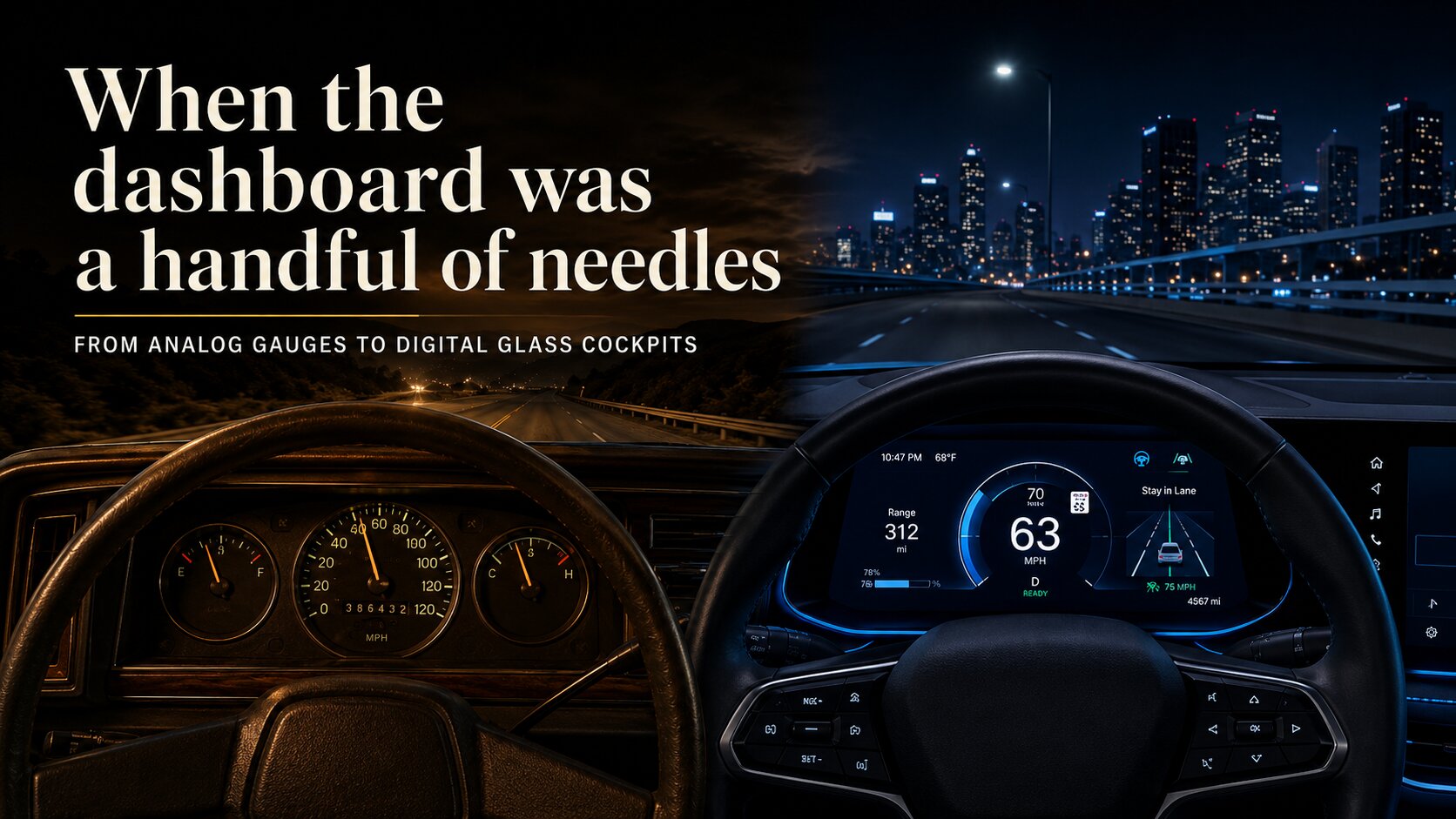
When the dashboard was a handful of needles
Picture an older American sedan at night, the kind that smells faintly of vinyl and heater dust. The dash is a simple stage: a speedometer needle sweeping over white numerals, maybe a fuel gauge that never quite tells the truth, and a few warning lights that feel more like scolding than information. For decades, that was the deal. The instrument panel existed to answer a few urgent questions: How fast am I going? Is the engine hot? Do I have gas? Everything else lived in the sounds and vibrations you learned to read as you racked up miles.
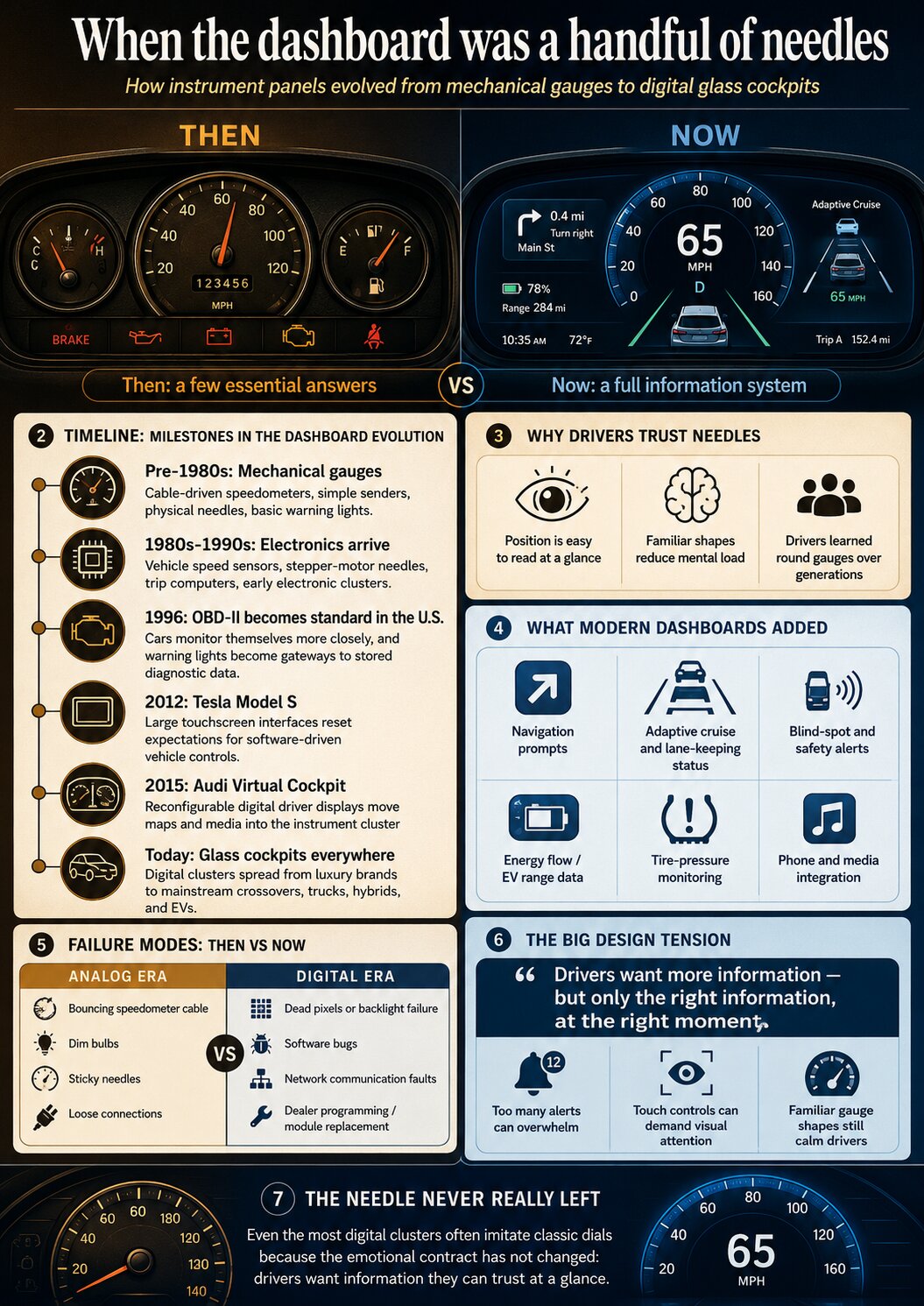
Those early gauges were literal machines. Speedometers were typically cable driven off the transmission, with spinning magnets and springs translating rotation into a needle position. Oil pressure and coolant temperature often came from simple senders, and in some eras and segments, “gauges” were partly theater: damped or non linear so they would not alarm drivers with normal fluctuations. That mix of honest measurement and curated calm shaped driver trust in a way we still feel today. People believed needles because they looked physical, but plenty of owners also learned that the needle could be vague by design.
The first big shift: electronics sneak in
By the late 20th century, cars were already becoming computers under the hood. Electronic engine control units and sensors spread quickly as emissions rules tightened and fuel economy mattered more. Even before screens took over, dashboards started to reflect that change. Mechanical cables gave way to electronic vehicle speed sensors on many models, and clusters began using stepper motors to move needles. To most drivers it still felt analog. The needles moved, the backlighting glowed, and the car still “talked” in the same language.
But the relationship between car and driver was changing. The dashboard became less about direct mechanical truth and more about what the car’s network decided to report. That brought real benefits. Electronic systems can be more accurate, they can self diagnose, and they can drive features like trip computers that became common in U.S. family cars by the 1980s and 1990s. It also introduced new failure modes: dead pixels on early displays, flaky solder joints in clusters, sensors that lied convincingly, and warning lights triggered by a glitch rather than a real emergency.
Digital dashboards before they were cool (or good)
If you want an early pop culture snapshot of “the future,” it is hard to beat the digital instrument clusters that appeared in some late 1970s and 1980s cars. General Motors famously offered digital displays on certain models in that era, including versions of the Chevrolet Corvette. These clusters used vacuum fluorescent or early electronic displays rather than LCDs as we think of them today. They looked space age in brochures and sometimes felt less charming at 60 mph on a bumpy interstate when your eyes wanted a stable reference point.
The appeal was obvious: numbers are precise, fonts are modern, and once you have a display you can show more information without adding more gauges. The drawbacks were just as real in typical daily use. Early digital clusters could be harder to read in bright sun or at certain angles depending on technology used, and when they failed, they often failed expensively compared with a cable and needle. Trust is fragile in cars; if your speed readout flickers once on your commute, you remember it for months.
OBD-II changed what drivers expected to know
A huge but quiet milestone arrived in the mid 1990s with standardized onboard diagnostics. In the U.S., OBD-II became required for most new passenger vehicles starting with the 1996 model year. This was not about pretty screens; it was about data access and emissions monitoring. Still, it changed dashboards indirectly by normalizing the idea that cars constantly monitor themselves.
The “check engine” light became a cultural character all its own. It also trained drivers to accept an odd bargain: you get less direct feedback through gauges, but more abstract warnings tied to computer logic. For many owners, that meant buying an inexpensive scan tool or visiting an auto parts store for code reads. The dashboard was no longer just an interface; it was a gatekeeper to information stored elsewhere in silicon.
Luxury led the screen invasion
The first wave of modern screen driven interiors did not start with instrument clusters. It started with center stacks: navigation screens, audio menus, climate controls migrating from knobs to buttons to software layers. Luxury brands pushed this early because they could charge for it and because their buyers expected novelty.
In American driveways, this is where skepticism set in. A touchscreen is great when it works like your phone, but cars live harder lives than phones: heat soak in summer parking lots, freezing mornings, years of vibration, coffee spills, glare through steep windshields. Drivers learned new kinds of failure modes too: delaminating screens on some older systems, laggy interfaces as software aged, or features locked behind menus when all you wanted was to turn down the fan while merging onto I-95.
Tesla makes the screen the whole point
No company did more to normalize “the car is a screen” than Tesla. The Model S arrived for the 2012 model year with a large vertically oriented center touchscreen that controlled many core functions. It also leaned hard into over-the-air software updates, which helped sell Americans on the idea that your car could improve after you bought it.
Tesla’s approach had ripple effects across competitors because it reset consumer expectations for interface size and responsiveness. It also highlighted a modern tension: software can add features quickly, but it can also change behavior overnight. For some drivers that feels exciting; for others it is unsettling because familiarity is part of safety. A speedometer needle does not move to a new menu after an update.
The “glass cockpit” arrives behind the wheel
Center screens were only half the story. The real psychological leap came when automakers replaced traditional gauge pods with reconfigurable digital instrument clusters: LCD panels that can mimic analog dials one moment and become maps or driver assistance visualizations the next.
A widely cited milestone here is Audi’s Virtual Cockpit, introduced on the Audi TT for the 2015 model year (U.S.). It put navigation and media front and center in a high resolution digital cluster directly ahead of the driver. Other brands followed quickly with their own configurable clusters across luxury segments and then mainstream trims as costs fell.
This is where dashboards started behaving like aviation inspired glass cockpits in spirit if not in regulation or redundancy philosophy. You could change layouts; you could prioritize different information; you could make your tachometer huge or shrink it away entirely depending on mood or drive mode.
Why people trust needles (even when they are fake)
There is an irony in modern clusters: many “analog” looking gauges today are digital simulations driving stepper motor needles or pixels arranged as dials. Yet drivers often report feeling calmer with round gauges than with raw numbers floating on a screen.
Part of that is human perception. A needle’s position gives you quick context without reading digits. Part of it is habit formed over generations of driving classes and family road trips where someone said “keep it under three thousand rpm” while pointing at a dial.
Automakers know this, so even fully digital clusters frequently offer classic layouts as an option. It is not nostalgia only; it is usability insurance.
More data than ever, but attention is still limited
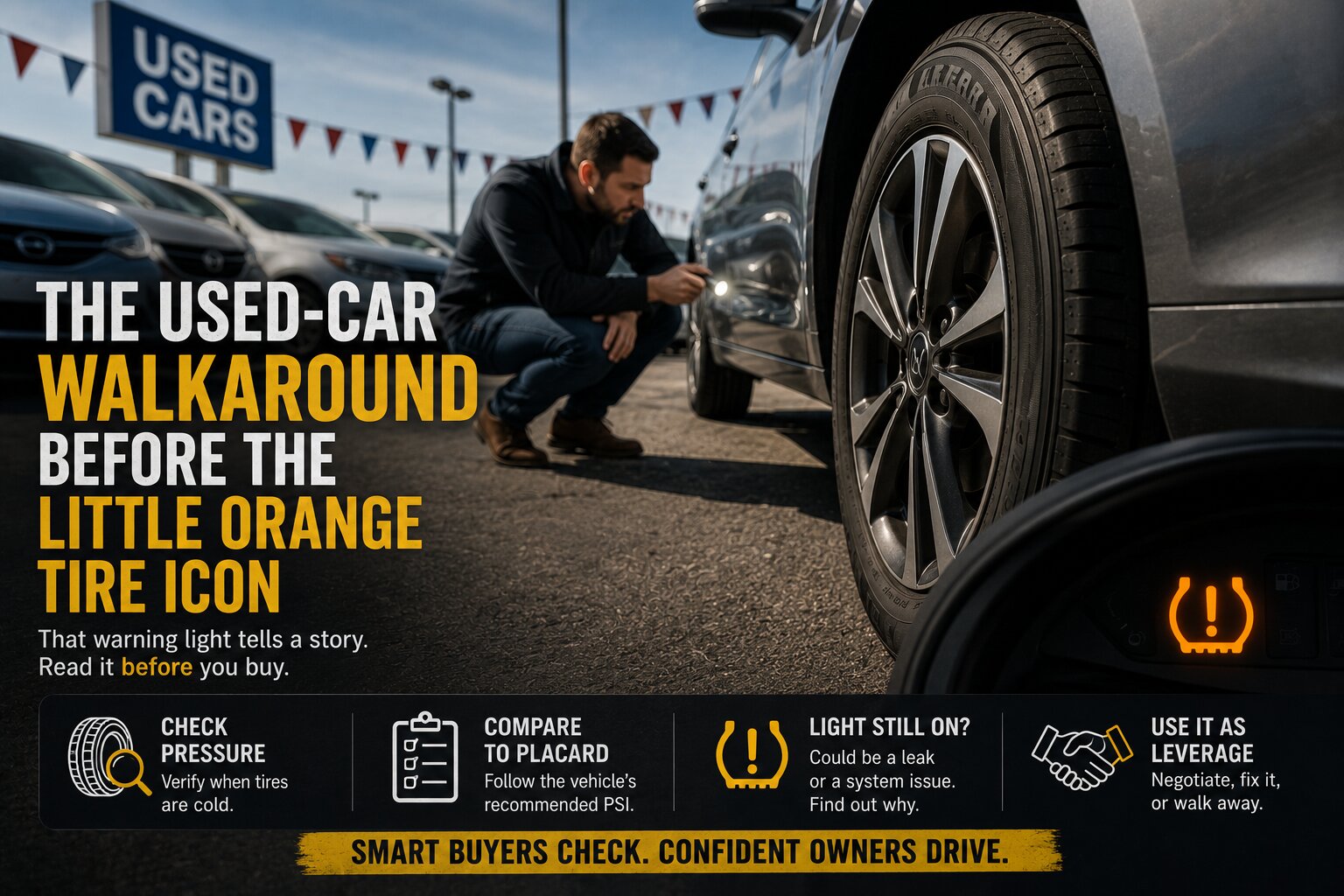
The modern dashboard has to juggle more information than any previous era: adaptive cruise control status, lane keeping indicators, blind spot alerts, navigation prompts, phone notifications, energy flow graphics on hybrids and EVs, tire pressure readings mandated by U.S. rules since TPMS requirements took effect after early 2000s legislation (implementation varied by manufacturer but became common by around 2007 model year).
This abundance creates a design problem that did not exist when dashboards had four needles and a clock: what do you hide? What do you surface? And what happens when everything wants your attention at once?
Some brands try head up displays so your eyes stay closer to the road; others rely on minimalist clusters plus audio cues; others pack in icons until it resembles an airplane annunciator panel during taxi out. Driver trust now depends less on whether a gauge seems accurate and more on whether alerts feel consistent and meaningful rather than jumpy or overly sensitive.
Failure modes moved from cables to code
Old dashboards failed in ways you could often diagnose by feel: a bouncing speedometer needle could mean a dry cable; dim lighting might be bulbs; sticky needles might be mechanical wear or voltage issues depending on era.
A screen based cockpit fails differently. Sometimes it is simple hardware like backlight failure or pixel defects; sometimes it is software bugs; sometimes it is network communication issues inside the car where modules stop talking cleanly over CAN bus style architectures used widely across modern vehicles (exact implementations vary). When an instrument cluster goes dark now, it can be genuinely disorienting because so many functions route through one display layer.
This has pushed automakers toward redundancy for critical warnings (audible chimes plus icons) and toward regulatory compliance for telltales such as turn signals and high beams regardless of layout changes. Still, owners have learned a new kind of anxiety: not “is my speedometer cable snapping,” but “is this going to need programming at the dealer.”
The competition heats up: who does screens “right”?
In today’s market, configurable digital clusters are common across segments from entry level crossovers to full size trucks depending on trim level and options packages. Luxury rivals tend to compete on screen size, resolution, refresh rate feel (rarely published as hard specs), integration with navigation ecosystems like Apple CarPlay and Android Auto (availability varies by model year), and how cleanly driver assistance visuals are presented.
Tesla remains its own reference point for minimalist interiors centered around one big display on most models (the Model S and Model X also have an additional driver display). German luxury brands such as Mercedes-Benz and BMW have pushed wide panel designs that blend cluster and infotainment into one continuous look on many recent products depending on model line. Audi continues its cluster forward philosophy on several models even as center screens grew larger too.
Mainstream brands compete differently: clarity with polarized sunglasses (a real issue for some LCDs), simple menus for climate controls during winter commutes with gloves on, physical buttons retained where customers complain loudly enough.
Cultural context: road trips changed too
The American road trip used to be navigated by paper maps folded wrong forever or by memorized exits scribbled on receipts from gas stations off interstates. When navigation moved onto screens first as pricey factory options then as smartphone mirroring through CarPlay or Android Auto, dashboards became travel companions instead of mere instruments.
You see it at rest stops: people glance at predicted arrival times while kids watch battery percentages tick down on phones plugged into USB ports integrated into increasingly screen heavy cabins. The dashboard now mediates not just driving but scheduling life around traffic data streams.
This convenience comes with tradeoffs drivers notice in daily life. Glare can make certain layouts frustrating at sunrise commutes heading east; fingerprints build up fast; menus can bury basics like seat heaters depending on brand philosophy; updates can rearrange icons just enough to annoy someone who drives half asleep at 6:30 a.m.
Where this heads next (and what we still do not know)
The trend line points toward more integration: bigger displays, fewer physical controls, more personalization tied to driver profiles, and more graphics dedicated to advanced driver assistance systems as those features spread across price points.
At the same time there is pushback in parts of the market toward keeping key functions tactile because touchscreens demand visual confirmation at exactly the wrong moment. Regulators globally continue to watch distraction concerns closely; specific rules vary by region and evolve over time.
One thing remains constant from analog days: drivers want information they can trust at a glance. Whether it arrives via a cable spinning behind your dash or via pixels rendered by software after passing through multiple sensors and computers, the emotional contract is similar. Tell me what I need to know right now; do not cry wolf; do not hide essentials behind cleverness.
The needle never really left
Even in full glass cockpits, designers keep returning to familiar shapes because familiarity calms people down when traffic gets dense or weather turns ugly halfway through a long haul across states. The dashboard became a computer screen without fully abandoning its old job description.
The best modern clusters feel almost invisible when everything is normal; they surface detail only when you ask for it or when something truly needs attention. That is not so different from those old glowing dials after all, except now there is an entire operating system behind them quietly deciding what “normal” looks like.
0 comments
Join the discussion around this article.
Please login to comment.