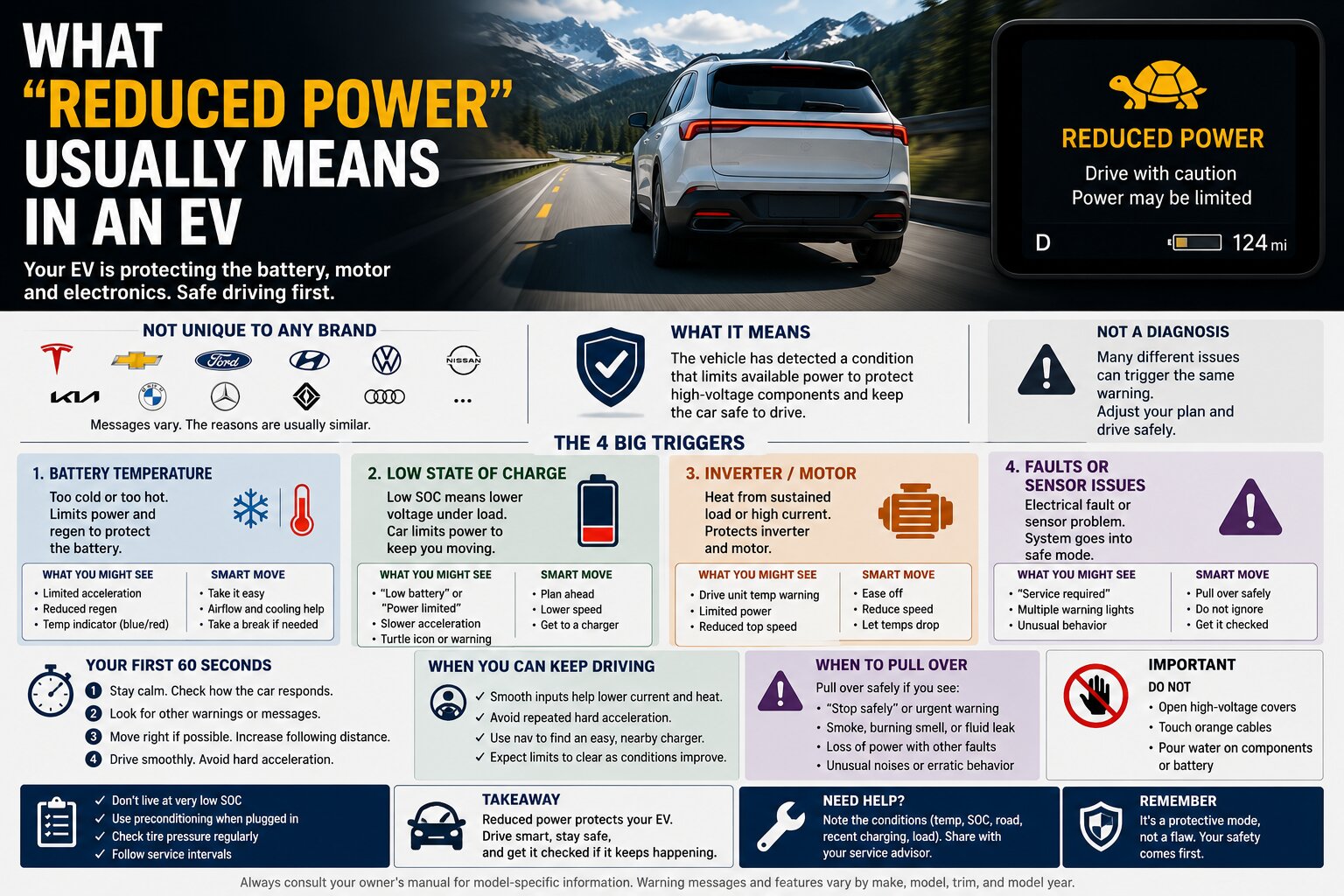
What “Reduced Power” Usually Means in an EV
“Reduced power,” “power limited,” or the classic turtle icon are not random nuisances. They are the vehicle telling you that one or more components in the high voltage system cannot safely deliver normal performance right now. In most EVs, the battery pack, inverter, and motor are managed by software that constantly weighs requested power against temperature, voltage, and component protection limits. When any of those boundaries get tight, the car limits torque to protect hardware and preserve enough energy for basic operation.
This is not unique to any one brand. You will see some version of it in mainstream EVs such as the Tesla Model 3 and Model Y, Chevrolet Bolt EV and Bolt EUV, Ford Mustang Mach E, Hyundai Ioniq 5 and Kia EV6, Volkswagen ID.4, Nissan Leaf, BMW i4, Mercedes Benz EQ models, and Rivian R1T and R1S. The exact message wording varies by model year and software version, but the underlying categories are broadly similar across the industry.
One practical point up front: reduced power is a protective mode, not a diagnosis. The same warning can be triggered by very different causes. Treat it like a decision prompt: adjust your driving plan and prioritize safety.
Common Warning Messages and the Likely Category Behind Them
Owners often ask for a one to one translation between a dashboard message and a specific failure. That is rarely possible without scan tool data. Still, you can map most reduced power events into a few likely buckets. Think of these as categories, not verdicts.
1) Battery temperature protection
Messages may reference battery temperature, limited acceleration due to cold or heat, or reduced regen. Many EVs also show a blue or red temperature indicator near the battery icon or range display. Cold packs cannot accept or deliver high current without risk of lithium plating or excessive voltage sag. Hot packs need current limits to prevent accelerated degradation and to keep cell temperatures within safe margins.
2) Low state of charge (SOC) or low voltage margin
At low SOC, pack voltage drops under load. The car may limit power to prevent the voltage from dipping below thresholds that could cause shutdown or damage. Some vehicles will show “low battery,” “charge now,” “limited power,” and then progressively reduce available acceleration as SOC approaches empty.
3) Inverter or motor protection (thermal or current limits)
If you have been climbing long grades at high speed, towing (where allowed), driving aggressively in heat, or repeatedly doing hard accelerations, the inverter and motor can heat soak. The car may limit torque even if the battery is fine. Some EVs explicitly mention “drive unit” temperature; others do not.
4) Software faults or sensor plausibility issues
A fault in a temperature sensor, coolant pump feedback, contactor monitoring, isolation monitoring, or other high voltage supervision systems can trigger reduced power as a safe default. These often come with “service required,” “pull over safely,” or a warning light beyond the typical turtle icon.
Turtle Mode: A Short Technical Explainer
“Turtle mode” is a nickname for severe power limitation at low battery charge or when protection thresholds are exceeded. It is widely associated with Nissan Leaf history because early Leafs used a turtle icon to warn drivers of very low remaining energy and reduced output. Other manufacturers use different symbols or text warnings but implement similar logic.
The key engineering idea is simple: high power demands require high current. High current creates heat in wiring and electronics (I²R losses), and it also increases voltage drop in the battery cells. If either heat or voltage gets too close to limits, the control system reduces allowable current. You feel that as softer throttle response and weaker acceleration.
The Four Big Triggers in Real Life
1) Heat: When Summer Driving Shrinks Your Power Budget
Hot weather does two things at once: it raises ambient temperatures around the pack and electronics, and it increases air conditioning load. On some EVs, especially during repeated fast charging sessions on road trips, battery temperatures can climb enough that charging speeds taper sharply. That same thermal management system may also limit propulsion power if temperatures continue rising.
What drivers notice first is often subtle: the car feels less eager on an on ramp; regenerative braking may be reduced; cabin fans run louder as cooling systems work harder. None of that automatically means something is broken. It can be normal protection behavior depending on conditions.
Safe decisions when heat is likely involved:
Reduce speed slightly and avoid repeated full throttle bursts. Power demand rises quickly with speed because aerodynamic drag increases dramatically as you go faster.
If you are on a long uphill grade, consider easing off to keep temperatures from climbing further.
If your route allows it, take a break with the car parked in shade while it continues cooling (many EVs can run thermal management while parked).
If you are road tripping and have just DC fast charged, expect that performance may be temporarily limited until temperatures stabilize.
2) Cold: Limited Regen Can Be Your First Clue
Cold weather brings its own version of reduced capability. A cold battery cannot accept strong regenerative braking without risking cell damage mechanisms that engineers work hard to avoid. Many EVs therefore reduce regen first, then limit peak power if pack temperatures remain low.
This has real driving implications because regen behavior affects pedal feel and stopping distances if you rely heavily on one pedal driving. The friction brakes still work normally in typical cases, but your deceleration from lifting off the accelerator may be weaker than expected.
Safe decisions when cold is likely involved:
Leave extra following distance until you are confident about regen strength.
Use scheduled departure preconditioning when available so the battery warms before you leave (especially helpful if plugged in).
Expect higher consumption in winter because cabin heat and battery warming draw energy; low SOC arrives sooner than many first time owners anticipate.
3) Low State of Charge: It Is Not Just About Range
A common misconception is that low SOC only affects how far you can go. In reality it also affects how hard the pack can push current without dropping voltage too far under load. That is why many EVs feel noticeably slower near empty even if there is no explicit turtle icon yet.
This matters most when you need acceleration for merging or passing. If reduced power appears at low SOC on a busy freeway, your best move is usually to stop asking for big power rather than trying to force it out of the car.
Safe decisions when SOC is low:
Plan for the right lane earlier than you normally would; give yourself more time to merge.
Avoid high speeds; slowing down even modestly can materially extend remaining miles in typical highway driving because aero drag dominates energy use at speed.
If navigation offers charger routing, follow it instead of improvising at very low SOC; arriving with a small buffer reduces stress and reduces the chance of deep discharge events.
4) Inverter or Motor Protection: The Hidden Heat Source
The traction inverter switches high voltage DC into three phase AC for the motor(s). It handles large currents and generates heat under sustained load. Motors also generate heat under high torque operation even if they are efficient overall. Depending on vehicle design, these components share coolant loops with other systems or have dedicated circuits.
You do not need to be racing to trigger protection behavior. Long mountain climbs at freeway speeds can do it, as can towing within rated limits on certain EV trucks and SUVs (towing ratings vary widely by model and trim; always follow your owner’s manual). If reduced power appears after sustained load rather than at start up or after charging, inverter or motor thermal limiting becomes a plausible category.
Safe decisions when drive unit thermal limiting is likely:
Easing off is usually more effective than stopping abruptly on a shoulder unless a separate warning tells you to stop.
If you are towing or carrying heavy loads, reduce speed and consider taking breaks on long grades.
Your First 60 Seconds: A Safety-First Checklist
When the message appears, focus on staying predictable in traffic rather than troubleshooting while moving.
1) Check what changed in how the car responds. Is acceleration simply softer? Is top speed limited? Is regen reduced? Those clues help you choose safer lanes and following distances.
2) Look for companion warnings. A generic “power reduced” message is different from “stop safely,” “service required,” brake warnings, airbag warnings, or anything indicating high voltage system fault. If you see an instruction to pull over safely, follow it as soon as practical.
3) Adjust your driving plan immediately. Move right if traffic allows; avoid passing; keep speed moderate; avoid sudden throttle changes that could surprise drivers behind you if acceleration is weak.
What Not to Do on the Roadside
An EV’s high voltage system is not a DIY roadside project. Even opening certain covers can expose dangerous components on some vehicles (designs vary). Avoid any attempt to access orange cables, battery enclosures, coolant loops tied to high voltage heaters, or underbody panels while stranded.
If you suspect overheating based on warnings or smell (hot electronics odor) do not pour water into grilles or underbody areas. Let the vehicle manage its own cooling; call roadside assistance if needed.
If You Can Keep Driving: How to Nurse It Safely
If the car remains drivable with reduced power and no instruction to stop immediately:
Smooth inputs help more than people expect. Gentle acceleration reduces peak current draw and heat generation; it also helps keep pack voltage stable at low SOC.
Avoid repeated hard accelerations. Many protection strategies recover when temperatures fall or SOC rises slightly after charging; repeated spikes work against recovery.
Use navigation to pick an easy destination. A nearby charger with simpler access beats squeezing across multiple lanes for a preferred network site when power is limited.
If You Need to Stop: What “Safe Pull Over” Looks Like
If warnings escalate or drivability becomes unpredictable:
Signal early; aim for an exit ramp parking lot rather than a narrow shoulder when possible.
Once stopped in a safe location, keep occupants away from traffic side doors if you must exit.
If smoke appears or you see fire cues (rare but serious), move away from the vehicle and call emergency services immediately. Lithium ion battery incidents require specialized response tactics; do not attempt suppression yourself.
The Charging Angle: Reduced Power After Fast Charging
A pattern many owners notice on trips is reduced charging speed followed by temporary performance limits after multiple DC fast charge sessions in hot weather. This can be normal thermal management behavior depending on vehicle design and conditions. Manufacturers tune these strategies differently across model years as software evolves; some cars precondition their packs before arriving at fast chargers to improve charging performance when routing guidance is used.
The practical takeaway is planning related rather than mechanical: build time buffers into road trips so you are not tempted to drive aggressively immediately after charging sessions in extreme heat conditions.
When It Is Likely Normal Versus When It Deserves Immediate Service
No dashboard message should be ignored indefinitely, but context matters.
Often consistent with normal protection behavior:
A temporary reduction during extreme heat or cold that clears after conditions moderate or after preconditioning completes.
A reduction at very low SOC that goes away after charging above low levels (exact thresholds vary by vehicle).
More concerning patterns:
The warning appears repeatedly in mild weather at moderate SOC without heavy driving demand.
You see additional alerts such as “service required,” drivetrain fault indicators, 12 volt system warnings (many EVs still use a 12 V battery for control systems), coolant system alerts, or isolation fault messages where provided by the manufacturer’s interface.
The car enters reduced power suddenly with jerking behavior, unusual noises from drive units (whining beyond typical EV motor sound), burning smells, visible fluid leaks (coolant), or loss of normal braking feel. Those situations justify stopping safely and arranging service rather than continuing home out of convenience.
A Few Ownership Habits That Reduce Surprise Events
You cannot prevent every reduced power event because some are triggered by genuine faults outside your control. Still, daily habits make them less common for many drivers:
Avoid living at very low SOC day after day. Many manufacturers recommend routine charging practices that keep daily use away from deep discharge extremes unless needed for travel (follow your owner’s manual guidance). Low SOC increases the chance of noticeable power limiting during routine merges and hills.
Use preconditioning when plugged in during extreme temperatures. Warming or cooling the battery using grid power helps preserve range while reducing early trip limitations like weak regen in winter.
Pay attention to tire pressure seasonally. Underinflated tires increase rolling resistance and energy use; they also affect stability systems calibration margins in subtle ways because wheel speed signals become noisier over rough pavement when tires are soft. Use the door jamb placard pressures when tires are cold.
The Human Part: Managing Expectations Without Panic
A reduced power warning can feel unsettling because EVs are normally so responsive that any drop in torque stands out immediately. The best mindset is neither denial nor alarmism. Assume the car has entered a protective strategy for a reason; then choose conservative actions that keep you safe and give the system time to recover if it can.
If it clears quickly after conditions change, log what was happening anyway: outside temperature, SOC percentage range estimate behavior, recent fast charging activity, steep grades, heavy loads. If it returns under similar conditions later, those notes help your service department reproduce it without guesswork.
0 comments
Join the discussion around this article.
Please login to comment.