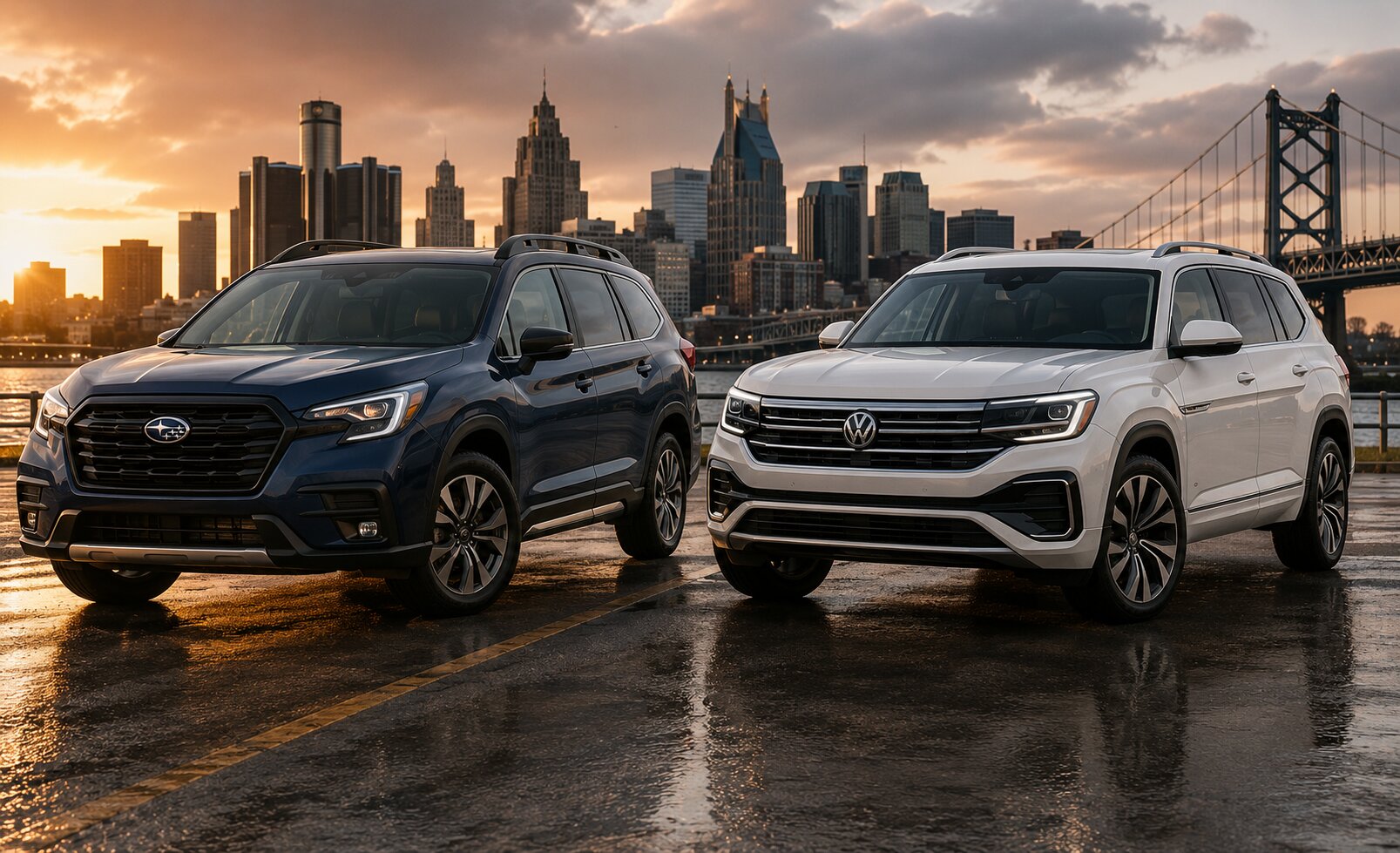
Subaru Ascent vs Volkswagen Atlas: the same job, very different personalities
I live in Detroit, which means I see family SUVs doing the hard stuff every day. Slushy school runs. Construction-zone commutes. Three-row road trips that start with optimism and end with someone asking for a charger that is definitely in the other bag. In that world, the Subaru Ascent and Volkswagen Atlas land on opposite sides of the same idea: a mainstream three-row SUV that is not trying to be a luxury statement, it is trying to be useful.
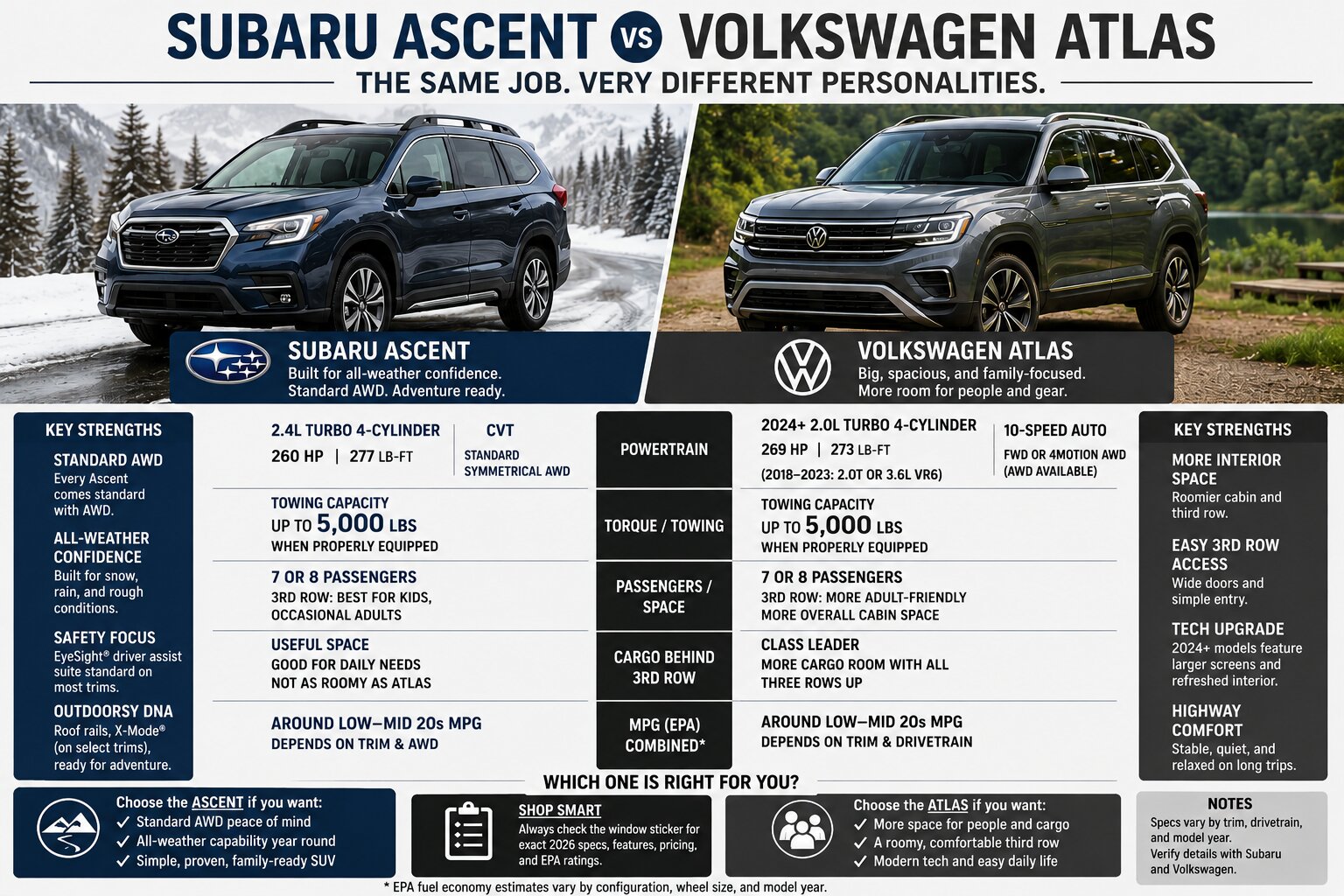
The split is pretty clear. The Ascent leans into all-weather confidence and a slightly more “outdoorsy” brand promise, backed by standard all-wheel drive and a turbo four-cylinder. The Atlas leans into sheer cabin ease, simple access to the third row, and an available V6 that feels old-school in a way some buyers still prefer.
To keep this grounded, I am going to focus on widely published U.S. specs for current versions of each vehicle. The Subaru Ascent is in its current generation (introduced for 2019) and received a notable refresh for 2023. The Volkswagen Atlas is in its first generation (introduced for 2018) and was heavily refreshed for 2024 with updated interior tech and revised powertrain strategy. Some numbers vary by trim, drivetrain, and wheel choice; where that matters, I will call it out.
The school run: easy doors, easy buckles, easy sanity
If your day starts with child seats and ends with sports bags, the Atlas makes its case in about ten seconds. It is simply a big-feeling SUV inside, and it has long been praised for an adult-friendly third row and straightforward access back there. Volkswagen also offers second-row captain’s chairs or a bench depending on trim, so you can choose your flavor of kid logistics. The Atlas’s size shows up at the curb too: it is a larger vehicle than the Ascent in footprint and presence, and in typical daily use that translates to more elbow room and an airier cabin.
The Ascent is no penalty box, though. It also offers either captain’s chairs or a bench in the second row depending on trim, and it was designed from the start as a three-row family hauler rather than a stretched two-row SUV. The third row is usable for shorter adults in a pinch and fine for kids most of the time, but if you regularly carry grown-ups back there, the Atlas tends to feel less like a compromise.
One practical note that matters more than brochure talk: Subaru’s EyeSight driver-assist suite is widely known for being standard across most of Subaru’s lineup, including Ascent trims in recent model years (specific feature content can vary by year). Volkswagen’s driver-assist availability depends more on trim level and options. Either way, if you are shopping used or cross-shopping trims on the lot, verify exactly what each vehicle includes because “standard” can change with model-year updates.
Bad-weather commute: where standard AWD changes the conversation
This is where the Ascent’s identity clicks. Every Ascent comes standard with Subaru’s Symmetrical All-Wheel Drive, paired with a continuously variable transmission (CVT). For many buyers in snow-belt states or anyone who deals with wet highways half the year, that standard AWD removes an entire decision branch from your purchase. You are not weighing whether you should spend extra for traction; you are just choosing trim and features.
The Atlas can be had with either front-wheel drive or all-wheel drive (Volkswagen calls its system 4Motion). In places like Michigan, dealers often stock plenty of AWD Atlases because they sell. But nationally, that choice matters for price and fuel economy. If you are comparing an AWD Ascent to a front-drive Atlas on price alone, you are not really comparing apples to apples.
On-road behavior follows those powertrain choices too. The Ascent’s turbocharged 2.4-liter flat-four makes 260 horsepower and 277 lb-ft of torque (widely published Subaru specs). That torque arrives low enough in the rev range that around-town driving feels easygoing even when you have passengers aboard. The CVT will never feel like a traditional automatic when you lean into it hard; some drivers notice the “rubber-band” sensation under full throttle that is common to CVTs. In typical commuting traffic, though, it does what families need: smooth pullaway, decent midrange shove, no drama.
The Atlas story depends on model year. For 2024 and newer Atlases in the U.S., Volkswagen moved to a turbocharged 2.0-liter four-cylinder as the sole engine; output is widely listed at 269 horsepower and 273 lb-ft of torque. That is surprisingly close to the Ascent on paper. Earlier Atlases offered either a turbo four (with lower output than today’s) or a VR6; the VR6 has been popular with shoppers who like six-cylinder smoothness and traditional sound even if it is not the most efficient route.
In foul weather at sane speeds, both AWD systems do what modern AWD systems do: they keep you moving and reduce wheelspin when conditions get ugly. The difference is psychological as much as technical. With the Ascent you never wonder whether you bought “the one without AWD.” With the Atlas you might have made that choice intentionally for cost or efficiency, but it is still a choice.
Adults in row three: comfort versus tolerance
Let’s be honest about third rows because families are honest about third rows after about one weekend trip.
The Atlas has earned its reputation as one of the more adult-usable third rows among mainstream midsize three-row SUVs. Legroom and general space are strong points relative to many competitors. If you routinely carry adults back there for more than ten minutes at a time, Atlas tends to be the safer bet.
The Ascent’s third row works best as “kids plus occasional adults.” It is not uniquely cramped compared with many class rivals, but it does not feel as generous as Atlas when you’re talking about full-size adults who want knee room.
Both vehicles offer family-friendly details like multiple cupholders and plenty of storage pockets depending on configuration. For real usability, check how easily your specific child seat fits in row two while still allowing someone to climb into row three; captain’s chairs usually make this easier even if they reduce total seating capacity compared with an eight-passenger bench setup.
Highway road trip: power delivery, noise levels, and fatigue
On long highway stretches, what matters most is how relaxed the powertrain feels at speed and how settled the chassis stays over expansion joints.
The Ascent’s 2.4 turbo has enough torque to handle passing without feeling strained when loaded up. Its towing rating tops out at 5,000 pounds when properly equipped (a widely published figure), which also tells you something about its cooling capacity and overall powertrain intent even if you never tow anything heavier than a small utility trailer.
The Atlas towing picture depends again on engine and model year. When equipped with the available VR6 in prior model years, Atlas has been rated up to 5,000 pounds (widely published). For 2024+ models with only the turbo four-cylinder, Volkswagen also rates towing up to 5,000 pounds when properly equipped (widely published). So if towing is part of your family life, neither has an automatic advantage on max rating alone.
Steering feel is more subjective than spec-sheet friendly facts; both vehicles use modern electric power steering tuned for ease rather than feedback. The Atlas typically comes off as stable and calm at speed in reviews because it has that bigger-body sense of mass on the highway. The Ascent feels more like what it is: a slightly smaller three-row SUV that still prioritizes predictable behavior over sporty responses.
If you care about fuel economy on road trips or daily commutes, here is where I have to be careful because EPA ratings vary by model year and configuration (FWD vs AWD for Atlas; wheel size; trim). Rather than guessing exact mpg numbers for every version, I will stick to what is broadly true: these are mainstream gasoline three-row SUVs that generally land in the low-to-mid 20s mpg combined depending on configuration according to EPA ratings across recent years. Always check the specific window sticker or EPA listing for your exact trim because small changes can move the needle by a couple mpg over thousands of miles.
Cargo behind the third row: grocery run reality
This is where families often get surprised: “three rows” does not always mean “room for stuff behind those three rows.”
The Atlas has long been one of the cargo-space leaders behind its third row among midsize three-row SUVs (based on widely reported comparisons across mainstream outlets). That matters when you want all seats up but still need space for strollers, backpacks, or airport luggage.
The Ascent has useful cargo room but tends not to match Atlas for sheer volume behind row three in typical comparisons. If your normal routine involves seven people plus gear with no folding seats allowed because everyone showed up at once, Atlas usually makes life easier.
Both fold flat enough for home-improvement runs within reason; neither replaces a minivan when it comes to loading height convenience or maximum interior volume efficiency.
Tech and controls: screens matter less than layout
Volkswagen made interior tech a headline item in its 2024 Atlas refresh, including larger available infotainment screens depending on trim and an updated cabin design language compared with earlier Atlases. If you have been avoiding older VW interiors because they felt plain or because touch-heavy controls annoyed you in other VW products, it is worth sitting in an updated Atlas yourself rather than relying on old impressions.
Subaru refreshed Ascent for 2023 with an updated front end and an available large portrait-style infotainment screen similar in theme to other recent Subarus (availability varies by trim). Subaru’s approach tends to blend physical controls with touchscreen functions depending on model year and trim; some buyers love having familiar knobs for climate functions while others want everything integrated cleanly into one interface.
In both vehicles there is no substitute for spending five minutes doing real tasks: pair your phone via Apple CarPlay or Android Auto (both brands support these features broadly across recent model years), adjust cabin temperature without looking away from traffic too long, find how many USB ports exist where your passengers actually sit (especially row two and row three), then decide which layout fits your household’s tolerance level.
Pricing reality: where trims muddy any clean comparison
MSRP comparisons between these two can get messy fast because both come in multiple trims with different standard equipment strategies. Subaru typically bundles features into trim steps with fewer standalone options than some competitors; Volkswagen offers distinct trims plus option packages depending on year.
I am not going to quote exact starting MSRPs here because they change year to year and can shift mid-year; if you are shopping new right now you should verify current pricing directly from Subaru and Volkswagen or from current-year window stickers at dealers. What I can say confidently is this: both play in the mainstream midsize three-row space below premium brands like Acura and Audi but above bargain-basement pricing once you equip them with popular family options like leather seating surfaces, upgraded audio systems, panoramic sunroofs (where available), advanced driver assists (where optional), and towing equipment.
If budget pressure is your main constraint, remember this key structural point: every Ascent includes AWD; many Atlases on lots will include AWD too depending on region but not all do nationwide. If you must have AWD for peace of mind or resale value where you live, compare an AWD Atlas directly against an Ascent rather than letting FWD pricing set expectations.
Ownership factors: maintenance cadence, resale vibes, and what we can say honestly
Reliability predictions and long-term costs are tricky territory because they depend heavily on model year data sets, service history trends over time, driving conditions, and how owners maintain their vehicles. I am not going to invent “expected repair bills” or pretend one brand will always cost less to own based solely on anecdotes.
Here are safer ownership truths:
Maintenance basics: Both use modern turbocharged engines in their current forms (Ascent always does; Atlas does for 2024+). Turbo engines tend to reward consistent oil changes using the correct oil spec and sensible warm-up habits if you plan to keep them long term. Follow factory service schedules rather than stretching intervals just because life gets busy.
Dealer network experience: Subaru dealers often do brisk business in snow states because AWD sells itself; Volkswagen dealers vary widely by region in volume and service reputation like any brand network. This is less about corporate logos than about your local store’s service department competence and scheduling capacity.
Resale value: Subaru as a brand has a strong reputation for resale value in many U.S. markets thanks to loyal buyers and standard AWD across much of its lineup. Volkswagen resale can be more variable depending on segment trends and incentives at time of purchase. Exact residual values fluctuate; consult current market data if resale is critical.
Warranty coverage: Warranty terms change over time by brand policy; verify current coverage details from each manufacturer for new purchases or confirm remaining coverage via VIN when buying used.
Competitors worth mentioning so you know where each fits
No three-row comparison exists in isolation because this segment is basically America’s default family vehicle class now.
If you are drawn to Ascent’s standard AWD vibe but want different packaging or powertrain choices, typical cross-shops include Toyota Highlander (and Grand Highlander), Honda Pilot, Kia Telluride, Hyundai Palisade, Ford Explorer, Mazda CX-90 (with inline-six options), Chevrolet Traverse (redesigned recently), GMC Acadia (also updated), Nissan Pathfinder, Jeep Grand Cherokee L, and even minivans like Toyota Sienna or Honda Odyssey when practicality wins arguments at home.
If you are drawn specifically to Atlas because of its space-first philosophy but want alternatives with similar third-row friendliness or cargo room focus, Traverse has historically been part of that conversation too (depending on model year), along with Pilot and Grand Highlander depending on how much space you need behind row three.
So which one fits your life better?
If your week includes regular bad-weather driving where traction confidence matters more than anything else, the Subaru Ascent’s standard AWD simplifies decisions and tends to align well with how many families actually use these vehicles year-round. Its turbo 2.4-liter output (260 hp, 277 lb-ft) feels tuned for everyday torque rather than flashy top-end theatrics; towing up to 5,000 pounds gives it legitimate weekend utility when properly equipped.
If your household keeps finding itself saying “we need more room back there,” especially with adults occasionally riding in row three or lots of cargo stacked behind it, Volkswagen Atlas keeps winning arguments through sheer space efficiency. Depending on year it offers either an available VR6 (older models) or a stronger modern turbo four (2024+ rated at 269 hp and 273 lb-ft), plus towing up to 5,000 pounds when properly equipped either way based on widely published specs.
The honest takeaway from my corner of Detroit is that neither SUV solves every problem perfectly because this class never does. The Ascent leans toward confidence-in-the-weather simplicity; the Atlas leans toward big-cabin calmness that makes families feel less squeezed. Pick based on what annoys you most today: slipping around in winter conditions or running out of room before everyone even buckles up.
0 comments
Join the discussion around this article.
Please login to comment.